

George Mario
5.6K posts


In 1820s, the island of Tasmania—then called Van Diemen’s Land—was the site of violent conflict between British colonists and the island’s Aboriginal peoples. Settlers expanded farms and grazing land, often through force. Aboriginal communities were driven from their territories, attacked, and displaced.
In this brutal environment, one woman emerged as a resistance leader: Tarenorerer.
She was a young Aboriginal woman from north-west Tasmania. As colonial violence intensified during what is now known as the Black War, she adapted in ways that surprised and alarmed British authorities. Unlike many Indigenous fighters who relied on traditional weapons, Tarenorerer learned to use a musket—likely taken from settlers or soldiers.
She did not simply use firearms herself. She trained others.
According to historical accounts, she organized small groups and taught them how to handle guns effectively. She studied settler routines, patrol movements, and supply routes. Instead of direct confrontation, her forces used mobility and knowledge of the land to launch sudden raids on isolated farms. Livestock were seized, buildings burned, and supplies taken.
British colonists were shaken. They had expected scattered resistance. Instead, they faced coordinated attacks.
Colonial records from the mid-1820s describe her as dangerous and highly capable. A reward was reportedly offered for her capture. Her leadership challenged two colonial assumptions at once: that Aboriginal resistance was disorganized and that women would not lead military action.
For the British, this was deeply unsettling. For Aboriginal communities under threat, it was a strategy for survival.
The Black War (roughly 1820–1832) was not a minor frontier disturbance. It was a sustained and violent conflict that dramatically reduced the Aboriginal population of Tasmania through killings, forced removals, and disease. In response to Aboriginal resistance, colonial authorities organized large military operations, including the 1830 “Black Line,” an attempt to sweep the island and capture remaining Indigenous people.
Tarenorerer’s campaign took place within this larger struggle.
Eventually, she was captured—not in open battle, but through pursuit and colonial control measures. Like many other Tasmanian Aboriginal people, she was removed to Flinders Island as part of the British relocation policy. The government claimed it was for protection. In reality, it isolated survivors from their land, culture, and resources.
On Flinders Island, conditions were harsh. Disease and despair spread quickly among the relocated communities. Tarenorerer died there in 1831.
She was still young.
For decades, her story was recorded only in colonial documents, often distorted or minimized. But modern historians and Aboriginal communities have reclaimed her legacy. Today, she is recognized as one of the most significant leaders of Aboriginal resistance in Tasmania.
Her actions show that Indigenous resistance was organized, strategic, and determined. They also challenge stereotypes about gender roles in early colonial history. Tarenorerer was not a passive figure in a story of conquest. She was a commander who adapted to new weapons, trained others, and used strategy against a global empire.
The British Empire described her as a threat. From another perspective, she was defending her homeland.
Her life reflects a larger truth about the Black War: Aboriginal Tasmanians did not disappear quietly. They resisted, adapted, and fought to survive.
Tarenorerer’s story is no longer a footnote. It is part of the history of Australia—a reminder that even in the face of overwhelming force, resistance was real, organized, and often led by those colonial powers least expected.
© Vintage Facts
#archaeohistories

English

More than four thousand years ago, before the idea of an “author” even existed, one woman stepped forward and signed her name....
Enheduanna lived around 2300 BC, in a world where writing was primarily administrative—lists, laws, inventories scratched into clay. She transformed it into something radical: personal voice. Not myth anonymously handed down, not royal propaganda spoken about gods, but words spoken to them, from an individual soul.
As high priestess of the moon god Nanna in the city of Ur, Enheduanna stood at the intersection of religion and empire. She was also the daughter of Sargon of Akkad, architect of the world’s first known empire. Her role was political as much as spiritual: through ritual and poetry, she helped bind conquered Sumerian cities to Akkadian rule. But her writing went far beyond statecraft.
In her hymns—especially those devoted to the goddess Inanna—she did something unprecedented. She wrote in the first person. She described fear, humiliation, exile, rage, devotion, and spiritual collapse. When she was violently removed from her temple during a political uprising, she did not record it as history. She wrote it as lived experience: a woman cast down, pleading with a goddess who embodied power, sexuality, destruction, and renewal.
This was theology infused with autobiography. Politics braided with prayer. Power examined from the inside.
Enheduanna’s language shaped religious thought across Mesopotamia for centuries. Later hymns to gods echoed her structure, her metaphors, her emotional intensity. Scribal schools copied her work long after her death, treating it as a model of literary excellence. Her influence is not hypothetical—it’s traceable in clay tablets found hundreds of miles apart, over generations.
What makes her extraordinary is not only that she was first, but how she was first. She claimed authorship. She declared that these words came from her mind, her devotion, her suffering. In doing so, she introduced a concept that underpins all literature that followed: that a single human voice, honestly expressed, can shape culture, belief, and power itself.
© Women In World History
#archaeohistories

English
@Amaku_Dancer @histories_arch Retard, it's a natural formation.
English

@histories_arch This line of thought is racist and insulting. Was Stone Henge a coincidence? Obviously, Indigenous engineers were intelligent. Revise or remove this post. It's 2026 and White culture is shamelessly expressing narcissistic notions of superiority. The Global Majority is exasperated
English
In the plains of Montana 🇺🇸 stands the Sage Wall, a 100 foot line of massive stone blocks weighing several tons each. The boulders are stacked with straight edges and tight spacing that looks deliberate, not random. No mortar. No clear tool marks. Just precision.
Geologists say it could be fractured bedrock shaped by natural forces. Others point out how closely it resembles megalithic walls in Europe and South America. After decades of study, no one can fully explain why it looks built instead of broken.
So what are you looking at here?
A rare geological coincidence… or something humans were never supposed to forget?
#archaeohistories

English
@miskitatec @NobelPrize Congratulations! That's the most retarded shit I've read all day! You just might be this week's winner but remember that the contest runs until midnight Saturday. If you're this week's winner my assistant will contact you within the next few days.
English

@NobelPrize Wow...a headscarf. I wonder what will haters think of her now? Was she opressed?, forced? Or was it normal.
English

As a young woman during World War I, Irène Joliot-Curie (left) worked with her mother Marie Skłodowska Curie (right) to provide mobile X-ray units for wounded soldiers.
Irène, born in 1897, later shared the 1935 #NobelPrize in Chemistry with her husband Frédéric Joliot.

English


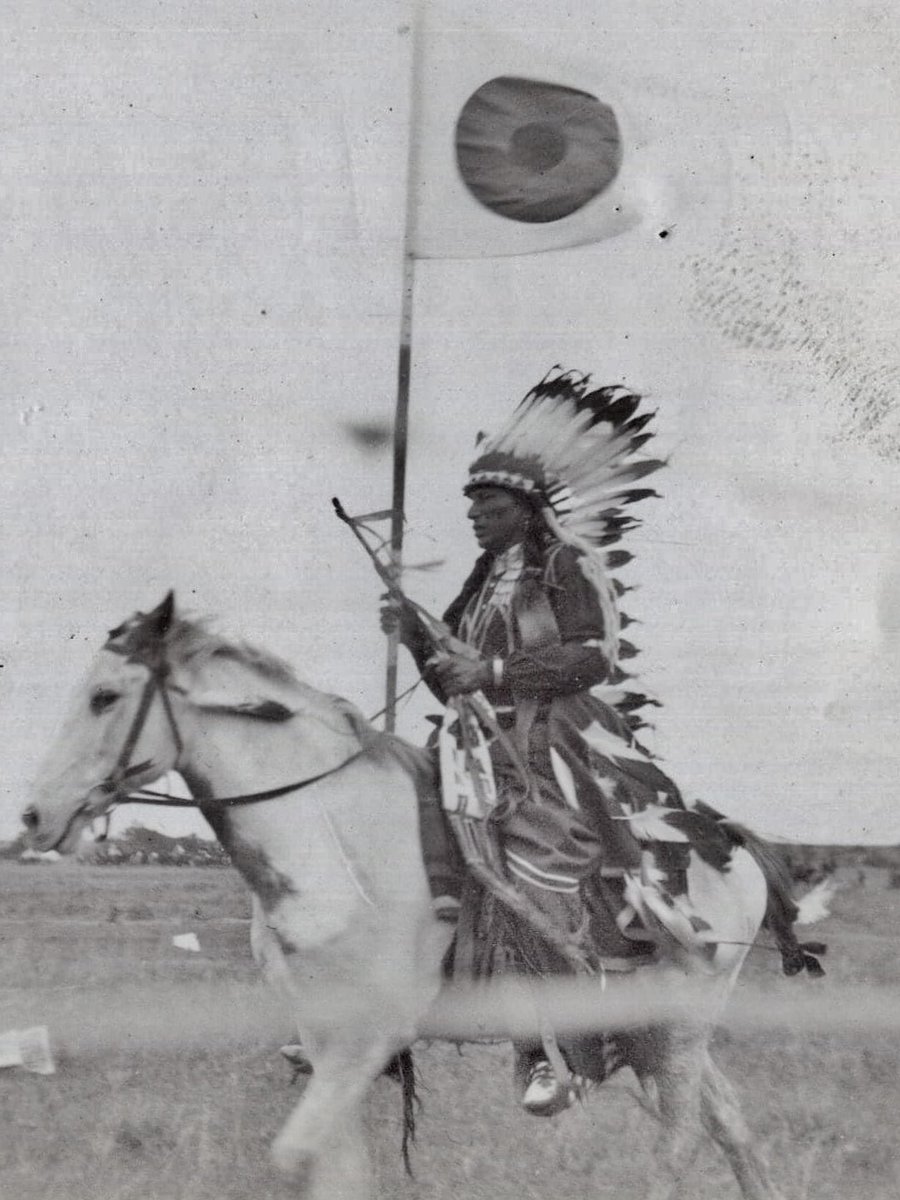
I like this neat photo of my great great grandpa Horse Chief Eagle who was the last hereditary chief of the Ponca wearing all the trappings of his office. Love the richness of all Native American cultures like this—these truly uniquely American cultures that need to be embraced!
English


@archeohistories "the so-called “little black people”"
They're the original Pygmy population of Asia who came there with the first successful Out Of Africa emigration that started 50,000 years ago.
Offcial explanation: shiprecked during the Trans-Atlantic slave trade...
telegraph.co.uk/news/2024/11/0…
English
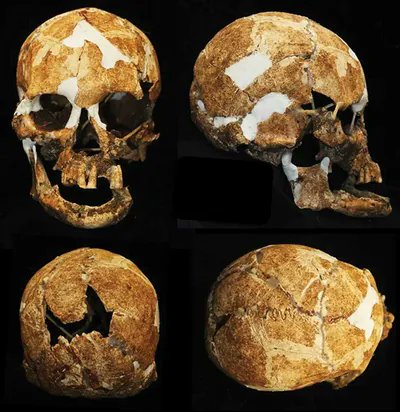
Skull confirms Taiwanese Legends of ancient peoples, who preceded the Austronesians -
Around 6000 years ago Taiwan was settled by Austronesians, who brought with them Neolithic technology and still make up around 2% of island’s population. However, 15 of the 16 Austronesian groups on the island have stories of small, dark people already living in the island’s forests and perhaps surviving alongside Austronesians until quite recently. Discovery of a skull confirms the tales and helps place lost people in the human family tree.
The presence of stone tools, some of them dating back 30,000 years, proved the Austronesians’ stories were not just the equivalent of European myths of fairies or elves. However, until now scientists had no way of knowing anything about these first inhabitants. The discovery of a skull and partial skeleton in the Xiaoma Caves on Taiwan’s east coast changes that. In World Archaeology, Dr Hsiao-chun Hung of the Australian National University explores what the remains of one individual can tell us.
Austronesian groups held widely differing views of the people they lived beside. Many describe them in hostile terms and have stories of fighting. However, at least four groups tell tales of intermarrying with the so-called “little black people” and one group, the Saisiyat continue to hold ceremonies in honor of those they call the Ta’ai, who they consider their teachers. Varied as these attitudes are, all the groups have common physical descriptions of people with dark skin, small body sizes, and frizzy hair living in the forested mountains, often in caves.
The skull found at Xiaoma is consistent with those accounts. It was in a layer approximately 5900 years old, around the time the Austronesians were arriving. However, its features make it clear it belonged to someone with a different heritage. Not only is the skull small, but 13 measurements of its shape most closely match those of the Negrito people of the Philippines, followed by those of the Andaman Islands. During the Ice Age, Taiwan was connected to both the mainland and the Philippines and people probably arrived on foot. “So far, though, no site in Taiwan has been dated between 15,000 and 6,600 years ago,” Hung told IFLScience, making it possible the Xiaoma people’s ancestors arrived by boat on an island whose original inhabitants were gone.
The authors conclude the bones belonged to a female, who was buried in a squatting position found in hunter-gatherer graves in southern China and Southeast Asia, strengthening the connection. Hung told that although Taiwan’s pre-Neolithic population density was probably low, “The rarity of findings of human remains from this period has been a reflection of the rarity of the preservation in ancient sites after so many thousands of years.” She attributes this primarily to the climate. Hung added archaeologists have not looked hard for older burial sites, and hope to rectify this.
Hung told IFLScience that around 7,000 years ago flake tools that resemble those used by hunter-gatherers elsewhere in South-East Asia arrived in Taiwan, possibly through contact with fishermen from Luzon. Taiwanese versions are smaller and benefited from the high-quality stone available. Reports from the Qing indicate the original inhabitants were surviving as a distinct people until two centuries ago. Even today they may not be entirely lost. Genetic analysts have contacted Hung and told her they believe there is evidence for their DNA among modern Austronesians.
The cave in which the skull was found sits 800m from the sea, but co-author Dr Mike Carson of the University of Guam told IFLScience, "[Taiwan’s] eastern coastal mountain range is among the fastest uplifting geological formations in the world.” When the individual was buried there the site would have been closer both to the sea and a nearby river, offering the inhabitants both freshwater and a food source close to hand.
© IFL Science
#archaeohistories
English

@archeohistories You mean , "still stands as a symbol of Black Africans achievement and ingenuity". Notice when you speak of Europe , Asia , or Native American accomplishment , you don't mention it as "human achievement". You give credit to the group who carried it out . Wonder why ? 🤔.
English
This stone is just one of the 2.3 million stones believed to have been cut, dragged, and lifted to construct the Great Pyramid over 5,000 years ago. The sheer number of stones involved in the pyramid's construction speaks to the monumental effort required to build such an ancient wonder of the world. Each block, some weighing several tons, was carefully shaped and moved into place, showcasing the incredible skill and organization of the workers involved.
The construction of the Great Pyramid has long been a subject of fascination and speculation. While the exact methods used remain a mystery, it is widely believed that workers employed a combination of ramps, levers, and sheer manpower to move and position these massive stones. The precision with which the stones were placed remains a testament to the advanced engineering knowledge of the ancient Egyptians.
Despite the passage of thousands of years, the Great Pyramid still stands as a symbol of human achievement and ingenuity. The remarkable feat of transporting and assembling these millions of stones continues to awe historians, architects, and visitors from around the world, solidifying the pyramid's place as one of the most impressive structures ever built.
© Reddit
#archaeohistories

English

English
@All_Source_News @SITREP_artorias No surprise when the Trump family are your role models
English

So the Former Deputy Chief of the Office of Financial Operations of the DEA, Special Agent Paul Campo, was just charged after agreeing to launder up to $12 million dollars for CJNG.
Source: @SITREP_artorias


English

🚨 BREAKING: Cartels are working with left-wing terror groups in the US offering thousands of dollars for the assassination of top border officials, including Border Commander GREG BOVINO
BOVINO: "We have criminals ramming vehicles, bringing guns to protests! This is NOT regular street crime in Chicago!"
"The lethality of these assaults is increasing!"
@TriciaOhio: "[Sec. Noem] has been HARDENING our ICE facilities...we are seeing a coordinated, highly organized waging of WAR on our law enforcement in Chicago...these foreign terrorist networks are using a tiered system of BOUNTIES to go after them."
Democrats MUST call off their foot-soldiers.
English
@piersmorgan You used to make sense... now you just sound like a retarded asshat
English

I think the IDF has caused most of the structural damage in Gaza. And if you don’t, and think Hamas did most of it, then you probably shouldn’t be playing the naivety card.
Tal Heinrich@TalHeinrich
Are you really that naive to think Hamas wouldn’t booby-trap every structure? We take our enemy very seriously after Oct. 7. You know, many of our brave soldiers paid the ultimate price because of their tactics. Our soldiers’ lives matter. And do you really think Israel would waste much-needed ammunition if it wasn’t for an important security purpose?
English

🚨DEVELOPING: Democrat activist Alexander Vindman used his position working under the President Trump to illegally leak one of his phone calls to try to undermine his presidency.
Should Vindman be prosecuted for this?
A. YES
B. NO

English
@clownworld They were probably with their children and grandchildren
English

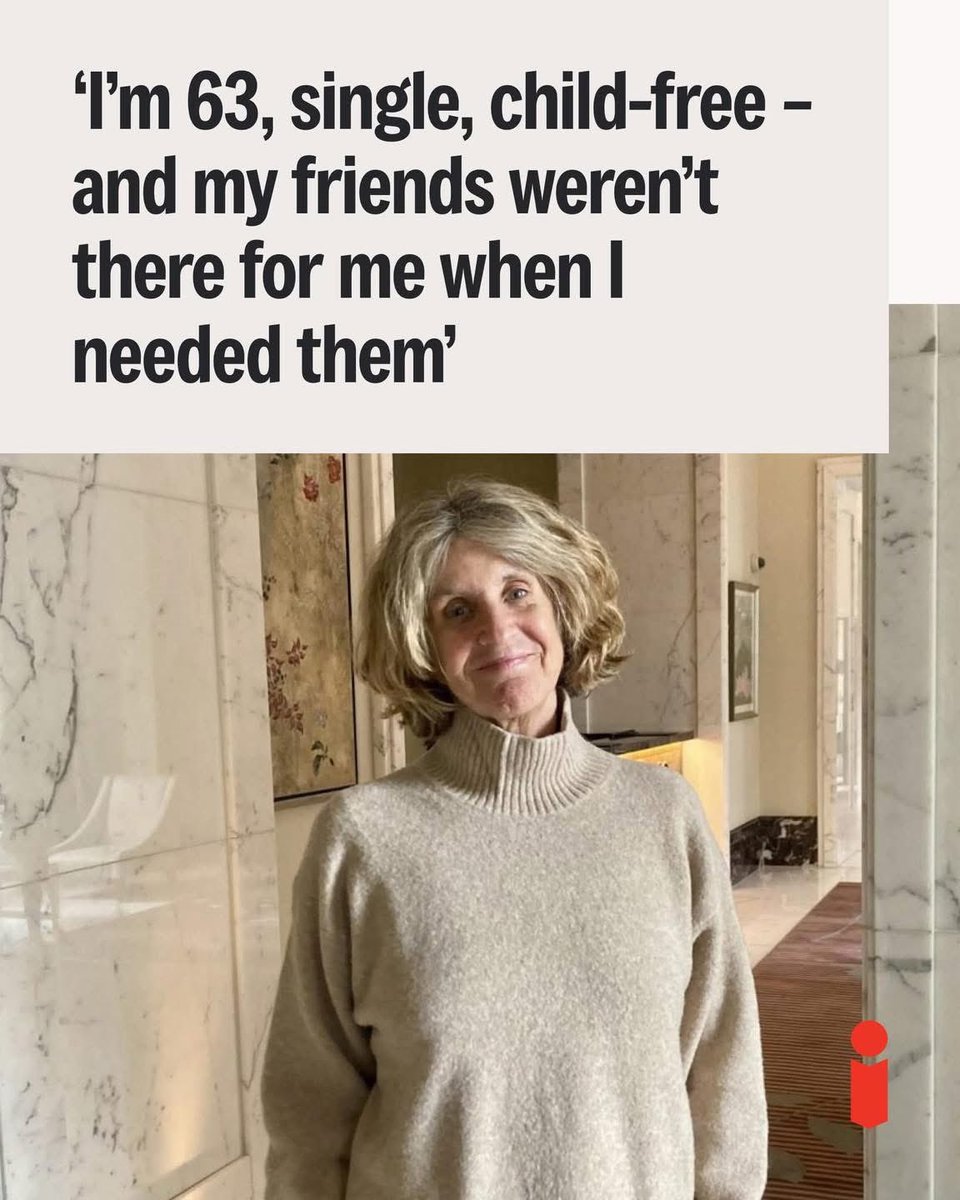

Instead of demanding a payout when four heroes detain your criminal son, why don’t you raise your son not to beat up helpless grandmothers? x.com/tommyrazorcuts…
English

The situation of the Haitian people is increasingly desperate. There are constant reports of murders, violence of all kinds, human trafficking, forced exile, and kidnappings. I make a heartfelt appeal to all responsible to release the hostages immediately, and I ask for the concrete support of the international community in creating social and institutional conditions that will allow Haitians to live in peace
English
@MURPHSLIFE We kill them in Texas. Sorry, not sorry. If they kill livestock, they're done
English

After telling our neighbors over and over to tie their dogs up.. they keep entering our farm and today they killed our daughter’s pet rabbit she had since she was born. Every part of me wants to end the life of these 2 dogs.
I think about the foreigner who was arrested for calling a woman stupid.
What do we do with these dogs El Salvador? Where owners allow them to roam the streets freely. This shit needs to change
English
@Emilio2763 Ignorant of the law, i.e., Pennsylvania vs Mimms
English


🚨MASSIVE BETRAYAL🚨Texas RINO SENATOR John Cornyn received an award from the Far-Left DEI Org LULAC. Cornyn praised Texas Democrat LULAC members and said he supports “bipartisanship.” LULAC supports DEI and Abortion.
CORNYN BETRAYED TEXAS!!
Follow: @Carlos__Turcios
English
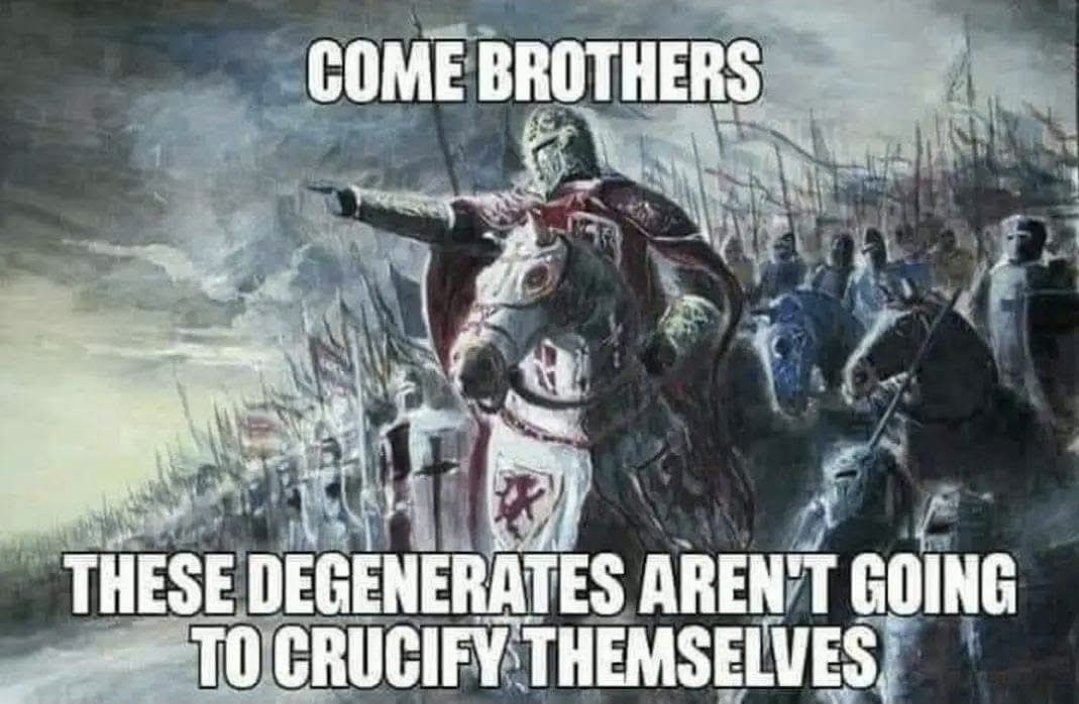

The UK is waking up!
Despite Antifa's large presence in the city they were dwarfed by the Patriots in the red white and blue.
Remigration OR civil War is inevitable.
We invite You to be part of a Strong , organised group.
Join the Templars Today
English

BREAKING: Australia will recognize a Palestinian state, Australian Prime Minister Anthony Albanese says - AP
English