Avtar Sehra

4.2K posts

Avtar Sehra banner
Avtar Sehra

Avtar Sehra

@avtarsehra

Founder/CEO STBL. Founded KAIO and Nivaura. Financial Engineer and Theoretical Physicist. Fascinated with Group Theory of Rubik’s Cubes

Katılım Ekim 2011
474 Takip Edilen8.7K Takipçiler
Avtar Sehra retweetledi
STBL
STBL@stbl_official·
STBL Co-founder & CEO @avtarsehra will be at ETHMilan. If you’re exploring the accelerating shift toward RWA tokenization and the emergence of the new financial era built around stable, yield-bearing digital assets, come say hello!
STBL tweet media
English
7
89
573
62.2K
Avtar Sehra retweetledi
STBL
STBL@stbl_official·
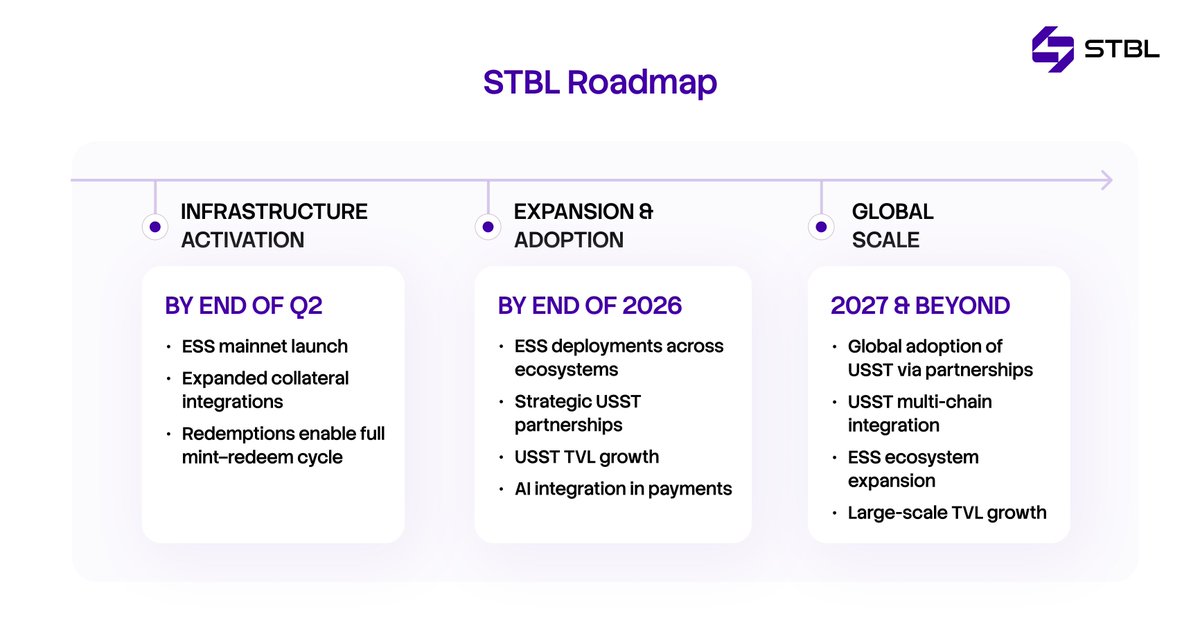
As regulatory clarity begins to reshape the digital asset landscape, the stablecoin industry is entering a new phase - one defined not just by liquidity, but by sustainable, compliant, and utility-driven financial infrastructure with aligned earning opportunities for ecosystem participants and value contributors. As we continue executing toward that vision, here are some of the key ecosystem milestones achieved over the past few days: ESS Mainnet Internal testing and pre-audit formalities are currently underway ahead of our targeted Q2 deployment timeline. STBL Stabilization Framework Testing for the Redemption Module - the third pillar of STBL’s tri-factor stabilization architecture has now been successfully completed, strengthening protocol resiliency and capital efficiency. The module is now being prepared for its dedicated audit phase. Stellar Integration Development continues to progress smoothly, with all core milestones aligned for a Q2 rollout. Documentation Overhaul A complete revamp of our technical documentation suite is underway and will reflect the latest protocol architecture and infrastructure enhancements. As always, our focus remains on building secure, scalable, and institution-grade financial infrastructure designed for long-term ecosystem sustainability. Thank you for your continued support as we advance toward our upcoming milestones.
STBL tweet media
English
21
77
477
58.9K
Avtar Sehra retweetledi
STBL
STBL@stbl_official·
It’s almost time.
English
30
50
487
70.4K
Avtar Sehra retweetledi
Reeve Collins
Reeve Collins@Reeve_Collins·
The Clarity Act just cleared its biggest hurdle. Stablecoin yield sharing now has a legal path in the US. After years of extractive fee models, regulators are finally catching up to where financial services need to go. The next generation of financial infrastructure is built around shared upside. That’s the foundation behind @stbl_official and @wefi_official .
English
10
46
151
12.3K
Avtar Sehra retweetledi
STBL
STBL@stbl_official·
Team STBL is heading to Consensus Miami. Stay tuned for @Reeve_Collins's panel on “How Stablecoins Are Rewriting the Rules of Money” and more insights live from Consensus with @rjvollono If you’ll be there, let’s meet: stbl.com/contact-us Looking forward to connecting with builders, institutions, and leaders shaping what’s next in digital assets.
STBL tweet media
English
15
44
482
50.4K
Avtar Sehra retweetledi
On Chain Notes
On Chain Notes@On_Chain_Notes·
🧵 $STBL Weekly Update: Shipping Infrastructure While most stablecoin projects talk about what they'll build, STBL is quietly shipping production-grade features This week's update shows real technical progress across 4 major workstreams Thread on what's actually being built👇
English
2
7
32
1.5K
Avtar Sehra retweetledi
STBL
STBL@stbl_official·
The next decade of digital assets will define the future architecture of global finance, reshaping how value is issued, moved and accessed across institutions, markets, and economies. Co-founder & CEO of STBL, @avtarsehra will be at CNBC Converge, discussing the structural shift underway across stablecoins, tokenization, and the foundations of the on-chain financial system. If you’re building or navigating this transition, let's connect: stbl.com/contact-us
STBL tweet media
English
11
27
586
68K
Avtar Sehra retweetledi
RedStone Indonesia ♦️
RedStone Indonesia ♦️@redstone_indo·
Ketika volume produk mulai meningkat, data yang dapat diverifikasi tidak lagi sekadar menjadi hal yang sekadar diinginkan. STBL telah mengintegrasikan Proof of Reserves independen dengan RedStone sejak awal.
STBL@stbl_official

We are happy to announce our partnership with @redstone_defi to implement independent Proof of Reserves (PoR). This integration is purpose-built for verifiable reserve transparency, adding an additional layer of assurance on top of STBL’s internal PoR framework. By combining Redstone’s third-party attestation with STBL’s continuous, protocol-level internal verification, we are strengthening trust to deliver an institutional-grade financial infrastructure.

Indonesia
3
5
49
2.5K
Avtar Sehra retweetledi
STBL
STBL@stbl_official·
Building a Global Programmable Money Infrastructure requires a clear, phased strategy. We’re deploying a scalable, transparent, efficient financial layer - powering Stablecoin 2.0 and enabling true Money-as-a-Service. Join today’s X Space to deep dive into what’s next with @avtarsehra @Reeve_Collins & @stucturedfi x.com/i/spaces/1MJgN…
STBL tweet media
English
19
42
585
72K
Avtar Sehra retweetledi
STBL
STBL@stbl_official·
We are happy to announce our partnership with @redstone_defi to implement independent Proof of Reserves (PoR). This integration is purpose-built for verifiable reserve transparency, adding an additional layer of assurance on top of STBL’s internal PoR framework. By combining Redstone’s third-party attestation with STBL’s continuous, protocol-level internal verification, we are strengthening trust to deliver an institutional-grade financial infrastructure.
STBL tweet media
English
26
36
641
102.5K
Avtar Sehra retweetledi
Proof of Talk
Proof of Talk@proofoftalk·
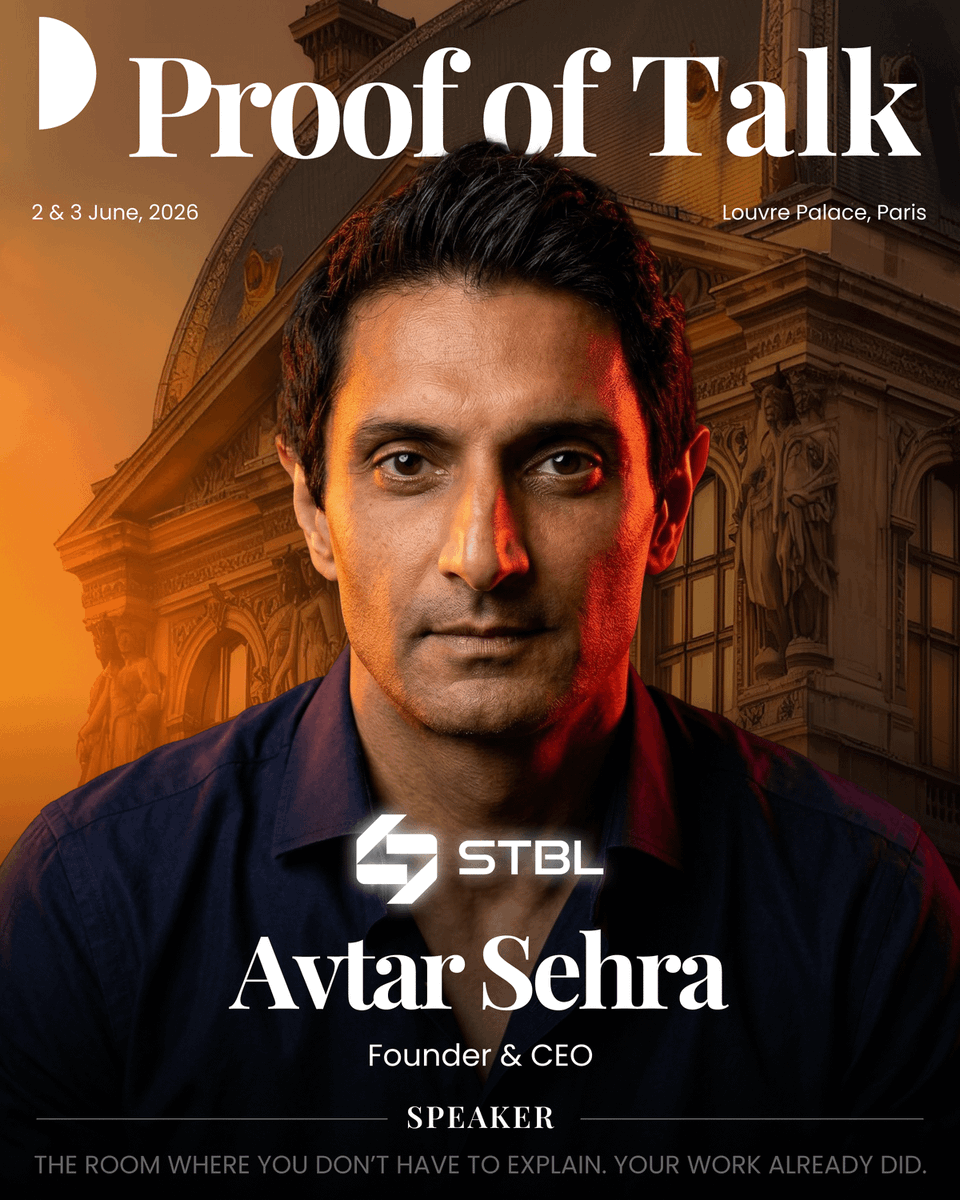
In 2014, Dr. AvtarSehra @avtarsehra built the first coloured-coins implementation for tokenised securities on Bitcoin. That experiment became @nivaura, then @KAIO_xyz with Brevan Howard's WebN Group, then @stbl_official. Dr. Avtar Sehra, CEO and Co-Founder of STBL, takes the @proofoftalk stage this June. In 2015, he founded @nivaura, one of the first platforms to tokenise securities in a regulated environment. The company raised $20 million and processed $6 billion in total issuances across Europe and Asia. He worked directly with the UK FCA to develop the early regulatory frameworks for tokenised securities. Those frameworks later informed how regulators globally approached the space. He then founded @KAIO_xyz, a fund tokenisation infrastructure platform created as a joint venture with Brevan Howard's WebN Group and Nomura's Laser Digital. Now with @stbl_official, he's building an RWA-backed stablecoin and yield management protocol designed to connect real-world assets with on-chain capital. Before digital assets, he held senior roles in quantitative risk, pricing, and market structure at tier-one investment banks. He also holds a PhD in Particle Physics and research degrees in computational engineering and is a graduate from Imperial College London. June 2–3 at the Louvre Palace, he's on stage. This is a room you want to be in. tickets.proofoftalk.io/passes
Proof of Talk tweet media
English
14
16
72
6.3K
Avtar Sehra
Avtar Sehra@avtarsehra·
Agree, runtime infra is the bottleneck today. My only point is that runtime feels solvable because it’s where everyone is focused. The bigger risk is that we optimize around a deployment model now that later makes coordination far harder at scale. A bit like HTML/HTTP - if we knew then what we know now, we might have designed parts of the stack differently. So yes, runtime is today’s constraint, but coordination may be tomorrow’s harder one.
English
1
1
12
275
REVENGE ARC (I'M HIM. BIO/ACC)
REVENGE ARC (I'M HIM. BIO/ACC)@RetardedNi85688·
Interesting framing. If coordination becomes the bottleneck in a trillion-agent economy, it implies the real infrastructure shifts from compute to ordering, settlement, and timing precision. But before coordination becomes the constraint, agents actually need to exist at scale. That’s where deployment and runtime infrastructure start to matter. Right now, most agents don’t run continuously. They’re experimental, stateless, or difficult to operationalize. Without persistent runtime layers, the agent economy never reaches the scale where coordination becomes the dominant problem. This is why infrastructure focused on deployment and uptime feels underappreciated. Coordination layers matter at billions of agents — but getting there requires platforms that make agents easy to launch, run, and maintain. In that sense, coordination may be the future bottleneck, but runtime infrastructure is the current one." You should probably checkout @HatcherLabs $hatcher.
Avtar Sehra@avtarsehra

Great podcast on scaling agent economies and what the future could look like. One push on the scaling thesis: in a trillion-agent economy, the key constraint may not be compute, but coordination. Once billions to trillions of agents are interacting, the bottleneck becomes coordination, ordering of actions, settlement finality, and preventing coordination failures across systems where timing precision may need to move from milliseconds toward picoseconds. In other words, time becomes the limiting factor for a global, fair coordination layer that can support a true machine economy. Curious for your view, @pmarca: how do the traditional scaling rules for tech change when global coordination, rather than compute, becomes the main limit? I write a draft paper on this recently, see link below.

English
3
5
22
1.1K
Avtar Sehra
Avtar Sehra@avtarsehra·
Great podcast on scaling agent economies and what the future could look like. One push on the scaling thesis: in a trillion-agent economy, the key constraint may not be compute, but coordination. Once billions to trillions of agents are interacting, the bottleneck becomes coordination, ordering of actions, settlement finality, and preventing coordination failures across systems where timing precision may need to move from milliseconds toward picoseconds. In other words, time becomes the limiting factor for a global, fair coordination layer that can support a true machine economy. Curious for your view, @pmarca: how do the traditional scaling rules for tech change when global coordination, rather than compute, becomes the main limit? I write a draft paper on this recently, see link below.
Latent.Space@latentspacepod

🆕 Marc Andreessen’s 2026 AI Thesis: Agents, Open Source, and Why This Time Is Different latent.space/p/pmarca @pmarca of @a16z says AI people keep swinging between utopian and apocalyptic for one simple reason: this field has been “almost here” for 80 years. But now, the breakthroughs are no longer theoretical. Reasoning, coding, agents, and self-improvement are all starting to work at once. This episode goes deep on AI winters, OpenAI + OpenClaw, infrastructure overbuild risk, proof-of-human, why software may soon be written mostly for bots, and why the real bottleneck may be society adopting AI rather than the models improving.


English
7
9
44
8.3K