Sabitlenmiş Tweet

James Blake
2K posts

@B1akeJR
Analyst, family man, lover of art and web technology. discord: jb1ake pro.swoosh

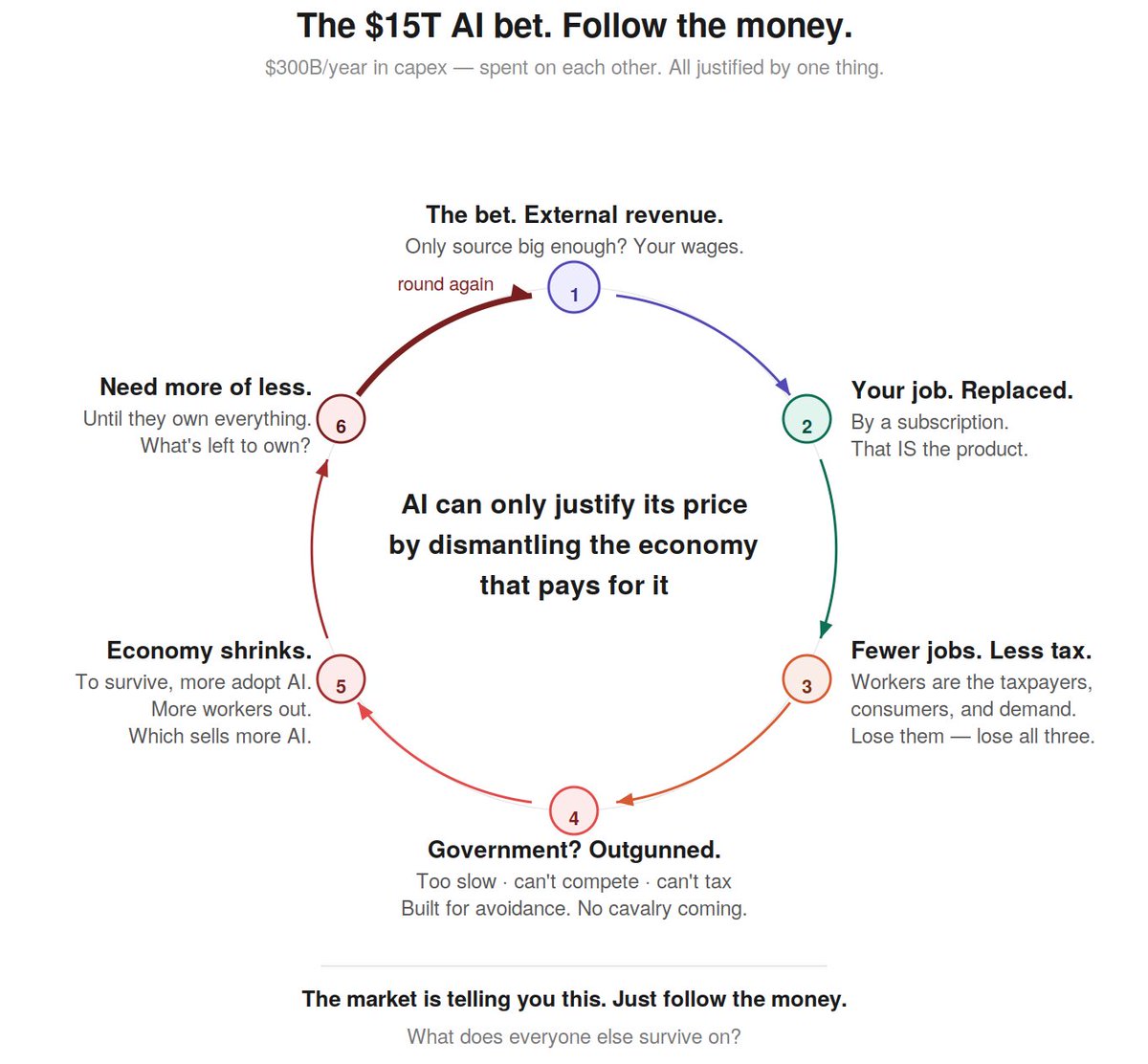
Two economists just published a mathematical proof that AI will destroy the economy. Not might. Not could. Will — if nothing changes. The paper is called "The AI Layoff Trap." Published March 2, 2026. Wharton School, University of Pennsylvania. Boston University. Peer reviewed. Mathematically modeled. The conclusion is one sentence. "At the limit, firms automate their way to boundless productivity and zero demand." An economy that produces everything. And sells it to nobody. Here is how you get there. A company fires 500 workers and replaces them with AI. A competitor fires 700 to keep up. Another fires 1,000. Every company is behaving rationally. Every company is following the incentives correctly. And every company is building a trap for itself. Because the workers who were fired were also customers. When they lose their jobs faster than the economy can absorb them, they stop spending. Consumer demand falls. Companies respond by cutting costs — which means automating more workers — which means less spending — which means more falling demand — which means more automation. The loop has no natural exit. The researchers tested every proposed solution. Universal basic income. Capital income taxes. Worker equity participation. Upskilling programs. Corporate coordination agreements. Every single one failed in the model. The only intervention that worked: a Pigouvian automation tax — a per-task levy charged every time a company replaces a human with AI, forcing them to price in the demand they are destroying before they pull the trigger. No government has implemented this. No major economy is seriously discussing it. Meanwhile the numbers are already tracking the curve. 100,000 tech workers laid off in 2025. 92,000 more in the first months of 2026. Jack Dorsey fired half of Block's workforce and said publicly: "Within the next year, the majority of companies will reach the same conclusion." Nobody is doing anything wrong. Companies are following their incentives perfectly. That is exactly the problem. Rational behavior. At scale. Simultaneously. With no mechanism to stop it. Two economists built the math. The math leads to one place. Source: Falk & Tsoukalas · Wharton School + Boston University · arxiv.org/pdf/2603.20617

Actually, AI/Robotics will mean everyone can have a penthouse if they want. The output of goods & services will be several orders of magnitude higher than today’s economy. Read the Iain Banks Culture books for the best imagining of how it will be. That said, what is the future you want? Amazing abundance seems the best to me.

Universal HIGH INCOME via checks issued by the Federal government is the best way to deal with unemployment caused by AI. AI/robotics will produce goods & services far in excess of the increase in the money supply, so there will not be inflation.



the fact that @DesLucrece made physical rip packs for BitMON at Art Basel is exactly the kind of unhinged art x collectibles energy I’m here for. Tolstoy said art is one person transmitting a feeling to another. and right now I have the sweaty palms. the irrational hope. that moment before you tear the foil where anything is possible. I haven’t felt like this since childhood. transported back to simpler times. and honestly? we need more of that. that’s what makes this art. not just the piece inside — the experience of revealing it. wish me luck hitting the bullseye!

Nobody’s burnt out from working too hard. They’re burnt out from working hard and still feeling behind. Your grandad didn't have it easy. He just didn't have Instagram. Were housing-to-income ratios better? Yes. But framing that as "they worked less hard" is cope dressed up as analysis. A 6-day week in a factory wasn't easy mode — he just wasn't documenting it. The real issue is comparison. Every previous generation only had visibility of the people on their street, in their office, maybe in a magazine. Now you've got a 24/7 window into the lives of the 0.01% — people whose Monday morning is a villa in Positano while yours is a Teams call with someone who should've sent an email. Burnout isn't just "I work too hard." It's "I work this hard and I'm still nowhere near the life I've been shown I should expect." That gap between expectation and reality is where the suffering lives. And that expectation wasn't set by boomers — it was set by an algorithm that profits from you feeling like you're behind. The fix isn't proving that previous generations had it easier so you can feel justified in your frustration. The fix is switching off the feed, sitting with the discomfort, and asking yourself what YOU actually want from your life — not what someone else's highlight reel made you think you should want. Entitlement isn't wanting a good life. Entitlement is believing you're owed one without defining what "good" even means to you personally.