Tamela Lewis retweetledi
Tamela Lewis
58.1K posts


Tamela Lewis
@BANKurKNOWLEDGE
#Harvard grad, lifelong #entrepreneur, #course creator, adjunct college faculty, chocolate lover, fun engineer
Katılım Eylül 2012
54K Takip Edilen50.7K Takipçiler

Tamela Lewis retweetledi

Your brain has a region that only grows when you do things you don't want to do.
It's called the anterior mid-cingulate cortex.
It's also the same region associated with the will to live.
Watch David Goggins' face when Huberman tells him this for the first time.
English
Tamela Lewis retweetledi

Tamela Lewis retweetledi

This morning in the living room, I finally hit my limit with the constant fighting.
My 9-year-old son and 7-year-old daughter were going at it again over the remote.... screaming, shoving, the whole chaos. I’m standing there in my robe with my coffee going cold, thinking not today.
Me: “Alright, new rule. Y’all are allowed to hit each other… but only once per day.”
Them: both freeze and stare at me like I grew three heads
Me: “And you better think it through real hard. Because once that one hit is used? That’s it. No more. Choose wisely.”
Fast forward 20 minutes…
They’re sitting on the couch, legs crossed, calm as can be. No hitting. No yelling. Just… negotiating.
Son: “So… if I hit you now, I can’t hit you later when you steal my chips?”
Daughter: “Yeah but what if I save mine for bedtime when you snore too loud?”
Son: “Okay fine, maybe after lunch is better…”
They’re literally scheduling their one hit like it’s a business meeting 😭
Actual fighting? Stopped cold. House is peaceful. I’m just over here sipping my now-warm coffee like the genius I am.
Soft life achieved with one ridiculous rule😂
English
Tamela Lewis retweetledi

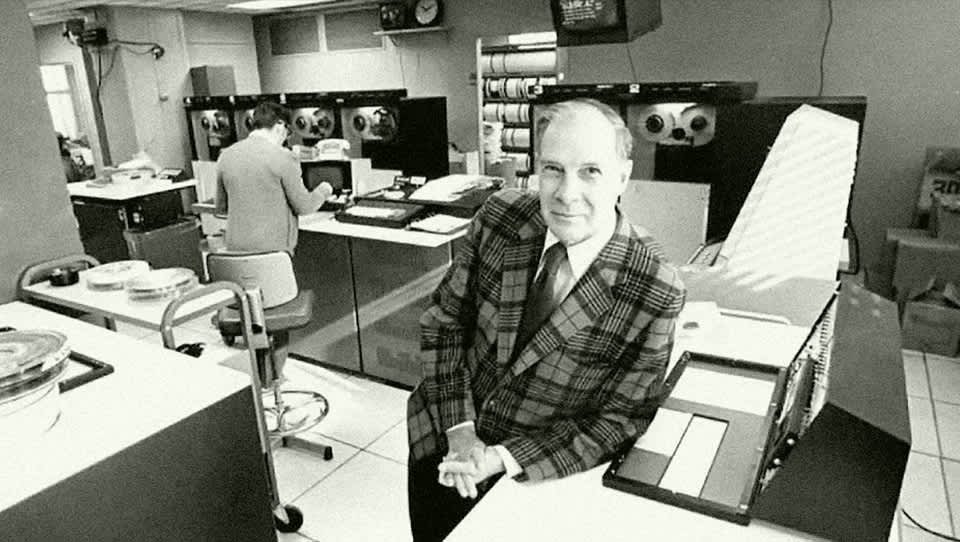
A mathematician who shared an office with Claude Shannon at Bell Labs gave one lecture in 1986 that explains why some people win Nobel Prizes and other equally smart people spend their whole lives doing forgettable work.
His name was Richard Hamming. He won the Turing Award. He invented error-correcting codes that made modern computing possible. And he spent 30 years at Bell Labs sitting in a cafeteria at lunch watching which scientists became legendary and which ones faded into nothing.
In March 1986, he walked into a Bellcore auditorium in front of 200 researchers and told them exactly what he had seen.
Here's the framework that has been quoted by every serious scientist for the last 40 years.
His opening line landed like a punch. He said most scientists he worked with at Bell Labs were just as smart as the Nobel Prize winners. Just as hardworking. Just as credentialed. And yet at the end of a 40-year career, one group had changed entire fields and the other group was forgotten by the time they retired.
He wanted to know what the difference actually was. And he said it wasn't luck. It wasn't IQ. It was a specific set of habits that almost nobody is willing to follow.
The first habit was the one that hurts the most to hear. He said most scientists deliberately avoid the most important problem in their field because the odds of failure are too high. They pick a safe adjacent problem, solve it cleanly, publish it, and move on. And because they never swing at the hard problem, they never hit it. He said if you do not work on an important problem, it is unlikely you will do important work. That is not a motivational line. That is a logical one.
The second habit was about doors. Literal doors. He noticed that the scientists at Bell Labs who kept their office doors closed got more done in the short term because they had no interruptions. But the scientists who kept their doors open got more done over a career. The open-door scientists were interrupted constantly. They also absorbed every new idea passing through the hallway. Ten years in, they were working on problems the closed-door scientists did not even know existed.
The third habit was inversion. When Bell Labs refused to give him the team of programmers he wanted, Hamming sat with the rejection for weeks. Then he flipped the question. Instead of asking for programmers to write the programs, he asked why machines could not write the programs themselves. That single inversion pushed him into the frontier of computer science. He said the pattern repeats everywhere. What looks like a defect, if you flip it correctly, becomes the exact thing that pushes you ahead of everyone else.
The fourth habit was the one that hit me the hardest. He said knowledge and productivity compound like interest. Someone who works 10 percent harder than you does not produce 10 percent more over a career. They produce twice as much. The gap doesn't add. It multiplies. And it compounds silently for years before anyone notices.
He finished the lecture with a line I have never been able to shake.
He said Pasteur's famous quote is right. Luck favors the prepared mind. But he meant it literally. You don't hope for luck. You engineer the conditions where luck can land on you. Open doors. Important problems. Inverted questions. Compounded hours. Those are not traits. Those are choices you make every single day.
The transcript has been sitting on the University of Virginia's computer science website for almost 30 years. The video is free on YouTube. Stripe Press reprinted the full lectures as a book in 2020 and Bret Victor wrote the foreword.
Hamming died in 1998. He gave his final lecture a few weeks before. He was 82.
The lecture that explains why some careers become legendary and others disappear is still free. Most people who could benefit from it will never open it.
English
Tamela Lewis retweetledi


Tamela Lewis retweetledi

Steve Jobs on why the Beatles were his business model:
In a 60 Minutes interview, Steve Jobs is asked about his approach to business.
His answer? The Beatles.
"My model of business is the Beatles. They were four very talented guys, four guys who kept each other's negative tendencies in check. They balanced each other and the sum was greater. The total was greater than the sum of the parts."
Steve explains that this is how he sees business:
"Great things in business are never done by one person; they're done by a team of people."
He points to what happened when the Beatles split up as evidence:
"When the Beatles were together, they did truly brilliant, innovative work. And when they split up, they did good work, but it was never the same. And I see business that way, too. It's really always a team."
When asked about his biggest strength as a person, Steve's answer reinforces this team-first philosophy:
"I've been very lucky in meeting incredibly talented people and hanging out with them. And so that's been my greatest strength."
But Steve also warns about what can undermine great teams — arrogance:
"All of us need to be on guard against arrogance which knocks at the door whenever you're successful."
When asked if he'd lived through that himself, Steve acknowledges he had. The interviewer points to Apple's initial success and the sobering reality of competitors catching up.
Steve goes further:
"As you may know, I was basically fired from Apple when I was 30 and was invited to come back 12 years later. So that was difficult when it happened, but maybe the best thing that ever happened to me. There wouldn't be a Pixar if that hadn't happened. And so you know, you just move on. Life goes on and you learn from it."
Asked if returning to Apple at 42 felt like sweet vindication, Steve's response reveals his broader outlook:
"No. I thought at that moment what a circle of life. Life is just always mysterious and surprising and you never know what's around the next corner."
English
Tamela Lewis retweetledi

Michael Phelps gave up dances. Friends. Normal weekends.
He didn’t call it sacrifice.
He said he wanted to give those things up.
“Those were things I wanted to give up to get to my goal.”
He spent 2 minutes explaining the mindset behind 23 Olympic gold medals:
What separates good athletes from the best?
"I think a lot of it is mental."
"If you want something that bad, you'll make sacrifices."
"Growing up, I made a lot of sacrifices that didn't seem like a big deal. I don't think of them as a big deal right now."
"There were Saturdays or Fridays where I'd give up going to a dance or hanging out with my friends because I had to work out the next day."
Here's the difference between good and great.
"Everybody can compete when they're feeling good. Happy. Excited. Rested."
"But the best people overcome when they're tired. Sore. Not in the best mindset."
"The greatest athletes do things when they're uncomfortable."
Look at Tiger Woods.
"That guy has a busted knee and still comes and destroys the rest of the field."
"People don't make excuses. The greatest athletes push all the pain aside."
Phelps did a Navy SEAL training course. There was a 45-foot wall.
"Was it easy for me to climb over a 45-foot wall and look down? Not at all."
"I'm afraid of heights."
"But I said to myself: I'm going to do this. And no one's going to stop me."
"How strong you can be mentally really shows who the person is."
"That's what separates the good from the greatest."
English
Tamela Lewis retweetledi

UNA LECCIÓN QUE NUNCA HE OLVIDADO
En la universidad yo no aprobaba las matemáticas ni aunque se me apareciese la Virgen. Me hablan de un Coronel jubilado de 80 años que da matemáticas. Me suena raro, pero me apunto.
Primer día, llego; me encuentro a un “hombrecillo” mayor, muy delgado.
De pronto habla con una voz que me no me esperaba:
“Isabel, mis reglas; a mi te diriges por D. Jose o Coronel, no tienes permiso para tutearme, si llegas a las 8 y un minuto, no hay clase, si no haces los deberes no hay clases, si me empiezas a cambiar los días, no hay clase,¿Queda claro?”
Yo: Sí, está clarísimo. (Me falto decirle que me tenia acojonada)
Coronel: ¿Qué te pasa con las matemáticas?
Yo: “No me gustan, ni siquiera me entero de las clases. Nunca se me han dado bien.”
Coronel: “¿Pues sabe lo que se hace en esta vida cuando algo no te gusta o no se te da bien y lo tienes que hacer?”
Yo: No
C: ¡PUES TE VUELVES UNA EXPERTA!
(Esa frase, con esa voz, se me quedó grabada)
Con las clases, me empezaron a gustar las matemáticas, me gusta su exactitud, las aprobé con Matrícula de Honor.
Me llevé muy bien con él, era frío, pero estaba contento conmigo.
La última clase le llevé unos bombones y le di las gracias. “Ha sido un honor tenerte de alumna y recuerda, en lo que no seas buena y lo tengas que hacer, vuélvete una experta”
Esa frase siempre ha estado en mi vida. Sin excepción, en el trabajo, en estudios.
Ahora se la digo a mi sobrino: ¿No te gusta esta asignatura, pues te tendrás que volver un experto”
Español
Tamela Lewis retweetledi
A Carnegie Mellon professor walked onto a stage in 2007 and gave an hour-long lecture to 400 people about achieving your childhood dreams. He did not tell the room that the entire talk was actually written for his three kids, who would grow up without him.
His name was Randy Pausch. The date was September 18, 2007. The video has since passed 20 million views, and the book that followed spent more than a hundred weeks on the New York Times bestseller list.
Pausch was 46 years old, had been diagnosed with terminal pancreatic cancer a month earlier, and had been told he had three to six months of good health left.
He did not walk onto that stage to talk about dying. He walked onto it to teach a single lesson hidden inside another one.
Here is what I missed the first time I watched it.
Pausch opened by doing push-ups on stage. He told the audience he was in phenomenally good shape, in better shape than most of them, and anyone who wanted to cry or pity him was welcome to get down and match him. The room laughed. Then he said the line that sets up the entire hour to come. We cannot change the cards we are dealt. Just how we play the hand.
That was the frame. Everything after it was a demonstration.
The lecture was officially titled Really Achieving Your Childhood Dreams, and Pausch did spend the first 40 minutes working through his actual childhood list. Zero gravity. Playing in the NFL. Writing an entry in the World Book Encyclopedia. Being Captain Kirk. Becoming a Disney Imagineer.
He walked the audience through which ones he got, which ones he didn't, and what the gap between wanting and getting had actually taught him.
The framework inside those 40 minutes is the part most people remember, and it is the one Pausch delivered with the most force.
He called it the brick wall. He said the brick walls in your life are there for a reason. They are not there to keep you out. They are there to give you a chance to show how badly you want something. They are there to stop the people who do not want it badly enough. They are there to stop the other people.
Read that again slowly. He is not saying brick walls are a test you have to pass. He is saying brick walls are a filter nature uses to separate the people who actually want a thing from the people who only like the idea of wanting it. That is a completely different claim. Most people treat obstacles as unfair. Pausch argued obstacles are the mechanism by which desire gets proven, and without that mechanism the whole concept of wanting something would be meaningless. Every dream he achieved, he achieved by treating the wall as a signal that he was close, not a signal that he should stop.
The second framework he taught the audience is the one almost nobody teaches in any classroom. He called it the head fake. He pulled it from football. Coaches teach young kids to tackle by having them run drills that look like they are about tackling, but the real lesson being embedded is teamwork, grit, how to take a hit and get back up. The kid thinks they are learning football.
They are actually learning something much larger, and they will not realize it until years later. Pausch said the best teaching in the world is head fake teaching. You get people to learn the thing they need by dressing it up as the thing they already want.
This is the technique behind Alice, the programming software he built at Carnegie Mellon. Kids thought they were making animated movies and games. They were actually learning to code. Pausch said one of his proudest claims to fame was that he had taught programming to a generation of students who had no idea they were being taught programming at all.
And then, with about three minutes left in the lecture, he ran a head fake on the room.
He asked the audience if they had figured out the first head fake of the talk itself. The room went quiet. He said the lecture was never actually about how to achieve your childhood dreams. It was about how to lead your life. If you lead your life the right way, the karma takes care of itself and the dreams come to you anyway.
Then he asked if they had figured out the second head fake. Even quieter.
He said the talk was not for the four hundred people in the room.
It was for his three kids.
Dylan was six. Logan was three. Chloe was eighteen months. They would grow up without their father, and he knew it. Pausch had spent an hour on stage pretending to give career advice to strangers because he needed to record something his children could watch when they were old enough to understand who their dad had been.
The entire architecture of the lecture was a message in a bottle disguised as a keynote. The filtered brick-wall philosophy, the football stories, the dreams he chased and the ones he missed, the line about playing the hand you are dealt, all of it was something a father wanted three small children to internalize after he was no longer there to say it in person.
That is the moment the video stops being a lecture and starts being something else entirely.
Pausch died on July 25, 2008, ten months after giving it. His final sentence on stage was that he had given the talk tonight, and then he walked off. The applause lasted nearly a minute before the camera cut.
Most professors spend their entire careers trying to say one true thing their students will remember for a week.
He said one true thing his children will remember for the rest of their lives, and the rest of the world is still watching the footage.
English
Tamela Lewis retweetledi

Just got out of an Uber on the way to LAX, headed to New York
Driver asks where I’m going, I say NYC
He goes, “I’ve got a crazy story for you”
He’s originally from Africa, moved to London, then moved to New York in the 90s for school
Young, broke, living in Manhattan
Ends up becoming close with his neighbor, older Jewish woman. They’d talk all the time.
She kept telling him, “You should buy an apartment here”
He laughed it off for years.
One day she’s getting sick and says, “I’ll tell ya what, you can buy the one you live in”
He had no clue she owned it.
Asks what she wants for it.
She says, “Whatever you have.”
He gave her everything. About $20,000.
For a 5 bed apartment in Manhattan
Few years later she passes
He finds out she owned the whole block. No kids, no family.
Just decided to sell it to him because she enjoyed him as a neighbor
I ask him what he’s doing out in LA
He tells me he’s visiting his two daughters at UCLA, one pre med and the other in medical school
Says his daughters love going back to New York to visit with friends and staying in that apartment, same place where it all started
Whole trajectory of his life changed off that one decision
As I’m getting out he goes:
“If you turn off social media and the news, you realize the world’s actually a pretty good place, and there’s a lot of really good people out there”
Whole lot of truth in that
English
Tamela Lewis retweetledi

My neighbor came up to me: "Your child is incredibly impressive. She came up to me, said hello, looked me in the eye, and engaged me in conversation. You never see children like this anymore. She has real manners! You must be the best mother. I couldn't wait to tell you."
Me: "No, it's her school @AlphaSchoolATX. They teach life skills, and they just did a unit on etiquette."
In life skills, they don't get a grade, but you can measure it in the number of adults who come up to you and tell you that your child is impressive: it's a non-trivial number.
English
Tamela Lewis retweetledi

People talk about burnout as if all hard work is the same. It is not. Meaningful strain is different from confused thrashing.
English
Tamela Lewis retweetledi
You don't need advice from editors on rejected manuscripts.
My short story “Ender's Game” was rejected by Ben Bova at Analog back when that was the top market for a sci-fi story. Ben gave me feedback. He thought the title should be “Professional Soldier” and he said to “cut it in half.”
But I knew he was wrong on both points and submitted it to Jim Baen at Galaxy. He sat on it for a year, and responded to my query with a rejection. There was some kind of explanation, but I don't remember what it was. I concluded at the time that Baen's comments showed that he had barely glanced at the story.
So … I got feedback both times, but it was not helpful. I looked at Ben's rejection again. What was it about the story that made him think it should, let alone COULD, be cut in half?
Apparently it FELT long. What made it feel long? Now, post-Harry Potter, I would call it the quidditch problem. I had too many battles in which the details became tedious. So I cut two battles entirely, merely reporting the outcomes, and shortened another. In retyping the whole manuscript (pre-word-processor, that was the only way to get a clean manuscript), I added new point-of-view material to the point that I had cut only one page in length. So much for “in half.”
But I already knew that my manuscripts did not need cutting — if it wasn't needed, it wouldn't be there in the first place. Even the battles were still there, but instead of showing them, I merely told what happened (so much for the usually asinine advice “show don't tell”), which kept the pace going.
Those changes made, I sent it to Ben again. I did not remind him of what he had advised me to do. I merely told him I liked my title, and said, “I have addressed your other concerns,” which was true. I figured he wouldn't remember what his exact words had been. My answer was a check. That revised story was the basis for my winning the Campbell Award for best new writer.
Did Ben's feedback help? Yes — but his specific advice was not right, and I knew it. On my next two submissions, Ben hated my endings, and I revised as suggested. The fourth submission he rejected outright, and the fifth, and I thought, Am I a one-story writer? I went back to Ender's Game and tried to analyze why it worked. Then, deliberately imitating myself, I wrote “Mikal's Songbird.” Ben bought it, and it received favorable mentions. I was afraid then that I had consigned myself to writing stories about children in jeopardy. But in fact I was writing character stories rather than idea stories. And THAT was how I built a career, not by self-imitation, and not by following editorial suggestions.
I did get wise counsel from David Hartwell on my novel Wyrms, but that was on a book that was already under contract, and it was story feedback, not style. I got wise counsel from Beth Meacham, too, on various books over the years — but again, only on books that were under contract. I also received appallingly stupid advice from the editor of my novel Saints, which temporarily destroyed the book's marketability; after that, I was allowed to go back to my original structure and save the book — now it's one of my best.
Editors don't know more than you about your story. They especially don't know why they decide to accept or reject stories. YOU have to know what your story needs to be, and take only advice that you believe in.
Your best counselor on a story nobody bought is TIME. Let some time pass and then reread the story. Don't even think about why it Didn't Work. Instead, think about what DOES work, and then write it again, a complete rewrite, keeping nothing from the previous draft. Find the right protagonist and begin at the beginning — the point where the protagonist first gets involved with the events of the story. Be inventive — the failed first draft no longer exists, so you're not bound by any of your earlier decisions. THAT is how you resurrect a good idea you did not succeed with on your first try.
English
Tamela Lewis retweetledi
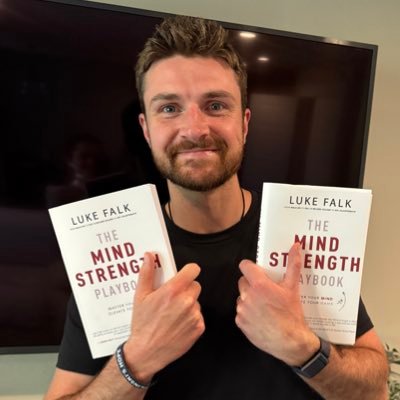
Every training camp I had at Washington State University, Coach Leach would share the same story.
The story of two kids. The rich kid and the poor kid.
The rich kid has two choices. He can become spoiled, entitled, lazy, and expect everything to be handed to him because he has been given more. Or he can take every advantage of what he has been given—resources, coaching, opportunities—and use it to become even better.
The poor kid has two choices too. He can say, “I never had a chance. Nobody gave me anything. The world is against me.” He can feel sorry for himself and use it as an excuse. Or he can say, “I may not have what they have, but I am going to outwork everybody.” He can become tougher, more driven, and more relentless than everybody else.
It was a powerful message in a locker room full of people from different backgrounds, different families, and different life experiences. Some guys came from wealth. Some came from almost nothing. Some had every opportunity. Others had to fight for every inch.
But despite all of those differences, everybody still had the same choice.
You can take ownership and use what you have as fuel.
Or you can become victim-minded. You can look for excuses, blame your circumstances, become entitled, and convince yourself that because of what you have—or because of what you do not have—you cannot become what you want to be.
It is not about how you start. It is about what you choose to do with how you start.
The rich kid can waste what he has been given or use it to build something greater. The poor kid can use his circumstances as an excuse or as fuel.
In the end, greatness does not come from starting with more or less. It comes from which person inside of you that you choose to feed.
If you like these Mind Strength Messages, click below to join our free newsletter and get a new Mind Strength Message every Monday to start your week on the right foot.
coachlukefalk.com/email-newslett…
#MindStrength

English
Tamela Lewis retweetledi

小学校の頃、家庭科の授業で「塩を一つまみ」という表現が出てきて「大人の一つまみと、子どもの一つまみでは全然量が違うと思います!」と思って先生に質問したのだが「しまった、怒られるかな…」と思ったら「面白いところに気づいたね。料理では、この一つまみとか、少々とか、2・3分みたいな、一見すると”いい加減”な表現が多くて、困る人が多いんだよね。これは悪い意味での”いい加減”なのでなく、”良い加減”ってことなんだけど、料理をはじめる入口でその加減がわからなくて料理に対して苦手意識を持つ人がいるのも事実なので、この授業では、一つまみは○グラム、少々は○グラム、2・3分は90秒ってことでやろう」って説明してくれた先生が居た。しかもその後の理科の時間だったと思うが「大人の一つまみと、子どもの一つまみ、それぞれどのくらいの重さがあるか」ってのを砂糖でやって、それを水にとかした時に、どのくらい味の差がでるのか、なんて実験までシてくれた。その後料理がある程度できるようになったのは、たぶんこの先生のおかげもあったような気がする。
日本語
Tamela Lewis retweetledi

My friend's husband was cheated out of his business.
When their second child was born there were complications. Their baby nearly died.
While in Neonatal Intensive Care Unit, her husband's business partner showed up.
He had shareholder agreements.
He created a situation where he made her husband feel he needed to transfer all his shares for their construction company.
So he signed the contract. They lost everything.
A few weeks later, he realized what he'd done. His business partner then took everything.
At age 37, he had to start again with nothing. A few months later, he built a pool room for a guy.
Put his heart and soul into it. Hit it off with the owner. They started playing pool together.
Turns out the guy was mega rich.
Months later they became business partners. The guy put up all the money.
Now they've completed several big projects and he's surpassed his previous net worth.
But that's not the end of the story.
The guy who stole his business is on the run from police. He bought several pieces of land then never settled on them.
He fell behind on his debt payments too.
Then his wife divorced him and his employees all quit. People found out he was a thief.
Now no one can find him.
If you just do the right thing and have real skills, even if the worst-case scenario happens, you can always rebuild.
Your character matters more than your financial situation.
English
Tamela Lewis retweetledi

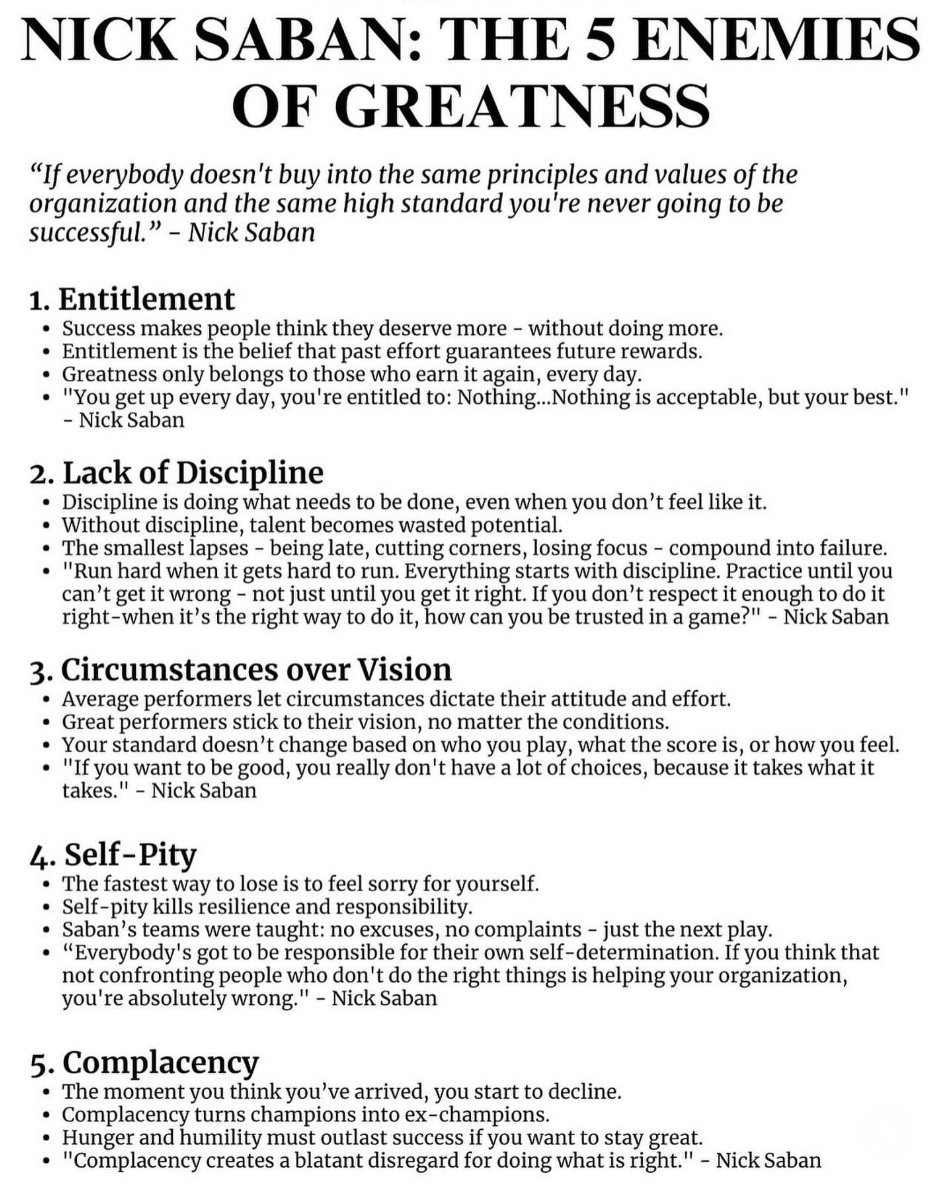
Nick Saban's 5 Enemies of Greatness.
Tack them on a wall.
English
Tamela Lewis retweetledi
Netflix co-founder and former CEO @marcrandolph says hard work is a myth.
Yes, sometimes you have to grind. But 99% of the time it changes nothing.
He uses 2 dead-simple examples to prove it:
1. Sprinting in a triathlon (you can't sprint the whole race)
2. Running through airports to catch flights (the plane left anyway)
"You don't lose the deal at 2 o'clock that morning because you didn't check the fonts. You lost it four weeks ago when you didn't have the fundamentals right."
His answer: stop grinding on the wrong things. Wisely choose your focal points and you make 99% of the difference without the extra hours.
English
Tamela Lewis retweetledi