Ben Turner

4.8K posts

Ben Turner banner
Ben Turner

Ben Turner

@BT_BXL

Works @ERC_Research. Former UK civil servant and diplomat. T/RTs: mainly science, technology, the economy. Likes: everything else.

Brussels, Belgium Katılım Ağustos 2017
2.4K Takip Edilen319 Takipçiler
Ben Turner retweetledi
Sam Bowman
Sam Bowman@s8mb·
Europe has one of the most essential and irreplaceable companies in the global AI supply chain: ASML, which produces the machines that TSMC uses to make its chips. These machines are roughly the size of double-decker buses. To ship one requires 40 freight containers, three cargo planes, and 20 trucks. They are the world’s most complex objects. Each contains over one hundred thousand components, all of which have to be perfectly calibrated for the machine to produce light consistently at the right wavelength. ASML was once seen as an also-ran compared to its arch-rivals Nikon and Canon. It succeeded thanks to involvement in a US program to develop extreme ultraviolet lithography, which only happened because the Americans were so worried about losing to Japan. ASML also outsourced much of its R&D instead of trying to do it all in house, which allowed it to spread its bets across many different companies. Today, the entire global AI industry depends on ASML. Understanding its success is crucial to understanding Europe's position in AI today, and how it can leverage that to avoid being left behind tomorrow. worksinprogress.co/issue/the-worl…
English
33
171
967
413.5K
Ben Turner retweetledi
Sixth Tone
Sixth Tone@SixthTone·
China’s Next Megaprojects Are Built for Big Science Data shows how China’s infrastructure drive is beginning to include new scientific instruments built to explore the frontiers of physics, astronomy, and energy.
Sixth Tone tweet mediaSixth Tone tweet media
English
2
28
141
15.2K
Ben Turner retweetledi
Dwarkesh Patel
Dwarkesh Patel@dwarkesh_sp·
Really enjoyed chatting with @michael_nielsen about how we recognize scientific progress. It's especially relevant for closing the RL verification loop for scientific discovery. But it's also a surprisingly mysterious and elusive question when you look at the history of human science. We approach this question stories like Einstein (who claimed that he hadn't even heard of the famous Michelson-Morley experiment, which is supposed to have motivated special relativity, until after he had come up with the theory), Darwin (why did it take till 1859 to lay out an idea whose essence every farmer since antiquity must have observed?), Prout (how do you recognize that isotopes exist if you cannot chemically separate them?), and many others. The verification loop on scientific ideas is often extremely long and weirdly hostile. Ancient Athenians dismissed Aristarchus's heliocentrism in the 3rd century BC because it would imply that the stars should shift in the sky as the Earth orbits the sun. The first successful measurement of stellar parallax was in 1838. That's a 2,000-year verification loop. But clearly human science is able to make progress faster than raw experimental falsification/verification would imply, and in cases where experiments are very ambiguous. How? Michael has some very deep and provocative hypotheses about the nature of progress. One I found especially thought-provoking is that aliens will likely have a VERY different science + tech stack than us. Which contradicts the common sense picture of a linear tech tree that I was assuming. And has some interesting implications about how future civilizations might trade and cooperate with each other. So many other interesting ideas. Hope you enjoy this as much as I did. 0:00:00 – How scientific progress outpaces its verification loops 0:17:51 – Newton was the last of the magicians 0:23:26 – Why wasn’t natural selection obvious much earlier? 0:29:52 – Could gradient descent have discovered general relativity? 0:50:54 – Why aliens will have a different tech stack than us 1:15:26 – Are there infinitely many deep scientific principles left to discover? 1:26:25 – What drew Michael to quantum computing so early? 1:35:29 – Does science need a new way to assign credit? 1:43:57 – Prolificness versus depth 1:49:17 – What it takes to actually internalize what you learn Look up Dwarkesh Podcast on YouTube, Apple Podcasts, or Spotify.
English
40
98
811
289.5K
Ben Turner retweetledi
Kyle Chan
Kyle Chan@kyleichan·
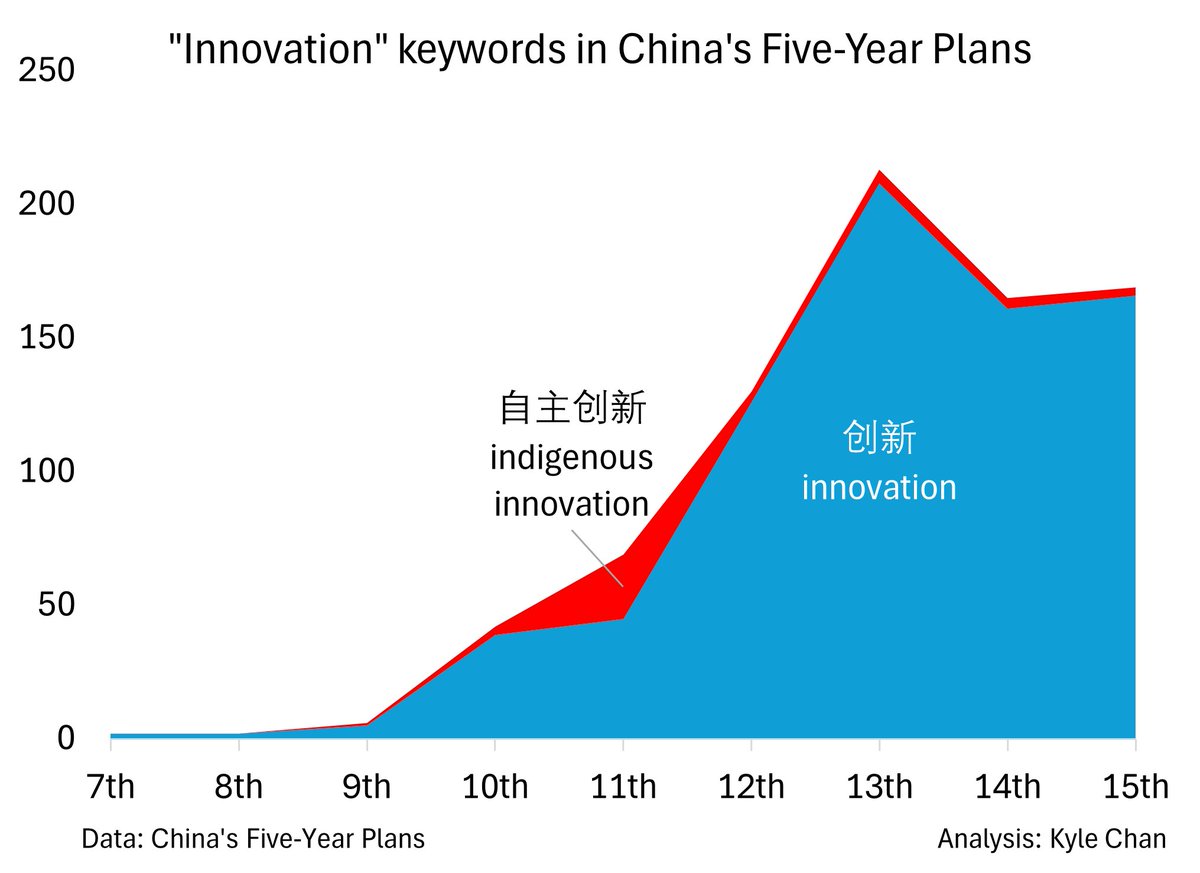
The rise of “innovation” 创新 in China’s Five-Year Plans. China began by focusing on “introducing and absorbing” 引进,吸收 foreign technology. Then China shifted toward “indigenous innovation” 自主创新, believing it needed to truly create and own technology to develop. From my new High Capacity piece on China’s technology long game: highcapacity.org/p/chinas-tech-…
Kyle Chan tweet media
English
7
52
176
12.1K
Ben Turner retweetledi
T. Greer
T. Greer@Scholars_Stage·
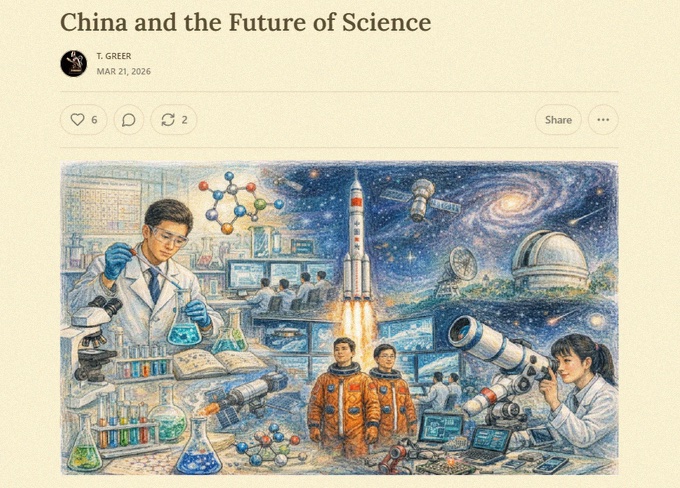
New essay: China and the Future of Science
T. Greer tweet media
English
6
40
193
56.7K
Ben Turner retweetledi
Dwarkesh Patel
Dwarkesh Patel@dwarkesh_sp·
When Copernicus proposed heliocentrism in 1543, it was actually less accurate than Ptolemy's geocentric model - a system refined over 1,400 years with epicycles precisely tuned to match observed planetary positions. It took another 70 years before Kepler, working from Tycho Brahe's unprecedentedly precise observations, replaced Copernicus’s circles with ellipses - finally making heliocentrism empirically superior. Terence Tao's point is that science needs a high temperature setting. If we only fund and follow what's most state of the art today, we kill the ideas that might need decades of work to surpass some overall plateau.
English
123
586
4.8K
537.9K
Ben Turner retweetledi
Martha Dacombe
Martha Dacombe@martha_dacombe·
Britain has, with the best of intentions, judicialised its own government into paralysis, hollowed out its departments, and outsourced delivery to 600+ arm's-length bodies that can't make trade-offs. New piece on why civil service reform needs to go further. Read in replies
Martha Dacombe tweet media
English
6
37
312
27.2K
Ben Turner retweetledi
Richard Jones
Richard Jones@RichardALJones·
But the economic growth hasn’t arrived, yet. What happens if it doesn’t? My blogpost: The UK’s big bet on science and technology softmachines.org/?p=3268
English
3
2
11
2.2K
Ben Turner retweetledi
Alexander Kustov
Alexander Kustov@akoustov·
My two posts on AI in academia got over a million views and a thousand angry responses. I got a few things wrong. I stand by the rest. But most people reacted to the headline, not the arguments. So here are all 20 theses laid out. Tell me which ones you actually disagree with 🧵
Alexander Kustov tweet mediaAlexander Kustov tweet media
English
14
104
415
124.4K
Ben Turner retweetledi
Devon Lum
Devon Lum@devonjlum·
Iran has struck at least 11 U.S. military facilities since Saturday. @heytherehaley @riley_mellen and I found damage on or near communications and radar systems at 7 of them (no paywall link here) nyti.ms/4upLCnl
English
107
1.2K
3.3K
954.5K
Ben Turner retweetledi
Aakash Gupta
Aakash Gupta@aakashgupta·
Tony Fadell has more receipts for this philosophy than anyone alive. The iPod launched with one function: play music. No FM radio, no voice recorder, no wireless sync. Apple’s board wanted all of it. Jobs and Fadell killed every single one. The iPod sold 100 million units in six years. The Nest Thermostat shipped with a display that only showed the temperature. Honeywell’s competing thermostats had 12 buttons and 6 menu screens. Nest had a single rotating dial. Google bought the company for $3.2B. “If you can’t explain why it matters, it doesn’t ship” sounds like a platitude until you realize what it actually requires. It requires a PM to walk into a room where an engineer spent three weeks building something and say “this adds complexity without solving the problem, we’re cutting it.” That conversation destroys most PMs. They default to shipping everything because saying yes is free and saying no costs political capital. The reason most products feel bloated is because saying yes is the path of least resistance. Nobody gets fired for adding a feature. People get fired for killing one that a VP wanted. Fadell’s Nest rule forces the opposite incentive structure. The burden of proof sits on the feature, not on the person cutting it. That one inversion changes everything about how a team prioritizes. Most PMs treat the roadmap like a to-do list. The best PMs treat it like a murder board. Every item is guilty until proven innocent. That’s the actual job.
Tony Fadell@tfadell

PMs don’t just ship features. They kill them. Shipping isn’t the job. Shipping the right product is. A great PM doesn’t fall in love with the roadmap. They fall in love with the problem and have the guts to say: This isn’t solving it. This adds complexity. This doesn’t matter. Every feature, setting, UI, element should fight to exist. At Nest, we had one rule: If you can’t explain why it matters, it doesn’t ship. You had to tell us the why. The reason a real person would care. That one rule killed dozens of features.

English
12
81
1.1K
199K
Ben Turner retweetledi
Kyle Chan
Kyle Chan@kyleichan·
“[T]he era of Chinese ascendancy in semiconductor manufacturing equipment (SME) has arrived, and it can be expected to have a dramatic impact on the global IT sector by the end of the decade.” Highly recommend @pstAsiatech’s new piece: americanaffairsjournal.org/2026/02/innova…
English
5
66
304
23.4K
Ben Turner retweetledi
Arnaud Bertrand
Arnaud Bertrand@RnaudBertrand·
I've been wanting to write this for a while: an article on the key characteristics of the Chinese health system, as a patient. It's something that I - perhaps unfortunately - have come to have a lot of experience with in my eight years in China. I've been to the doctor as a patient dozens of times. My wife delivered our first daughter in a Chinese hospital, and had cancer surgery in Shanghai. My younger daughter - who once completely severed her thumb in an unfortunate accident in rural Gansu - had emergency surgery in a small clinic there (her thumb is fine now!). We spent the entire covid episode in China. And, to this day, I still go back to China every year to do my routine health tests or the occasional procedure (like a thyroid biopsy in Harbin last year). In other words, when it comes to the Chinese health system, I've seen a lot. What's fascinating about the Chinese health system, and that's true in general about many things in China, is that it never inherited Western dogma about how things were supposed to work, it's completely unconstrained by what everyone else has decided is "normal". And, as a result, you end up with things that would simply sound impossible to any Western patient: a consultation with the head cardiologist of one of Shanghai's best hospitals for less than $10, blood test results in under 30 minutes, and a system where you can walk in, see three specialists and walk out with a diagnosis and your medicine - all before noon. As I argue in the article that's all enabled by 3 characteristics that sound super unorthodox: 1) extremely short consultation times, less than 5 minutes 2) no GP gatekeepers (you go straight to see specialists) 3) systematic testing for every patient, even if you just have a cold Each one sounds wrong. And in fact when I describe them to doctor friends in the West they immediately explain to me why that can't possibly work, and how their own system is far superior. Except that it does work, I checked the numbers (on top of my personal experience): the Chinese system handles close to 10 billion total outpatient visits a year (nhc.gov.cn/cms-search/dow…), or about 7 visits per person per year on average, and the average wait time is only about 18 minutes (gov.cn/yaowen/shipin/…). Contrast this with France, my country, where people already go to the doctor A LOT, but still less than in China: only 5.5 visits per person per year (evaluation.securite-sociale.fr/home/maladie/M…). And the French system can't even handle this lower volume: when you can see a specialist straight away in China - you don't even need to make an appointment in advance - you need to wait months to see one in France (50 days on average for a cardiologist, for instance: drees.solidarites-sante.gouv.fr/sites/default/…). I've personally managed to see 3 specialists AND do all related tests AND get the test results AND get diagnoses AND buy the medicine to cure me - all in the space of a morning at a hospital in Shanghai. That would have undoubtedly taken me a whole year in the French system. My purpose here is not to argue that the West should replicate the Chinese health system wholesale, but to ask an honest question: what if some of the things we take for granted about healthcare aren't nearly as inevitable as we think? Is it completely unthinkable that we've developed some dogmas that are costing us - in money, in time, and occasionally in lives? That's the whole point of my article: describing a health system built from first principles by people who never assumed we in the West knew better - up to you to decide if they have a point. Enjoy the read here: open.substack.com/pub/arnaudbert…
Arnaud Bertrand tweet media
English
298
2K
7.7K
838K
Ben Turner retweetledi
Ethan Mollick
Ethan Mollick@emollick·
Every few months, I write an updated, idiosyncratic guide on which AIs to use right now. My new version has the most changes ever, since AI is no longer just about chatbots. To use AI you need to understand how to think about models, apps, and harnesses. open.substack.com/pub/oneusefult…
English
76
368
3K
626.3K
Ben Turner retweetledi
Luis Garicano 🇪🇺🇺🇦
Luis Garicano 🇪🇺🇺🇦@lugaricano·
Europe does not need more venture capital for startups. It needs more investable startups for VC. Sweden has 10 m. people and 48 unicorns. Italy has 6x people and 4x the GDP and 1/3 the unicorns. The difference is not lack of VC money. With Per Strömberg. siliconcontinent.com/p/why-sweden-h…
Luis Garicano 🇪🇺🇺🇦 tweet media
English
29
160
758
205.1K
Ben Turner retweetledi
Edward Luce
Edward Luce@EdwardGLuce·
Excellent primer on the three Trump admin factions - primacists, restrainers, prioritizers - and how they compete for Trump's goldfish-type attention and dress up whatever they're pushing up as easy, televisable wins. Neither coherence nor stability can ever emerge from this.
Majda Ruge@majda_ruge

When @JyShapiro & I mapped the three GOP tribes shaping Trump’s foreign policy, we figured they’d unite around Indo-Pacific. Plot twist: prioritisers are losing hardest, just behind liberal Europe. My latest on faction fights for Trump's mind👇 ecfr.eu/publication/on… via @ecfr

English
7
92
282
78K
Ben Turner retweetledi
Kaiser Kuo
Kaiser Kuo@KaiserKuo·
Absolutely do not sleep on this @ezraklein interview with @adam_tooze. It was hands down the best sense-making conversation I've heard about the state of the world after Davos and Mark Carney's "rupture" speech, from someone who was there and who has thought deeply about the United States, Europe, and especially China. This is exactly what I have in mind when I speak about the need for a "great reckoning." The best interviewer in the game speaking with the most perspicacious public intellectual on the scene. Would love to hear your reactions once you've heard it! nytimes.com/2026/01/30/opi…
English
21
139
747
109.5K