@christesla@SawyerMerritt@wholemars@Tesla They clarified that a decision is yet to be made. Apparently they felt the need to soften the certainty that could be picked up from Tesla’s own messaging.
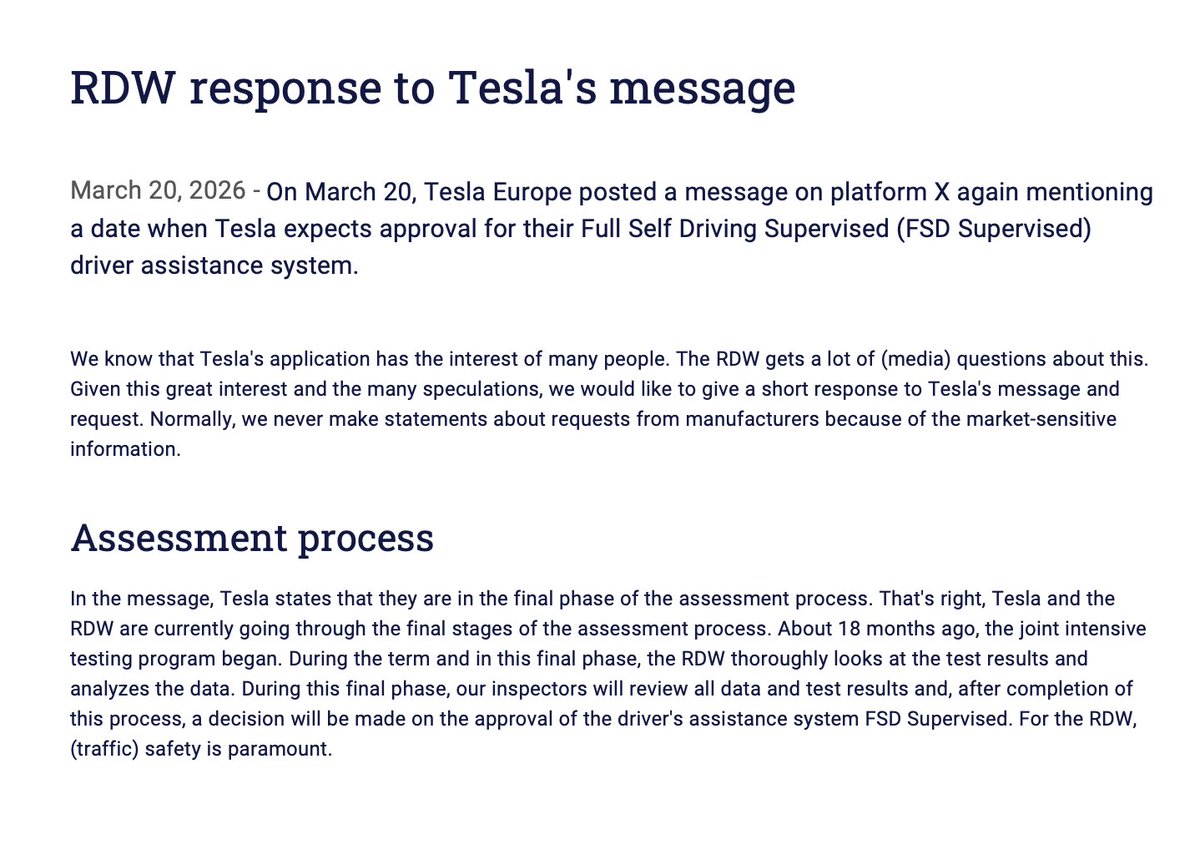
NEWS: Dutch regulators (RDW), the key authority that would clear the path for Tesla FSD approval across much of Europe, has issued a response to @Tesla’s 𝕏 post today.
"We know that Tesla's application has the interest of many people. The RDW gets a lot of (media) questions about this. Given this great interest and the many speculations, we would like to give a short response to Tesla's message and request. Normally, we never make statements about requests from manufacturers because of the market-sensitive information.
Assessment process:
In the message, Tesla states that they are in the final phase of the assessment process. That's right, Tesla and the RDW are currently going through the final stages of the assessment process. About 18 months ago, the joint intensive testing program began. During the term and in this final phase, the RDW thoroughly looks at the test results and analyzes the data. During this final phase, our inspectors will review all data and test results and, after completion of this process, a decision will be made on the approval of the driver's assistance system FSD Supervised. For the RDW, (traffic) safety is paramount."
Mechanical odometers in older vehicles rely on a simple but precise system of numbered drums connected by a series of reduction gears. As the vehicle moves, a cable driven by the transmission rotates the internal mechanism, advancing each digit in a controlled sequence.
Most classic designs were limited to six digits, meaning the highest readable mileage was 999,999. Once the final drum completes its full rotation, the gearing forces every number wheel to return to zero and begin counting again from 000,000.
@zakarum4@corsix If you write those functions by hand, it is not a generic (de)serializer. Our (de)serializer does file I/O in legacy binary format without any need to annotate or extend the existing data structures. It is all generated at compile time.
Speaking as someone who studied joint mathematics and computer science, this right here is how you tell apart the mathematicians from the computer scientists.
@igorsushko Probably not the camera CMOS, but rather the transceiver for the signal through the optic fibre. They need to be quite sensitive and a medium powerful laser which enters the cable from the side can oversaturate the delicate receiver.
One step closer to Terminator warfare:
Russia has been using fiberoptic drones to great effect. Immune to jamming.
They'd land them on logistic routes to ambush Ukrainian forces.
Now Ukraine is flying drones armed with lasers that disable the camera CMOS, which appears to result in a short circuit and loss of connection.
@Morgrid1@saintjavelin I think it potentially damages the optoelectronics at both ends of the cable. Taking out the controller is likely more significant than taking out the drone!
Footage shared by Russian sources appears to show Ukrainian forces using a laser beam to burn through the fiber-optic cable that controls so-called “waiter” FPV drones.
In the latest iOS update the all app search doesn’t bring up the keyboard so you can’t actually search anymore
My phone gets worse with every single update they put out
The chart shows _business_ creation _by_ a percentage of people, not _job_ creation _for_ a percentage of people. And as the chart shows, Norway is not an outlier regarding the disparity between men and women involved with entrepreneurship, it is just very low overall. In other words, most Norwegians work in the public sector or for well established businesses.
@TNiskakangas You need to look under the hood, mister.
Unless you like socialism, nanny state politics, high taxes and climate change lunacy.
It’s the 8th of March. So let’s look at private sector job creation for women. What country should absolutely not be at the very bottom?
This week I travelled to Oslo to interview Nicolai Tangen, who runs the world's largest sovereign wealth fund. I knew Norway was wealthy. The reality was still striking. I'm still amazed by the things I saw in Oslo and its suburbs.
🧵
I just had a revelation that LISP, in its superiority, does not need operator precedence. You always write everything in functional form, and there is no ambiguity what applies to what!
Obvious in hindsight, but I got a real "whoa" moment after thinking through it explicitly!
@maxj0nes@abdimoalim_ Define a few common idioms you use regularly. Implement them in both D and Rust. Then compare the result and the experience.
That is how we landed on D, in favour of Ada and Free Pascal. Rust was not on the short list (this was years ago).
@abdimoalim_ it's okay but it's really not general-purpose the way rust/c++/d are, it's basically just a modernized, nicer C
I liked D when I tried it but the GC may be a dealbreaker, also it's pretty much dead
if in doubt, use Rust though I'm told modern C++ is nice
@Doge2113@abdimoalim_ Lack of external library? The “import C” feature lets you use C libraries with just the C header. No need to even write a wrapper!
@abdimoalim_ D has terrible lack of community and external library.
Not to mention a lot of the std doesn't work in nogc.
found this out hardway years ago in 2017 :(
really liked the language and it's features but held back...
“what candidate [] other than Go and Rust would one realistically choose for serious production use?”
We chose D for our port from Pascal. Very versatile and pragmatic. Offers a choice in the level of memory safety and a variety of memory management strategies, including GC. It is a language that appeals to people that still enjoy programming.
A few days from now I'm going to ship my first program written in Rust. But I don't actually know Rust. Strange days have found us.
The astute among you will already have guessed that I used an LLM to translate to Rust a program I originally wrote in C. And that would be correct! But there's a bit more to the story, and some heavy symbolic freight.
For, you see, to me this isn't just any C program. It's the very first one I wrote, back in early 1983. It marks the point where I was able to stop farting around with OSes and tools that were doomed to rapid obsolescence and become a Unix developer
It's hexd, my humble little hex dumper that has survived four decades and is packaged by several Linux distributions competing with od(1) because it emulates the more pleasing and ergonomic dump format now associated with CP/M. (The style actually goes back further to the PDP-11 and very old DEC operating systems.)
That year, 1983 was approximately the beginning of the long dominance of C as a systems programming language. It have been in use at Bell Labs earlier than that, of course, but not until the early 1980s did it escape containment and begin to steamroll every other compiled language and use at the time.
And in a few days I'm going to ship a Rust translation. Alongside the C, giving distribution makers a choice between memory safety with a large binary made from Rust versus a small but very well tested binary without those guarantees. So one could argue it's a half step.
Still. The portents are clear. The old order passeth. C being replaced by languages with stronger memory safety guarantees. But in a twist nobody anticipated, this won't happen because developers are changing their manual coding habits. It will change because increasingly, automatically moving code between languages is nearly trivial.
Not long ago I LLM-lifted another ancient C program I maintain, cvs-fast-export. That one went to Gol. I do know Golang and I like it. So, why move hexd to Rust?
The answer is: automatic memory management. cvs-fast-export needed that capability rather badly; hexd does not. I think this is the big fork on the road when it comes to moving stuff out of C, because in 2026 what candidate l C successors other than Go and Rust would one realistically choose for serious production use?
I was there at the beginning of the long era of C. I believe now that I will live to see its end, and the large language models will be the instruments of its demise. Somebody should write an elegy.