Arjun Malhotra

3.2K posts

Arjun Malhotra

Arjun Malhotra

@BadCapitalVC

Investing in companies that don't make money @GoodCapitalVC

India Katılım Şubat 2012
1.4K Takip Edilen10.9K Takipçiler
Sabitlenmiş Tweet
Arjun Malhotra
Arjun Malhotra@BadCapitalVC·
If you need an investor that can put on their big boy pants and lead your round, call me.
English
56
4
282
0
Arjun Malhotra
Arjun Malhotra@BadCapitalVC·
So category builders spend years paying to create demand, and once it exists, the rest of the shelf gets to use it too. Premiumisers skip that cost because the demand is already there, but they don't get to own it the way a category creator would.
English
1
0
4
285
Arjun Malhotra
Arjun Malhotra@BadCapitalVC·
The trap is that the incumbent is standing next to you as a competitor from the start. Plus, a million retailers are already stocking the product, which is why brands playing this bet usually get bought rather than go public. ITC took Yoga Bar. Marico picked up True Elements, Cosmix, Plix.
English
1
0
1
367
Arjun Malhotra
Arjun Malhotra@BadCapitalVC·
Building a "healthier" or "better for you" brand in India is really one of two bets. Either you build a category nobody had, or you premiumise a habit everyone already has. Here are the moats & traps on each 🧵
English
1
1
47
5K
Arjun Malhotra retweetledi
Shreyans Salecha
Shreyans Salecha@shreyansalecha·
Almost every investor talks about how founders should make pitch decks, but nobody shares how they read one. So, here's an insider perspective on what we're looking for as we read through your deck. 1/15
English
4
5
53
7.2K
Arjun Malhotra
Arjun Malhotra@BadCapitalVC·
Also goes beyond spouses. Household wealth in India is typically pooled, spread across people- the HUF in the past, now still parents and jointly held gold & property. For most wealth management startups, the actual unit they should be modelling is the family.
Gautam Shewakramani@gshewakr

I’ve seen many wealth management apps raising money over the last few weeks. I’m arguably among the most coveted user demographic. Not one of them allowed me to pull my spouse’s portfolio in. Everyone is quick to jump to recommendations without understanding the whole picture.

English
2
0
36
5.4K
Govind Vashistha
Govind Vashistha@vash_go2012·
@BadCapitalVC I have a kotak bank account that I use everyday. I couldn’t really make out that this was a kotak ad.
English
1
0
1
64
Arjun Malhotra
Arjun Malhotra@BadCapitalVC·
For two years, the Chinese AI play was simple - be the open & cheap alternative to the American labs. To my surprise, it worked well - chinese models have crossed 30% of US enterprise weekly token spend. Now that they're in, DeepSeek raised $7B and is building its own inference chips. Interestingly, this is their first outside round after refusing VC for years! And of course China's now weighing limits on overseas access to their top models. China has run this before with solar & EVs. Subsidise hard to capture the market, then close the gates and monetise once you're entrenched. Given we've recently seen this with Fable as well, it feels like the cheap & open phase for AI models is just about over.
English
3
1
20
1.9K
Arjun Malhotra
Arjun Malhotra@BadCapitalVC·
The standard read on a lot of "failed" startups is that the idea didn't work. I think more often than not it's a verdict on the timing instead. A category can show up before the infra exists, so the first movers have to improvise around what isn't there yet, and that's a huge constraint. Qcomm is the great example. When PepperTap started in 2015, instant grocery was a brand new model and nobody had built the rails for it. So the first movers did the only thing you could do then - they went asset-light, sitting on top of local kirana stores instead of running their own logistics. It was the right way to test a new idea with what existed at the time. It gave them speed to launch, but no control over delivery or quality, and the economics hence didn't work. Then Zepto leaped as they bet the whole company on the dark-store model, building logistics-first from the ground up, and that's the version that set the template the rest of the category built around. The first wave of startups in a new category typically carries constraints the next one doesn't. PepperTap launched before UPI, before Covid made grocery delivery a habit, before anyone had a dark-store playbook. While Zepto did have to do the heavy lifting to build full-stack logistics, the market timing supported it perfectly.
English
3
0
20
2.2K
Arjun Malhotra retweetledi
Aakash Gupta
Aakash Gupta@aakashgupta·
Taiwan solved tax evasion in 1951 with a trick so cheap it should embarrass every tax authority on the planet. The problem was an all-cash economy full of small shops. A merchant pockets the cash, skips the receipt, and the sale never existed. Auditors can't catch what was never recorded, and hiring enough of them to watch every noodle stand costs more than the missing tax. So finance chief Ren Xianqun flipped the incentive. Print a lottery number on every receipt. Draw winners every two months on live TV. Top prize today: NT$10 million, about $310K. Suddenly the customer and the shopkeeper want opposite things. The merchant wants the sale off the books. The customer wants the ticket. And there are millions more customers than merchants. Every transaction now carries a built-in witness demanding the paper trail. Year one, reported tax revenue jumped 75%, from NT$29 million to NT$51 million. Seventy-five years later, roughly 70% of Taiwanese still play. Convenience stores redeem the smallest NT$200 prizes at the register, so even a coffee receipt feels like a scratch card. The elegant part is what the audit force costs. The prize pool runs about NT$7 billion a year, roughly $20 million. In exchange, the government gets 23 million unpaid auditors working every checkout line in the country, forever. No inspector general on earth delivers that coverage at that price. Greece, Italy, Portugal, and Slovakia all copied it. The most effective compliance tool ever built looks like a game, and that's exactly why it works.
CR1337@CR1337

In order to prevent stores from evading taxes, every receipt in Taiwan is automatically a lottery ticket, too, which can win up to $300k, turning customers into voluntary tax auditors:

English
622
7K
30.7K
3.8M
Arjun Malhotra
Arjun Malhotra@BadCapitalVC·
There are two ways to use AI at work, and they lead to very different places. 1. The first is to take the work you already do and use AI to do it faster. This is where most teams start, and it makes sense because you can feel the speed immediately. The sales rep who wrote 4 follow-up emails a day now writes 20. You get more output, but in the exact same shape. The hours you free up get filled with more work. Over the last two years, multitasking is up 12% and weekend work up 40%. Your day just got denser. 2. The second is to use AI to change what the work is. Instead of writing those 20 follow-ups faster, you ask why a human is chasing follow-ups at all, and hand the whole loop to an agent so the rep only steps in when a deal is real. You're either deleting a step, or going the other way and doing things you couldn't do before, like reading every support ticket from the last two years to find what keeps breaking - like reading every support ticket from the last two years to find what keeps breaking - things no one had the hours to attempt until now. That's a different job, and in most cases, a more productive one.
English
5
3
29
3.1K
Arjun Malhotra
Arjun Malhotra@BadCapitalVC·
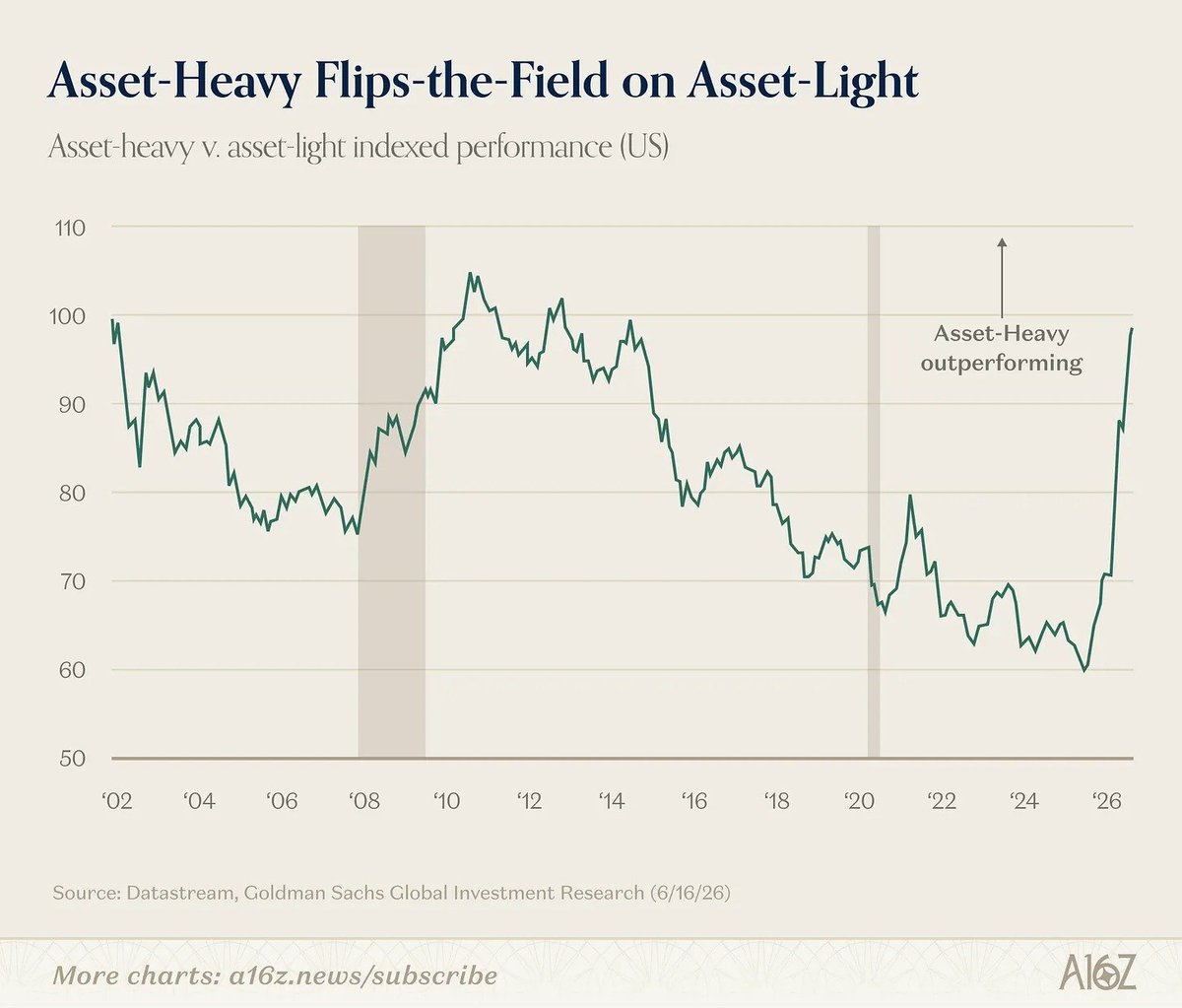
being asset-heavy is really just another way to own your supply. instead of renting the capacity, you put the capital in to own it outright. the asset light advantage is unwinding
Arjun Malhotra tweet media
Arjun Malhotra@BadCapitalVC

for a startup, both demand and supply are hard problems. they're just hard in different ways. demand is rentable. a first-mover can absolutely win on demand if they earn customer love and get people to keep coming back, and building that kind of retention is its own herculean challenge. but the companies that have honestly worked in our portfolio are the ones that solved the supply side first. supply is much slower to build. you spend years on relationships, solidifying ops & infra that can compound. it even needs higher upfront capex but once you own it, no new entrant can rent it out from under you. some examples from our portfolio: > meesho started by aggregating the unbranded sellers and small manufacturers from smaller towns, retained them by dropping seller commissions to zero, and later built its own logistics stack (valmo) so the low-price economics could work at scale. the seller base and the cost structure are the moat, not the ad spend. > solarsquare owns the whole solarr chain: the design, the install, the subsidy paperwork, the financing, and years of after-sales service and performance guarantees. rooftop solar is a trust business, and you only earn that trust by owning the entire process. > orange health runs its own accredited labs and its own trained collection team, which is how it can promise a pickup in 60 mins and reports within a few hours. its customer nps is exceptional for the category, and that only holds because it keeps such tight control over its supply. > lead school gives schools a full integrated system: the curriculum, the content, the teacher training, the assessments. the whole academic delivery is what they own, and that end-to-end control is what makes them so reliable for the schools that adopt them. none of these founders slept on demand, but they knew supply was the part the competitor couldn't easily lift.

English
3
0
14
2.2K
Arjun Malhotra
Arjun Malhotra@BadCapitalVC·
for a startup, both demand and supply are hard problems. they're just hard in different ways. demand is rentable. a first-mover can absolutely win on demand if they earn customer love and get people to keep coming back, and building that kind of retention is its own herculean challenge. but the companies that have honestly worked in our portfolio are the ones that solved the supply side first. supply is much slower to build. you spend years on relationships, solidifying ops & infra that can compound. it even needs higher upfront capex but once you own it, no new entrant can rent it out from under you. some examples from our portfolio: > meesho started by aggregating the unbranded sellers and small manufacturers from smaller towns, retained them by dropping seller commissions to zero, and later built its own logistics stack (valmo) so the low-price economics could work at scale. the seller base and the cost structure are the moat, not the ad spend. > solarsquare owns the whole solarr chain: the design, the install, the subsidy paperwork, the financing, and years of after-sales service and performance guarantees. rooftop solar is a trust business, and you only earn that trust by owning the entire process. > orange health runs its own accredited labs and its own trained collection team, which is how it can promise a pickup in 60 mins and reports within a few hours. its customer nps is exceptional for the category, and that only holds because it keeps such tight control over its supply. > lead school gives schools a full integrated system: the curriculum, the content, the teacher training, the assessments. the whole academic delivery is what they own, and that end-to-end control is what makes them so reliable for the schools that adopt them. none of these founders slept on demand, but they knew supply was the part the competitor couldn't easily lift.
English
4
2
23
4K
Arjun Malhotra
Arjun Malhotra@BadCapitalVC·
Telegram always needed usernames. the whole product is built around broadcast and discovery, ie public channels and groups you can find by a handle. Usernames have to be the default for that to work. Whatsapp started as the opposite by being private and contacts-only. Your phone number was the door and you conciously decided who got it. It's no surprise that this positioning has been slipping away for years. Open the app today and countless brands, businesses and the occasional spammer already reach you with your number in nobody's contact list. So introducing usernames only now is the confirmation that the private chat app you actually controlled is long gone.
English
10
10
142
15.2K