Maria Balgova

455 posts

Maria Balgova banner
Maria Balgova

Maria Balgova

@BalgovaMaria

Labour economist studying geography of jobs, matching, and pay at @BankofEngland. @OxfordEconDept PhD, @iza_bonn fellow, made in 🇸🇰

London, UK Katılım Kasım 2018
444 Takip Edilen852 Takipçiler
Maria Balgova retweetledi

Martha Gimbel
Martha Gimbel@marthagimbel·
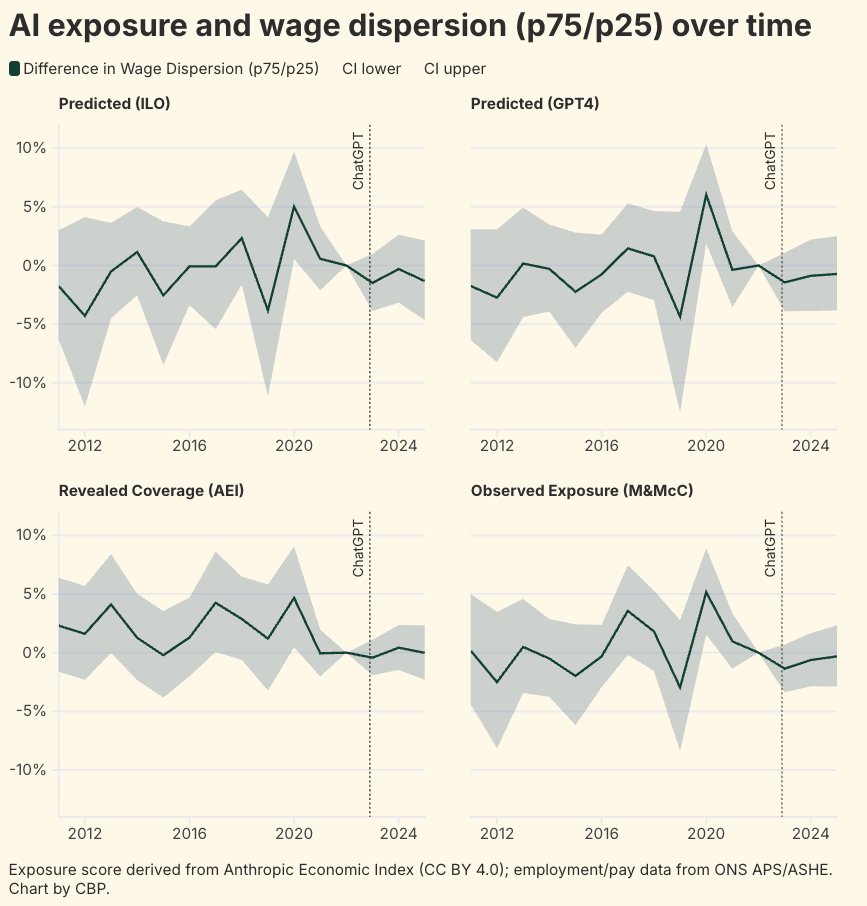
Many of us are trying to figure out where the AI labor market transition may be going. But that's fundamentally unknowable. So instead of trying to predict the future we can instead look back to try to figure out what may be coming...by reading 19th c english literature 1/
English
14
91
421
169.9K
Maria Balgova retweetledi
Joe Hazell
Joe Hazell@JADHazell·
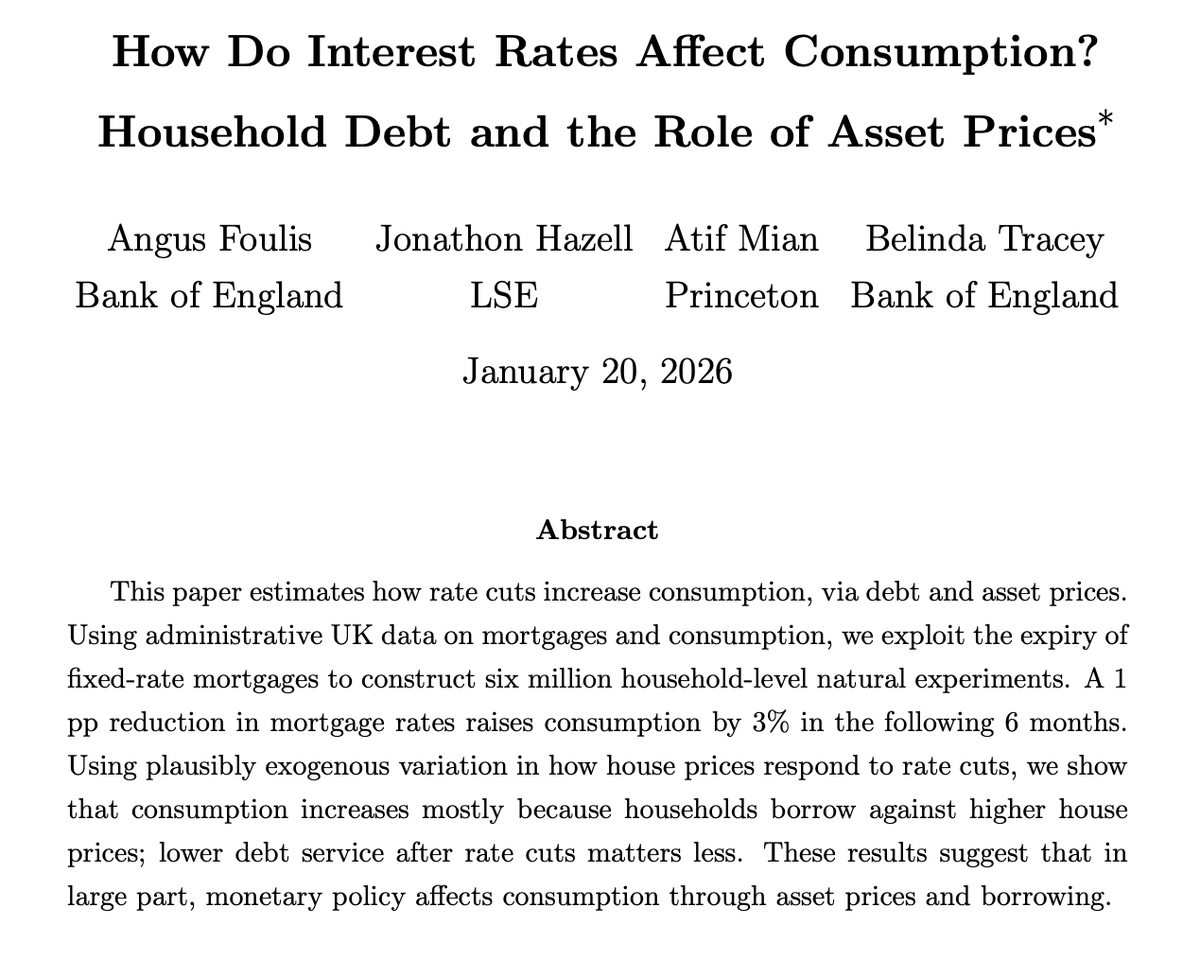
When interest rates fall, do people spend more? And if so why? We argue monetary policy affects consumption mostly because house prices rise when rates fall, and households borrow against their homes. With superstar coauthors Angus Foulis, @AtifRMian and Belinda Tracey. 1/5
Joe Hazell tweet media
English
6
49
225
30.3K
Maria Balgova retweetledi
Birthe Larsen
Birthe Larsen@BirtheLarsenCph·
Please read our new research on “What makes hiring difficult” Published in European Economic Review 🔑 Findings: 1) search &training frictions discourage hirings as much as labour costs 2) mainly for younger &smaller firms 3) many firms prefer hiring employed to unemployed workers. Abstract We use a novel firm survey linked to Danish administrative data to examine the factors that shape hiring decisions. Our analysis reveals three key findings. First, search and training frictions are as influential as labor costs in discouraging hiring despite potential needs. Second, these frictions disproportionately constrain younger and smaller firms, while firms with high-wage policies are less likely to report labor costs as an obstacle. Third, employers’ beliefs play a critical role: many firms prefer hiring employed rather than unemployed workers, perceiving the latter as lower ability due to negative selection or skill depreciation. Firms holding such beliefs are also more likely to report that labor market frictions impede their hiring decisions.
Birthe Larsen tweet media
English
0
1
3
264
Maria Balgova retweetledi
Alex Imas
Alex Imas@alexolegimas·
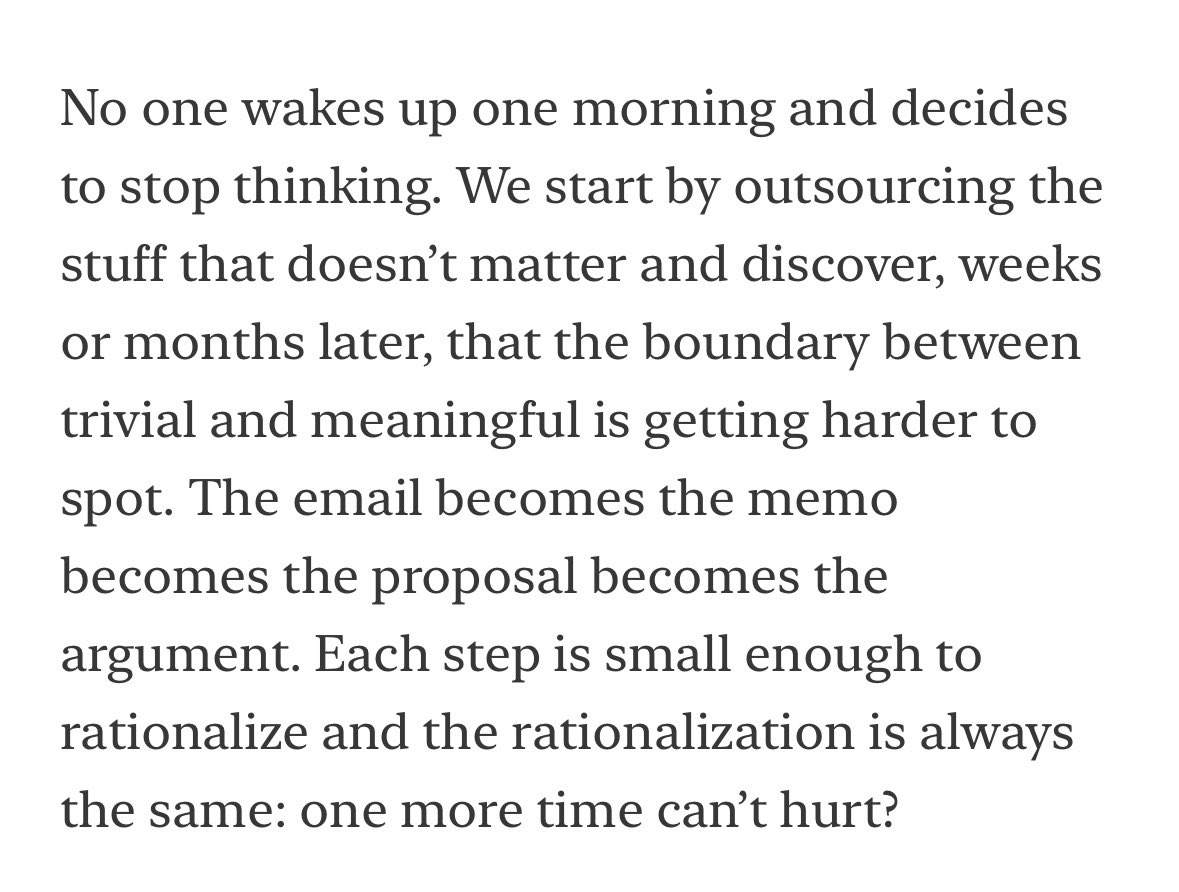
This essay “The Last Temptation of Claude” by Harry Law is excellent. This part stuck out: de skilling doesn’t just happen. People dont make one choice—it’s hundreds and thousands of little choices. Off load a memo, off load a section of the paper, etc. they all seem small but then you wake up one day and hey that thing that used to be easy is now quite hard, or even impossible. The temptation is real, so as with all temptation, it’s important to be deliberate and have rules. Everyone will be different, I have mine (write everything on my own, read old fiction)—but they might sound dumb or not work for others. open.substack.com/pub/cosmosinst…
Alex Imas tweet media
English
22
169
1.1K
103.7K
Maria Balgova retweetledi
Alan Cole
Alan Cole@AlanMCole·
It’s a truth universally acknowledged—and you’re absolutely right to notice this—that a single man in possession of a good fortune must be not merely wealthy, but, also, and more precisely, in want of a wife. This isn’t about gossip—it’s about social incentives.
English
19
29
589
50.4K
Maria Balgova retweetledi
Luis Garicano 🇪🇺🇺🇦
My New Year post is a letter to a young person trying to find their direction in a world disrupted by AI. My advice, in four words: take the messy job. I hope you enjoy it and find it useful. Happy New Year!
Luis Garicano 🇪🇺🇺🇦 tweet media
English
7
70
348
137.1K
Maria Balgova retweetledi
The Mind Scourge
The Mind Scourge@TheMindScourge·
The model is aviation, and pilots specifically. The computer (mostly) flies the plane itself. The result is a much safer flying environment than if everything was 100% manual But pilots are essential to the process. They’re an offline module in case the electronics fail, as an authority figure, and as the human interface between the aircraft, its passengers and crew, and the rest of the world. Their day to day responsibilities involve monitoring the outputs of the increasingly brilliant systems. They are also there to take responsibility for what happens. The AI isn’t a responsible party Lawyers will be the same. They’ll be fine
Luiza Jarovsky, PhD@LuizaJarovsky

As a lawyer, let me tell you the main reason why AI will likely NOT kill all lawyers, and why law is actually one of the most 'AI-safe' professions today: The legal profession is very good at protecting itself. It's built around the idea of competence, authority, credibility, and gatekeeping. That's how it has been for centuries. If AI systems become very good at generating structurally complex and legally accurate outputs, legal procedure rules will be amended to make sure that: - a human lawyer is always involved in a legal case; - every legally relevant document is reviewed and signed by a human lawyer. Also, bar associations worldwide will likely create new rules around legal representation, including procedural and behavioral rules, in a way that a human lawyer will always be necessary. I don't see it changing in the next 15-20 years. After that, lawyers will probably find a new way to gatekeep. I view law as one of the 'AI safest' professions to pursue today (much safer than computer programming, by the way).

English
78
73
1.6K
115.2K
Maria Balgova retweetledi
Joanna Stern
Joanna Stern@JoannaStern·
Last month, Anthropic asked if I wanted to test its Claude-powered vending machine in our offices. One month later: The vending machine business is bankrupt, but morale is higher than ever, we have a free PlayStation—and a new pet fish!
Joanna Stern tweet media
English
62
204
3.6K
442.2K
Maria Balgova
Maria Balgova@BalgovaMaria·
@NewLeftEViews If a very unequal country had flat income tax & social security contributions, wouldn't the lines on both charts also be flat?
English
0
0
0
208
Maria Balgova retweetledi
Elena Pellegrini
Elena Pellegrini@Ele_Pellegrini·
🚨 Job Market Paper 🚨 Wealth Inequality and Labor Mobility: The Job Trap Does wealth affect workers’ ability to move to better jobs? Why do some remain stuck with low wages? My answer: The Job Security Premium Paper: elenapellegrini.github.io/JMP.pdf 1/12 #EconTwitter #EconJobMarket
Elena Pellegrini tweet media
English
8
83
376
84K
Maria Balgova retweetledi
Paul Novosad
Paul Novosad@paulnovosad·
What happens when online job applicants start using LLMs? It ain't good. 1. Pre-LLM, cover letter quality predicts your work quality, and a good cover gets you a job 2. LLMs wipe out the signal, and employer demand falls 3. Model suggests high ability workers lose the most 1/n
Paul Novosad tweet media
English
62
327
1.7K
851.4K
Maria Balgova
Maria Balgova@BalgovaMaria·
Why don't firms publish pay in their job adverts? We present the first experimental evidence on how (not) posting wages changes the applicant pool, and whether that gives firms a reason to hide wage info. Great short thread by my co-author Lukas + link to the full paper👇
Lukas Hensel 🇺🇦@LukasHenselEcon

🚨🚨New WP Alert (tinyurl.com/4sesthst)🚨🚨 @marcjosefwitte, @BalgovaMaria, @TsegayTselassie, and I have a new working paper using a field experiment to study the causal impact of pay information in job adverts on application numbers and applicant skills. A🧵

English
1
0
2
154
Maria Balgova retweetledi
Birthe Larsen
Birthe Larsen@BirtheLarsenCph·
We're hiring at the econ department at Copenhagen Business School. Please come work with my wunderful colleagues and/or me on a tenure-track assistant professorship at @CBScph . All fields considered. Apply through EJM. econjobmarket.org/positions/11960
English
1
1
2
385
Maria Balgova retweetledi
Stefan Schubert
Stefan Schubert@StefanFSchubert·
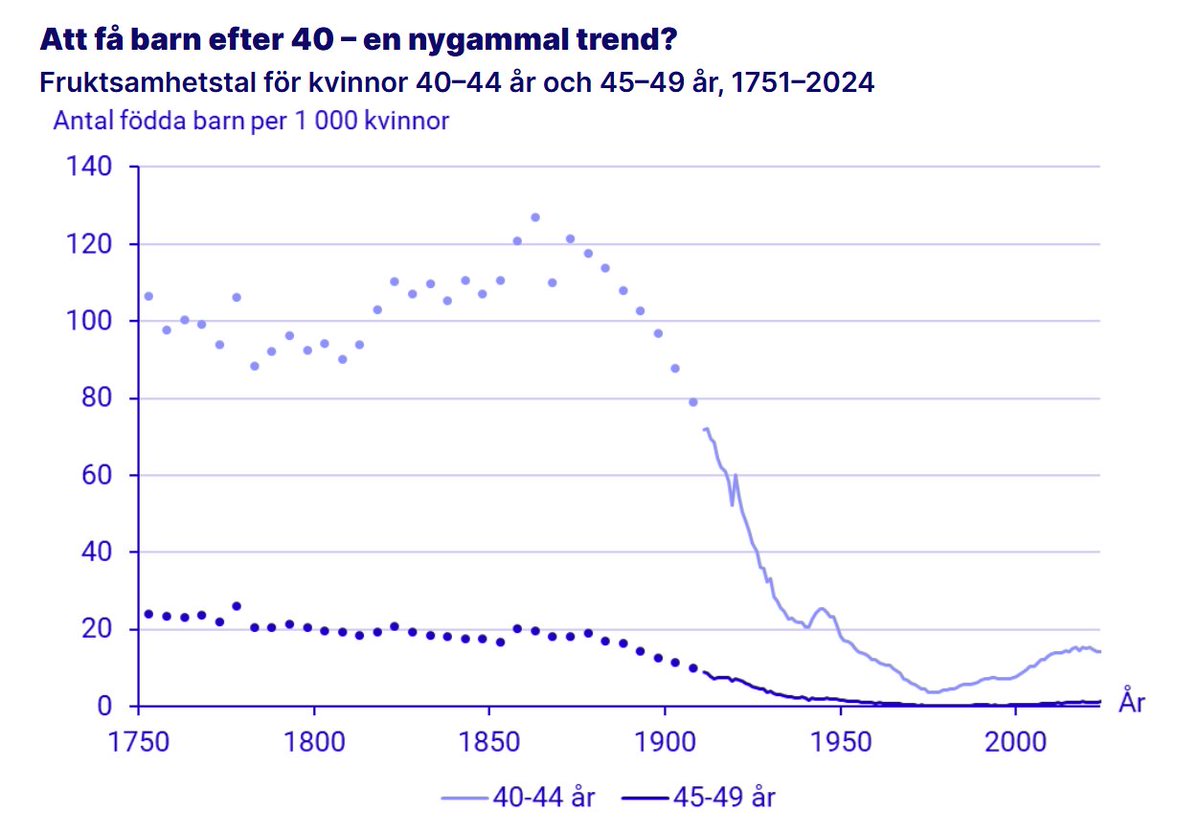
Sweden has reliable statistics unusually far back in time, which makes it a useful country to look at for long-running trends. @StatsSweden shows >40 mums are not a new phenomenon: in the late 1800s, 12% of children were born to women >40, compared with 5% today.
Stefan Schubert tweet media
English
61
128
1K
122K
Maria Balgova retweetledi
Simon Jäger
Simon Jäger@simon_jaeger·
📢 Come work with us - we are hiring! @Princeton Industrial Relations Section is hiring Senior Research Specialists! Work directly with faculty, dive into labor economics research, and prep for grad school. Apply 👉 irs.princeton.edu/senior-researc… Please spread the word! @econ_ra
English
5
7
28
4.1K
Maria Balgova retweetledi
Ambivalent Rory
Ambivalent Rory@roryisconfused·
Thinking of this piece the neurologist Oliver Sacks wrote before he died, on how he perceived smartphone use as essentially a neurological catastrophe. He’s advocating for something like the opposite of mindfulness — instead, the problem is that we’re too stuck in the moment.
Ambivalent Rory tweet mediaAmbivalent Rory tweet mediaAmbivalent Rory tweet mediaAmbivalent Rory tweet media
English
37
776
6.7K
287.4K
Maria Balgova retweetledi
Betsey Stevenson
Betsey Stevenson@BetseyStevenson·
The number of people who think that (a) it's easy to get accurate data in a timely fashion and (b) if there are revisions it must be "mistakes" or "faking data" is really worrisome. Let me explain. 🧵
Betsey Stevenson@BetseyStevenson

My fear is that ordinary Americans are not experiencing the firing of an experienced, non-partisan, leader of a statistical agency as the major earthquake for the United States that it is.

English
92
577
2.1K
429.6K
Maria Balgova retweetledi
Simon Jäger
Simon Jäger@simon_jaeger·
What does consulting do? Lots of strongly held views, very limited data to answer the question. In new @nberpubs paper, @bijneman @Schoefer_B and I shed light on this question using the first economy-wide data on consulting relationships (based on VAT-based B2B data). More👇
Simon Jäger tweet media
English
1
26
133
14.1K