Coldgaze 🦇🔊

825 posts

Coldgaze 🦇🔊 banner
Coldgaze 🦇🔊

Coldgaze 🦇🔊

@Banath4

“A good traveler has no fixed plans, and is not intent on arriving.” Lao Tzu

Indochina Katılım Ağustos 2013
477 Takip Edilen98 Takipçiler
Sabitlenmiş Tweet
Coldgaze 🦇🔊
Coldgaze 🦇🔊@Banath4·
@sassal0x The wives of three crypto devs are discussing their sex lives. The first one says: "My husband is a Bitcoin developer, sex is good but the problem is he knows only one pose and never changes. 1/3
English
9
65
313
0
🥬
🥬@lettuceisms·
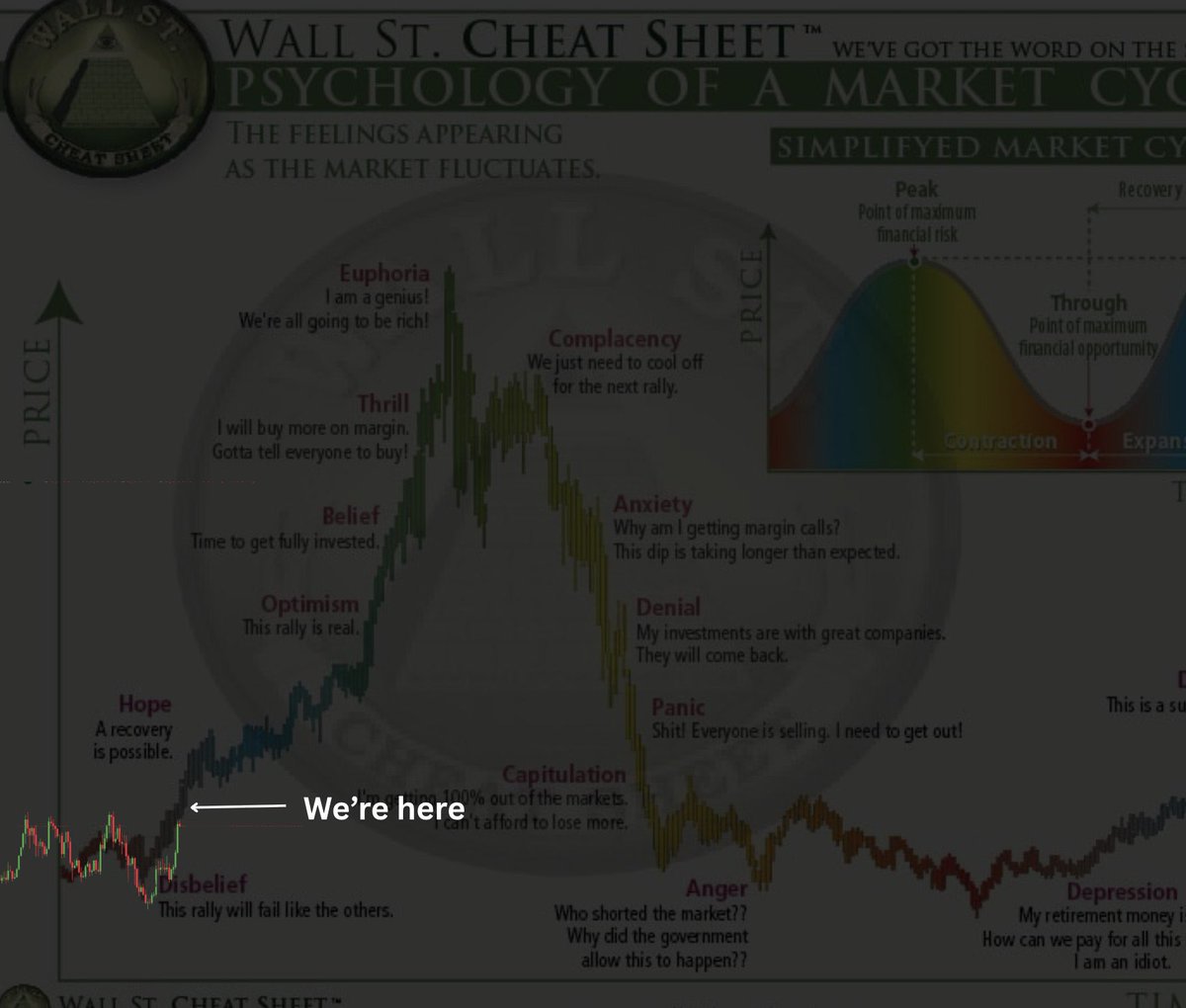
I think $ETH / $BTC is preparing for a major breakout. It's at the same levels as the 2021 breakout and looking to return to past dominance. WLFi (A Trump company) is trading their $BTC for $ETH as we speak. CZ purposely bottlenecked ETH to acquire more ahead of this flip.
🥬 tweet media🥬 tweet media
English
7
6
118
5.7K
Coldgaze 🦇🔊
Coldgaze 🦇🔊@Banath4·
$ETHBTC weekly volatility is compressed to levels not seen since October 2023, the tightest squeeze in over two years. Dead quiet before the storm, $ETH is about to wake up.
Coldgaze 🦇🔊 tweet media
English
0
0
1
151
Coldgaze 🦇🔊 retweetledi
SamAlτcoin.eth 🌞
SamAlτcoin.eth 🌞@SAMALTCOIN_ETH·
$ETH will be measured in trillions. Corpo chains like Solana or Tempo can be valued on revenue like SaaS businesses, Bitcoin can be valued like digital gold, but Ethereum is trustware and should be valued like the next internet. William Mougayar is one of Ethereum’s earliest thinkers and advisors, who worked closely with Vitalik Buterin at Ethereum’s inception. $BTC $ETH $SOL
English
33
49
354
18.1K
Coldgaze 🦇🔊 retweetledi
SamAlτcoin.eth 🌞
SamAlτcoin.eth 🌞@SAMALTCOIN_ETH·
One $ETH user = $313,000 Raoul Pal says valuing Ethereum on cash flows misses the point. It’s a network that compounds users, and Metcalfe’s Law makes that growth exponential.
English
38
65
555
58.9K
Coldgaze 🦇🔊 retweetledi
Joseph Young
Joseph Young@iamjosephyoung·
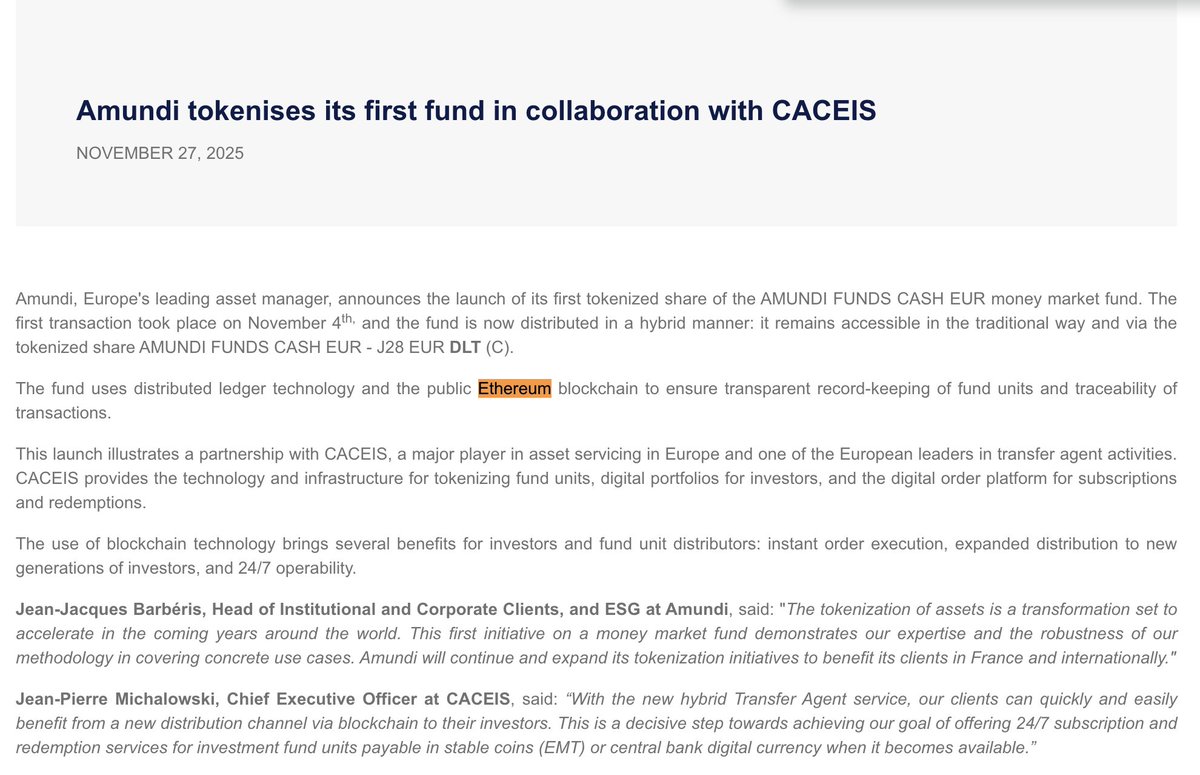
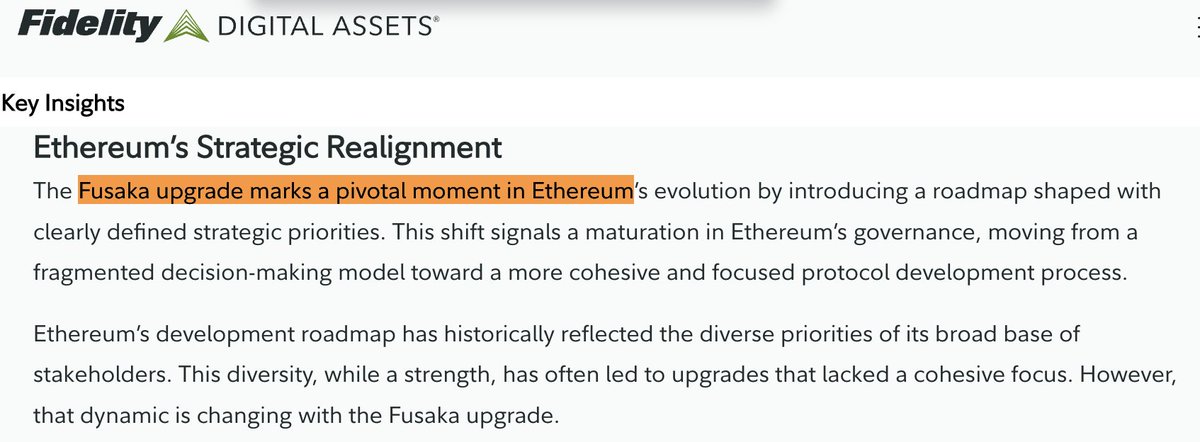
gm ☕️ JUST IN: $2.75 TRILLION asset manager amundi launched a tokenized money-market fund on ethereum. last week, $6 TRILLION asset manager fidelity said fusaka is pivotal for ethereum. wall street and tradfi aren’t passive anymore. they’re building on ethereum. ETH.
Joseph Young tweet mediaJoseph Young tweet media
English
30
79
290
36.4K
Coldgaze 🦇🔊 retweetledi
Rick Barber
Rick Barber@Rick_Barber_·
We are watching one of the strangest moments in crypto history. Bitcoin has gone through a major downturn. Altcoins have been falling for years. And sentiment is sitting in the basement. Yet every headline on the news looks like something that should be sending the entire market straight into orbit. We are finally seeing the things we wished for in early 2021. Clearer regulation. Real adoption. Enterprise usage. Massive players planting their flags. Everything that once would have ignited a runaway bull market is happening right now. And instead of lifting the market, it has left a lot of people with a sour taste and a sinking portfolio. Many bought in anticipation that all of this progress would show up in price. When it did not, they chalked it up to failure. But that reaction misses the deeper truth. Most people still make moves based on emotion. They blame the market. They blame projects. They blame timing. In doing so, they miss what I believe is a once in a lifetime moment, because the evolution of global finance is happening right in front of us. It is easy to be discouraged when the retail stock market is on fire and pushing to new all time highs while the crypto projects you believe are foundational continue to bleed. It creates a sense that something is wrong or broken. But there is a reason for the disconnect. There is always psychology behind moments like this, and that psychology is used aggressively by the biggest players who shape sentiment, who shape liquidity, and who shape price. You can get frustrated about that. Or you can recognize it as part of the game. Once you accept the reality that the market is controlled by those who understand it at the deepest level, it becomes a strategic advantage. Once you accept the importance of preservation of capital, you unlock the only thing that matters. Positioning yourself for the moments when the major shifts finally arrive. Most of us did not grow up with strong financial education. Public schools never taught how money actually works. They did not teach what the dollar is built on, or what traditional finance really looks like behind the curtain. These were lessons reserved for the wealthy, passed down through families that already had access, leaving everyone else to figure it out on their own. The first step is realizing that this information gap exists. The next step is developing the discipline to benefit from moments like the one we are in right now. Here is the truth. The world is moving to tokenization and blockchain whether people are ready or not. Anyone who cannot see this is either not paying attention or refuses to believe what is right in front of them. If all they care about is what the chart is doing this week, they will never see the larger transition taking place. Traditional finance and the institutions that run it want to own the digital world that is coming. And the only way to do that is to enter as early and as aggressively as possible. They can only accumulate at scale by shaking people out. By painting the entire space as unsafe, uncertain, or doomed. By flooding the news with mixed signals. By letting volatility do the heavy lifting as retail gets chopped to pieces entering at the wrong times and exiting at the worst times. This is not an accident. It is not incompetence. It is strategy. And while all of that is happening, the global market is forming right behind the scenes. We are no longer dealing with a United States market or a European market. We are entering a true global financial system built on open networks. The size of the crypto and blockchain sector compared to the traditional financial system is so small that the phrase “you are still early” actually carries meaning. It took the entire life of #Bitcoin to reach this transition point. It will take the next several years to complete it. And that final stretch will be filled with volatility, doubt, and confusion, because this is the part of the transition where everything is at stake. And when it comes to altcoins, which are the infrastructure that brings real utility and real financial systems to life, their importance has never been greater. Even a further drop of twenty or thirty or fifty percent does nothing to change the direction of the entire financial world. That is the irony. The worse the charts look for some of these projects, the stronger their fundamental position becomes. @chainlink and @CurveFinance , for example, continue to see some of the worst price action in the entire market. Yet their foundational importance to decentralized finance and global settlement grows every single month. Stablecoin infrastructure. Oracle networks. Liquidity routing. Institutional settlement. These are not narratives. These are the backbone of the next financial era. And when the event horizon finally arrives, these are the projects that will move in ways few people are ready for. So I watch the charts. I protect capital. I look for the moments where the next move becomes clear. But I do so with optimism, because I can see how the pieces are coming together. Regulation. Adoption. Enterprise usage. Global settlement. Stablecoin rails. Tokenized markets. The Clarity Act and similar frameworks closing in. The ability for blockchain to offer a real transition away from fiat based systems. All of it is lining up. Wealth is never destroyed. It is transferred. And if there was ever a tool capable of shifting that wealth from one system to another, it is blockchain. Anyone who has studied monetary history knows that this moment has been building for decades. So stay optimistic. Be cautious. Respect risk. Take profit when it makes sense. Do not cling to any one project. And do not be afraid to step out of the market for a time if the chart demands it. A missed opportunity is always better than a destroyed account. Honestly, I have probably lost more than I have made in this space so far (when counting unrealized gains). That has not changed my belief in the future. It has only sharpened my discipline and my conviction. Bitcoin is trading near $91K as I write this. It fell from one $126K, bounced from $80K, and it will set new all time highs again. I do not know when. But I do know that $BTC will not be the only story anymore. The era of utility is here IMO. The era of real adoption is here. The era of the global financial transition is at the door. And when it fully opens, the entire space will move in a way that most people are simply not prepared for. This space is not dying. It is preparing. I am staying ready and I encourage you to do the same. $Link $CRV
Rick Barber tweet media
English
6
12
69
5.2K
Coldgaze 🦇🔊 retweetledi
⟠
@ryanberckmans·
Stripe's fading of how crypto actually works Patrick's essay below suggests that he may be missing the bigger picture of exactly how and why crypto is useful. When you miss the big picture, you can over-index on the small picture, and that can cause you to make strategic mistakes, like launching an L1. The benefits of onchain can be partitioned into three categories (1) technology (2) scale (3) decentralization These three categories are fully independent from each other (orthogonal). Each must be looked at and solved for on its own. Like many trad tech leaders in 2025, Patrick has an excellent understanding of the *tech* benefits of crypto. EVM, ERCs, widespread adoption of public/private keypairs, the adversarial computing environment with public consensus, permissionless composability, and the transactional model, etc., are all major tech level-ups compared to tradfi's use of e.g. private SQL databases and REST APIs. However, the above are just the tech benefits. Most trad leaders don't think past this. Notice how former Libra leaders' recent writings show that they know better than to focus exclusively on tech benefits, because they've been through the meat grinder over the years, like our community. The other two other categories of crypto benefits are Scale benefits (as in "economies of scale" and not "TPS") relate to density of network effect accumulation. There're certain key things you can only do on the L1, such as borrow $1B in 10 minutes (collateralized) or have access to an incredibly rich best-in-industry tapestry of interwoven protocols and assets. By opting out of L1 settlement, you increase the friction and risk for the L1's assets and protocols to participate in your alt L1's economy. Crucially, you also increase the friction and risk for every other L2's assets and protocols to participate in your alt L1's economy. Congrats, you settled on a distant tiny volcanic island surrounded by dangerous seas. But isn't Tempo just about payments and flows? Why would they need to care about all this other onchain stuff? Time and time again, history shows that emergent behavior of networks is surprising and produces *way better* UX and solutions in a dense competitive market. That's why any random cheap restaurant in NYC is on average better food than expensive restaurants in many suburbs-- due to local network effect density. In Tempo's case, we might imagine that payments could soon benefit from highly liquid lending markets to maximize yield of payment instruments at rest. But Tempo's access to the deepest lending markets in the world is high-friction and high-risk. And added friction/risk for what? A view of more TPS? Ok-- we now have fractal validium L2 scaling maturing rapidly for ~infinite (fragmented) TPS which is great for payments; or you could fork Mega or Rise and/or just use both of them in an interchain L2 system. Hell, use all the L2s. That's how I designed 3cities payments, it's on all L2s simultaneously all the time. So what are you even talking about with this TPS nonsense? Lending is but a simple example. Actual reality is super complex and will inevitably surprise in the years to come. By being an L1, Tempo fades the lessons of history's great network economies, including globalization and the internet. The third category of crypto benefit is decentralization. The value of decentralization is risk minimization. And the value of risk minimization is that the tech/scale benefits of crypto can't be applied to the entire global economy unless it's sufficiently non-risky to bring it all onchain-- and all on the same unified network (i.e. on eth) because of the scale benefits. That's why Lubin is now calling eth "trustware". It's important to understand that decentralization is "merely" a force multiplier on other benefits, and not a benefit in and of itself. Look at Bitcoin's decentralization. Most market actors believe that Bitcoin is highly decentralized and credibly neutral. But what does that actually deliver? It gives the world low risk BTC transfers at small scale, and low risk BTC custody at medium scale, and nothing else. Low value app layer = low value decentralization. When it comes to Tempo, Patrick and Matt seem to have argued that they'll take a big bite out of global payments long before their lack of decentralization becomes a meaningful drag coefficient. And by then, as they tell it, they'll be able to just "decentralize", right? Wrong. Very wrong. Look at eth's social layer depth and diversity, ETH holder diversity, large research community whose effectiveness is mechanized by the supremacy of the L1 PDF protocol spec, our hard fork culture, core dev dispersion, high-scale app layer that drives increased eyeballs on protocol changes (one is willing and able to investigate what's shifting under the feet of one's tens of billions of dollars), etc., and recognize that these items are all upstream of the industry tending to focus the decentralization conversation purely on the technical realities of e.g. client diversity, validator count, and economic security. Decentralization is *extremely* hard. Nobody nails this like Ethereum. Given the incentives involved to (i) Just use Ethereum or (ii) centralize (and maybe pretend you're not centralized, a perishable strategy that's rapidly dying), it's possible that never again will anyone nail it like Eth. Maybe not for decades/centuries. Saying you'll "decentralize later" means you either don't understand the full scope of what this entails, or you do understand and know you'll fail but are satisfied to let the (immature, rapidly-being-educated) market think that you'll probably succeed. So which is it? In sum, by launching an L1, Patrick and Matt are fading the extremely high value of L2s' access to the Ethereum L1's benefits of scale and decentralization. Specifically, they are mistaken about - The immediate value of eth's decentralization to turbocharge immediate Tempo growth, despite even Stripe's star power and massive BD efforts surely underway beneath the surface. - The value of immediately colocating payments with many other kinds of at-scale economy activity, such as lending. - The impossibility of "decentralizing later". Just use Ethereum. You'll find the water is warm and that in time, your own results will surprise to the upside.
Patrick Collison@patrickc

Someone on HN (which is often quite crypto-skeptical) asked why exactly businesses are finding crypto and stablecoins useful. It's a very reasonable question. My response:

English
66
45
465
55.5K
Coldgaze 🦇🔊 retweetledi
Omid Malekan
Omid Malekan@malekanoms·
With all due respect to Matt, the notion that Tempo will in any way be neutral is a fantasy. First, the very fact the he is billed as the "project lead" while sitting on the board of Stripe, a corporation who is clearly central to this effort, and being a GP at a VC firm that will likely be heavily invested in it, is a problem. That screams "not neutral." (counterintuitively, the better Matt is at being project lead, the less neutral the chain will be). Second, he is conflating the chain being permissionless with it being public. Public means "anyone can transact or issue on it" and permissionless means anyone can be a validator. As stated by Matt, Tempo will start as a permissioned chain. A permissioned chain will never be public. To wit: will North Korea be able to freely issue tokens on Tempo? What if Do Kwon decides to launch an algorithmic stablecoin on there from jail? And then Putin says "we will route payments for our sanctioned oil being sold on the black market via stablecoins on Tempo"? Will the permissioned, known, and regulated corporations who run the validators be OK with all of this? Will the general council of Visa declare "Yes: we are clearly violating many US Federal laws and risk losing or licenses and possibly going to jail, but the docs said Tempo is a public blockchain, so we will process all of these transactions?" I don't think so. As I argued yesterday, permissioned networks do not provide validators the plausible deniability required for a chain to be neutral: x.com/malekanoms/sta… Third, no permissioned network has ever successfully transitioned to being permissionless. Hyperliquid is trying, but they have a long way to go, and are a special use case because it's mostly an app-chain, one whose primary margin asset still remains "elsewhere", something that might be OK for perps but not for payments. Tempo will have an even harder time transitioning, because per the announcement, there is heavy involvement from various payments incumbents, most of all Stripe. To believe that the network can transition to permissionless is to believe that corporations that accrued hundreds of billions of dollars in value over recent decades by owning a network will now launch a new network that they own (cause it's permissioned) but then magically decide to give all the power and profits that come with it away, quite possibly to competitors that will try to destroy their incumbent businesses. That is highly unlikely. As @ccatalini pointed out yesterday, even Libra's original plans to someday decentralize nwere pushed to the back burner rather quickly. And Facebook did not have an incumbent payment business to protect. Stripe, Visa, Nubank, etc etc all do. Y'all really think they'll give it away? This has never happened before in the history of shared corporate infrastructure - which is what Tempo will be on day one. Every other shared corporate infra (Visa, Mastercard, CME, NASDAQ, SWIFT, The Clearing House, etc etc) has gone in the opposite direction - it has centralized power and become more permissioned and censorable over time. This is literally why Satoshi invented Bitcoin. And I say this not as an ideological opposition to Tempo, but as an observation of what will be debated in the conference rooms of every potential issuer, user, etc etc. Y'all really think Mastercard will jump all over a permissioned network controlled by Stripe and Visa? Or Amazon or Walmart - fresh off their endless lawsuits against Visa and Mastercard for being oligopolies? Lastly, It's hard enough to bootstrap a PoS chain from scratch because of the "rich get richer" problem of staking. Ethereum is still the only PoS chain that's achieved a diverse token-holder set that can deem it "a neutral L1." It got there by : a)having a tiny premine by modern standards and b)being PoW for years. Tempo will start with a massively concentrated token holder set and permissioned validator set. To argue it'll easily become neutral is to make a whole bunch of assumptions that are contrary to the ideals and lived experience of this industry.
Matt Huang@matthuang

On Tempo, permissionlessness, L1 vs L2 Tempo will be a permissionless chain. On day 1, anyone will be able to deploy a token, and anyone will be able to transact on the chain. Some projects think that attracting real-world usage and serious institutions requires giving up on base layer neutrality. We do not think that, and that's not how we're building Tempo. The plan for Tempo is to have permissionless validation and permissionless smart contract deployment as well as permissionless usage: just like Bitcoin, Ethereum, Solana, etc. We’ll start with a permissioned validator set to get going and decentralize further from there. We’re building in features to make it easy for entities interacting with the blockchain (like asset issuers, money transmitters, etc.) to comply with their relevant obligations, but the base layer will remain neutral. This is a principle we feel incredibly strongly about (see: paradigm.xyz/2022/09/base-l…). As many parts of the mainstream world look to adopt crypto, we think there is a risk that they adopt permissioned systems. Our goal with Tempo is to help onboard them onto crypto rails that solve specific payments needs while still being truly permissionless. — Why L1 rather than an Ethereum L2? At Paradigm, we are heavily invested, both intellectually and literally, in the Ethereum ecosystem. We will continue to help it scale, and invest in and support companies building on Ethereum. We are also extremely excited about single-sequencer L2s for many use cases, including trading. But building a network for global payments will require bringing together thousands of partners that may not trust us, or Stripe, or anyone as a platform. We think a decentralized validator set—for the chain itself—is a necessary requirement for those partners, and to ensure that the chain is unquestionably neutral in the long run. From an operational perspective, we feel urgency to build for the demand that’s coming and want fewer dependencies, including on the rate of Ethereum L1 progress. With Tempo, we tried to remove all crypto tribalism and alignment games from our thinking and just focus on building the right product for crypto payments. At a technical level, we are prioritizing attributes like fast finality (L2s are generally only as final as the underlying L1), multiple validators (vs. single sequencer), and custom transaction lanes and gas pricing. Some of these are technically possible for an L2, but could be complex, slow to implement, and/or introduce many external dependencies. Tempo is stablecoin-focused, so interoperability through native issuance is more relevant to us than the native bridge to Ethereum that L2s have. We aren’t Bitcoin, Ethereum, or Tempo maximalists. We’re maximalists for permissionless crypto. We want Ethereum L1 to scale, and we want L2s to thrive. We love Bitcoin as a monetary asset. We find substance in Solana, Hyperliquid, and many other ecosystems. We want to ensure real-world payment flows happen on crypto rails, and that’s why we’re building Tempo.

English
93
182
1.4K
182.7K
IT Tech
IT Tech@IT_Tech_PL·
Il Capo of Crypto is back with the ultra bearish charts again. Whenever he calls for a crash… history shows it’s often the opposite. One of the best inverse indicators in the market. Bear call = bullish fuel. 🐻➡️🐂 👉 Do you fade or follow this signal?
IT Tech tweet media
English
31
9
120
15K
Coldgaze 🦇🔊 retweetledi
DEGEN NEWS
DEGEN NEWS@DegenerateNews·
NEW: @zachxbt SAYS “RIPPLE HOLDERS PROVIDE NOTHING OF VALUE TO THE INDUSTRY EXCEPT EXIT LIQUIDITY FOR INSIDERS THUS ARE NOT WORTH SUPPORTING (LIKEWISE WITH CARDANO, PULSECHAIN, HEDERA, ETC)”
DEGEN NEWS tweet media
English
406
393
4.3K
383.3K
Coldgaze 🦇🔊
Coldgaze 🦇🔊@Banath4·
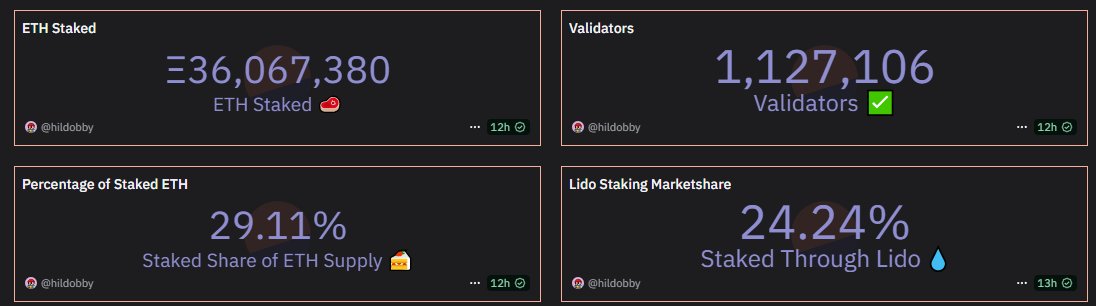
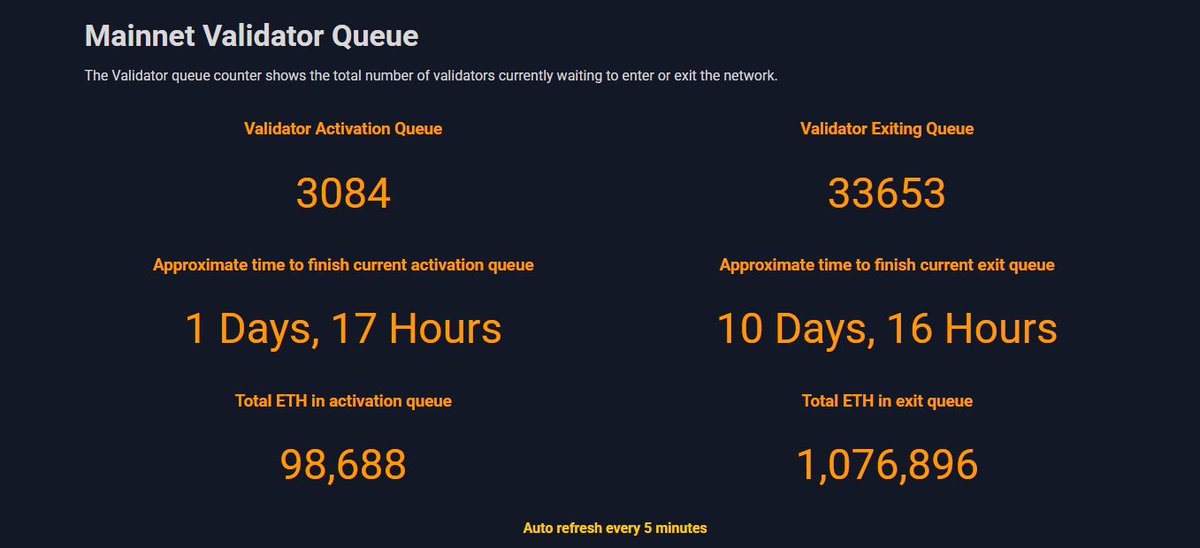
@Wenmerge2022 This has been going on for awhile now and the amount of staked ETH is still over 36 million, only Lido dominance is decreasing, which tells me this is just ETH being restaked.
Coldgaze 🦇🔊 tweet media
English
1
0
0
67
Wenmerge🦇🔊
Wenmerge🦇🔊@Wenmerge2022·
WOW approaching 1% of supply churning in the validator queue with a 10 day exit (earning nothing) - shits about to get serious. 👀
Wenmerge🦇🔊 tweet media
English
1
0
0
404
Coldgaze 🦇🔊 retweetledi
Brian Armstrong
Brian Armstrong@brian_armstrong·
Happy ETH all time high to all those that celebrate!
English
577
881
9.4K
416.4K
Coldgaze 🦇🔊 retweetledi
sassal.eth/acc 🦇🔊
sassal.eth/acc 🦇🔊@sassal0x·
- No client diversity so Bitcoin Core is effectively the protocol spec - 2 KYC'd mining pools in the U.S are the biggest pools - PoW inherently centralizes over time due to economies of scale - Impossible to mine at home profitably (has been for long time) - No long-term security budget once mining rewards become too low in 2-3 more halvings (will lead to even more mining centralization and eventually spawn camp attacks) - Very few active core developers left (less than 5?) - Social layer is more "unified" in a single message (digital gold) so diversity of thought is limited
English
5
6
138
4.1K
DCinvestor
DCinvestor@DCinvestor·
probably something
DCinvestor tweet media
English
88
29
521
37.4K
Coldgaze 🦇🔊
Coldgaze 🦇🔊@Banath4·
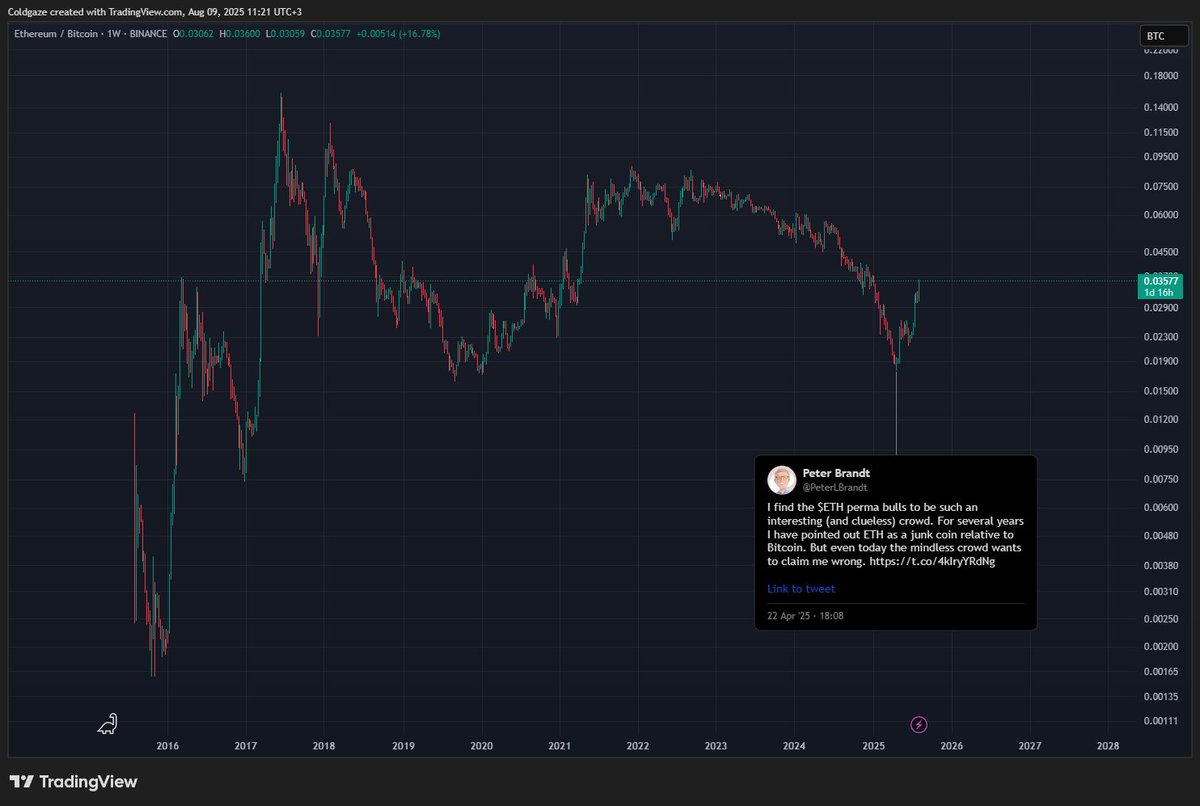
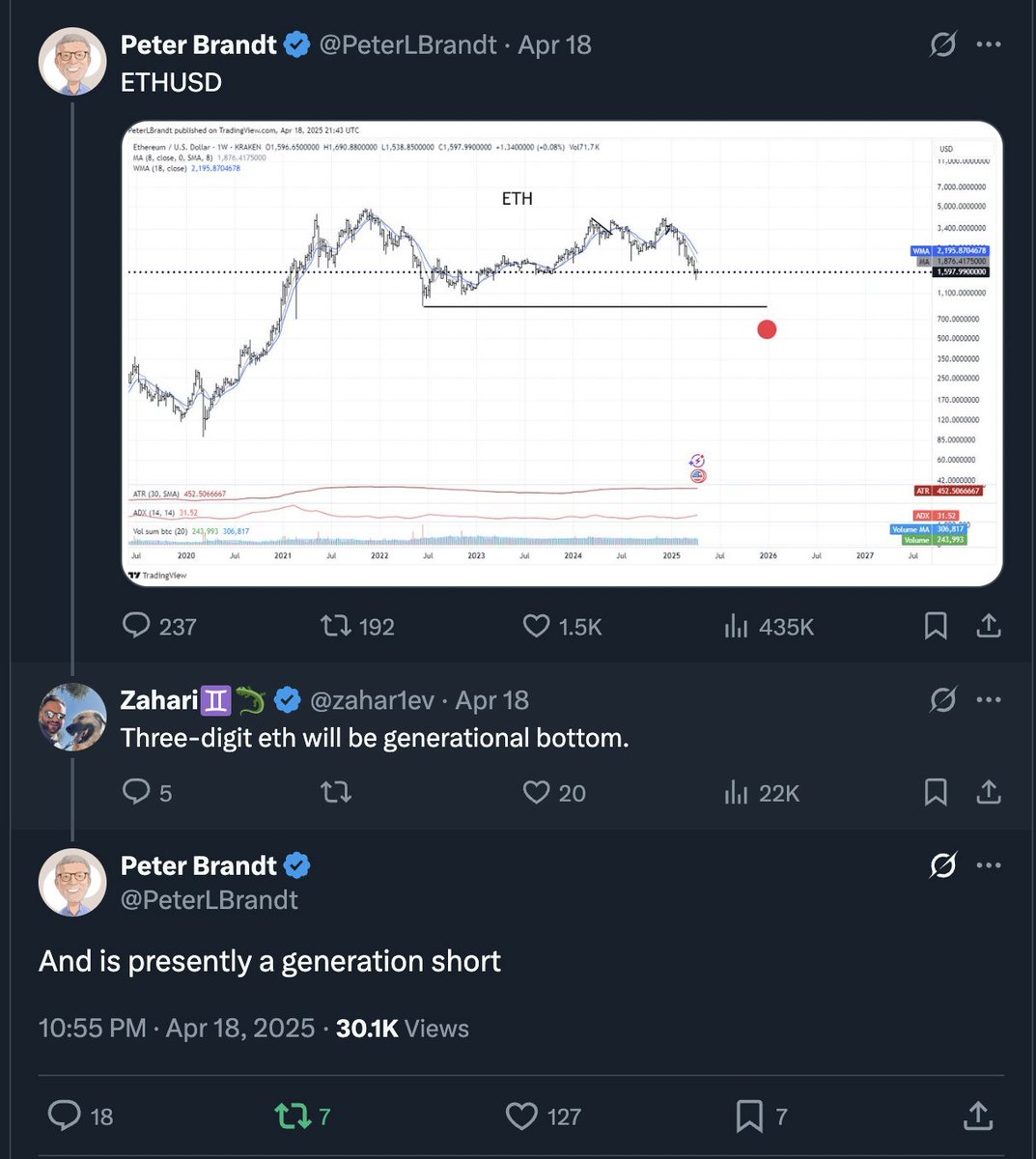
@MacroCRG Dude is a complete clown, marked the top of SOLETH and the bottom of ETHBTC.
Coldgaze 🦇🔊 tweet mediaColdgaze 🦇🔊 tweet media
English
1
0
3
141
CRG
CRG@MacroCRG·
ETH is +155% since Peter Brandt called it a generational short The best to ever do it
CRG tweet media
English
147
96
1.9K
125.9K
Curiosity
Curiosity@CuriosityonX·
How old will you be when Halley's Comet returns in 2061?
Curiosity tweet media
English
551
233
2.2K
184K
Ash Crypto
Ash Crypto@AshCrypto·
ETH pumped from $2500 to $3860 in 2 weeks so expect some correction and stop acting like a little bitch on every little dump. Nothing goes up in straight line. Bitcoin had multiple pumps and corrections before hitting $123,000. ETH bull cycle is just getting started
Ash Crypto tweet media
English
437
301
2.7K
152.1K