Barry O'Reilly

19.8K posts

Barry O'Reilly banner
Barry O'Reilly

Barry O'Reilly

@barryoreilly

Entrepreneur | Advisor | Author #ArtificialOrganizations #Unlearn #LeanEnterprise | Cofounder AI Venture Studio @NobodyCrowd | Faculty @singularityu

Singapore Katılım Haziran 2010
997 Takip Edilen7.2K Takipçiler
Sabitlenmiş Tweet
Barry O'Reilly
Barry O'Reilly@barryoreilly·
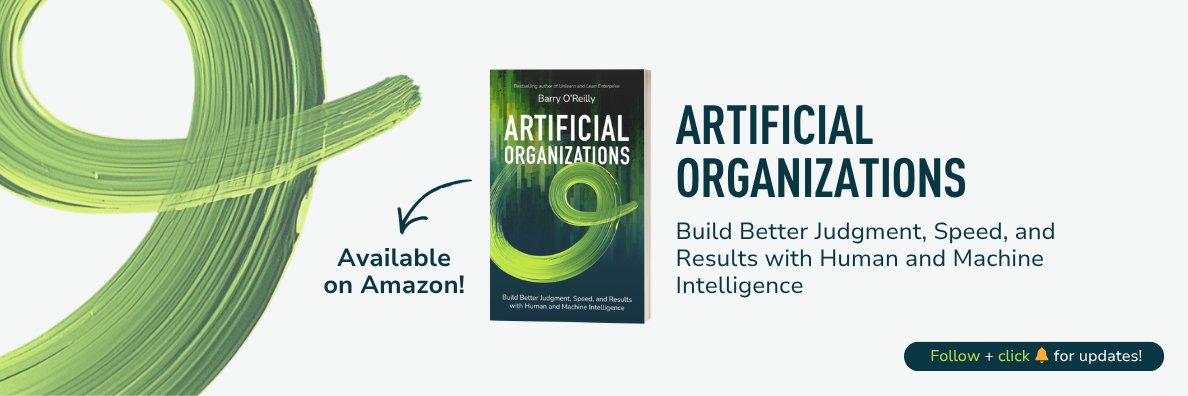
I’m excited to share that my new book, Artificial Organizations, is coming out in mid-March! I’ve been working on this over the past number of months, driven by a simple question I keep hearing from executives: How do we pair human intuition with machine insight to actually get better outcomes, not just more activity? This book is for leaders navigating that shift in how we work in high-paced environments. Not AI as a tool. Not AI as automation. But AI as a thinking partner that helps you make better decisions, faster without losing judgment, context, or humanity. Sign up at artificialorganizations.com to be notified of the official book release!
English
0
0
3
520
Barry O'Reilly
Barry O'Reilly@barryoreilly·
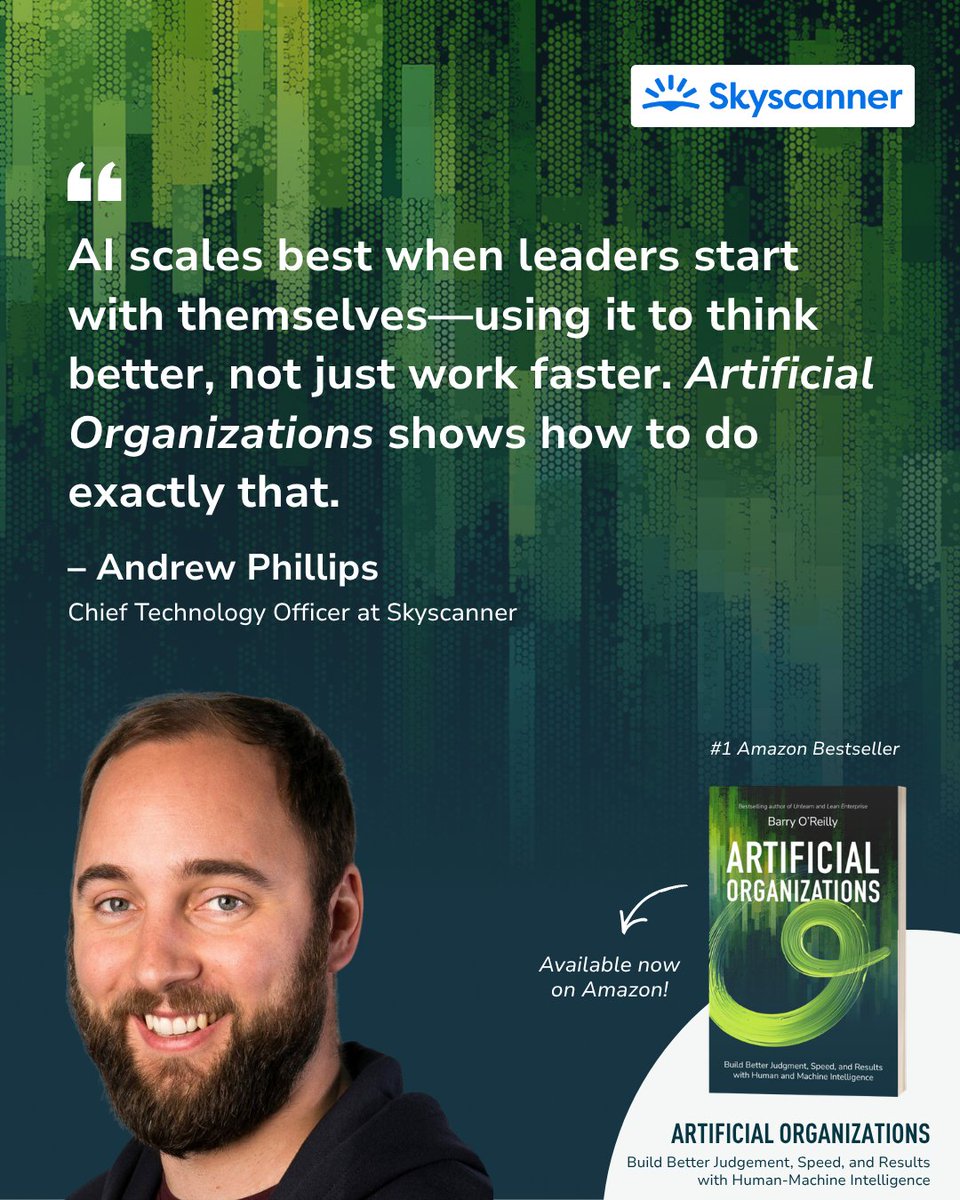
When Andrew Phillips, CTO of @Skyscanner, first started experimenting with AI, he didn't launch a strategy. He didn't form a task force. He didn't roll out a organization wide mandate. He asked one simple question: "Is this actually making my day better?" That's it. Skyscanner serves 160+ million monthly users. Andrew sits at the center of that complexity — board discussions, architectural reviews, leadership syncs, external conversations — all running simultaneously. The problem was never lack of information. It was holding all of it in his head. Switching contexts fast, and still showing up fully present in every room. So he started experimenting in the flow of real work. Some things worked. Many didn't. Yet here's what he did next that made all the difference: He said so out loud. He told his leadership and technology teams exactly what he was trying, where tools fell short, when outputs felt generic, and when the overhead simply wasn't worth it. No performance. No pretense of mastery. That honesty changed everything. It gave his teams permission to experiment without fear. AI stopped being a performance expectation and became a shared learning space. That's the lesson we wrote about in Artificial Organizations. You don't scale impact by starting with scale. You scale impact by starting with yourself. The leaders pulling ahead aren't the ones with the biggest AI budgets or the boldest transformation plans. They're the ones willing to try, fail, and say so — so everyone around them feels safe enough to do the same. 📖 Artificial Organizations is on Amazon and Kindle now: @ 👇 Who in your organization is modeling this kind of open, honest experimentation? Tag them.
Barry O'Reilly tweet media
English
0
0
0
51
Barry O'Reilly
Barry O'Reilly@barryoreilly·
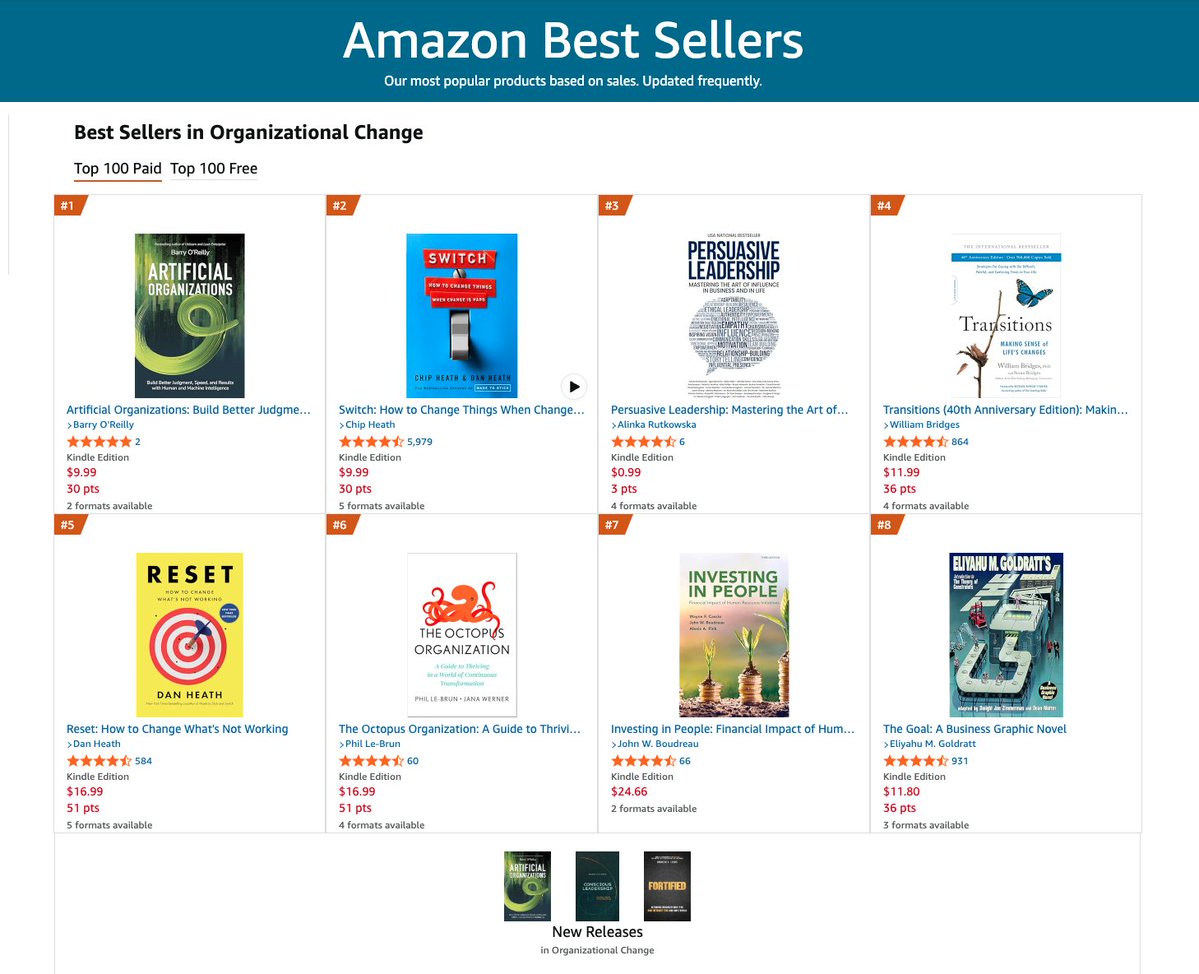
It hasn’t even been a week since launch, and Artificial Organizations is already the #1 Amazon bestseller in Organizational Change! 🚀☝️ We didn’t write this book for rankings, but it’s a meaningful signal. More leaders are realizing that the challenge isn’t access to AI. It’s knowing how to use it to think clearly and make better decisions. And that’s what this book is about. If you’ve already read it, thank you, and we really appreciate the support. And if it’s been useful in your work, it would mean a lot if you could leave a quick review on Amazon. It helps more leaders find it. 🔗 geni.us/artificialorgs
Barry O'Reilly tweet media
English
0
0
0
28
Barry O'Reilly
Barry O'Reilly@barryoreilly·
Getting some many interesting questions about Artificial Organizations... Here's a couple "pairing human judgment with AI for decision-making. I usually try not to outsource that. Curious to see how this plays out in practice" The trap isn’t “pairing” with AI. It’s outsourcing thinking to it. The leaders getting value aren’t handing over decisions. They’re using AI to pressure test their thinking, surface blind spots, and explore options faster—then making the call themselves. In practice, it looks less like: “AI, tell me what to do.” And more like: “Here’s how I’m thinking—where am I wrong? What am I missing? What would break this?” Done well, it actually raises the bar for judgment, not lowers it. Totally fair to be skeptical though—the difference only really clicks once you try it on a real decision that matters.
English
0
0
0
48
Barry O'Reilly
Barry O'Reilly@barryoreilly·
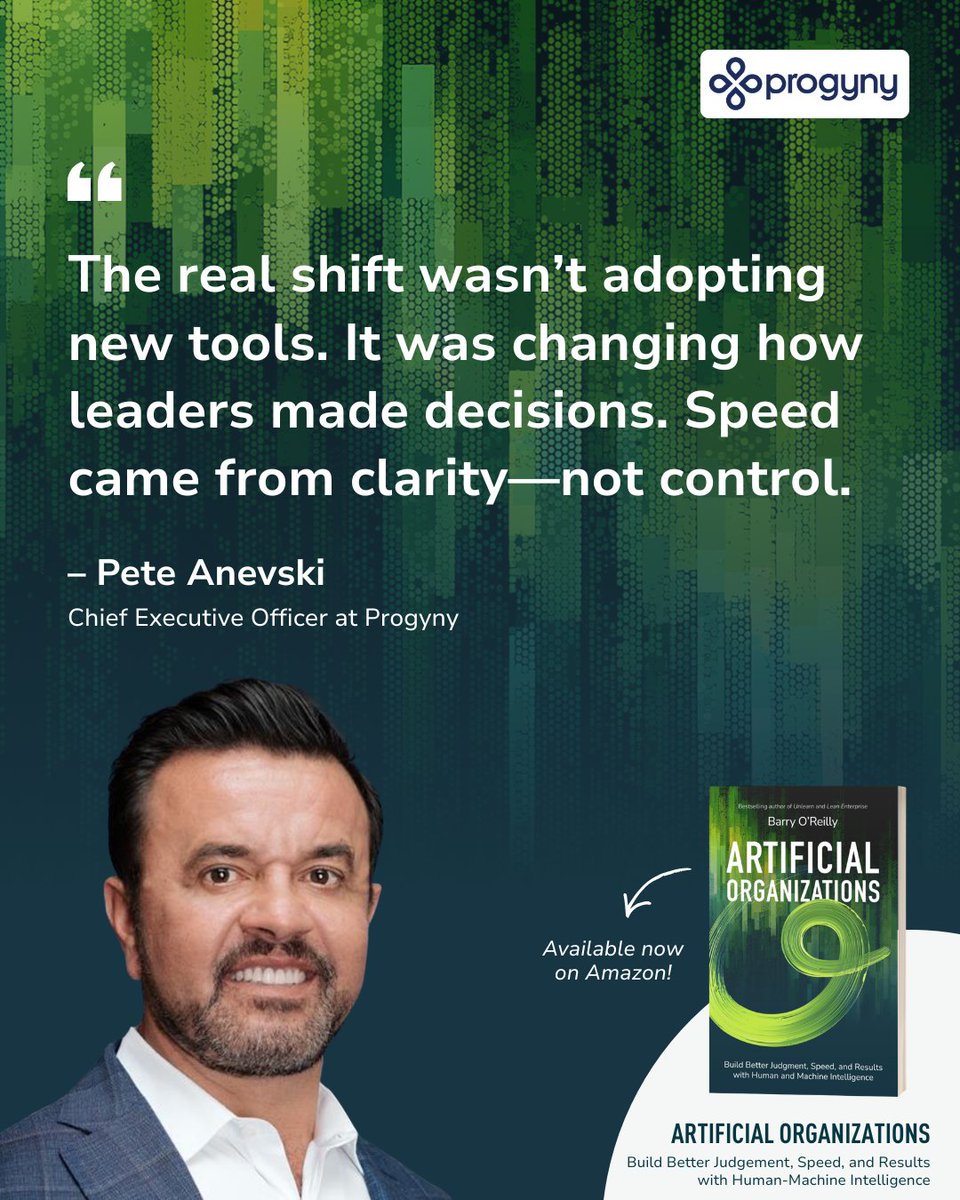
From day one of @Progyny's AI rollout, CEO Pete Anevski made one point clear to the entire company: "We're not using AI to reduce headcount. We're using it to elevate your human skills — not eliminate them." That single statement changed everything. Fear turned into curiosity. Resistance turned into experimentation. Experimentation turned into results. But then came the harder question — the one most leaders never ask: "What will you do with the capacity this creates?" Most people assume capacity means more work. More deliverables. More meetings. More pressure. That's the wrong answer. The real opportunity is giving leaders back the one thing no tool can manufacture: Space to think. For years, he tracked every 1:1 with every direct report manually — risks, actions, commitments — in a single Word doc, updated at the end of each day. When we introduced an AI meeting assistant, the shift was immediate. → Decisions got crisper → Follow-ups became automatic → Context stopped leaking between conversations → My team moved faster — not because I pushed harder, but because ambiguity disappeared The real shift wasn't operational. It was how I showed up. Calmer. More present. More decisive. That's what Artificial Organizations helped him articulate. The goal of AI in leadership isn't productivity. It's judgment infrastructure — systems that create the space for leaders to think clearly, decide confidently, and act with conviction. You don't get better decisions by putting people under more pressure. You get better decisions by giving people room to breathe, reflect, and choose well. Speed came from clarity — not control. If you lead a team and you're still measuring AI success by hours saved, you're measuring the wrong thing. Measure decision quality. Measure presence. Measure how your team shows up. 📖 Artificial Organizations is on Amazon and Kindle now. geni.us/artificialorgs
Barry O'Reilly tweet media
English
0
0
0
58
Barry O'Reilly
Barry O'Reilly@barryoreilly·
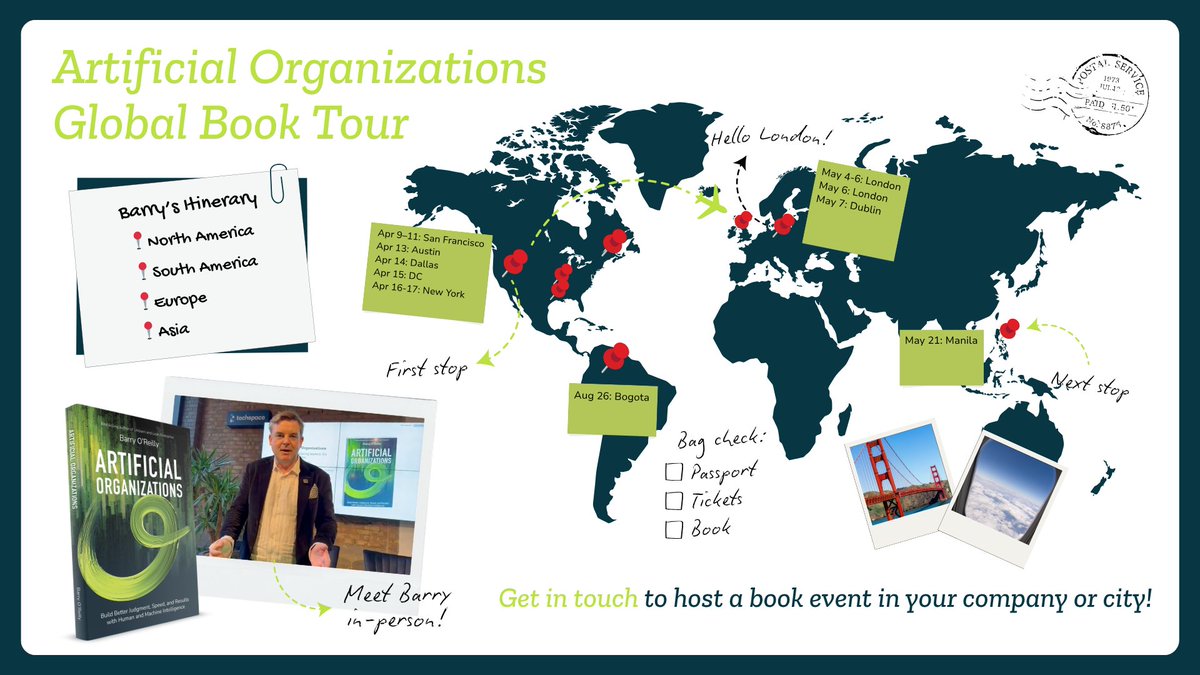
Excited to announce that Artificial Organizations is going global! 🌍🚀 Over the next few week and months, I’ll be traveling across North America, Europe, Asia, and South America as part of the book tour. This isn’t a tour focused on AI tools, vendor hype or how you’re going to be replaced. Leaders are being asked to make faster, higher-stakes decisions with AI but nobody has given you a system for how to actually do that. This book is that system. Artificial Organizations shows leaders how to pair human judgment with machine intelligence — so decisions get faster, execution gets tighter, and results compound. The book tour will be a series of conversations with leaders on how to improve judgment under pressure with greater clarity and confidence. Here are the first stops: 🌍 North America - Apr 9: San Francisco — Official Book Launch (Open to All) Book your spot: luma.com/artificial-org… - Apr 10-11: San Jose - Apr 13: Austin - Apr 14: Dallas - Apr 15: Washington DC — Public Book Launch (Open to All) - Apr 16–17: New York 🌍 Europe - May 4–5: London - May 6: London — Public Book Launch (Open to All) - May 7: Dublin — Public Book Launch (Open to All) 🌍 Asia: May 21 - Manila 🌍 South America: Aug 26 - Bogota I’ll be hosting a mix of public sessions and smaller leadership discussions across these cities. 👉 If you'd like to attend one of the open events or explore hosting a session in your company or city, you can get in touch here → #get-in-touch" target="_blank" rel="nofollow noopener">artificialorganizations.com/?utm_source=ne…
Barry O'Reilly tweet media
English
0
0
1
99
Barry O'Reilly
Barry O'Reilly@barryoreilly·
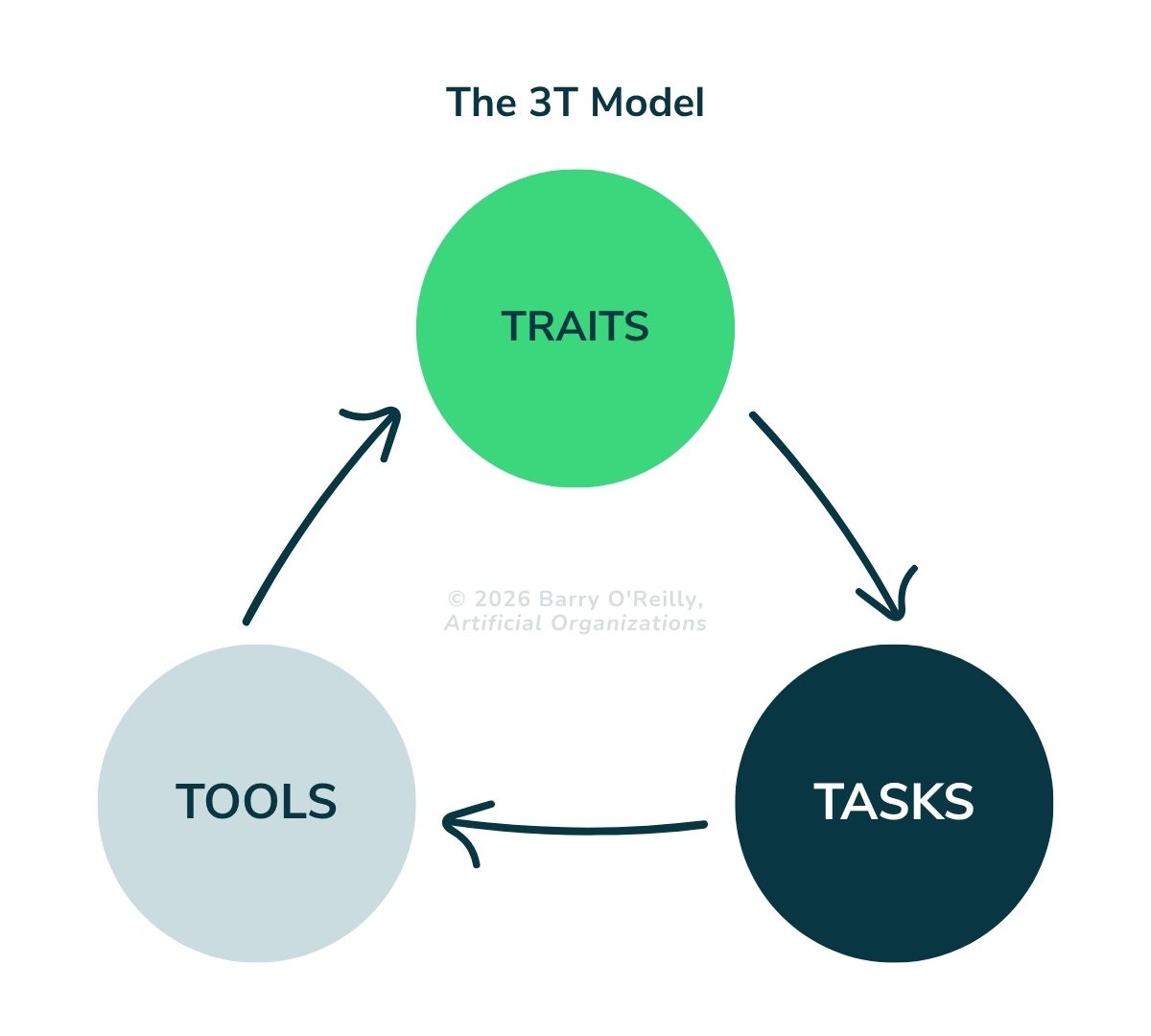
Most leaders start with AI tools. That's the mistake. The 3T Model flips the order: Traits → Tasks → Tools Traits — Start with who you are. How do you naturally create, capture, and recall information? That's your superpower. AI amplifies it — but only if you know what it is first. Tasks — Which decisions and workflows actually drain your judgment? Those are the leverage points. Redirect AI there — not everywhere. Tools — Last. Pick tools that fit your traits and tasks — not the ones with the best marketing. When leaders invert this order, they amplify noise. When they respect it, AI becomes a multiplier. This isn't productivity sequencing. It's judgment infrastructure design. Get the book at geni.us/artificialorgs
Barry O'Reilly tweet media
English
0
0
1
118
Barry O'Reilly
Barry O'Reilly@barryoreilly·
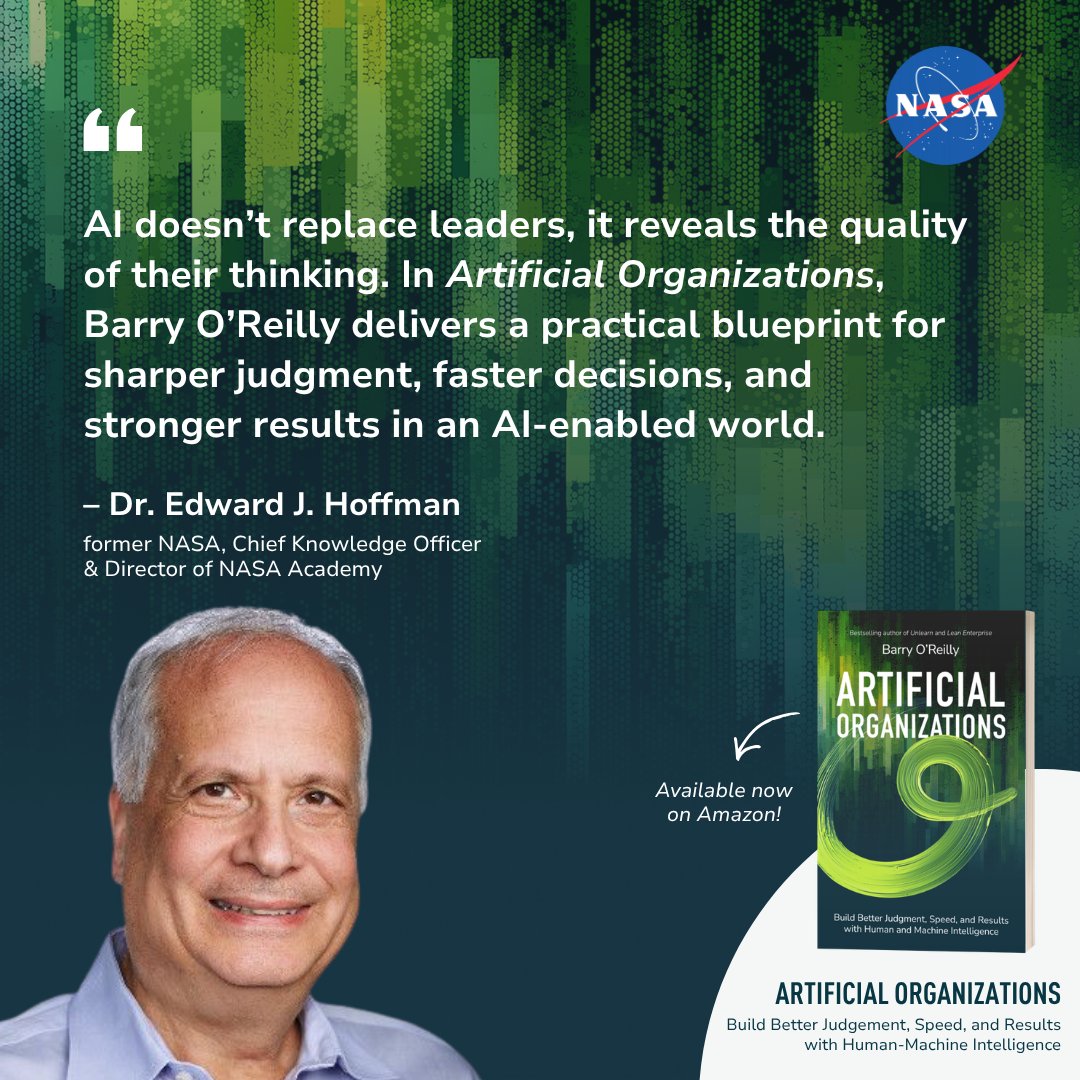
At NASA, Ed told me they had a saying: The mission doesn't forgive unclear thinking. When the margin for error is measured in milliseconds and miles, when a single decision made under pressure can determine whether a crew comes home, you learn something most organizations never fully confront: The quality of your judgment is your most critical asset. Ed Hoffman @hedhj16 spent decades at @NASA_Technology studying how high-performing organizations build, transfer, and protect knowledge under conditions of extreme complexity and consequence. The pattern was always the same. The organizations that failed didn't fail because they lacked information. They failed because the quality of thinking around that information broke down under pressure. Now we're in a new era, where AI gives leaders more information, more synthesis, more speed than any point in human history. Here's what we we spoke about from his career spent at the intersection of human performance and organizational intelligence: AI doesn't replace leaders. It reveals the quality of their thinking. Put a great thinker alongside an AI system, and their judgment compounds. Put a poor thinker alongside the same system, and their blind spots scale. The tool amplifies what's already there. That's why Artificial Organizations matters. It's not a book about AI adoption. It's a book about building the judgment infrastructure that makes AI worth adopting. The practical blueprint it offers — for sharper thinking, faster decisions, and stronger results — is exactly what leaders need right now. That moment is now. For every leader. In every organization. 📖 Artificial Organizations is available now on Amazon and Kindle: geni.us/artificialorgs 👇 Where in your organization does AI risk amplifying poor thinking rather than sharpening good judgment? That's where to start.
Barry O'Reilly tweet media
English
0
0
0
64
Barry O'Reilly retweetledi
Nobody Studios
Nobody Studios@NobodyCrowd·
Barry O'Reilly’s new book, Artificial Organizations, is the practical playbook for combining human judgment with machine intelligence to move faster. If you’re leading through uncertainty, this is your edge. Get your copy: geni.us/artificialorgs #NobodyStudios
Nobody Studios tweet media
English
0
1
0
79
Aaron Levie
Aaron Levie@levie·
We dramatically underestimate how much change management it is going to take to automate most knowledge worker tasks. Between data being in legacy environments or systems or without good APIs, context missing for doing the task, teams that are less technical, and other factors, there’s still a lot of work to drive real AI transformation in an enterprise. This is actually great news if you’re building right now because the opportunity is to build the software bridges to make this easier, or to build new services firms to help with this change management. Opportunity is all around for those looking.
Jason Shuman@JasonrShuman

Silicon Valley thinks AI agents are a $20/mo self-serve subscription. Main Street is paying local agencies $10,000 just to turn them on. Everyone assumes AI will be bought primarily online like Slack or Zoom. I think they are wrong. Some of the biggest winners in the AI boom won't be the software vendors. It will be the humans installing it. Here is the reality of SMBs right now: • 54% lack internal AI expertise. • 41% have data quality too poor for AI to even work. • 41% already prefer buying AI through a local IT provider. You cannot "1-click install" a genius AI into a messy CRM or a 15-year-old server. It will just execute the wrong tasks at the speed of light. The AI software will be cheap and a lot will absolutely be bought online. Making it actually work for a messy, real-world business will be expensive. Very bullish on the "Do It For Me" economy being back.

English
120
121
1.2K
263K
Barry O'Reilly
Barry O'Reilly@barryoreilly·
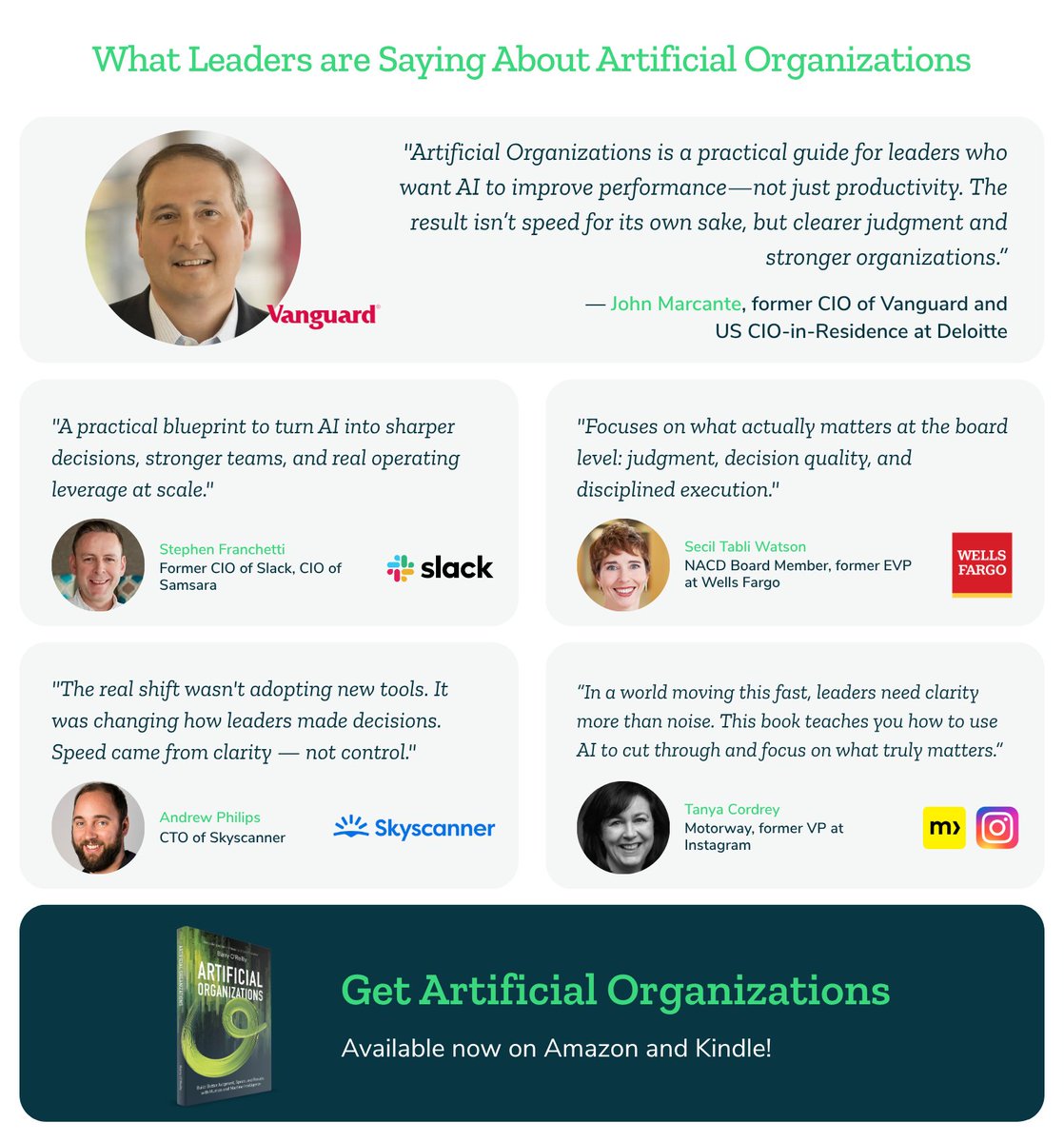
These are CIOs, CTOs, board members, CEOs—people making decisions under real pressure. Different industries. Different contexts. But the signal is consistent: - AI doesn’t improve performance on its own - More output doesn’t equal better outcomes - The real shift is how leaders make decisions The feedback that stood out to me after they read the book “Clearer judgment and stronger organizations.” “Sharper decisions, stronger teams, real operating leverage.” “Speed came from clarity—not control.” “Focus on what actually matters: judgment, decision quality, disciplined execution.” That’s the thread running through all of it, not tools. Hype, job replacement, or technology never came up as critical. What did was judgment. This is exactly what Artificial Organizations is about. How leaders: - think clearly under pressure - make better decisions with AI - build systems where decision quality improves over time The companies that figure this out won’t just move faster. They’ll make better calls, more consistently. That’s where the advantage compounds. Artificial Organizations is available now on Amazon. If you’re leading in this environment, it will give you a system to work from. 🔗 geni.us/artificialorgs
Barry O'Reilly tweet media
English
0
0
0
66
Barry O'Reilly
Barry O'Reilly@barryoreilly·
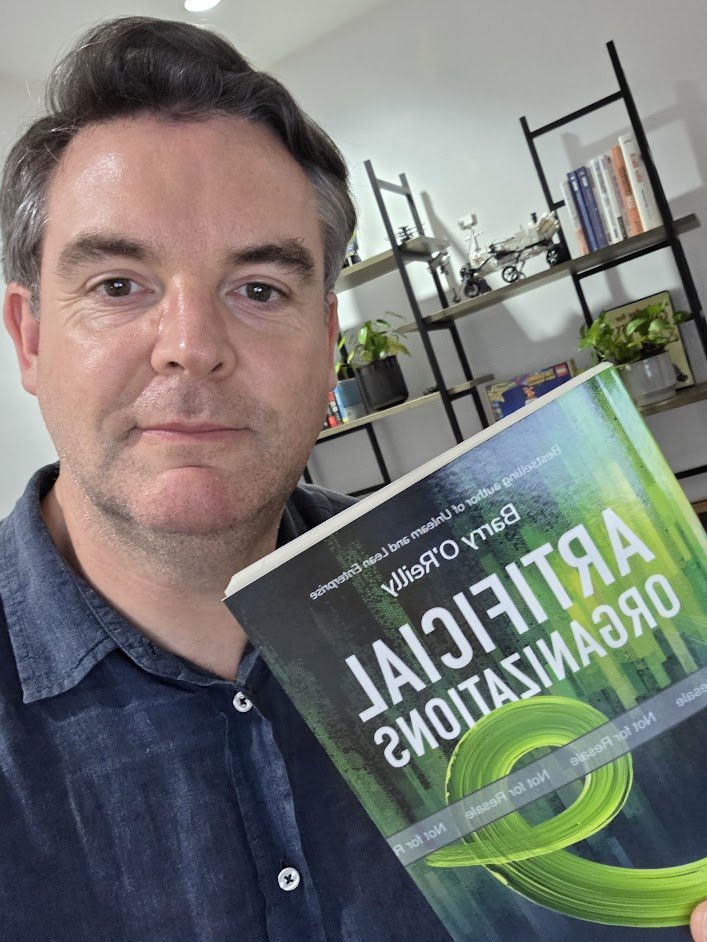
It never feels real until you have the book in your hands. From idea → to system → to something physical. This book was shaped through real conversations with leaders navigating pressure, complexity, and constant change. Seeing it arrive makes all of that real. Artificial Organizations is now out in the world. 🚀 🔗 Available on Amazon, link here: geni.us/artificialorgs #ai #artificialorganizations #newbook #leadership
Barry O'Reilly tweet mediaBarry O'Reilly tweet media
English
0
0
5
81
Barry O'Reilly
Barry O'Reilly@barryoreilly·
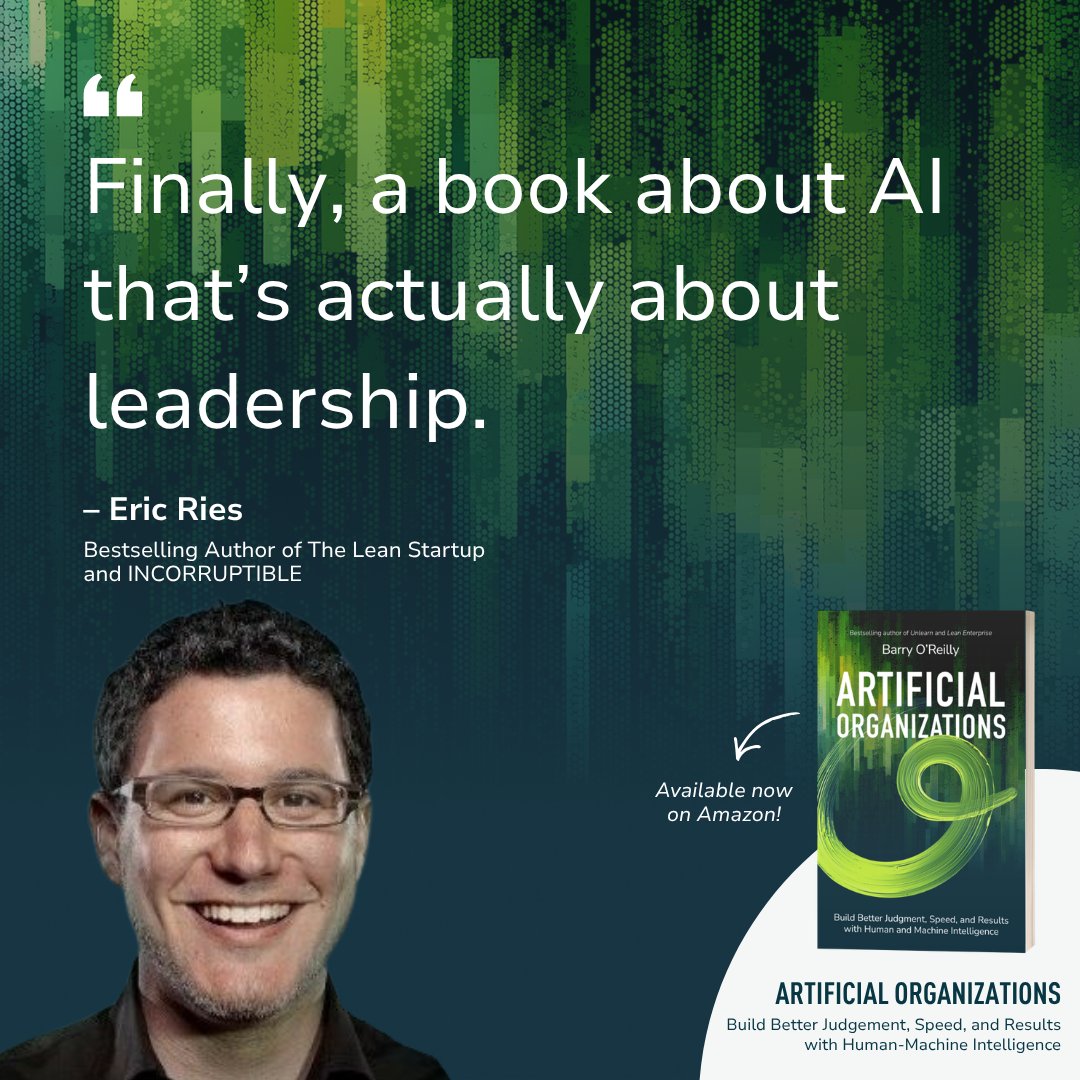
"Finally, a book about AI that's actually about leadership," @ericries, author of The Lean Startup and Incorruptible Too much of the conversations about AI focus on tools, features, and capabilities and FOMO! Artificial Organizations is about how leaders think, decide, and operate when working with AI. 📚 It is live on Amazon now → geni.us/artificialorgs
Barry O'Reilly tweet media
English
0
3
4
1.4K
Barry O'Reilly
Barry O'Reilly@barryoreilly·
There are now only two types of leaders: Those using AI to think, decide, and act faster Those using AI to write emails The gap between them is compounding daily. This isn’t about tools. It’s about how judgment flows through your organization. The future belongs to leaders who combine human + machine intelligence. That’s what Artificial Organizations is all about. Join us in SF, Thursday April 9 for the book launch 👇 luma.com/artificial-org… #Startups #AI #Execution
English
0
0
0
43
Barry O'Reilly
Barry O'Reilly@barryoreilly·
The biggest lie in AI right now: “AI will make your team more productive.” No it won’t. It will expose how poor your decision-making actually is. The real shift: AI doesn’t scale work. It scales judgment. And most orgs aren’t designed for that. That’s why 95% of AI efforts go nowhere. I wrote Artificial Organizations to fix that. geni.us/artificialorgs
English
0
0
0
58
Barry O'Reilly
Barry O'Reilly@barryoreilly·
This 👆 is exactly how the future org shows up. The people you’re calling “AI-obsessed” are already operating in a different system: → faster loops → better judgment → outcomes over roles The mistake isn’t that they’re moving too fast. It’s that the organization around them isn’t built to keep up. That’s what I wrote Artificial Organizations for — how to design teams where this behavior is the norm, not the exception. If you’re seeing this inside your company, you’re closer than you think. geni.us/artificialorgs
English
0
0
0
74
Codie Sanchez
Codie Sanchez@Codie_Sanchez·
You know that person on your team with AI Derangement Syndrome who won't stop talking about what AI could do for the business? They've already built three internal tools over the weekend and sent them to the team on Slack. Whatever you do...don't shut them down. Fund them. Get out of their way.
English
232
94
1.2K
63.7K
Barry O'Reilly
Barry O'Reilly@barryoreilly·
AI-flunet... Meh We need leaders how know how to be build judgment system and infrastructures so they can make quality decisions at speed with confidence We need people that by combining human and machine intelligence for better outcomes That's everyone if they want to take part And to get started—here that leadership operating system for the AI-era Get busy being the best you can be geni.us/artificialorgs
English
1
0
0
150
Arjun Mahadevan (Mr. LLC 🇺🇸)
The most epic 13 minute AI rant I've heard in 2026 PS: My parent's heard this when I was playing it in the car and thought @jasonlk went OFF like @stephenasmith does on first take PPS: Full transcript below [17:00] Harry Stebbings: I I just wanted to ask Jason, if the people that we want are fundamentally different, the developers that we used to hire, we don't because AI writes the code for us. The marketers we don't want, the sales people we don't want—who who do we want genuinely? Like what is the attractive profile? Because your Anthropic’s and your OpenAIs are hiring, so so what are the people that we want in the companies of the future? [17:18] Jason Lemkin: Look, I know it sounds trite, but but the answer is simple. It's just the expression each year changes. We want folks that are genuinely AI fluent. It's pretty simple. Now you know, maybe last year we called them prompt engineers, right? That used to be a job. I don't know if you remember that actually used to be the hottest job on planet earth. Now no one needs a prompt engineer because it's pretty easy to prompt all these tools. That job died. Okay. Um and now we need go-to-market engineers. Um I think that job's going to die. We need—everyone needs so many forward deployed engineers. Like you can't hire enough forward deployed engineers. But uh you know um but Palantir just announced in whatever their their big their big event—they've gotten their deployment times down over 90% with forward deployed engineers. So that may become—so the this wave of disruption for the titles and the specificity, it's also exhaustingly accelerating. But it's really simple. You meet anyone for any role—sales, marketing, engineering, product, QA—they're they're either they're either they can't keep all of the ways they use AI to accelerate their job from spewing out of their mouth, or they're staring at you. It's there's nowhere in the middle. Like, and the person that comes in and says—it's it's it sounds Captain Obvious—but like, you know, you just had the whatever from Lovable, the the marketing head that was super popular on the show, right? She's just spewing AI-native insights into Lovable, right? It's not that complicated. You hire her, Elena, or whatever it is. You just hire her. It doesn't matter whether she's still in college or a junior or a senior or a middler, a left or right. And honestly, if you interview people, I would say of all even of the best startups I've invested in, maybe 30% of the management team meets this standard at best. 30%. Maybe less. And of the interviews I do in general, it's single-digit percents. It's just and in in that sense, it's the same as ever. Like you either lower the bar in hiring or you hire someone that's actually great. And someone that's actually great is so far ahead of you in how to apply to to employ the efficiencies of AI in their role, your jaw falls on the table. The difference is we used to need warm bodies. That's what's changing. We used to need warm bodies to answer the call, to do QA, to do code review, to to get the blue pixel to go from the upper left to the lower right. You laugh, but you need you literally needed to brute force this with humans. With AI, every day that goes by, the AI—you do not need brute force human beings on your team. And that's another reason they're shrinking. Why are all these new companies so efficient? They're just not brute forcing things with humans. They're just not. They're choosing not to. And so these team—all the brute forcers out there—everyone talks about how bloated teams got in 2021. I don't agree with that. I think they got as big as they needed to be when growth was high and you needed humans to do everything. All you look at these teams that that doubled—well if growth continued at 60% like the rate in early 2021 for 5 years or can help me do the math and every single thing a software company did required a human. You were understaffed by your 2021 headcount. You'd be sitting here in 2026. You every office in SoMa would be triple packed and you there wouldn't be enough humans to staff your company. It's just the world changed. [20:33] Harry Stebbings: Jason, you live on the bleeding edge. I think me and Rory see that and I think the world sees that when they hear you every week in terms of how you run SaaS. For all of the CEOs and execs who listen to the show, what would you advise them in terms of determining whether someone is AI fluent when they meet them for jobs, for talent? [20:51] Jason Lemkin: Here's I realized I was just asked this. I just did a review with a super fast startup growing just crossing 100 million and I was asked this question. And one of my favorite executives, I thought his answer was pretty dated and because he gave me an answer that was about 6 months old. The answer 6 months old is: "I look for folks in my team, I look for you know at what tools they play with." Okay, that was a great answer in like summer of 2025. Okay, I tried Lovable last week. Okay, the answer in 2026 is: "What commercial AI tool have you brought into your organization this month?" That's the test. Anyone that is on the bleeding edge that you would want to hire—now there are so many great products in the market. Okay, there is no excuse in any role to have not brought one tool a month into your organization. Okay, there—now there's going to be better and better tools and better and better products as the year goes on. What's the one you did? And you will see folks with their deer in the headlights to this question. What what sales tool? What marketing tool? What product tool? What engineering tool? What did you bring in? Why did you pick it? How does it working? Because if you're at remotely at the cutting edge, you're all over this. You're looking for the next agentic tools that will radically improve how you do business. This is—you think everyone thinks SaaS is at the bleeding edge, right? You know, you know, all we do is we're just looking for the tools and trying them. Okay? Okay, we're one year ahead of everybody else because we did the simplest thing in the world. Like we tried the tools early and we trained them. We trained them for a month. Okay, I'll give you—want hear a horrible example from this week? Super hot AI company valued at 6 billion. Okay, I'm not going to name it. Um, this week yesterday told us we had to quadruple what we spent on their product. Okay, their agent told us, right? And why did this happen? Okay. Well, at this $6 billion company, no one had trained the agent on its pricing properly. No one had tested it. They said, "Well, well, we've been in beta." And we said, "Well, when did the beta launch? A year ago." Okay, these are people asleep at at the wheel. You want somebody who the instant this comes up, they exactly know what the issue is. And "Hey, when I was at Lovable Replit, we trained the agent. This is how we did it. I brought in this tool. I brought in this tool that that Rory invested in last week. It solved all these issues." That's what you want to hear. And if they haven't brought in a tool in the last 30 days, at least deeply evaluated it. I don't really care whether they bought it, but gone so far down the funnel they can tell you—pick whatever tool: Fixie, Regie, GC, AIGC—I don't care how you went through it, you looked at it, you can tell me the eight ways it would improve the productivity of your business and three you didn't. Just don't hire that person because they're going to run your company to the ground. This is the job today. The job today is not to screw around on ChatGPT and to be a prompt engineer. The job today is to bring the best AI and agentic products into your organization and leverage all the hard work that the engineers have done building those products. That's your job. You don't have to screw around. You don't have to be a prompt engineer anymore. You have to be an agent deployment expert. A—this is the new job we're making up today. An Agentic Deployment Expert. That's your job from C-level to junior. Agentic Deployment Expert. Don't hire anybody else. You're going to regret it. They're going to stare at the camera. He's good. Stare at the camera. He's honorable. We could probably just I could slip away, get a coffee, and come back. No. And I I sound exasperated, Rory. And I—but the reason I am is I can just see I can see my best companies doing it. And I can see some companies I've invested in not doing it. And I want to cry. I just want to cry when they have no ADs on their team. I just—like you're flushing your years of your life down the toilet by not approaching your how you're building this company this way. [24:33] Rory: Yes. And at the risk of being positive, it's worth pointing out two things he didn't say. Well, something implicit why he said—Jason didn't do the only hire, you know, he didn't commit the um employment law, I think it's a civil penalty of saying only employ people below X who get the new new thing because he implicitly said anyone can do it provided you're willing to learn. And I think that's the big aha that's one of the positive statements to make here right? Look and I think it applies—I'm always wary of being "Hey, coming across, hey this this is the things that you all have to do." I think it applies to everyone including investors right? I mean I will say I have found that unless you're willing to invest the time learning these tools you actually shouldn't be investing in them. One of my partners Andy had this expression: "You know, if you decide you want to stop learning new things you probably should retire within 6 to 12 months and never write another check again." Maybe that's down to 3 to 6 months at this stage, right? And I think, you know, it's— [25:27] Harry Stebbings: Yeah, I actually I actually had a meeting with mine and Jason's biggest investor the other day and I—pretend he's not here—I said I think he's the most equipped investor for this generation of investing because I don't think anyone quite sits at the bleeding edge like he does on the investor side. [25:42] Harry Stebbings: Why in terms of using the equip stuff? Yeah. Yeah. In terms of using the stuff, understanding understanding bottlenecks, constraints. For sure. [25:51] Jason Lemkin: But can I just add one point? We can just cuz it's so important if it helps people. Okay, we are—and thank you Harry. We're going through these phases. Okay, and when AI started to blow up for real for us, uh call it early 2024, right? Maybe late '23, I wasn't equipped. It was too technical. I wasn't going to go in and figure out—I wasn't smart enough to figure out how to deal with a massively hallucinating LLM API and turn that and turn that into something magical. Kudos to investors and others that that got it in early '23, '22. I mean I remember I—I guess it was maybe SaaStr Annual '23. I was with David Sacks and I did a Q&A and I said, "How you thinking about AI at Craft?" He's like, "Well we're all in. We want 80% of '23 of investments to be AI." I'm like, "Great but like show me the show me the great ones in market." He's like, "They're all prototypes. We're all they're all they're all proof of concepts but we're all in anyway." That's where you kind of had to be in '23 if you weren't investing at like the LLM level. Okay, I wasn't smart enough. Then we went through this weird-ass prompt engineer era where like you you could torture these products to do something good, right? But you had to torture them. You had to like craft these crazy things that made no sense. Now we are in the era where mere ordinarily smart generalists can make these tools do magical things. And literally I go to these meetings and people be like, "I don't know how to like this is so scary. I don't know how to do this." And we show them our backends. Do you know how to do a workflow generator? Do you know how to do a a decision tree? Like we've been building these since software in the '90s. Okay, if you—I can show you all of our agents. The how they work is novel. They do have to be trained. You can't be lazy and have these agents work. But honestly, the the UI, the UX, the way we interact with them, it's just software. And so my point is: Pick yourself off the ground. This is your time now. If you felt lost in AI era, if you felt like you're behind, you don't understand what all these people are saying on X and Twitter and their Claude and and their and talking about all the 4.6 point Nano point and it's over—like you just it's not your world. This is your time. This is your time for the generalist that knows how to use software tools really really well. And I—this is my last point but it's so important. If ever in your recent life—and this is why you could be all you need to be is young at heart to Rory's point—if in the last three to five years you have successfully deployed a piece of enterprise software of any sort you yourself, not some agency you hired, but if you have deployed it, you can deploy any agentic tool. Any. And you can become the hero in your company and you can become the hero in your functional area. But I watch folks—I'm literally helping a company now that they're adding hundreds of sales folks this year with a new pre-IPO COO—he's not hasn't brought in a single tool, totally scared of it. Okay, it's not that hard. Did you use SalesLoft? Did you use Outreach? Did you use HubSpot? Do you know these tools? If you can deploy these tools, you can deploy a world-changing AI agent. And so this is the time for people like the folks that that were shut out of the AI revolution right now. The generalist folks that are not that know how to deploy software that don't even know how to build software. Like vibe coding for me was folks who knew how to build software, but you didn't have to be an engineer. Now, you just need to know how to deploy software to win with AI agents. That's all you need to know. So many people have these skills and they're petrified of AI. "How did you do that? How did you deploy an AI BDR?" Well, we bought a piece of software, we figured out how it worked for a day, we set it up in an afternoon, and then and then we did spend 30 months training it, which you didn't do with this old software because in the old days, we just had to manually upload all the data, right? And there was no training. The the only non-intuitive part is training these things. And it's it's it's just work. So that's why when I see folks on the management team not doing this, there's no excuse. You do not need to be technical to win with AI agents in Q2 of '26. You do not need to be even 1% technical. Not at all. So it's your time. Or you're going to get laid off. Or you're going to get laid off because you're not going to matter.
English
10
9
178
35.8K
Barry O'Reilly
Barry O'Reilly@barryoreilly·
San Francisco 👋 We’re stepping into a new era of how leaders think, decide, and act. Join me for the launch of Artificial Organizations — a playbook for building better judgment, speed, and results by combining human and machine intelligence. 📍 Frontier Tower, Market Street 🗓 April 9 ⏰ 6:30 PM This isn’t theory. It’s how the next generation of companies will operate. If you’re a founder, exec, or builder — you’ll want to be in the room. Register here → luma.com/artificial-org… Free book for first 50 people! Let’s explore what becomes possible when intelligence is no longer limited to humans. #ArtificialOrganizations #AI #Leadership #Startups #SanFrancisco
Barry O'Reilly tweet media
English
0
0
1
61