Jake Bartschi

39 posts

Jake Bartschi

Jake Bartschi

@BartschiJake

Katılım Ocak 2021
10 Takip Edilen20 Takipçiler
Jake Bartschi
Jake Bartschi@BartschiJake·
#PT582 #CC I wouldn't use ultrasound to reduce pain because the research doesn't back it and we have so many other tools in our tools kit that are shown to reduce pain. If I used it on a patient for other reasons and they reported pain reduction as well, I might use it again.
English
0
0
1
0
Jake Bartschi
Jake Bartschi@BartschiJake·
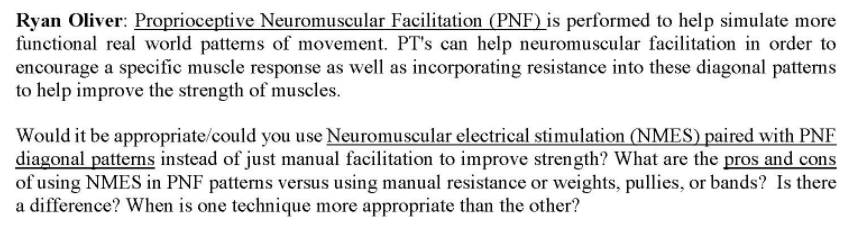
@RyanOli22855873 #PT582 #RO We could use PNF patterns in conjunction with NMES at the beginning stages of rehab is the patient is really struggling with muscle activation and contraction but after that we should be using résistance/pullies etc. in order to progress rehab.
English
0
0
1
0
Jake Bartschi
Jake Bartschi@BartschiJake·
@manderslat #PT582 #AS We should see these alternative treatments once conservative treatment has failed us and we are not longer seeing progress. Patient that are more susceptible, patients that are performing a lot activity are at higher risk, resting and patient education are best.
English
0
0
1
0
Jake Bartschi
Jake Bartschi@BartschiJake·
@SptTaryn I think a bungee would also work, making sure the bungee has enough support for the patient is key since they vary in resistance. Also guarding the patient when necessary.
English
0
0
1
0
Taryn McMorrow, SPT
Taryn McMorrow, SPT@SptTaryn·
@BartschiJake #PT582 #TM The use of a harness is a great idea! Do you think the use of bungees would be appropriate for amputee patients with prosthetics? Do you think they would provide enough support for the patient?
English
1
0
0
0
Jake Bartschi
Jake Bartschi@BartschiJake·
We can fit amputees with prosthetics and customize This article talks about the use of a harness to help patients feel more stable while performing more complex core exercises. chttps://wheelessonline.com/userfiles/21-1-8.pdf when necessary. #PT582 #TM
English
1
0
1
0
Jake Bartschi
Jake Bartschi@BartschiJake·
@rainataylorrr I would say start simple, challenge them to start exercising in 10 min blocks and seeing how that makes them feel. Hopefully they feel better and become more motivated!
English
1
0
1
0
Raina Taylor, SPT
Raina Taylor, SPT@rainataylorrr·
@BartschiJake #PT582 #RT We definitely need to be able to provide examples! Do you have any ideas of what you would do for a patient who is unmotivated to begin?
English
1
0
0
0
Jake Bartschi
Jake Bartschi@BartschiJake·
#PT582 #RT As entry level physical therapists we can educate our patients not only on the benefits of physical activity, but how much is optimal, and also give them some ideas of how they can meet the guidelines. Some people never start because they don’t know what to do.
English
1
0
2
0
Jake Bartschi
Jake Bartschi@BartschiJake·
#PT582 #JB Thanks for a great discussion about implementing contextual interference into practice as a PT. Here is my summary!
Jake Bartschi tweet media
English
0
0
0
0
Jake Bartschi
Jake Bartschi@BartschiJake·
@CaitieBell1 #PT582 #JB Great progression Catie! That will definitely help the patients balance once they get out in the community that is full of uneven surfaces and all kinds of objects/forces that might perturbate them.
English
0
0
0
0
Caitie Bell
Caitie Bell@CaitieBell1·
High level athletes should practice w/ high contextual interference to be ready for any situation (ex plyos). Patients in early rehab stages/elderly should have low contextual interference to practice basic skills (ADLs) & increase difficulty as they improve #JB #PT582
English
1
0
3
0
Jake Bartschi
Jake Bartschi@BartschiJake·
@layneunderthes1 I like the way you are thinking, helping our patients to be able to adapt to the world around them is crucial! I think we can apply this approach to specific goals that each patient has so they can perform the activities they love #PT582 #JB
English
0
0
2
0
LayneHerrick
LayneHerrick@layneunderthes1·
@BartschiJake #PT582 #JB Absolutely! Life is random, so if a patient is struggling with skill repetitions, and we can make that skill "instinctual" to a stimuli like an obstacle course, then they might see success. Sort of like a "hack" for implementing skills, for all populations!
English
1
0
2
0
LayneHerrick
LayneHerrick@layneunderthes1·
#JB #PT582 I'd say blocked for new skills and random for skills seen before. And sometimes, random works best for "problem skills" because sometimes patients think too hard about the skill and it needs to be switched up a bit. As Val says, treatment aimed at the success!
English
1
0
2
0
Jake Bartschi
Jake Bartschi@BartschiJake·
@ColleenDrisSPT #PT582 #JB That is a great example! One example I thought of was when I was working with a patient going through cardiac rehab, instead of the patient just walking the therapist had the patient bouncing a physioball in different ways while walking.
English
0
0
2
0
Colleen
Colleen@ColleenDrisSPT·
@BartschiJake That’s a great question! Thinking back I do not recall therapist using higher contextual much. Possibly with gait training they would have some obstacles which would be higher level for those patients! #pt582 #jb
English
1
0
1
0
Colleen
Colleen@ColleenDrisSPT·
#PT582 #JB Pts starting out w/ new tasks start w/ low interference, as you still need their buy-in & don't want to discourage. In advanced athletes, you could start sports-related high interference as they have the experience of the tasks and could help them develop their game.
English
1
0
1
0
Jake Bartschi
Jake Bartschi@BartschiJake·
@layneunderthes1 #PT582 #JB Layne I agree, I was thinking an obstacle course would be a great way to introduce contextual interference to a elderly patient wanting to ambulate in the community!
English
1
0
0
0
LayneHerrick
LayneHerrick@layneunderthes1·
@BartschiJake #PT582 #JB "Problem skills" are things that when taken out of a sequence, result in a stutter of some kind. We see it in geriatrics with patients who don't want to turn left or right. But by making an "obstacle course" we can make it fun and encourage these skills in a sequence
English
1
0
2
0
Jake Bartschi
Jake Bartschi@BartschiJake·
@CaitieBell1 #PT582 #JB Thank you Caitie those are great examples! Providing perturbations to patients while they are practicing static balance might be a way to start introducing more contextual interference, how might we progress the patient from there?
English
1
0
1
0
Caitie Bell
Caitie Bell@CaitieBell1·
@BartschiJake Absolutely! If we mastered a turn/leap in dance, they would put it in a combo to increase difficulty. Non-athletes can use high contextual interference in rehab when they need quick reactions (like catching themselves when falling or reacting before twisting their ankle)
English
1
0
0
0
Jake Bartschi
Jake Bartschi@BartschiJake·
@ColleenDrisSPT #PT582 #JB That is awesome, thank you for the example! You also worked at a clinic, can you remember when the physical therapists used higher contextual interference on an athlete or maybe a non-athlete during rehab?
English
1
0
1
0
Colleen
Colleen@ColleenDrisSPT·
@BartschiJake During bullpens my coach would constantly change the situation and batter so we had to adjust our pitch choice depending on the situation at hand! Doing that stimulated game like situations better than just pitching to pitch! #pt582 #jb
English
1
0
2
0
Jake Bartschi
Jake Bartschi@BartschiJake·
@EmilioA43040616 #PT582 #JB Yes I agree and the general consensus appears to favor low contextual interference at the earlier stages of rehab, can you think of a specific patient impairment that might benefit from higher contextual interference earlier in rehab?
English
0
0
0
0
Emilio Aranda
Emilio Aranda@EmilioA43040616·
#PT582 #JB This is a very thought-provoking question. It would seem reasonable to assume low contextual interference w/ Pts who possess low familiarity and low skill levels with a task. Progressing to high contextual tasks later in the treatment session would be beneficial!
English
1
0
1
0
Jake Bartschi
Jake Bartschi@BartschiJake·
@kdavidnau #PT582 #JB It seems like working with athletes might be the most common use of random practice, can you think of a time when you observed random practice being used on a non-athlete patient?
English
0
0
0
0
Jake Bartschi
Jake Bartschi@BartschiJake·
@EmilySelby_SPT #PT582 #JB During the later stages of rehab once the patient has built confidence and is progressing, how might we introduce random practice to an elderly patient recovering from a total knee that would like to be able to go on hikes again?
English
0
0
0
0
Emily Selby, SPT
Emily Selby, SPT@EmilySelby_SPT·
#PT582 #JB Low contextual practice seems better for early stages of rehab and less advanced patients, as this might allow for more success in the short term, where confidence and comfort are key in progressing. High contextual practice would be good for higher level patients...
English
2
0
1
0