

lorenzo
4K posts


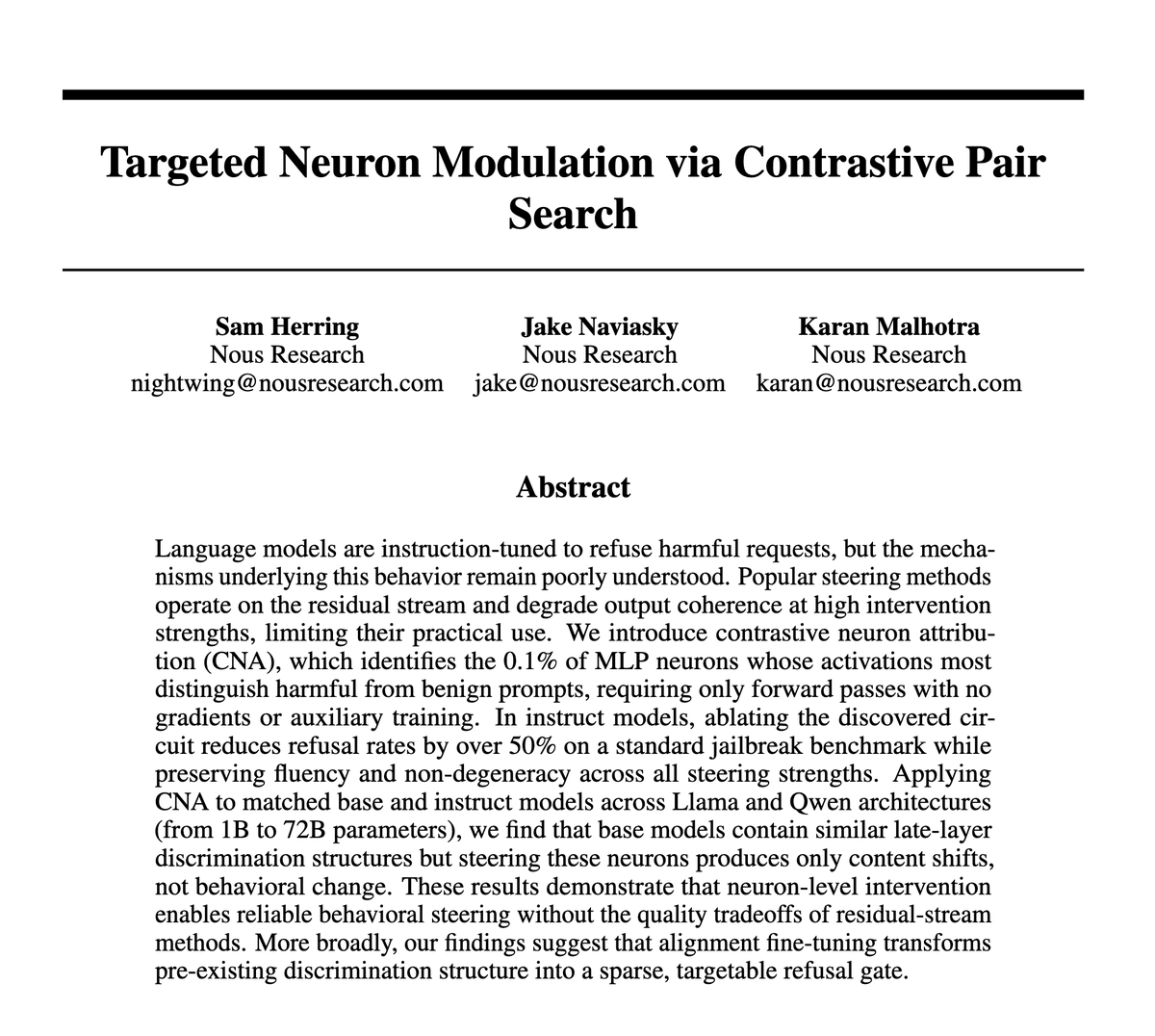
Today we release Contrastive Neuron Attribution (CNA), a method for steering LLM behavior by identifying and ablating sparse circuits in the MLP basis without training a sparse autoencoder, modifying weights, or degrading general capability benchmarks.
Given a small set of contrastive prompt pairs that elicit a target behavior and its opposite, CNA isolates the top 0.1% of MLP neurons whose activations differ most between the two sets. Ablating that small circuit removes the behavior while leaving the rest of the model intact, and the intervention remains robust at high strengths where residual-stream methods like Contrastive Activation Addition (CAA) start to degrade.
Validated on the refusal circuit across 8 instruct-tuned models, including Llama-3.1-70B, Llama-3.2-3B, Qwen2.5-72B, and Qwen2.5-14B.
The work on CNA was led by @yaboilyrical, with support from @qorprate and @karan4d.
English
lorenzo retweetledi

Siamo contenti di essere arrivati primi, insieme a LBS. Però da noi si mangia meglio.
@Unibocconi @sdabocconi

Italiano

Codex usage limits have now been reset across all paid plans. Enjoy the weekend!
Tibo@thsottiaux
We found and fixed two issues that could explain this degradation of the capability of GPT-5.5 in Codex over the last ~ 48 hours. We are monitoring over the coming hours to fully confirm and I will reset usage limits this evening. Apologies and now is the time for /fast maxxing.
English
lorenzo retweetledi

$1.3 million in tokens in 1 month from 1 person.
Peter Steinberger 🦞@steipete
The latest CodexBar update renders API costs wayyyy nicer. codex.bar
English
lorenzo retweetledi

People freaking out over my AI spend. What nobody sees: Part of what excites me so much about working on OpenClaw is that I'm trying to answer the question:
How would we build software in the future if tokens don't matter?
We constant run ~100 codex in the cloud, reviewing every PR, every issue. If a fix on main lands, @clawsweeper will eventually find that 6 month old issue and close it with an exact reference.
We run codex on every commit to review for security issues (as it's far too easy to miss).
We run codex to de-duplicate issues and find clusters and send reports for the most pressing issues.
We have agents that can recreate complex setups, spin up ephemeral crabbox.sh machines, log into e.g. Telegram, make a video and post before/after fix on the PR.
There's codex that watch new issues and - if it fits our documented vision well, automatically create a PR of it. (that then another codex reviews)
We have codex running that scans comments for spam and blocks people.
We have codex instances running that verify performance benchmarks and report regressions into Discord.
We have agents that listen on our meetings and proactively start work, e.g. create PRs when we discuss new features while we discuss them.
We build clawpatch.ai to split all our projects into functional units to review and find bugs and regresssions.
We do the same split for security with Vercel's deepsec and Codex Security to find regressions and vulnerabilities.
All that automation allows us to run this project extremely lean.
English
lorenzo retweetledi

lorenzo retweetledi

What can I say to describe this masterpiece to the next generation? I won’t live forever, but I’m certain this song will make it to the end of time. :) 🎸🎵
Sultans of Swing 🎸🎵❤️
English
lorenzo retweetledi

New Anthropic research: Natural Language Autoencoders.
Models like Claude talk in words but think in numbers. The numbers—called activations—encode Claude’s thoughts, but not in a language we can read.
Here, we train Claude to translate its activations into human-readable text.
English
@Pinperepette Hey dai un’occhiata qui denied.dev
Grazie se puoi lasciare i tuoi commenti
Italiano

La cosa che mi manda ai matti è che stanno tutti correndo a fare agenti, wrapper, MCP, orchestrator e AI OS vari... cazzi e mazzi, però manca ancora il layer base, quello inevitabile tipo Cloudflare per il web, OAuth per identity, Stripe per i pagamenti o Sentry per observability. ... ci siamo capiti. Per gli agenti ancora non esiste un trust layer standard fatto bene e secondo me è lì il buco enorme, perchè appena questi iniziano davvero a usare tool random da internet succede il delirio tra tool poisoning, prompt injection cross-tool, memory poisoning, fake MCP, wrapper compromessi e tutte le merdate che possono venirvi in mente. Non ho trovato un infrastruttura seria, vedo soprattutto wrapperini sopra SDK OpenAI e demo messe insieme a culo. La roba figa sarebbe un Agent Security Gateway che si mette in mezzo tra agente e tool, tipo agente -> gateway -> MCP/internet, e lì fai trust score, verifica MCP, sandbox, isolamento permessi, logging serio, memory boundary, allow/deny policy e explainable trust... lo stretto necessario. Poi più avanti ci attacchi reputation graph, signed MCP identity, graph threat intel, behavioral fingerprint e autonomous containment e due puttanate commerciali. E tra l’altro questa roba non è nemmeno facile da copiare al volo, perchè servono dataset, telemetria, graph intelligence, reputation storica e skill security vere. Boh, magari sto sparando alto, però secondo me nei prossimi due anni diventa quasi obbligatoria come roba, perchè gli agenti senza trust infrastructure appena escono dalla demo fanno casino subito.
Italiano
lorenzo retweetledi

In the next few days we'll be ramping up Claude inference on Colossus.
Grateful to be partnering with SpaceX here. We are going to need to move a lot of atoms in order to keep up with AI demand, and there's nobody better at quickly moving atoms (on or off planet Earth)
English
lorenzo retweetledi

lorenzo retweetledi
🦀📦Crabbox 0.4.0.
Often I need to quickly recreate conditions on macOS, Linux and Windows and need fast empheral machines.
Crabbox are machines for agents on the fly, using AWS spot instances, Hetzner or @useblacksmith.
Infinite codex + tests!
crabbox.sh
English
lorenzo retweetledi


lorenzo retweetledi
lorenzo retweetledi

Jack Dorsey, co-founder of Twitter (now X) and Block, on why treating AI as a "copilot" is a losing strategy:
@jack argues that most companies are approaching AI in a way that will make it nearly impossible for them to survive.
"I think most of the industry is thinking about AI as like a co-pilot, as something that is augmented onto, rather than like how do you just rebuild our whole company with this as the core."
His concern is that bolting AI onto existing structures produces companies that look indistinguishable from each other, and from the AI labs themselves.
"If it doesn't make sense for your business to do that and you end up being or looking very similar or rhyming too closely with the frontier labs, then I think it's going to be very, very challenging to differentiate and survive."
This thinking has been driving his decisions since early 2024, when these tools "really came to bear."
That's when his team began building Goose, an agent coding harness, as part of a broader effort to rebuild around AI rather than layer it on top.
The core insight?
Speeding up old workflows with AI is a short-term gain every competitor will match. Real differentiation comes from rebuilding the company itself around intelligence.
English
lorenzo retweetledi

this is exactly what tools like @denieddotdev was built for (behavioral auth)
some agent behavior should be deterministically blocked by a separate policy layer, not via prompt instructions
reach out to @p_valfre for help w this stuff
JER@lifeof_jer
English
lorenzo retweetledi

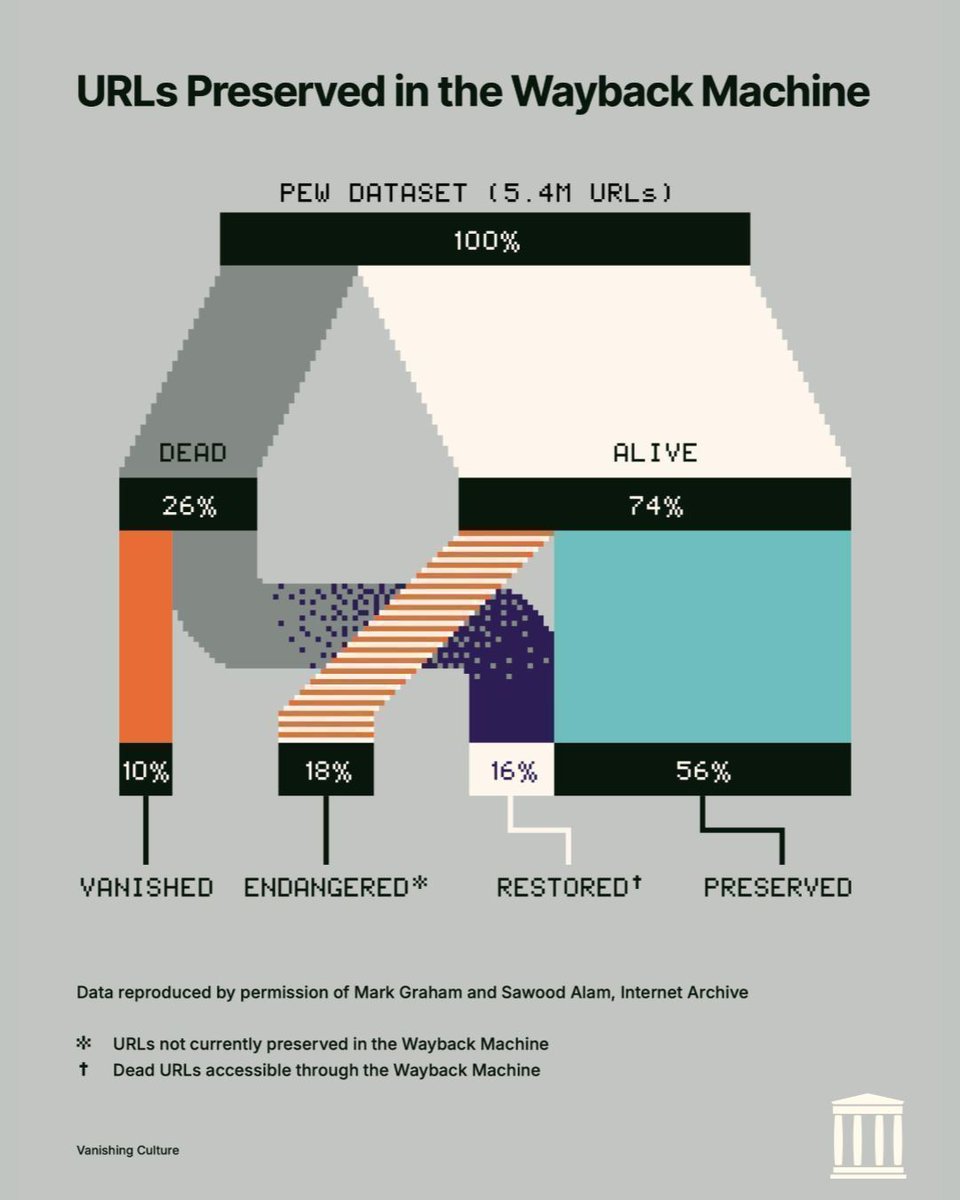
The web is disappearing 🕳️
According to a Pew Research Center report, 26% of pages from 2013-2023 are no longer accessible.
But that’s not the whole story.
In a new study published in Internet Archive's book, VANISHING CULTURE, data scientists working with the Wayback Machine have found:
16% have been restored through the Wayback Machine.
56% are preserved before they disappear.
Preservation is the remedy for cultural loss.
📚 Read VANISHING CULTURE free from the Internet Archive
📖 Download & read: archive.org/details/vanish…
🛒 Purchase in print: betterworldbooks.com/product/detail…
#VanishingCulture #DigitalMemory #InternetArchive #BookTwitter
English
lorenzo retweetledi

Today, we’re open-sourcing the draft specification for DESIGN.md, so it can be used across any tool or platform. We’re also adding new capabilities.
DESIGN.md lets you easily export and import your design rules from project to project. Instead of guessing intent, agents know exactly what a color is for and can even validate their choices against WCAG accessibility rules.
Watch David East break down this shared visual language in action👇. New capabilities and links in 🧵
English
lorenzo retweetledi

SpaceXAI and @cursor_ai are now working closely together to create the world’s best coding and knowledge work AI.
The combination of Cursor’s leading product and distribution to expert software engineers with SpaceX’s million H100 equivalent Colossus training supercomputer will allow us to build the world’s most useful models.
Cursor has also given SpaceX the right to acquire Cursor later this year for $60 billion or pay $10 billion for our work together.
English