Bashor Lab

213 posts

Bashor Lab banner
Bashor Lab

Bashor Lab

@BashorLab

Bashor Lab in Houston, Texas | Mammalian Synthetic Biology et al.

Houston, TX Katılım Aralık 2022
803 Takip Edilen1K Takipçiler
Sabitlenmiş Tweet
Bashor Lab
Bashor Lab@BashorLab·
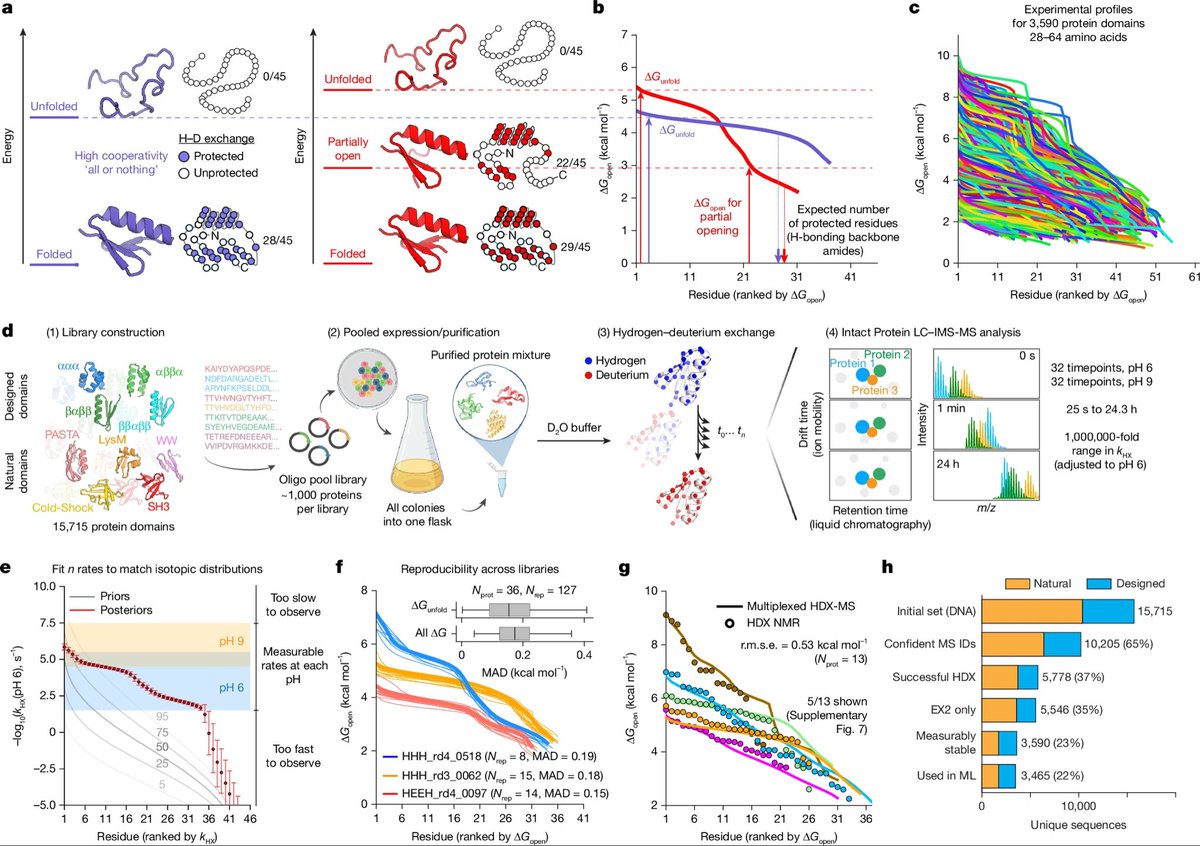
We are pleased to share a paper from our lab out in this week’s issue of @Nature, where we show that HT + ML can dramatically speed up the synbio DBTL cycles, profiling gene circuit design spaces at unprecedented scale: nature.com/articles/s4158… (1/16)
English
3
35
128
15.4K
Bashor Lab retweetledi
Nature Reviews Bioengineering
Bioengineering succeeds or fails as a system, not as a collection of optimized parts. From closed-loop devices to cell therapies, systems engineering can help convert independently optimized components into robust, validated and usable technologies. bit.ly/4bneQLq
English
1
11
21
2.1K
Bashor Lab retweetledi
Mo Khalil
Mo Khalil@MoKhalilLab·
🌱🚨 Very proud and excited to share our PREPRINT, unveiling an advance for plant science, biotech, & synthetic biology in the first (of many) Khalil <> Gehring collaborations! biorxiv.org/content/10.648…
English
3
24
80
7.4K
Bashor Lab retweetledi
Science Advances
Science Advances@ScienceAdvances·
A study of 110,303 manuscript submissions to two elite research journals has identified factors during the editorial and peer review stages that impact whether a paper is accepted for publication. scim.ag/4plgl2p
Science Advances tweet media
English
1
84
352
62.3K
Bashor Lab retweetledi
Krishna Shrinivas
Krishna Shrinivas@shrinivaslab·
Inspired by condensates that form on specific DNA loci, we ask: Can we design multicomponent fluids to form distinct condensates on diff. surfaces? i.e., perform a type of information processing (surface classification) through condensation! arxiv.org/abs/2509.08100 (1/2)
Krishna Shrinivas tweet media
English
1
10
33
6K
Bashor Lab retweetledi
Anders Sejr Hansen
Anders Sejr Hansen@Anders_S_Hansen·
(1/16) Our 3-lab collab (Mirny & Zechner) led by Harvey, Henrik & Jack is out: Q: How do enhancers & promoters interact in space (contact vs. action-at-a-distance) and time (stable vs. transient)? A: Transient E-P contact (~25-42 nm lasting ~10-20 sec): biorxiv.org/content/10.648…
Anders Sejr Hansen tweet media
English
2
61
192
16.2K
Bashor Lab retweetledi
Michael Lin, MD PhD 🧬
Michael Lin, MD PhD 🧬@michaelzlin·
The biggest lesson of my research career is something I didn't expect. It's that as hard as it is to make new discoveries — each mechanistic finding or therapeutic molecule requiring years of creativity, insight, coordination, and hard work — there is something even harder: persuading people to act on those discoveries, rather than wasting time and money on the useless or trivial. Maybe it wasn't the case when we started, but became the case now.
English
9
9
92
8.7K
Bashor Lab retweetledi
Jorge Bravo Abad
Jorge Bravo Abad@bravo_abad·
No scaling laws for single-cell foundation models: when bigger atlases stop teaching the model anything In language and vision, the recipe has been simple: more data, bigger models, better performance. Single-cell biology borrowed that playbook. Foundation models for transcriptomics jumped from 1 million cells to atlases of over 100 million, on the assumption that scale would unlock the same gains. Alan DenAdel and coauthors put that assumption to the test, and the result is sobering. Working from a 22.2-million-cell corpus, they pretrained 400 models across five architectures (from PCA and a variational autoencoder up to the Geneformer transformer) and ran 6,400 evaluation experiments. They varied not just dataset size (1% to 75%) but also diversity, using cell-type re-weighting and geometric sketching to deliberately enrich rare cell types and transcriptional states. The finding: performance saturates almost immediately. On cell-type classification, batch integration, and perturbation prediction, most models hit their ceiling at roughly 1% of the corpus, about 200,000 cells. Beyond that, adding millions more cells changed essentially nothing. More diversity didn't help. Even spiking in genome-scale Perturb-seq data, to give the models perturbed phenotypes rather than just healthy ones, failed to move the needle. Larger models did score better overall, but they too plateaued early on data. Two points stood out. Simple baselines (PCA, logistic regression) often matched or beat the transformers. And the strongest model, SCimilarity, won not because of size but because its contrastive training objective is aligned with the downstream task. For single-cell data, what you train on and how you frame the objective matters far more than how much you collect. This reframes a quiet but expensive habit. In drug discovery, biotech, and any pipeline leaning on cell atlases, the instinct to keep scaling pretraining corpora may be burning compute for no return. The real leverage sits elsewhere: curating high-quality, task-relevant data and matching the training objective to the actual question you're trying to answer. Paper: DenAdel et al., journal license | doi.org/10.1038/s41592…
Jorge Bravo Abad tweet media
English
14
96
388
100.4K
Bashor Lab
Bashor Lab@BashorLab·
@chorye Congratulations, Emma! Well deserved!
English
0
0
2
115
Emma J Chory
Emma J Chory@chorye·
Deeply honored to be named a 2026 Beckman Young Investigator #BYI!🧬 This recognition reflects the creativity and hard work of my incredible lab, and we are so grateful and excited for the Foundation's support as we tackle the next generation of continuous evolution.
Beckman Foundation@BeckmanFnd

Congratulations to our 2026 Beckman Young Investigator Awardees! Twelve Researchers Selected to Receive $7.2M in Total Science Funding for Cutting-edge Research #BYI" target="_blank" rel="nofollow noopener">beckman-foundation.org/latest-news/be… #beckmanresearch #newlyawarded

English
5
5
63
8.3K
Bashor Lab retweetledi
Jonathan Henninger
Jonathan Henninger@jehenninger·
Excited to share the first pre-print from our lab!! Check it out here! biorxiv.org/content/10.648… We found that many RNA-binding proteins understood to regulate RNA processing can also function like transcription factors and cofactors to directly regulate transcription.
Jonathan Henninger tweet media
English
4
85
342
20.9K
Bashor Lab retweetledi
Dan Landau
Dan Landau@landau_lab·
Exciting breakthrough technology from the lab, now live in @CellCellPress ! Instead of cutting the genome where proteins bind (e.g., Cut&Tag), D&D-seq scars the DNA with a deaminase, allowing single cell genome mapping of TFs and chromatin remodellers!
Dan Landau tweet media
English
19
171
668
56.4K
Bashor Lab retweetledi
Heidi Klumpe
Heidi Klumpe@HeidiKlumpe·
The preprint from my work @MoKhalilLab and @DunlopLab at BU is out on bioRxiv! As new tools come online to engineer multicellularity, we asked: how does sticking cells together into larger groups affect their fitness and function?
Heidi Klumpe tweet media
English
1
14
45
15.6K
Bashor Lab retweetledi
Polly Fordyce
Polly Fordyce@fordycelab·
Characterizing AI-designed proteins requires quantitative biochemistry at massive scale. Enter Amplicon/Protein Bead Display (APB-Display), a fully in vitro platform that quantifies Kd's for >100,000 variants in <3 days (preprint link below!) @Stanford_ChEMH @czbiohub (1/n)
Polly Fordyce tweet media
English
3
97
442
63.7K
Bashor Lab retweetledi
Arjun Raj
Arjun Raj@arjunrajlab·
Can someone start a journal called “Cell Atlases” so that the rest of the journals can go back to publishing interesting things?
English
30
117
1.1K
80.7K
Bashor Lab retweetledi
Kathrin Leppek
Kathrin Leppek@KatLeppek·
🚨 1/5 Check out the 2nd preprint from our lab on how IRES-mediated translation of synthetic circRNAs is employed in cells and in cell-free translation extracts, a highly collaborative effort with Immagina & the labs of Anders Lund and CK Chen.
Kathrin Leppek tweet media
English
3
12
62
7.2K
Bashor Lab retweetledi
Adam Rubin
Adam Rubin@adamjrubin·
In this project with Tyler Dao, Aviv Regev, Alex Shalek, and others (@shaleklab @broadinstitute @MIT @ragoninstitute), we combined genetics with molecular biology, computational protein modeling, and imaging to investigate T cell receptor signal branching. (2/4)
Adam Rubin tweet media
English
2
1
1
869