Bbaka

302 posts

Bbaka banner
Bbaka

Bbaka

@Bbaka_Crypto

Analyzing @Moneytaur_ 🔬 Quick X Search - https://t.co/cRcff2j6kx GPT trained on MT content - https://t.co/FhsNg88sWf

Katılım Şubat 2022
34 Takip Edilen1.2K Takipçiler
Bbaka
Bbaka@Bbaka_Crypto·
This approach is good for beginners. One tip I can give: you need to zoom out a chart as much as possible to fit as many candles on the screen as you can = more data in the dataset. Another tip is when you max zoomed out the chart - you can zoom out the web page itself and fit even more candles. I was able to fit 25000+ candles per screen that way. Once you start thinking about bulk analysis and more data and automation - I would recommend using at least Binance API, or even better CCXT API. Fetching data manually from TradingView is just a first step. Good luck!
English
1
0
1
56
Splendour Bytes
Splendour Bytes@SplendourBytes·
@Bbaka_Crypto Did not realise you can export from tradingview like that! This is gonna accelerate my automation tenfold Thanks for sharing the article as well by the way. Very interesting
English
1
0
1
33
Ace
Ace@CTD444·
🚨FREE, OPEN-SOURCE BREAKER BLOCKS🚨 I am proud to announce the release of multi-timeframe breaker block indicator for the community. This is, and will stay, completely free + open source.💻 LINKS👇: LTF - tradingview.com/script/D76cXPD… MTF -tradingview.com/script/0ZLFXWj… HTF-tradingview.com/script/7hl4JJM… - Live and Historical blocks under one roof - All standard timeframes - Possible to use in TV replay** - Customisable differentiation for 1x, 2x, 3x + blocks - Toggle labels - Customisable lookback Currently offers: 1m, 2m, 5m, 10m, 15m, 1h, 2h, 4h, 6h, 8h, 12h, 1D, 2D, 3D, 4D, 5D, 6D, W , 2W I have put a great deal of effort into creating this, which I originally intended for personal use. It is not perfect, there are known bugs and pine-script limitations however as it is open source I invite you to share any solutions you may find to the errors you incur. ⭐️If you find some value from this, show some love with a repost or comment so it can reach more people. --- Known issues: **In replay only functions when time frames selected are = or < timeframe the chart is viewed in ( pine-script constraint ) **On HTFs can encounter runtime errors in replay. Toggling labels will refresh script and fix this. Mitigation % selector for 2x+ blocks can be hit and miss. ⚠️If you encounter any other issues, first open and close trading view. If it persists feel free to drop me a DM and I will take a look!
English
54
77
538
38.6K
Bbaka
Bbaka@Bbaka_Crypto·
@CTD444 I wonder if it’s open-source - why don’t just share the GitHub with the script?
English
2
0
2
605
Ace
Ace@CTD444·
🚨Scripts are currently down. TradingView issue. Working to get it resolved ASAP
English
1
0
26
1.3K
Bbaka
Bbaka@Bbaka_Crypto·
@Phaco10 Piece of advice: avoid image analysis for pattern recognition. It's better to rely on pure price data at first. Once it's ready, you can add image analysis as an extra layer.
English
0
0
1
51
Phaco
Phaco@Phaco10·
@Bbaka_Crypto Wow... That's impressive. I'm trying with a friend to build something like pattern detection and it's nothing but simple. We are using openclaw and supabase. We are still learning and improving. I'm glad to see your approach <3
English
1
0
1
59
Bbaka
Bbaka@Bbaka_Crypto·
@log1_053 Hi, can you add me to the list? I wanna be on the walk of fame one day.
English
0
0
4
166
M-log1
M-log1@log1_053·
Like bro are you serious? How are "real" people talking like this about someone who has been wrong shitloads of times. What person talks like this, fights like this, for a digital person they never seen before. Absolutely no sane person that makes dollars himself would do so. Moneytaur you're done. Below just a few from the last 10 minutes.
M-log1 tweet mediaM-log1 tweet mediaM-log1 tweet media
CryptoBelle@CryptoBelle01

@log1_053 At this point you must be paid by some whale to shit talk the master in this game. What a sheep you are with ur 90% down portfolio.

English
31
0
15
7.5K
Bbaka
Bbaka@Bbaka_Crypto·
If you're using Cursor, you can switch to other model for planning. Limits are per model, not per Cursor account. Keep chats short, start new ones more often. Longer chat = more expensive it becomes. When you start a new chat, ask model to summarize everything you discussed or did so far, and paste that into the new chat to keep the context.
Bbaka tweet media
English
1
0
0
124
Karlis Laucis
Karlis Laucis@FTKarlisLaucis·
@barnc0re @Bbaka_Crypto That cursor is amazing, but I recommend you to plan and generate ideas in a different platform, as I did everything in cursor and burned through my tokens in 3h.
English
1
0
1
32
Buying the top
Buying the top@buying_top·
@Bbaka_Crypto Wow this is great, I've lost my motivation with programming a while ago but this fully revived it. Great read thank you!
English
1
0
1
71
Bbaka
Bbaka@Bbaka_Crypto·
@RiskHedge99 WR really depends on the asset and timeframe. And WR alone does not always provide a profitable edge.
English
1
0
1
290
RiskHedge99
RiskHedge99@RiskHedge99·
@Bbaka_Crypto Adding multiples scenario + scoring with confluence +decreasing scoring on touch and just take a+ setup you can reach around 65% WR
English
1
0
1
120
Bbaka
Bbaka@Bbaka_Crypto·
Are you building it yourself only or with the Claude? When I was getting stuck with bugs, here what I did: 1) Gathered all bug descriptions with steps to reproduce them 2) sent them to the Claude as bug tickets 3) Asked to work on each of them separately and test the whole pipeline after each change That way I was mimicking real waterfall development as it happens in development teams. You can also introduce a separate Claude agent that behaves as Product Owner for better features/bug descriptions. Also, every fix first had to be done in the back end. Once it was ready - the front end work was an easy fix. Feel free to dm me if you need more help.
English
1
0
0
93
Level Up
Level Up@DeCodeTheAlgo·
@Bbaka_Crypto This is awesome!! Currently building my detection engine with the goal of backtesting strategies soon. Bug introducing and consequently fixing has been a nightmare! Getting there though...
Level Up tweet media
English
1
0
1
124
Bbaka retweetledi
David F
David F@TradingHurst·
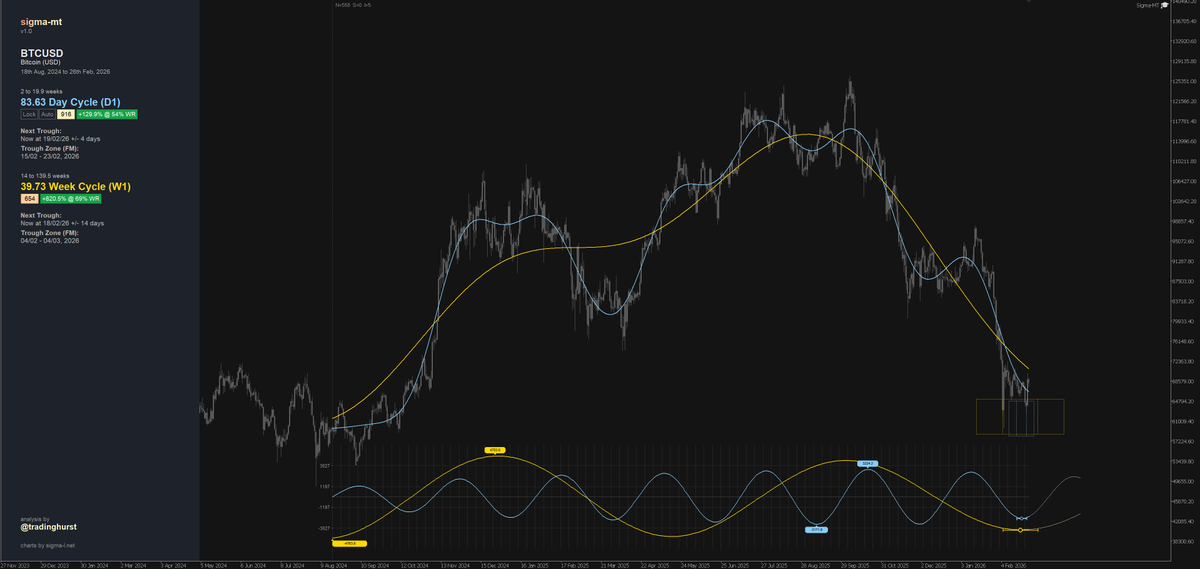
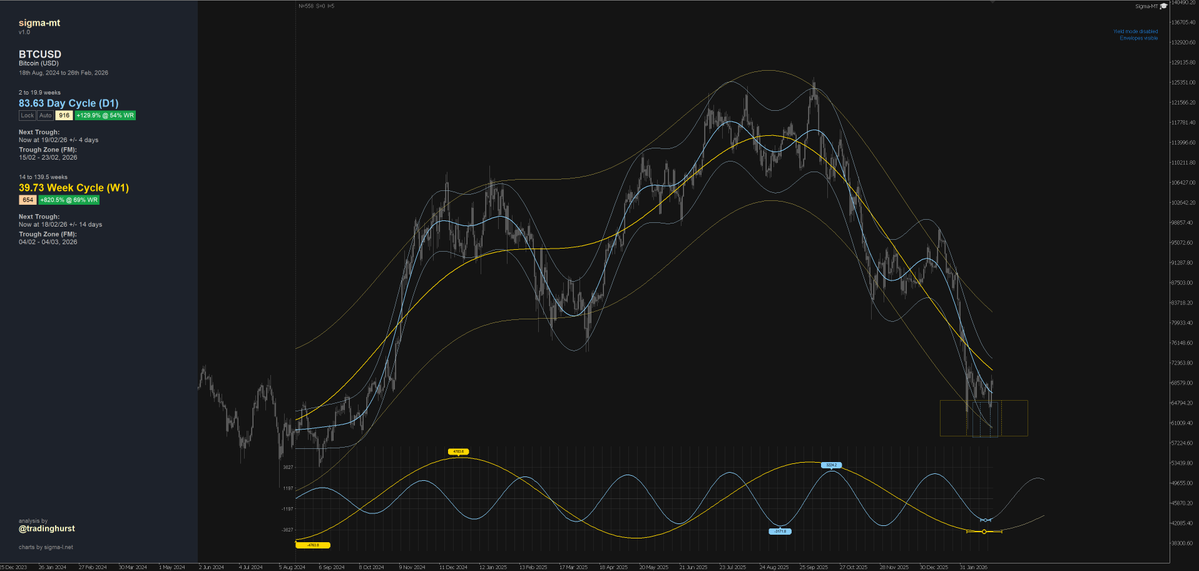
Bitcoin, such a thing of beauty at the moment. ~ 80 day cycle (blue) ~ 40 week cycle (yellow/gold) Also a video showing the emergence and modulation of the ~ 80 day cycle. Watch for the striking move to around 60 days and then back again! #timefrequency #bitcoincycles
David F tweet mediaDavid F tweet media
English
13
8
127
14.9K
Bbaka
Bbaka@Bbaka_Crypto·
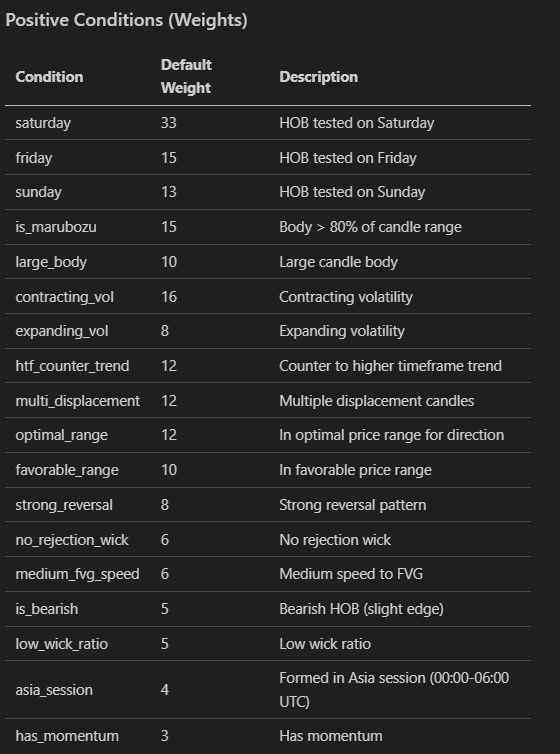
The framework described above provides some interesting conclusions, but to get specific "advices" on trading you need a little more work. What you can achieve with the one above: 1) HOB detection 2) Win rate % per asset/timeframe 3) Win rate median and mean reaction per asset/timeframe 4) PnL simulation where you would trade each HOB in the dataset with specific SL and TP. You definitely can use this data to finetune your trading. One thing that I found interesting are the longest win and lose streaks. For example, if there are multiple 5-6 length lose streaks in the dataset - I should expect the same performance in the future, not panic in case they happen and keep practicing the same edge. You can also discover timeframes and assets with a pretty big win rates, but very small R:R that does not make sense to trade - eventually it can lead to loss of all funds. Opposite case are timeframes and assets with a low % of reacted HOB, but once they do - they cover all the previous loses and more. Once this framework is done and reliable, you can build an app that would provide you data on why specific HOBs perform better than others. I call it Scoring System. Example is on the screenshot. It's up to you what kind of conditions to check, but you also can cheat and ask Claude to identify those conditions, just provide all datasets that you got after running the pipeline. Once you have those conditions - you definitely can use them for trading. For example multiple crypto assets perform better on weekends, especially Saturday. There are unlimited conditions that influence the performance, but you need to use large amount of data to be sure that condition is positive, and how much positive it actually it. Usually I recommend having at least 30 HOBs in the dataset for simple analysis, but the best results are above 200 HOBs. I upload up to 25000 candles per analysis. I also did a Position Calculation app. This one takes the result from the Scoring System, and calculates the most optimal size, SL and TP for the new HOBs based on their score. Now about conditions around HOBs, majors, fibs, etc. It is possible to add them to the pipeline, but I'm not ready for that yet. All of the back testing that is done by the framework relies on the pure price action of the asset. Adding majors doesn't sound difficult. You need to analyze 2 chart: an asset and a major. Then you add a validation: if asset_price is in an HOB zone & major_value is in an HOB zone = confluence. Then you run the same pipeline as before. You can also do the same for multi timeframe confluences - so instead of a major you compare against a different timeframe. Adding BOS condition sounds a little more difficult. You need a condition that checks: if asset_body_candle closes above HOB_shadow = BOS. I simplify the logic, but I hope you got the idea. Fibs are difficult and I don't have enough knowledge to do that. Identifying ranges, PSL and PSH is pretty subjective and relies on vision a lot. I bet there are complete solutions, but I didn't use anything that I didn't build myself. Macrofactors are visible on the data already. For example, when HTF trend is bearish, I can see that bearish HOBs start to perform better, with lower lose streaks.
Bbaka tweet media
English
0
0
10
463
DonJim🌱
DonJim🌱@Donjim95·
A very interesting post, thank you for taking the time to write and share it with us I have some questions if yu don't mind First of all, has this whole system helped you somehow practically in your trading ? I mean based on your data, did you stop trading specific HOBs and focus only on the ones with the highest win ratio ? What are your conclusions ? Secondly and most importanly, do you think the results are valid enough to consider them without the context around the HOB ? For example: 1. If BOS performed ( i didn't see anywhere talking about it, correct me if i am wrong ) 2. Macro factors/ Trend 3. Fib levels. If a fib clearly lines up inside the HOB area ( or above it ), which one is and if different fibs gives different results ect Correct me if I am wrong, but I think the context doesn't matter only if you tell me that you have found a TF on an asset that has high winrate, otherwise if your data shows that all TFs has around 50% winrate then the context matters
English
1
0
2
748
Bbaka
Bbaka@Bbaka_Crypto·
Feel free to ask!
English
1
0
8
971
Bbaka
Bbaka@Bbaka_Crypto·
You definitely can! Just get yourself Cursor with Claude Opus. Here is the pipeline: 1) Detector App: this one should find/detect BBs. You input data as a .csv file - you can get it in TradingView > export. It should output you all the timestamps of the candles that match BB criteria (preferably as a .csv file as well). You don’t need to code the detection logic, but you need to explain to Claude very precisely each condition of a BB - what makes any candle a BB. Here you only want to explain basic rules, do not go into fine tuning yet. Start with a small dataset around 100 candles where you know for sure are some BBs (even ugly ones), iterate with Claude until it finds all of them in that dataset, then expand to bigger dataset. 2) WinRate App: you input your new BBs .csv, original .csv that you used for detection, and a stop loss. App should analyze every BB from dataset against your stop loss. If it wast hit and BB did a reaction = win, if SL was hit before reaction = loss. You can also add a reaction % calculation - what was the furthest price a BB reacted, before returning back to BB price range and eventually hitting your SL. Again, you save your results as a .csv file. 3) Scorer App: this is app where you can see how some edges are emerging. Give Claude your original dataset and both datasets from Detector and WinRate apps. Ask to identify what are hidden conditions of the most profitable BBs. It will provide you with a list. You can use and modify this list as you want, eventually you need this list for the Scorer App. This app will do the same analysis that Claude did, but on any dataset with pre-setup conditions. Each condition should get a score, for example from -20 to +20, where -20 is a conditon that totally fucks up a BB performance, and +20 as opposite. From here it’s up to your imagination what conditions you want to verify, but this is a basic framework to begin with. You can give this description to Claude and make a development plan. Each app can be a simple python script. If you’re struggling using a command prompt/terminal - for each app you ask Claude to make a simple html page with UI controls. All LLMs are great for data analysis, and price charts are full of data. Also quick note: for statistical edge you need at least 30 data points, better when 100+, perfect when 500+. Feel free to ask!
English
5
1
26
794
Overlord
Overlord@OverlordEins·
@Bbaka_Crypto It's great to be able to backtest with code rather then manually. I hope AI develops fast enough so I can simply backtest strats with a prompt.😅
English
2
0
3
630
Overlord
Overlord@OverlordEins·
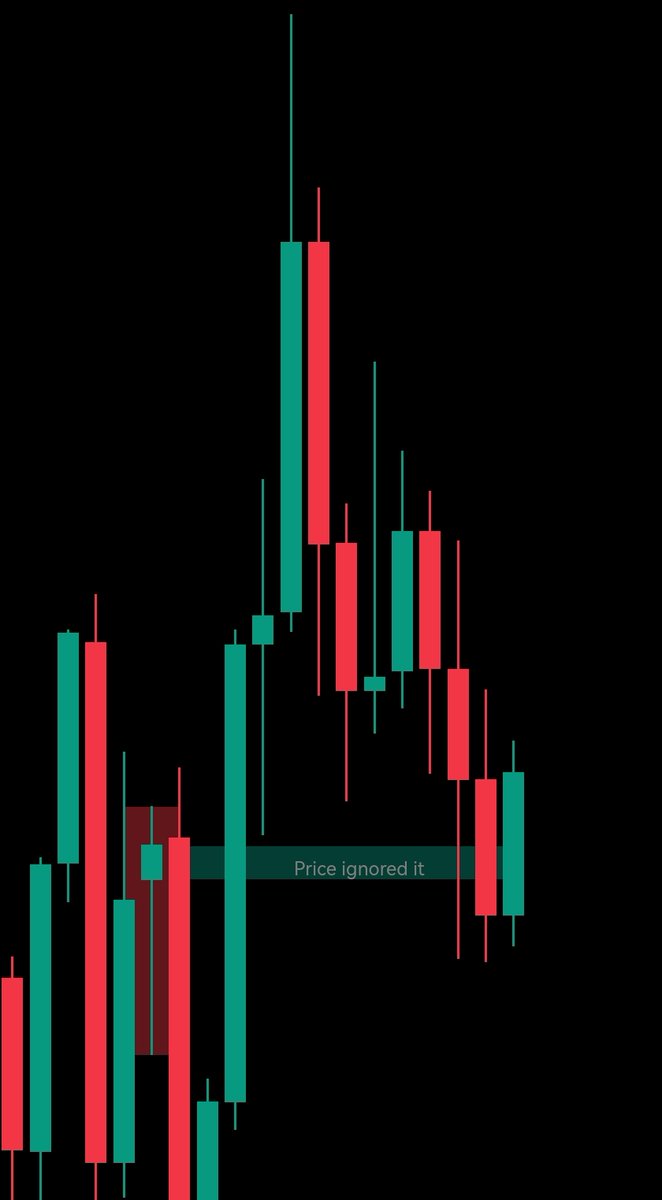
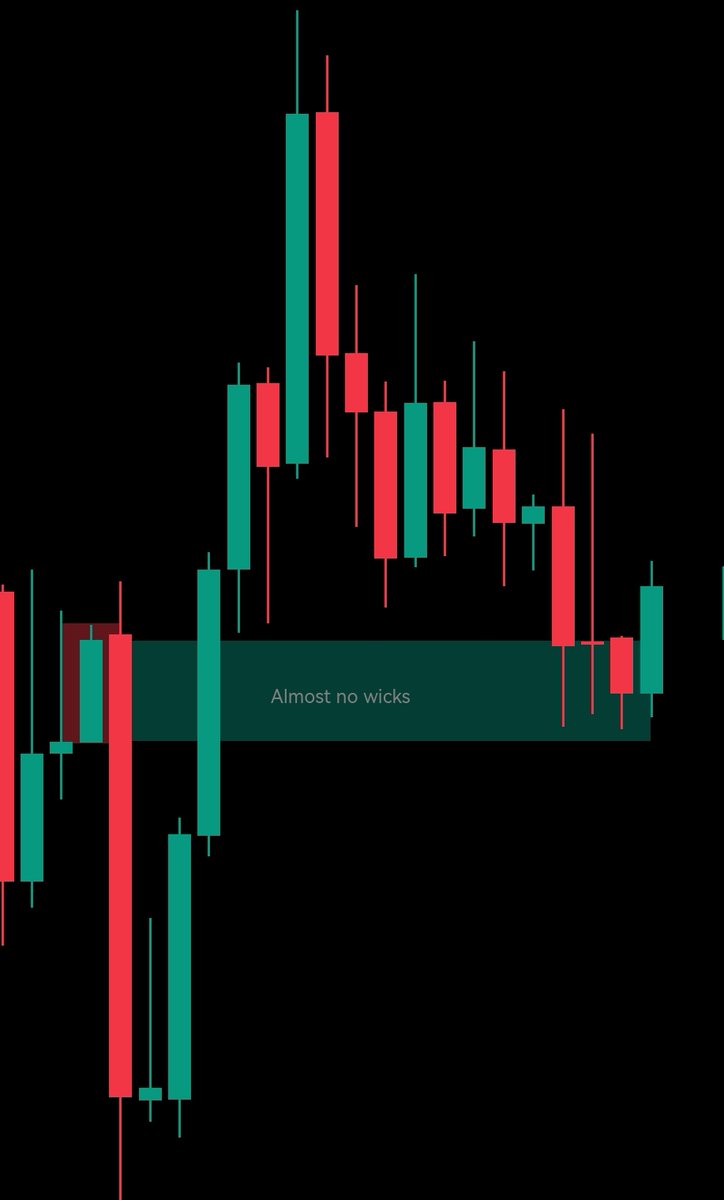
⚠️ How to Filter Out Weak Order Blocks In the past, I compared OB/BB to a Time Price Opportunity chart. If we know that price spent six months within a very small range, we can approximate where most of the liquidity is located. Image 1: However, with an OB where the wicks are disproportionately larger than the order block itself, using only the candle body might distort that. The wicks show the wide range in which price spent those six months. If we choose the candle body as a key liquidity level, the chance that the volume is actually in the wicks increases. Image 2: On the other hand, if we go down to the 5 month timeframe, we might see an order block with almost no wicks. When there are very small wicks, we can be more confident that most liquidity is concentrated within the body of the candle. In that case, we know that price spent roughly five months within that narrow range. Observing how price reacted, the 5 month block seemed to work better. In MTC, we might describe this as price taking all the liquidity hidden in the wicks. That’s also why order blocks tend to work better when they align with the POC — because that alignment might correct for any distortions caused by wick extremes. When refining order blocks, we also check multiple timeframes to find overlapping levels that confirm that price spent the most time within a specific range, which increases the probability of it being a key market maker zone. It’s just a theory I’m still working on, but I wanted to share my current thoughts. What do you think of this theory? I haven’t done enough backtesting yet, but from a logical standpoint, it seems to make sense. Of course, candle closes themselves also show institutional bias, and MT also says that volume is located within the body. However, he then also refines the wicks into bodies, choosing the areas where most of them overlap.
Overlord tweet mediaOverlord tweet media
English
8
22
196
7.3K
Bbaka
Bbaka@Bbaka_Crypto·
@OverlordEins I only check the BB body itself in that case.
English
1
0
2
305
Overlord
Overlord@OverlordEins·
@Bbaka_Crypto Did you also check the Marubozo on both candles or only the expansion candle. And I guess it also usually created an FVG. (Marubozo = Candle with no or very thin wicks)
English
1
0
5
673
Bbaka
Bbaka@Bbaka_Crypto·
What data do you have to prove that particular candle on a swing extremum was the one were MM bought/sold? Behind each SM concept is some logic or math, but just believing that "this is what MM does" is not the explanation. Most MMs profit from the spread trading. It's profitable, predictable and risk is calculated. What you're referring to are more of whales/institutions that "control" the price. These ones are definitely can let some of their bags/positions to go negative - because they have multiple bags, each one hedges the other, and the eventual goal is to be profitable across all of them. They also compete with each other and are not orchestrated. The way they build positions and hide them are not OB/BBs. Those are just indicators of liquidity the nature of which can be different. When whales are moving the market (insiders with information, big liquidity/emission holders) - MMs are at risk of losing, not winning. Toxic order flow is in no way any good for a market maker, but the biggest problem to solve.
English
0
0
1
39
Harry
Harry@harryarist·
@OverlordEins @Bbaka_Crypto The "why" behind OBs is clear. MMs bought/sold heavy and they do not accept their bag to go negative. But the "why" behind BBs... haven't figured it out yet.
English
1
0
0
62
Overlord
Overlord@OverlordEins·
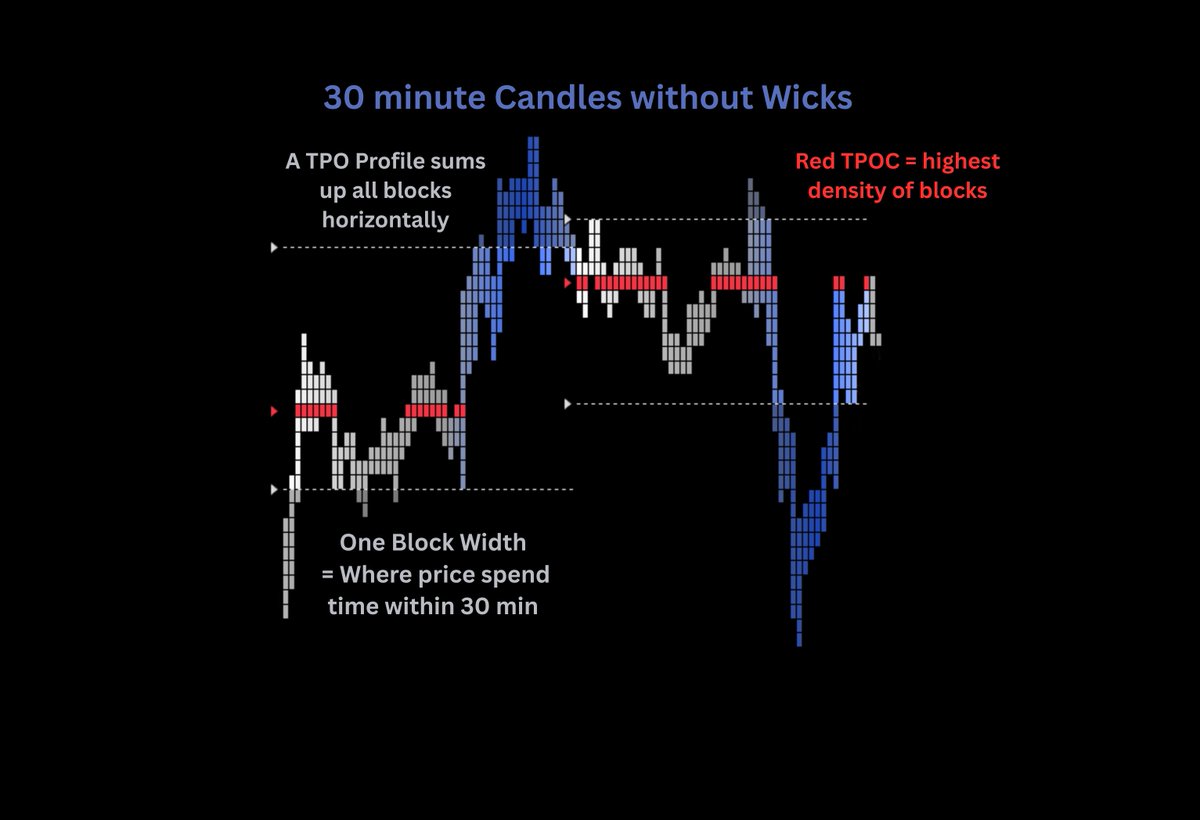
⚠️ Why do visual candlestick patterns like OB/BBs even work? To understand the logic behind these, one must understand how volume is created within a chart. In the past, before retail traders had access to precise volume data, Time Price Opportunity (TPO) charts were used to approximate volume. For volume to occur, price needs to be present. Volume then shows the participation in trade at those levels. The presence of price and the time spent there is a limiting factor for Market Makers to get their large orders filled. The less time spent at a level, the less participation (volume) is possible. Looking at an example of an extended TPO profile, one can notice that it closely imitates a 30-minute candlestick chart, simply without any wicks. Now, to approximate the volume at different prices, these 30-minute candles are added up horizontally to create a profile. Using this profile, one can identify where price spent most of its time and probably transacted most of its volume. Looking at the image below, one can clearly see the overlap between the TPO Profile (blue/white) on the left and the Volume Profile on the right. The TPO profile also shows where price spent the least amount of time through single prints. These are areas where, by adding up all blocks horizontally, there is only one block in width. Those are often either wicks (tails = 3 single prints) or FVGs that are commonly used as S/R levels. (last image) So, why do candlestick patterns even work? When we use them, we are essentially doing the same thing as analyzing a profile: we are identifying areas where many time-blocks overlap. That is why MT also focuses mainly on the candle body rather than the wicks. A basic OB on a HTF shows a summary of multiple low-TF candle bodies that spent a lot of time within that area. This presence at a price level is often created by MMs trying to fill large orders, which translates directly into volume. A BB is similar, except that price previously spent a lot of time forming an OB, which then gets ignored by printing single prints/FVG. Similarly, refining works on the same principle by narrowing it down to the highest density of bodies. The last image is from @luckychartape's discord. He made it free for this week. I would recommend joining to check it out, he even made a video on this topic.
Overlord tweet mediaOverlord tweet mediaOverlord tweet media
English
9
48
374
20K
Bbaka
Bbaka@Bbaka_Crypto·
Just curious: 60 minutes sounds like a lot. Are you using vector optimization for detection logic? Are you running on 1 thread? In my experience it should take couple of minutes. Also, wouldn’t it be better to fetch the data ones per let’s say hour and just cache it? Instead of running everything from scratch for each user.
English
1
0
0
63
Liquidity Scanner
Liquidity Scanner@LiquidityScan_·
@barnc0re 🙏 Thanks for taking the time to write this up – I couldn’t have described the purpose and workflow of the Liquidity Scanner better myself. If anyone has questions about runs, settings or the files, I’m happy to answer it.
English
2
0
11
437
Barncore
Barncore@barnc0re·
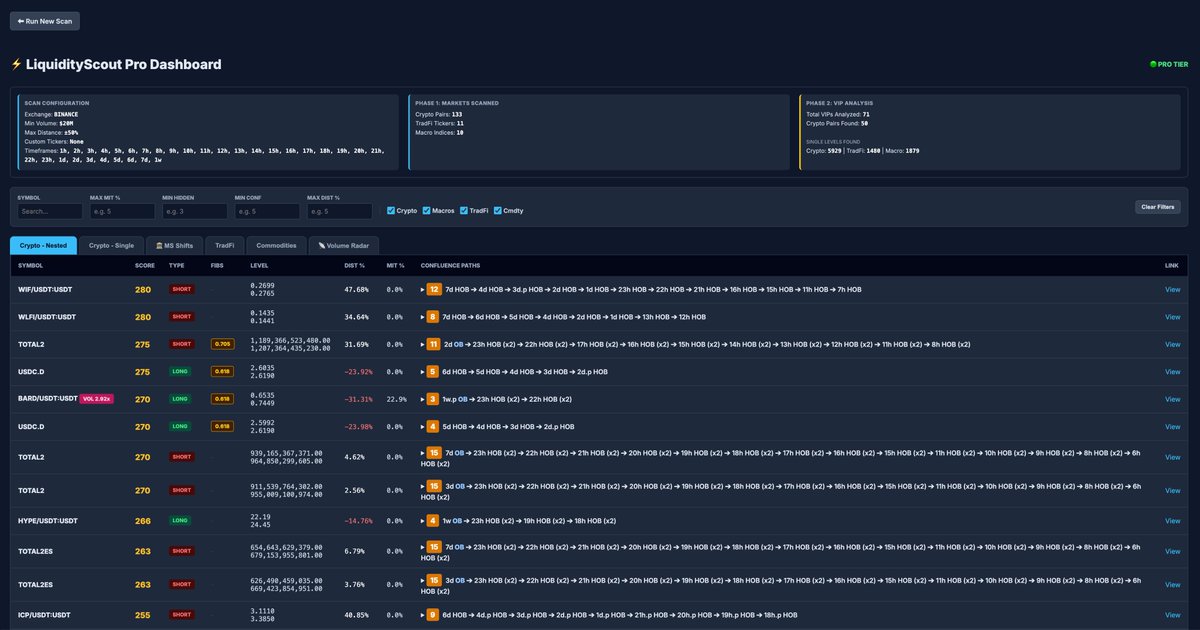
Dear Moneytaur traders, you just found your new secret weapon... Have you ever spent hours charting various coins, only to realize there's no actionable OBs in the bunch? Have you ever wished there was some kinda tool that automates the "screening" process and just somehow delivers you a map of ALL the relevant/nearby OBs from HUNDREDS of charts to your door at the click of a button? If so then you'll seriously wanna check this out... WHAT IS IT: - It's a tool that generates a spreadsheet on command, which contains lists of nearby OBs (yes and HOBs) across multiple coins of an ENTIRE exchange, across MULTIPLE TIMEFRAMES. - The tool is essentially a FILTER, it shows only the relevant OBs that withstood a rigorous filtration process. E.g. Only OBs within 20% of current price, coins must be over a certain volume amount, OB candle bodies must not be under a certain size, stuff like that (see website for details). It delivers only the very finest. - Then you can filter the actual spreadsheet yourself. Maybe you'll choose to only chart the HOBs instead of just the OBs. Or maybe you'll only chart the OBs with 0% mitigation. But you wanna hear the REAL game changer? It also shows you if an OB has OVERLAPPING OBs from OTHER TIMEFRAMES. 🔥🔥🔥 This thing is the king for finding A+ setups quickly. I'll show you my workflow in the comments. SO WHAT DOES THIS MEAN 4 ME: - It means that you only have to focus on JUST CHARTING. It will feed you the LOCATION of the various relevant OBs, but it's still up to you to assess MS context, find confluence with fibs etc, read PA, and execute. - If you're a serious trader, this thing will not only save you tons of time, but brain power too. Everybody's brain has only so many "micro decisions" they can make per day, and this tool reduces those so you can focus on what matters: charting / execution / management. - Minimize decision fatigue. Maximize time. I SAID WHAT IS IT: It's called the Liquidity Scanner - @LiquidityScan_ Essentially the main design principle is that showing you the nearby OBs allows you to act on it soon after charting it, while it's still fresh in mind. - Site: liquidity-scanner.gitbook.io/liquidity-scan… - TG bot: t.co/mJ6uVSVGXW WHAT'S THE CATCH: - It takes 10-60 mins for the spreadsheet to generate (depending on how many timeframes you choose) - It costs money (it's for serious traders only) - It just filters the relevant OBs for you, you still have to actually chart it up, find confluence etc - Once you use it you wont be able to live without it- Warning! WHY ARE YOU SHOWING ME THIS: Straight up: because i want the dev to get more subscribers so he keeps the tool running lol. It's THAT fkn useful. That's my bias. But what that should tell you is this: I value this tool enough to put effort into this post even though i don't get money out of it. This thing is seriously handy. I've been feeding feature requests to Simon for almost a year and he has been very receptive, he adds suggested features quicker than you can say "liquidity scanner". The thing has steadily improved every month, and he still has more improvements in mind for the future. But here's the thing guys, right now this thing apparently has only 5 regular daily users, so this is still a very hidden edge. Whoever signs up after reading this will be among a small group of smart cookies. I don't get any kickback by the way, i just want the lights to stay on. ENOUGH TALK SHOW ME: See comments for workflow... 🧵
English
13
11
106
12.2K
Bbaka
Bbaka@Bbaka_Crypto·
>Hidden liquidity in the premium of the range. >30+ days. >When retail was bullish - longs SL liquidity got taken to fuel up. >Later most of short SL liquidity taken as well, while everyone got bearish > expect to get enough liquidity to fuel down. >New levels got printed below = magnet for the price. >Find, wait, execute. >Don't over-complicate. Thank you for the DAX video!
English
1
0
36
1.2K
Albert
Albert@Albert_618·
Whats the Difference Some Months ago some people asked questions and were in doubt like "what if they change that Hidden Orderblocks work because everybody knows about them?" The doubts came before they made money. Whats the difference? Why do my trades work on an okay Winrate but others don't? When you maybe watched my videos or looked at some of the past trades, they have something in common. Can you spot it? If you are really interested, go and find the levels and the things that they have in common. $POL x.com/Albert_618/sta… $GUN x.com/Albert_618/sta… $XRP x.com/Albert_618/sta… $DAX (full explanation I think...) x.com/Albert_618/sta… Can you see it? There are way more on my feed... I don't only post them to show off (yes ofc I am proud on the trades I take but you can actually learn something) I recognize the difference how people see things. When I look at a Chart and find a Block my brain works a lot. I want to see the Pattern I like, I want to find the things that should be in the PA and then I make my plan. Of course I'm wrong often. Part of the game of making money on charts. I See a lot of people marking every BB or even trading every BB. Some go on weird Timeframes, as if the Hidden liquidity would be a holy grail that fills their pockets with $ - a fantasy that sadly will never come true. There's more in the charts. Way more. Once you understand what makes sense, your number of trades (maybe) goes down a lot and you become more relaxed. Stop rushing. So... back to the beginning: What are the things that have these Setups in Common?
English
15
6
154
6.9K