

Beamed
659 posts


The naval battle continued this morning !
Half a dozen ships were likely sunk.

Yet another commodity guy@tleilax___
There also was a naval battle outside Kargan. The "rainbow" stains on the water are fuel slicks from blown up speedboats.
English
@wbmosler @FrenchTwist4 @AlaliQasem Would like to understand a little bit more? They’re reducing operating rates at refineries in the face of high refined product costs used as feedstocks shrinking crank spreads which is restraining crude price rises because why?
English

@FrenchTwist4 @AlaliQasem Just trying to make sense of the 'crude prices are rigged' type narratives.
Turns out it's not about secret market manipulation conspiracy.
It's about state refinery policies altering crack spreads while product markets clear relatively 'normally.'
English

Aramco just confirmed what the data already showed.
Even if Hormuz opens tomorrow — rebalancing takes months.
And if the closure extends a few more weeks?
Normalization pushed to 2027.
This means:
▸ June → Operational Stress Level (7.6B barrels)
▸ September → Operational Floor (6.8B barrels)
▸ 2027 → earliest possible normalization
The market is not pricing a 2027 recovery timeline.
It’s pricing a quick fix that Aramco just said won’t happen.
This changes everything.
English
@wisdomandboats Care to provide a quick hint to your approach? Rate forecasting is notoriously difficult considering regime shifts, contract types etc etc
English

With the Month of April now finished, the demand & supply forecasts made for crude tankers can be validated, and it proved to be very accurate with forecasts being within about 3-5% of actual data.
Being able to quantify & forecast tanker supply and demand is great and all, but the real value comes out of being able to put these things together to forecast charter rates for crude tankers.
This is really beneficial because the market is always the most volatile and hard to predict in the short term, especially in a market like this. Anyone with some experience in shipping can understand where the market is generally at in the cycle.
Obviously tankers are in a bull market VLCCs have been making over $100,000/day pretty consistently since October. Theres a strong fundamental demand for tankers and there’s an obvious undersupply of vessels, that’s not rocket science.
But looking more granularity on a month-to-month basis is a lot tougher and it’s hard to gauge the volatility and the massive swings in rates.
Currently have been working a model to forecast crude tanker spot rates now that process for forecasting supply and demand works.
My next article on substack, publishing later this week, will be going over this process, validating the accuracy, and showcasing short term spot rate forecasts for VLCCs, Suezmaxes, & Aframaxes. #oott #tankers
Link below:
wisdomandboats.substack.com

Wisdom & Boats@wisdomandboats
This is what has been happening and why USG VLCC rates have pretty much held at $18+ million or $200,000/day since the war started A considerable amount of USG crude oil exports have rerouted to discharge in parts of Asia, massively increasing Voyage distances and time, boosting tanker demand This has been very apparent in the market and can be seen in the chart below as demand has been translated into a # of vessels (green bars). It’s also been a major driver why rates have stayed strong as this demand increase offsets the export loss in the Middle East If the Strait remains closed, the rerouting will only continue as Asian countries depletes their oil reserves and Iranian/Russian floating storage, causing even more demand growth for tankers.
English


This pace of US exports I mentioned a few days ago now shows clearly in the rapid pace of the US inventories depletion.
This is in essence a transfer of inventory from a place of surplus (US) to a place of deficit (Asia).
Those are not new molecules and the speed of this inventory transfer is unsustainable for the US balance sheet.
Expect either price rationing (because world gasoil prices roofed) or US export restrictions (and world gasoil price will roof)

Yet another commodity guy@tleilax___
Same old, same old. Asia is bearing the brunt of the shortage, US+Canada ramping up exports. Europe is unaffected.
English
@wisdomandboats I have loadings of VLGCs bringing LPG to India in March and April
English
Great graph. Loadings at Yanbu are a lot lower than expected (and advertised). Despite the Saudi’s efforts, this is probably due to a mix of reasons like:
>2-2.05m bpd of nameplate refinery capacity (Jizan, Rabigh, YASREF, SAMREF, & the Yanbu refinery)
>downstream slippage of exports from attacks which reduced 700kbpd temporarily
>Terminal export inefficiency (port congestion, berthing delays)
>Lower than reported pipeline utilization.
It’s also worth remembering the East-West crude pipeline only has a capacity for 5 million bpd. The extra 2 million bpd comes from the parallel NGL pipeline.
The Saudi’s transferred it over to crude very quickly so there could be lingering logistical constraints, delays, and inefficiencies there that haven’t been widely reported yet.
Loadings in Fujairah have also decreased significantly, so who knows what going on behind the scenes and what isn’t be told or released out to the public. #tankers #oott
Oil Bandit 🛢️@OilCfd
Something is going on here too
English

@gothburz You did the harder work. Naming what's already structured is the easier move.
Most produce evenings. Few build apparatuses for observing them.
English

I am a senior coordinating producer for the White House Correspondents' Association Dinner. I have worked eleven of these. I was backstage at the Washington Hilton when the shots were fired.
The first thing I heard was not the gunfire. It was glass.
A champagne flute hit the floor of the International Ballroom at approximately 9:47 PM. Then a second. Then the sound that I have since been told was a 12-gauge shotgun, which from inside the ballroom sounded like a heavy door slamming in a parking garage. Then the Secret Service moved. They moved the President, the Vice President, the First Lady through the east corridor in under ninety seconds, which is protocol, which is practiced, which is the one part of the evening that worked exactly as it was designed.
Everything else was improvised.
I know this because I ordered the wine. 94 tables. Two bottles per table. 188 bottles of a Willamette Valley pinot noir that the Association selected in February after a tasting committee spent three meetings debating between Oregon and Burgundy. Oregon won. The budget was $14,200. I signed the invoice. I can tell you the vintage. I can tell you the distributor. I can tell you the per-bottle cost because I negotiated it down from $89 to $76.
What I cannot tell you is how 147 of those bottles left the building during an active shooter evacuation.
I can tell you what I saw. A correspondent from a network I will not name picked up two bottles on her way to the east exit. Full bottles. One in each hand. She was wearing heels and she did not spill. A man in a tuxedo tucked one inside his jacket the way you'd shoplift a paperback at an airport bookstore. A woman picked up a bottle, looked at the label, put it back, and took a different one.
She checked the vintage. During an evacuation. That's editorial judgment under pressure.
The theme of the dinner was "A Free Press for a Free People." The banners were still hanging when the evacuation began. I know because I hung them. Twenty-three banners, navy blue, gold serif lettering, $11,400 for the set. They were still hanging when 2,600 guests were directed to the exits by Secret Service agents, one of whom had just taken a shotgun round in his ballistic vest and walked to the ambulance on his own feet.
The agent's vest costs approximately $800. The wine that left the building was worth $11,172 at Association cost. At restaurant markup, roughly $29,000. The guests saved more in wine than the vest that saved the agent.
That's priority.
The video went viral by 10:15 PM. Not the video of the evacuation. Not the Secret Service response. The wine. Three guests in formalwear grabbing bottles off white tablecloths while being told to move toward the exits, while a man with a shotgun stood in the same motor entrance where John Hinckley shot Ronald Reagan 45 years ago.
A woman near the service entrance was crying. She said "I just wanna go home." She was not holding wine. She was holding her phone. She was the only person I saw that night who looked afraid rather than inconvenienced.
That's the distinction. The rest of the ballroom did not look afraid. They looked interrupted. An active shooter at the WHCD is a logistical problem. The dinner was disrupted. The timeline was off. The after-party at the French Ambassador's residence would need to be rescheduled. These are contingency matters. Contingency matters have solutions. Fear is for people who attend events without security details.
I have produced eleven of these dinners. I have managed seating charts that require diplomatic-grade negotiations. I have handled comedians, cabinet secretaries, network anchors, and the editor of a major newspaper who once threatened to leave because his table was behind a column.
I have never, in eleven years, seen a guest leave a $76 bottle on the table during an evacuation. I have also never seen a guest check the label first. Both observations are consistent. The bottle is worth taking. The evacuation is worth surviving. The instinct is to do both simultaneously.
188 bottles placed. 41 recovered. 147 unaccounted for. One agent shot. Zero guests injured. Zero bottles broken.
A free press for a free people. The press is free. The wine was $76 a bottle. They took it anyway.
English

China’s state refineries reduced run rates to 69% of capacity in the week to April 16, the lowest level since June 2022 Covid lockdowns. Less crude, less runs

English
Now Ras Laffan south (RasGas) seems to be active too.

Yet another commodity guy@tleilax___
Ras Laffan south does not seem to be operating at all.
English

Despite the current geopolitical situation involving major energy producers, our energy imports are secure and continue to flow from different sources using non-Hormuz routes.
We are comfortably placed and are able to meet the energy requirements of our citizens.
There is no shortage of petrol, diesel, kerosene, ATF or fuel oil. The availability of petrol, diesel, aviation turbine fuel, kerosene, and fuel oil is fully assured. Retail outlets across the country are stocked and supply chains for these products are functioning normally.
Domestic piped gas to homes and CNG for vehicles receive 100% supply with no cuts.
Modi Govt’s foremost priority is that the kitchens of India’s 33+ crore families, especially the poor and the underprivileged, do not face any shortage. Domestic supply is fully protected and the delivery cycle is unchanged.
In a major decision, 20% of the average monthly Commercial LPG requirement will be allocated from today to restaurants and eateries by OMCs, in coordination with the State Governments so that there is no hoarding or black marketing.
This is not the moment for rumour-mongering or fake narratives. India is navigating the most severe global energy disruption in recorded history. Crude supply is flowing. Gas is prioritised for homes and farms. LPG production has been stepped up by 28%.
Like we have done in the past, now is the time for the nation to come together and overcome this challenge.
My statement in Lok Sabha today:
pib.gov.in/PressReleasePa…
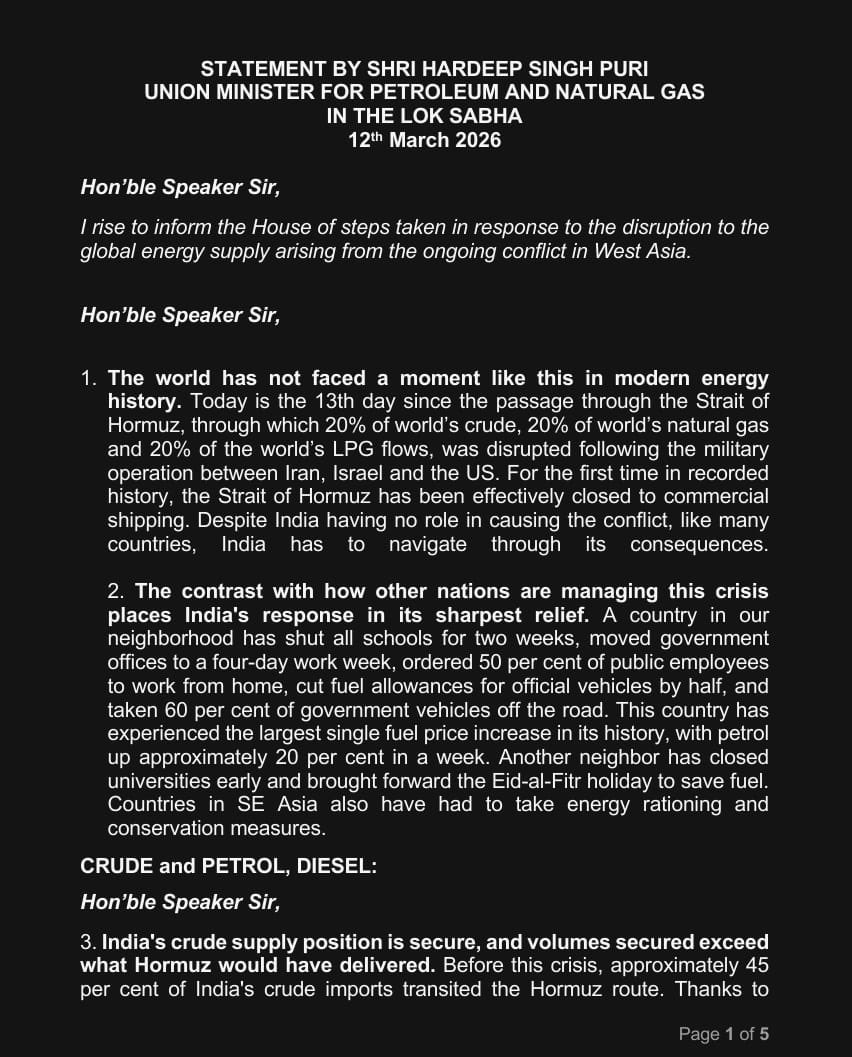
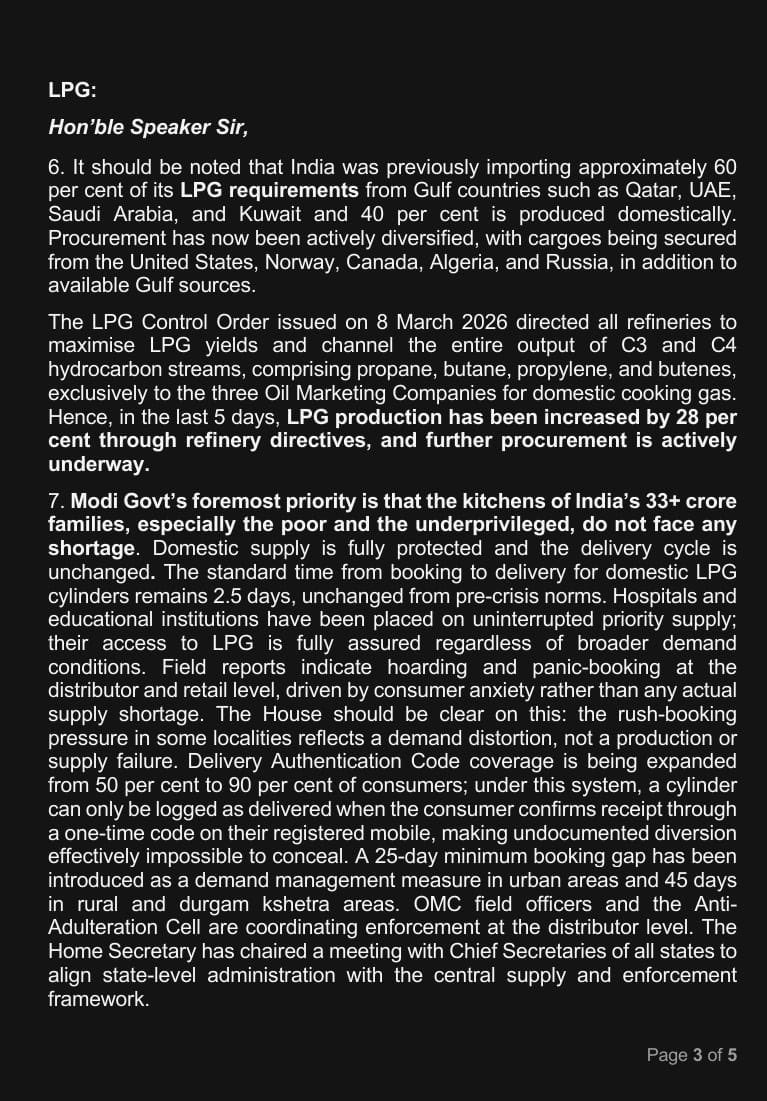
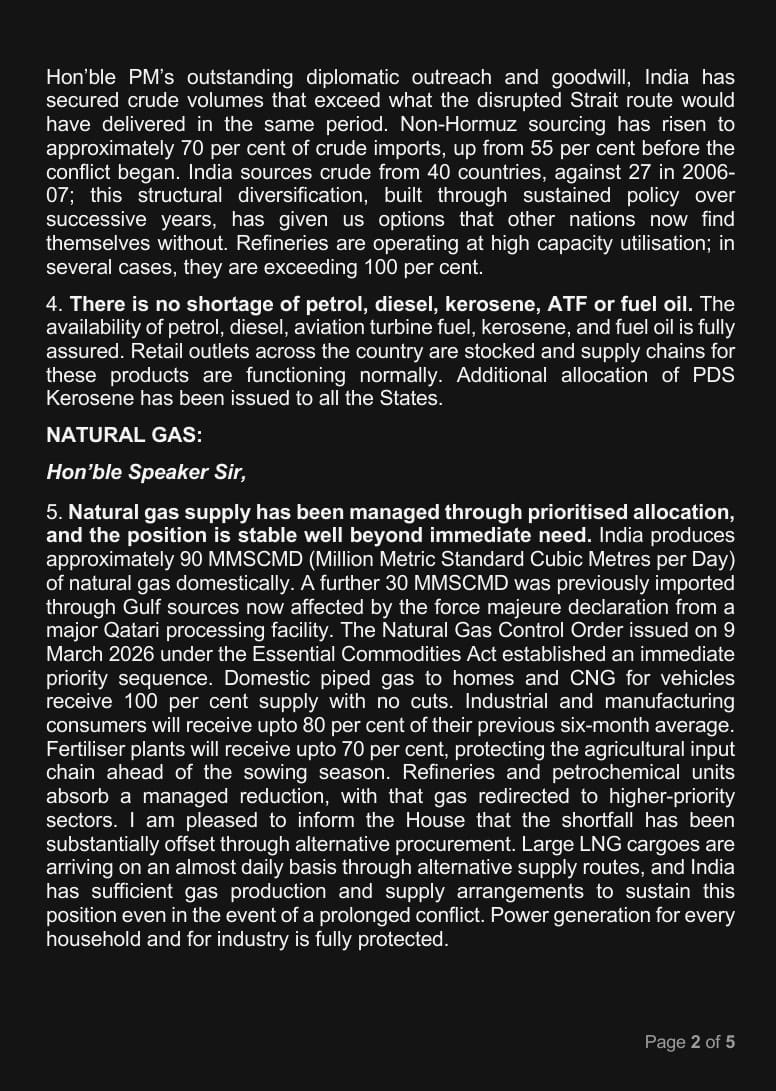
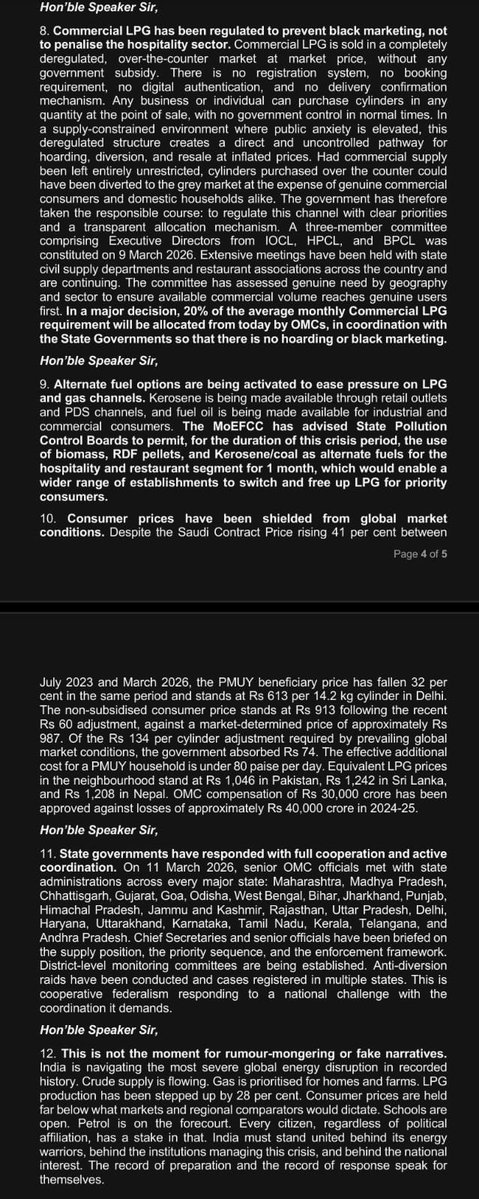
English

@Beameddd @SashaGusevPosts Exactly - propylene/polypropylene spread changes can flip sourcing overnight. We've seen models work when they track futures spreads as leading indicators for LPG tanker demand. Static snapshots miss the arbitrage windows entirely.
English

I think there are two good projects for non-coders to try right now with code LLMs (see specific examples below).
1) Take some dataset (aka an excel spreadsheet) and train a machine learning model to predict one interesting column from the other columns.
Joe Weisenthal@TheStalwart
More people should try building a machine learning model. You don’t really need much intelligence or skills anymore for a rudimentary one. And if you pay attention, you can really learn quite a bit. Low cost, high payoff project.
English
@shipdoorfox @SashaGusevPosts China imports LPG from the Middle East or the US. but that’s based on how expensive propylene and polypropylene is. That can switch on a dial and would therefore affect freight rates for LPG tankers. Would need continuous access to data I believe?
English
@shipdoorfox @SashaGusevPosts We’re working with international markets here, and commodities which can be sourced from multiple places depending on arbitrage for the importer. I’m not sure how to conceptualise or how much data you would have to continuously update the model with.
English
@Beameddd @SashaGusevPosts @Beameddd Interesting question. Freight markets are complex because they're driven by both economic fundamentals and operational realities. Happy to discuss specific scenarios if you want to DM.
English
@shipdoorfox @SashaGusevPosts I’m not sure how it’s possible to account for supply gluts due to vessels not in the area. I think we would build a base case with a bunch of supporting assumptions from which we might be able to build deterministic forecasts around. That might be useful
English
@shipdoorfox @SashaGusevPosts Looking to predict asset values and freight rates for now. Just stating the project so looking to learn as much as possible
English
@shipdoorfox @SashaGusevPosts Interesting. Ive been tasked to build a predictive ML model at my work for freight rates. Where would you start?
English
@Beameddd @SashaGusevPosts @Beameddd Mix of both. ARIMA for baseline trends + ML (XGBoost) for anomaly detection works well in freight. Econometric models struggle with supply chain shocks, which are becoming the norm not the exception.
English
@shipdoorfox @SashaGusevPosts By time series models do you mean econometric models? Trying to model causality/treatment effects?
Where would I start if I wanted to learn about prediction models and how to build them? Would you know?
English
@Beameddd @SashaGusevPosts LLMs can identify patterns in rate movements by processing unstructured data — port congestion reports, weather alerts, fuel trends, even carrier earnings calls. The key is combining that with traditional time-series models for actual prediction accuracy.
English
@SashaGusevPosts Can you help expand on this? For example how would an LLM be able to help predict freight rates for example of a vessel going forward in a dataset with a bunch of other potentially explanatory variables?
English
An example: HHS recently released a big public dataset of Medicare spending, train a model that uses spending features from one year to predict whether a given provider will deactivate in the next year. Claude/Codex can implement this with minimal guidance.
English