Connor Murray@Bitcoin_Beyond
I want to acknowledge that from the outside looking in, this post might "make sense" because the Association can and should continue to be more open, transparent, and engaging with the BSV community. This is something that Asgeir and Siggi are fully committed to. As someone that has been in BSV since day 1, I have never felt more confident in the Association's leadership, and I've never been more optimistic in BSV's future. Babbage is not on the outside looking in, which is what makes this post all the more confusing.
There's a fundamental confusion here between decentralized governance and distributed systems. Bitcoin was never meant to be governed by committee — it's a distributed network with defined rules. The NAR codifies those rules.
The guy who wrote the ISDA Master Agreement, the standard contract governing trillions in derivatives globally, helped draft the NAR. This wasn't guesswork. It was deliberate: model the rules on frameworks that have actually been stress-tested in high-stakes commercial contexts.
Let's address your specific claims:
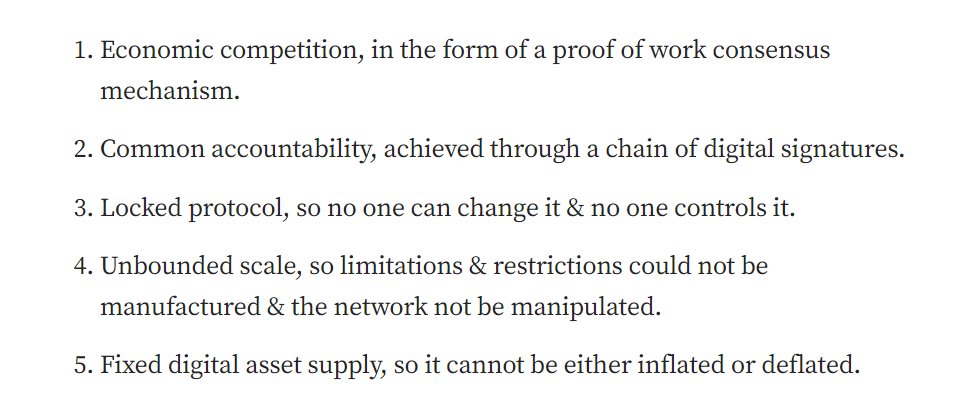
"The BSVA has ultimate authority over everything on-chain" — No. Read Part I, Clause 1a. The NAR is a multilateral legal agreement between the Association AND all Nodes. The Association is bound by the same rules. They can't act outside them. Their powers are explicitly constrained to the original Bitcoin protocol. They cannot alter the coin supply. They cannot change the protocol outside Satoshi's design. "Set in stone" is now a legal constraint written into the framework, thanks to the NAR.
"You alone can order all nodes to cut off their fellow chefs" - Also no. Any enforcement action requires the Association to act "reasonably and in good faith" (Clause 6). There's an entire Part III (Enforcement Rules) and Part IV (Dispute Resolution Rules) that govern this. It's not arbitrary. It's not unilateral. There's due process. The Association can send Messages (alerts), but only within defined parameters, only for actual rule violations, and with accountability mechanisms built in.
"You alone can change the NAR whenever you want" - This fundamentally misunderstands how multilateral contracts work. The NAR is anchored to an external, unchangeable standard: the original Bitcoin protocol as described in the White Paper. That anchor doesn't move. The Association can't just rewrite the terms because the foundational reference point is fixed. You can't "update" a contract to contradict its own core premise. That's not how contract law works - and the people who helped to draft this understand contract law better than most.
The NAR is a multilateral contract. Nodes are bound. The Association is also bound. They can't alter the coin supply. They can't deviate from the original protocol. The protocol is "set in stone" as a legal commitment, not just an allusion to an old forum post by Satoshi. The Association's hands are tied to Satoshi's design. That's the whole point.
On "openness": The NAR is published. All of it. Every rule, every enforcement mechanism, every dispute process — it's all at nar.bsvblockchain.org. Compare that to the backroom "rough consensus" of other chains where rules change based on who shows up to a call. Clear rules, published publicly, that bind everyone equally — that's transparency. That's the opposite of operating in secret.
On "political weaponization": You've got it backwards. The NAR exists precisely to make weaponization impossible. When the rules are anchored to an external, unchangeable standard (the original Bitcoin protocol) there's nothing to weaponize. No one gets to rewrite the rules because they don't like the outcome. The Association doesn't have that power. The NAR explicitly removes it.
What you're proposing - turning the Association into an open charity with democratic governance - would actually increase the attack surface. Now you've got factions, voting blocs, whoever organizes best wins. That's how protocols get captured. That's how politics gets introduced. Rules-based systems resist capture. Political systems invite it. I, and many others, supported BSV precisely to prevent this possibility from happening. And I will continue to ensure it doesn't happen.
On "weak institutions": You know there's new leadership. You know the team. You know they're qualified, they're capable, and they're working on exactly the kinds of structural improvements you're describing - funding diversification, stakeholder engagement, all of it. You could have picked up the phone to talk about any of this. You could have had this conversation privately with people who would have welcomed it. Instead, you chose a public thread framing the Association as "the devil" at the exact moment when the ecosystem is trying to establish credibility with regulators and legislators. That's a choice. And it's worth asking who that choice actually serves.
We're at a moment where real progress is happening. The CLARITY Act is being debated. Serious conversations are happening in DC with an administration that is outwardly pro-blockchain. BSV is finally getting recognized for what it is — the original Bitcoin protocol, the scalable one, the regulation-friendly one. Public infighting over governance philosophy at this exact moment serves one purpose: it undermines all of that progress.
If the concern is resourcing and funding — let's talk about that directly. But framing a competent legal framework as "the devil having authority" while the entire ecosystem is trying to establish credibility with regulators is counterproductive. This isn't the time.