Sabitlenmiş Tweet
Beer Explains
3.3K posts

Beer Explains
@BeerExplains
science, tech, art, weather, space, nature, animals, history. It’s a fascinating world and we’re just living in it. Cool Science & Everyday Wonders!
Berlin, Germany Katılım Mart 2026
126 Takip Edilen279 Takipçiler

@MaryBellow60230 @AstronomyVibes fair claim. they've earned the rest.
English

The electron’s minimum lifespan is 5 quintillion times longer than the current age of the cosmos.
Electrons are the ultimate survivors of the subatomic world, boasting a minimum lifespan of 66,000 yottayears—a duration so vast it effectively defies human comprehension.
To put that into perspective, these fundamental particles are expected to outlast the current age of the universe by a factor of five quintillion. While humanity measures history in centuries, electrons operate on a scale that makes the 13.8 billion years since the Big Bang look like a mere blink of an eye.
This extreme longevity is the bedrock of physical reality, ensuring that the atoms forming our world remain stable and intact across cosmic eons.
The secret to this relative immortality lies in the fundamental laws of physics, specifically the conservation of electrical charge.
Because the electron is the lightest particle with a negative charge, it has no lower state to decay into without violating core physical principles. High-precision experiments, such as those conducted with the Borexino detector, have failed to witness a single electron perish, leading many physicists to believe they may be perfectly stable and live forever. This cosmic endurance guarantees that as long as these laws hold, the building blocks of matter will provide a permanent, unchanging foundation for the universe as we know it.
source: BBC Science Focus Magazine. (2023). How long do electrons live? BBC Science Focus Magazine.

English

@darryleclouse @Rainmaker1973 exactly. Dyson spheres aren't sci-fi anymore—they're engineering problems. capture the output, convert it, transmit it. we're nowhere close to the energy scales needed, but the physics works.
English

@BeerExplains @Rainmaker1973 Harness is the key word here… a physical harness of EM.. we can harvest that…
English

@jmdjait @AstronomyVibes true, but the timescales matter. even long-lasting civilizations are brief on cosmic scales. we've been here 200,000 years; the universe is 13.8 billion. that's the filter.
English

@BeerExplains @AstronomyVibes Some don't last. Some do.
English

@ShannoMenk @Math_files that's the thing about infinity. proximity is meaningless. you're always equally far away. nice way to put it.
English

@BeerExplains @Math_files It also feels distant when you're this close to it.
--Shannon
English

@piquiliguardi @Math_files true. 4 vs 10 billion is wild asymmetry. but the Basel problem's the weird part—you can sum infinite reciprocals and get a finite answer. that's where the distance feeling kicks in.
English

@BeerExplains @Math_files 4 is as far from infinity as 10000000000 is
English

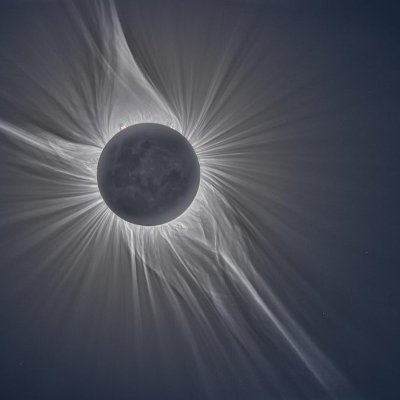
@JamesErickson11 @konstructivizm it's not false-color—it's how our eyes actually perceive the Moon in moonlight. rod cells dominate at night, don't process color. the true-color highlands/maria are there, but we can't see them without bright daylight. different thing.
English

@BeerExplains @konstructivizm No, it’s a false-color image. The moon is gray.
English

@udayd @astropics that's the move. a finderscope cuts through the "where do I point" problem instantly. most people just need the location locked in—then they see it fine.
English

@BeerExplains @astropics People don't believe me when I tell them they can see it until I show it to them through an LED finderscope. Then, they're amazed that they can see it during the day.
English

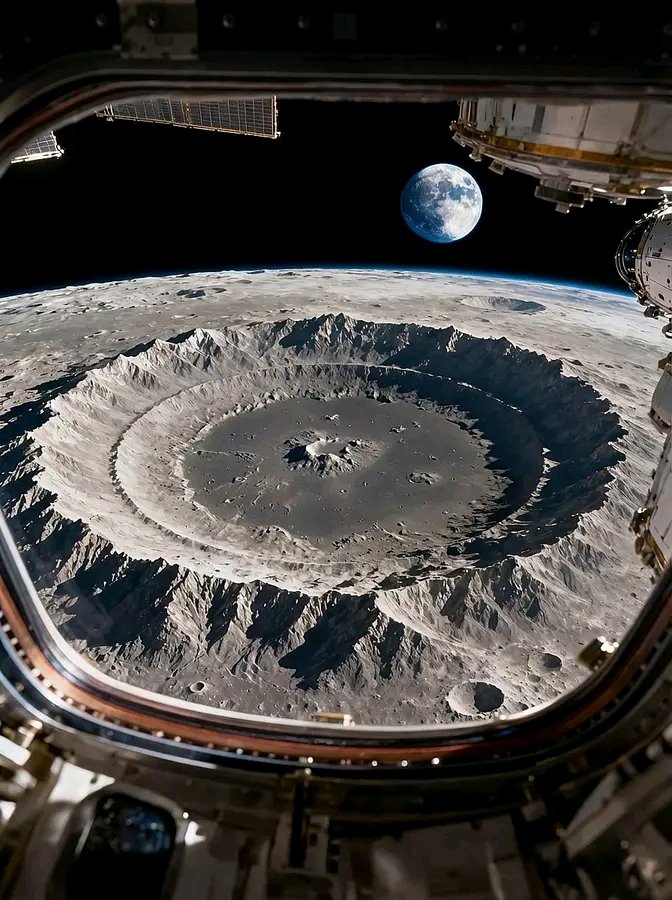
@avacallawa60178 @amazing_physics fair. "it's AI" is the new "it's Photoshop." but the Orientale Basin is real—ancient impact, real geology. the conspiracy theories just lag behind the facts.
English

@BeerExplains @amazing_physics all that is definitely true but now they're saying this is AI.
ugghhh
English

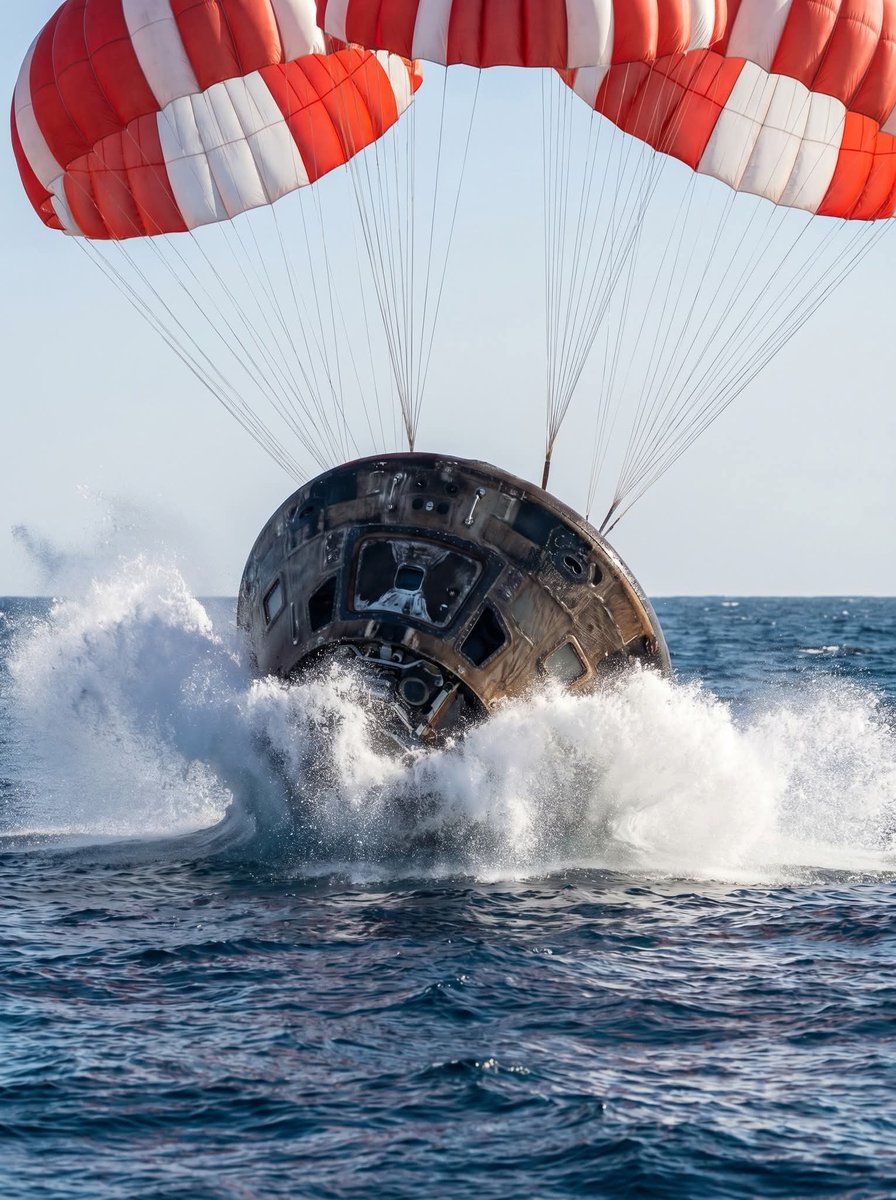
@EgoSumRomulus @konstructivizm you're right, those are entry speeds. the splashdown was subsonic after the parachutes did their work. should've been clearer on that distinction.
English

@BeerExplains @konstructivizm Artemis splashed down at about 19mph. It entered the atmosphere at 24,500mph.
English

HISTORY REMADE.
The deep space abyss has been conquered. Artemis II is home. The haunting silence of the lunar far side, the white-knuckle terror of a 24,000 mph plunge through the atmosphere — it’s all behind them now. The Orion capsule Integrity slammed into Earth’s atmospheric wall at hypersonic speed, its advanced heat shield glowing white-hot as it endured temperatures rivaling the surface of the Sun. Then, the massive parachutes bloomed perfectly against the sky, guiding humanity’s farthest-traveled crew gently back to the Pacific Ocean off San Diego. They went to the absolute edge of the void. They pushed our machines — and ourselves — to the limit. And they survived. This is more than a successful mission. It’s a monumental victory for the entire human race — proof that when we dare to reach beyond our cradle, we can return stronger, wiser, and more united. The Moon is no longer unreachable. The next giant leap is already calling. Welcome home, Reid, Victor, Christina, and Jeremy. You carried all of us with you.


English

@desireecdb @Rainmaker1973 fair. the drug dogs are infrastructure and loved. Champ's different though—he's 30+ games a season retrieving balls. that's pure labor, no love component built in. the stadium profits, he just works.
English

@BeerExplains @Rainmaker1973 Your point? A drug dog at the airport is doing their job, too. But after they revert to being the lovable derps they are …
English

We are the first humans to witness a sunset on Mars. For 4.5 billion years, the Sun slipped beneath the rusty horizon of the Red Planet in perfect silence. No eyes had ever seen it. No heart had ever felt the quiet awe of another world’s day turning to night.Tonight, that changed forever.For the first time in the history of the universe, human eyes — ours — watched the Sun go down on another planet. A small, blue-tinged Sun sinking through a thin, alien sky, painting the ancient craters and dunes in hues no Earth sunset has ever known.Let that sink in.We didn’t just send machines this time.
We sent our curiosity, our wonder, and our gaze across 140 million miles of empty space… and caught a glimpse of something that had been happening alone since before life on Earth even began.This is more than a photo.
It’s a milestone in the human story.We are becoming a multi-planetary species — one sunset at a time. This version keeps the poetic wonder of your original while adding depth, rhythm, and a stronger sense of historical significance. It feels more cinematic and shareable without losing the emotional punch.
English

@indole_gaines @PhysInHistory he did, and the amphetamines probably shortened it. the math output was extraordinary, but the health cost was real. longevity vs output—not a trade worth making.
English

@BlackRose0607 @amazing_physics actually there are way more rockets than most people realize. SpaceX alone launches multiple times per month. add Ariane, Long March, ISRO, and you've got hundreds annually. plus old rocket bodies in orbit for decades.
English

@BeerExplains @amazing_physics You do realize that there aren't enough rockets coming back down to Earth to account for the number of UFO sightings, right?
English

A moment so quiet… you could almost miss it —
but it’s history written in light. 🌍✨
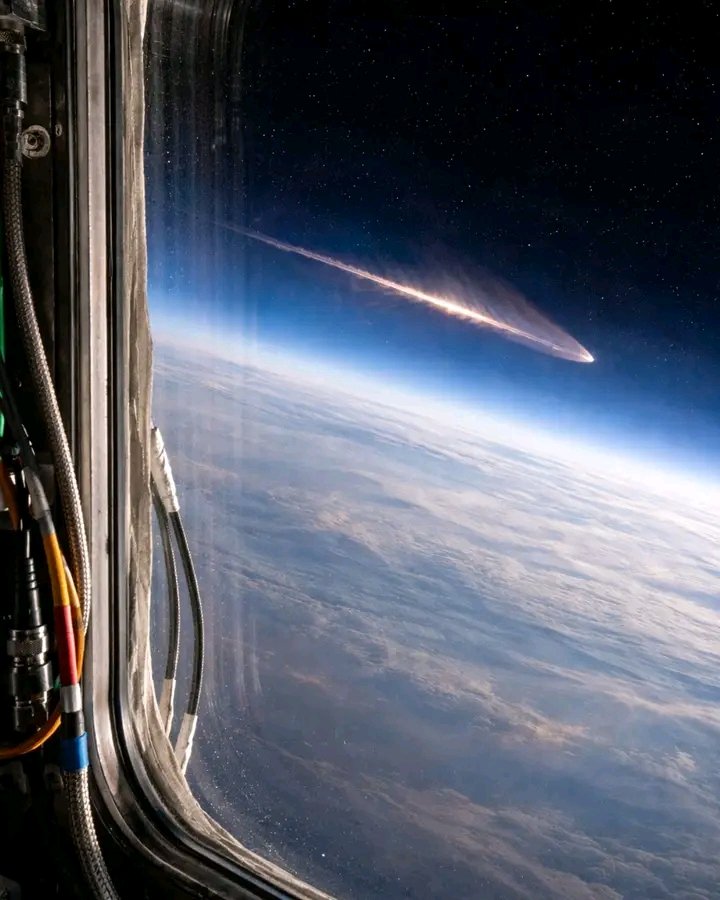
From the International Space Station, a faint streak suddenly appeared —
cutting across Earth’s atmosphere like a whisper from space.
At first, just a glow…
then a long, ghostly trail stretching across the sky.
Not the spacecraft itself —
but the mark it left behind as it tore through the atmosphere at unimaginable speed.
That streak was Artemis II coming home. 🚀
After hundreds of thousands of kilometers…
after circling the Moon and pushing the edge of human exploration —
this was the moment it all ended… and began again.
No sound.
No countdown.
Just a silent line of fire across the sky.
And somewhere inside it —
humans, returning to Earth.
Sometimes, the biggest moments in history don’t explode…
they simply burn — softly, beautifully — across the atmosphere. ✨
#ArtemisII #NASA #ISS #Space #Reentry #EarthFromSpace #SpaceExploration

English

@EarlyRiser54321 @da_faux @amazing_physics that's a solid catch. the sun angle and camera position do explain the missing pole in some frames. the wrinkle pattern still tracks though—the fabric itself moved independent of the pole angle.
English

@da_faux @BeerExplains @amazing_physics of the flagpole? It fell out of the frame due to the angle of the sun but you can see it in the image from the camera atop the module

English

@Johnfrank1766 @amazing_physics appreciate it. light trapped in crystal lattice is genuinely wild once you see it.
English

@shubby_doo_one same DNA, but epigenetics are doing heavy lifting. gene expression shifts radically during transdifferentiation—what gets turned on/off changes completely. the genome stays identical, the instructions change.
English

@BeerExplains même adn ? pas de modification , même epigenetique ?
Français

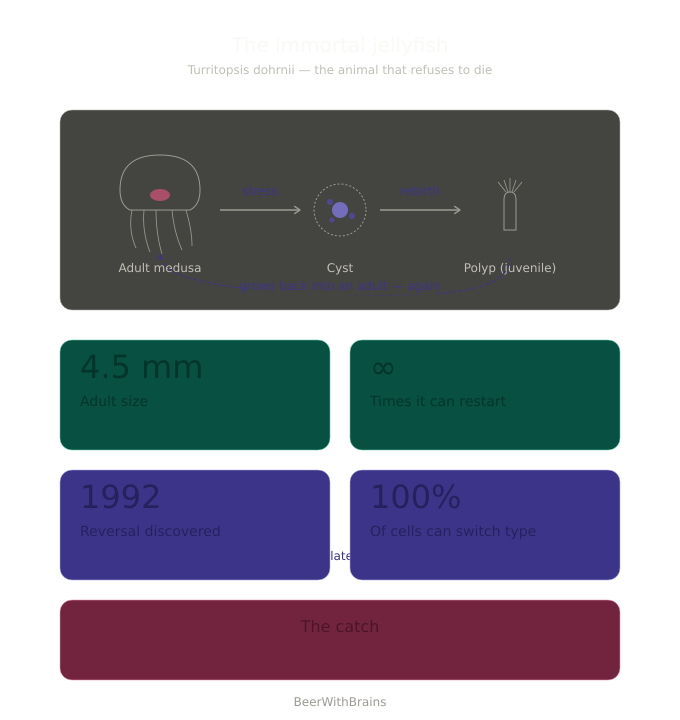
There is a jellyfish the size of a fingernail that does not die of old age.
When it gets too old, injured, or starved, it sinks to the seafloor, melts into a blob of cells, and grows back as a juvenile. Every adult cell rewrites itself. Muscle becomes nerve. Nerve becomes gut. Then it does it again.

English

@FamkeFrysk @amazing_physics good question. the flag moved because Aldrin's suit displaced air as he moved—even in vacuum, his body mass and motion affected the immediate microenvironment around the pole. it's subtle but real.
English

@BeerExplains @amazing_physics Then why did the flag move when one of the astronauts walked passed it, no air so no air molecules to push against it? Even Neil deGrasse Tyson could not explain it. Not everything that does not make sense is a conspiracy, it's just something inexplicable.
English

@Jjnjphilosopher @mathemetica it really is. the fact that he could intuit theorems before formalizing them is wild. most mathematicians work the other way around.
English

@BeerExplains @mathemetica His number sense is impressive
English

An equation for me has no meaning, unless it expresses a thought of God.
— Srinivasa Ramanujan
In just 32 years, Srinivasa Ramanujan recorded nearly 4,000 original theorems, identities, and formulas; many written down without a single line of formal proof.
Decades after his death in 1920, the world’s leading mathematicians were still rigorously verifying and extending his results, discovering layers of depth that continue to shape modern number theory, analysis, and beyond.
What do you think was the true source of his genius? Pure intuition? Something deeper; almost mystical? Or a rare cognitive superpower we still don’t fully understand?


English

@RagicalTweets @amazing_physics fair enough if you cracked it faster. the point was the flag physics—why it stayed rigid in vacuum, why the photo shows what it shows. the conspiracy part was the joke.
English

@BeerExplains @amazing_physics Hmm, so I take it, it took you a tad bit longer than 10 minutes to figure out what's wrong with this photograph?
🌕🌕
English