
Beezer Clarkson

6.7K posts

Beezer Clarkson banner
Beezer Clarkson

Beezer Clarkson

@Beezer232

Looking to change the world for the better through technology, investing & partnerships. Partner at @SapphirePrtnrs – the LP arm of @SapphireVC. ✍️ at @Open_LP

Austin / ✈️ Katılım Nisan 2009
1.1K Takip Edilen17.1K Takipçiler
Sabitlenmiş Tweet
Beezer Clarkson
Beezer Clarkson@Beezer232·
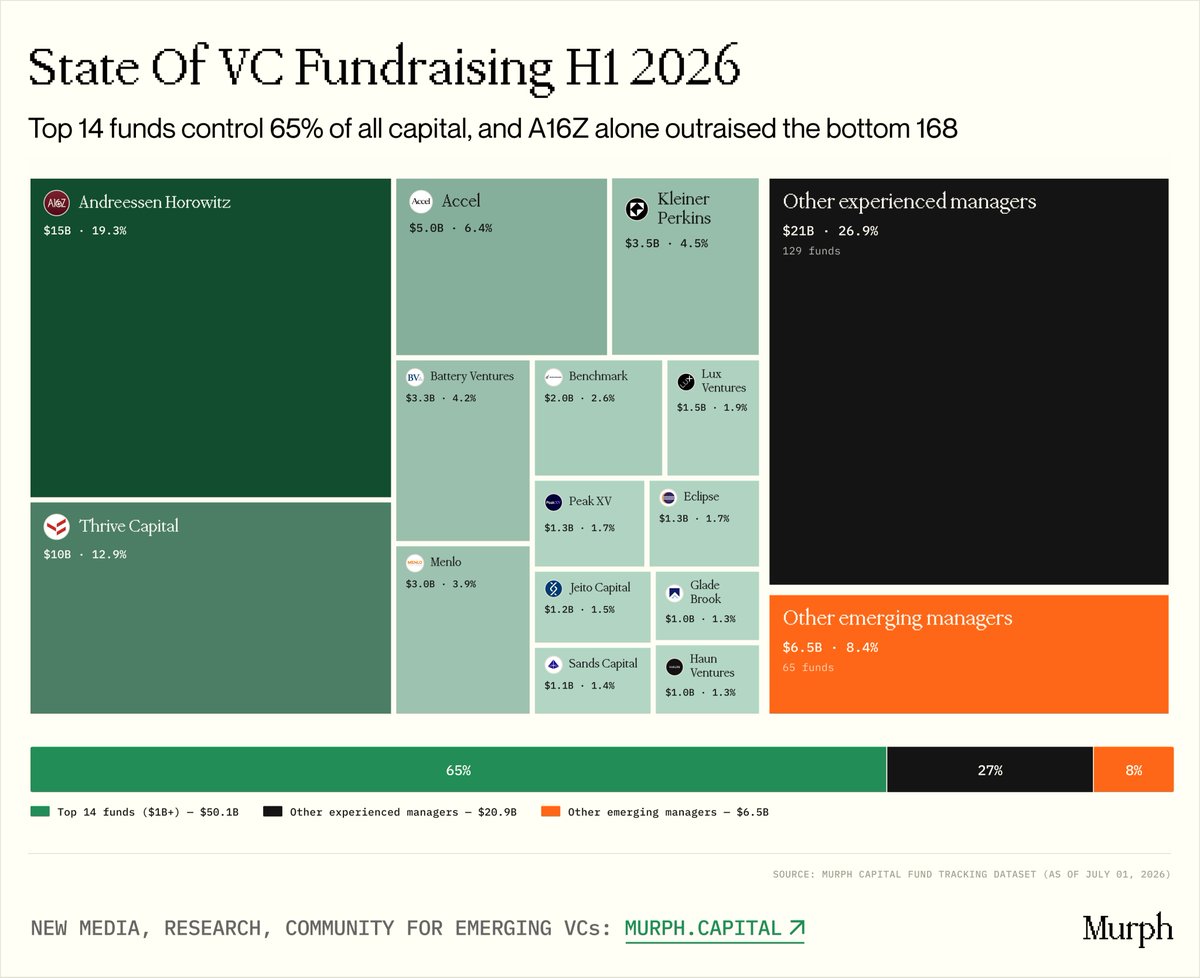
🧵1/ For decades, venture has expanded practically by default: more funds, more managers, more capital. After 20+ years, we are now facing the first meaningful industry-wide contraction since the dot-com collapse, with the smallest active investor base in more than 25 years.
Beezer Clarkson tweet media
English
18
29
125
51K
Jared Sleeper
Jared Sleeper@JaredSleeper·
For the love of God, why do big companies always do the thing where they slap the same tired, failed branding everywhere? "Copilot Cowork" "XBox Music" "Watson Health" "Agentforce Tableau" Make it stop
Satya Nadella@satyanadella

Announcing Copilot Cowork, a new way to complete tasks and get work done in M365. When you hand off a task to Cowork, it turns your request into a plan and executes it across your apps and files, grounded in your work data and operating within M365’s security and governance boundaries.

English
7
0
14
6.1K
Michael Eisenberg
Michael Eisenberg@mikeeisenberg·
Special 10 minute monologue episode of my podcast Invested. The future for Israel 🇮🇱and 🇺🇸is bright. Israel produces Agency at scale! The war is pushing Bleeding Edge Tech Innovation and reducing Iranian discount on Tel Aviv Stock Exchange. Hope you will enjoy and share!
English
18
22
156
15.8K
Oana Olteanu
Oana Olteanu@oanaolt·
Happy International Woman’s Day! Can’t think of a better video for female founders. Keep dreaming, keep building
English
3
3
7
446
Trace Cohen
Trace Cohen@Trace_Cohen·
In theory I totally agree with the thesis that emerging managers are generally the better source of Alpha in VC. 1) this goes to 2012 so it’s a nice vintage timing when angels and new small funds reigned supreme in a tiny alt asset. 2) 2020-2022 changed VC forever a) everyone became an investor for better or worse b) secondaries become not just acceptable but encouraged 3) Post Covid LPs and family offices got burned and everyone fled to safety at the expense of emerging managers. 4) the rise of Ai - expensive technical and experienced talent + massive capex led bigger funds needing to fund it 5) coupled with later liquidity that disproportionality hurts smaller funds who have a less stable, institutionalized LP base 6) why take the risk? No one got fired for big LP checks into a few funds / less work than multiple smaller checks.
English
3
1
5
1.9K
Beezer Clarkson
Beezer Clarkson@Beezer232·
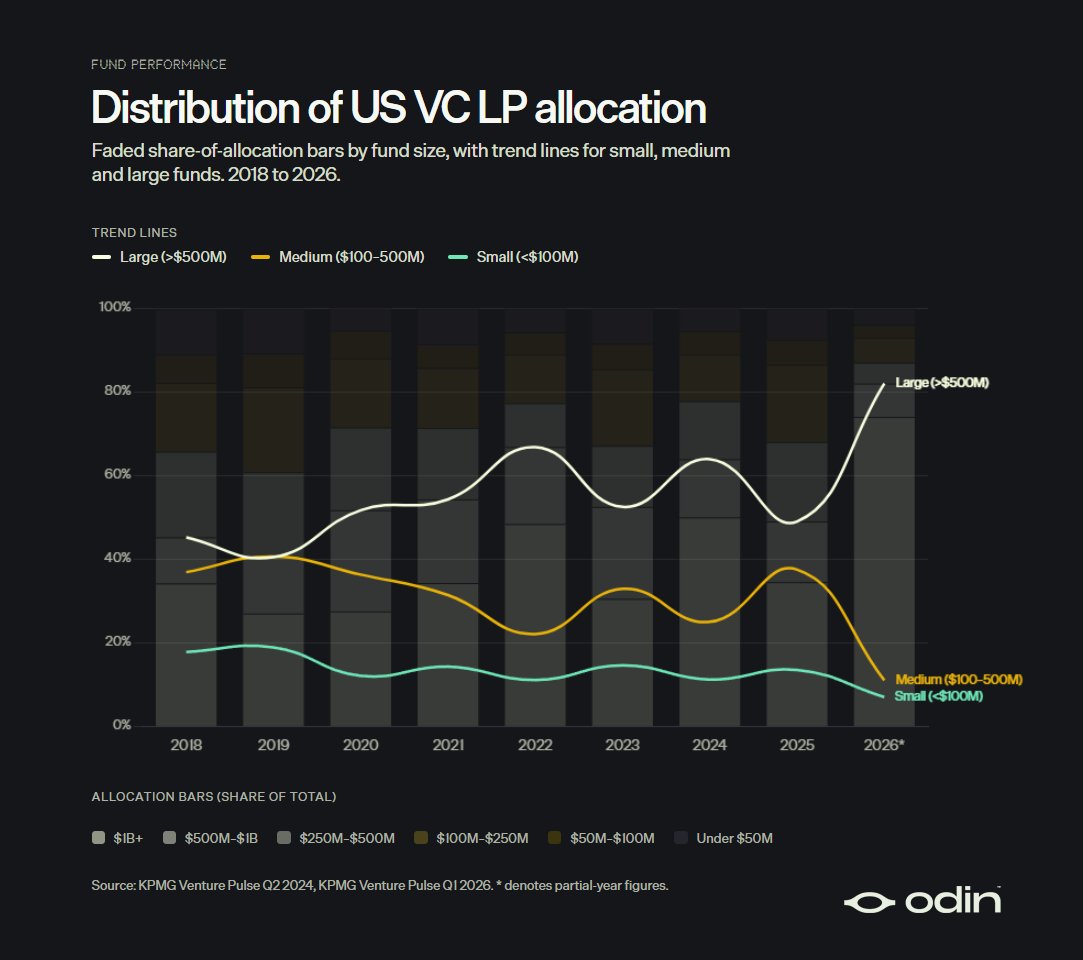
1/ If emerging managers are responsible for an estimated 40–70% of venture’s total gains (per Cambridge Associates), why does so much capital continue to consolidate into the largest platforms? @credistick's new piece argues venture may be over-concentrating. He says Funds I–III remain underfunded despite repeatedly showing up among top-performing vintages. He attributes EM outperformance to: smaller fund math, sharper focus, & differentiated access.
Beezer Clarkson tweet media
English
14
18
147
18.9K
Dan Gray
Dan Gray@credistick·
To pre-empt this a little bit, I don't think my view is necessarily a contradiction of David's. If you have access to a set of top-performing franchise funds, with persistence derived from a consistent strategy, that's a great place to be. But those firms can only absorb so much capital (although that often increases!), and so many LPs. For anyone outside of that bracket, or looking to expand outside of it, there's definitely alpha in a solid emerging manager strategy — which has the benefit of shoring up the ecosystem as a whole. Looking forward to the episode!
English
1
0
3
216
Beezer Clarkson
Beezer Clarkson@Beezer232·
4/ Appreciate both of these opposing POVs from two incredibly thoughtful humans who don’t just speak anecdotally, but always come data-backed. Dan’s piece below👇. Origins w/ David Clark drops in March 👀. Stay tuned! blog.joinodin.com/p/venture-capi…
English
0
0
13
720
Beezer Clarkson
Beezer Clarkson@Beezer232·
3/ Venture is a power law business, but power laws are relative. A $30M fund needs a different magnitude of outcome to return capital than a multi-billion-dollar fund. If you’re having the small vs large debate, I think one has to understand these are fundamentally two different games, & there is more than one way to win in venture.
English
1
0
17
1.2K
Chris Brown
Chris Brown@almostcmb·
My 2c is that this is one of the most important topics to internalize in venture I was lucky enough to learn from some great folks at the start of my investing career before we started Inspired. And every successful GP I’ve observed has navigated this exact thing a handful of times in their career It’s hard to no matter who you are. As investors expand their scope to match the opportunity set the world presents, they get critiqued. Chasing hype, scope creep, etc. (Exhibit A: you don’t need to spend very long on the timeline right now before encountering AI/hard tech investors being persnickety about new entrants to those categories, irrespective of talent and track record) I think @andrew__reed referred to this on a recent pod as “re-potting oneself” in reference to Doug Leone’s late career investment into a nascent Brazilian consumer fintech biz (Nubank) following a career of enterprise investing People do it in a number of ways. Sometime they are just so good that it comes naturally. Other times a great firm brand effectively builds the bridge across platform shifts for them (note: this is why most MPs focus on firm brand building as it ties directly to durability across platform shift eras). But the most reliable path is to carefully and authentically identify connective tissue between their existing focus and the new era, and then use that to slingshot themselves across the chasm. Ribbit’s recent token paper is a great example of this — connecting the dots between fintech, crypto, and AI in a legitimate way No matter how you get there, re-potting well seems to require: (1) having a repeatable decision making process that scales (i.e., those who heavily weight team and market structure tend to have an easier time as those things are observable across categories) (2) a partnership that acknowledges the importance of growing their understanding of the world and therefore encourages it (3) willingness to step off the deal flow carousel long enough to THINK (4) some combo of courage/intellectual honesty/ability to tolerate feeling dumb
Jeff Morris Jr.@jmj

One of the biggest traps I see early VCs and new venture firms make is convincing yourself that you're only allowed to invest in a specific category. You fall into the trap of becoming a SaaS investor or a fintech/crypto investor or a deep tech investor & that tunnel vision prevents you from seeing what's happening in the world outside of your domain. If you look at most of the greatest investors in our industry and study their careers, the very best VCs have redefined themselves with every important technology shift. This might look effortless to the outside, but it requires an immense amount of humility as you'll often feel like you're starting from scratch learning new subjects & building new networks again. You might also worry that your limited partners won't trust that you know what's going on in this new area & you’ll have to prove yourself all over again. Some investors don’t want to “start over” because it requires putting your career on the line every few years but it's really the only way to stay relevant. As the rate of technology progress accelerates at rates we’ve never seen, you should consider stepping outside the box that you've trapped yourself in.

English
1
3
39
9.5K
Beezer Clarkson
Beezer Clarkson@Beezer232·
@fendien Yup. We see a high attrition rate from Fund I to Fund II… average over last 20+ years is ~50%
English
0
0
3
252
Jonathan Lehr
Jonathan Lehr@fendien·
Wild stat from StepStone about emerging managers: In 2021/2022 there were 938 managers who raised a Fund I Since then, only 190 subsequent funds have been raised by this group
English
29
29
416
129.2K
Beezer Clarkson
Beezer Clarkson@Beezer232·
@ttunguz Great points and yes… we are seeing secondaries play a much more meaningful role
English
1
0
6
610
Tomasz Tunguz
Tomasz Tunguz@ttunguz·
For the first time in venture history, three distinct channels share the liquidity burden roughly equally. A decade ago, secondaries barely registered. They accounted for roughly 3% of exit value in 2015. Today they claim 31% : nearly $95b in the trailing twelve months. The shift accelerated after 2021’s IPO bonanza. When public markets closed their doors in 2022, investors found alternative routes. Secondaries absorbed demand that would have flowed to traditional exits. When Goldman Sachs acquired Industry Ventures, the transaction signaled secondaries have arrived. Morgan Stanley followed with EquityZen, then Charles Schwab announced its acquisition of Forge Global. Wall Street recognized the structural change before most of venture did. This matters for founders & investors. When IPOs dominated exits, fund models assumed a small number of public offerings would generate the bulk of returns. Now liquidity arrives through multiple doors. A founder might sell secondary shares to patient capital while the company remains private. A GP might move positions through continuation vehicles. An LP might trade fund stakes on an increasingly liquid secondary market. The 830 unicorns holding $3.9t in aggregate post-money valuation cannot all exit through IPOs. The math doesn’t work. At 2025’s pace of 48 VC-backed IPOs, clearing the unicorn backlog would take seventeen years. Secondaries provide a release valve that traditional exits cannot. Companies like OpenAI have embraced this reality, running employee tender offers while voiding unauthorized secondary transfers. The largest private companies now manage their own liquidity programs rather than waiting for public markets. Today, secondary liquidity concentrates in the top 20 names. SpaceX, Stripe, OpenAI. For the founder of company #50, the secondary market remains largely theoretical. For secondaries to succeed as a broad asset class, buyers must underwrite positions in companies without household recognition. As the market grows, this coverage gap becomes opportunity. For LPs starved of distributions since 2022, the expansion of secondary channels offers hope. The $169b in cumulative negative net cash flows needs somewhere to go. More exit paths mean more opportunities to return capital. When a Series B employee asks about liquidity today, the answer isn’t “wait for the IPO.” It’s “we’re planning a tender offer next year.” A decade ago, secondaries were a footnote. Now they’re infrastructure. Liquidity flows where it can, not where tradition suggests it should. tomtunguz.com/a-third-a-thir…
Tomasz Tunguz tweet media
English
22
43
204
54.7K
Jack Altman
Jack Altman@jaltma·
I’m really excited to share that I’m joining Benchmark. The past two years as a full time investor have been the most rewarding of my career. I really love venture capital, which is not something I ever imagined I’d say when I was kid, but here we are. I love new ideas and being part of a team with a mission. I love getting to be there for people who are struggling towards goals they really care about. I love learning from people who are better CEOs than I ever was. I love the texture of the work, the competition, and the way the job lets you invest in relationships. I love it so much that I’ve even turned into a little venture nerd with a podcast who goes around harassing great investors and founders, trying to learn as much as I can as fast as possible. I’ve certainly learned what I care most about, and what kind of investor I want to be. What I’ve realized is that I love investing at the Series A, when there’s enough going on that an investor can be useful but not so much that you can’t have an impact. I think there are many amazing ways to practice venture, it’s just the way that most speaks to me. And as I came to realize that, I started to think about how to best set myself up to do that craft as well as possible. It became clear to me there is nowhere better for this than Benchmark; the way they’re structured, their principles, their overall approach to investing, and their track record all create an environment that I believe will let me do my best work as an investor and help founders the most I possibly can. As I’ve gotten to know the team at Benchmark I’ve come to admire so much about each of them. Peter is truly playing his own game. A lot of what he says sounds like poetry at first, but as the ideas roll around in your head for a while you realize how much depth they have. I first heard about Eric many years ago from my friend Saji at Benchling while I was building Lattice, who described him as the most amazing board member and attributed him with a lot of the company’s success. That’s the kind of partner I want to be one day. Chetan is brilliant and truly thinks for himself; I’ve realized over time what a courageous guy he is. And then there’s my friend Ev, whose skills complement mine and who I just love to be around. I can’t wait to have him as a partner in crime. When given the chance to work with this group I just knew I had to go. One of my motivating north stars with Alt Capital was to build a firm and be a partner that I most would have wanted as an entrepreneur. Although I haven’t gotten everywhere I want to be yet, I’m proud of the work so far. And now I’m excited to build on that work at Benchmark, where I hope to increase my rate of learning and get armed with the power of a partnership so I can help founders reach their dreams even more. Thank you to the companies who’ve let me invest with them at Alt Cap. I’m keeping all my board seats and supporting everyone just the same as before. Thank you to the LPs who’ve backed me as well. I am so excited about the portfolio we have and am grateful I can stick with all those companies. And finally thank you to my teammates, Bala, Vivek, and Nate. Bala took a bet on me and started investing with me before it was remotely obvious, and we’ve been able to grow so much figuring it out together as investors. I credit Nate with helping Alt start feeling like a firm. He joined us from First Round over a year ago and made everything run smoothly. And while Vivek joined just a little while ago, even in the short time we’ve worked together he’s had a meaningful impact on how we think and invest. They’re all joining Benchmark with me. So pumped for this chapter.
Benchmark@benchmark

We are thrilled to share that @jaltma is joining Benchmark as our newest General Partner. The Benchmark partnership is built on a shared commitment to the craft of venture capital, where our work is defined by the depth of service and commitment to the founders we work with. We believe this work does not scale and is best practiced where we win as a team of partners. By operating as a true partnership rather than a collection of individual franchises, we ensure that every founder we back benefits from our combined experience and a singular, shared commitment to their success. We first met Jack as a founder of Lattice over a decade ago. We followed Jack as he built Lattice into a leader in its category and navigated the turbulence that every software company faced in 2020. We admired Jack’s character and the way he prioritized transparency and authenticity to build a great team. That same value system defined his transition to founding a venture capital firm, Alt Cap, where he has made a familiar commitment to craft and service over capital. As an investor, Jack has partnered with some of the most ambitious founders of the generation with his investments in Legora, Rogo, Owner, Avoca, Rippling, and many others. Founders told us “I call Jack first to work through the toughest problems,” “He is my most trusted partner on the board,” and “Jack provides steady and grounded support that is rooted in having been a founder himself.” He combines relentless energy, deep intellectual curiosity, and a competitiveness to see founders win, all anchored by high integrity. We have always believed that our firm’s strength lies in its equal partnership: a small, focused group of individuals who operate with the same authority, responsibility, and singular mission to support entrepreneurs from the earliest stages. By joining our partnership, Jack brings a fresh perspective that will help us continue this mission. Welcome to Benchmark, Jack. – Ev, Chetan, Eric, Peter

English
411
60
2.1K
1.7M
Beezer Clarkson
Beezer Clarkson@Beezer232·
LPs & GPs are often having the same conversation, but not speaking the same language. In my convo w/ @chudson & @miafarnham, we talked about the LP/GP “language gap.” As Charles put it: “Once you learn to decode it, it’s actually quite clear what people are telling you.” In Funds I–III, GPs are (rightly) focused on survival + getting to the next close. Meanwhile, LPs are listening for something else: durability, learning velocity, & signals you’re building for longevity. Give it a listen. 👇 youtu.be/mue5kE4UVLE?si…
YouTube video
YouTube
English
2
2
40
5.4K
Jenny Fielding
Jenny Fielding@jefielding·
Half the VCs I know are changing their focus areas / investment thesis right now. Feels like a moment of deep reflection - or panic.
English
125
37
574
108.7K
Endowment Eddie
Endowment Eddie@endowment_eddie·
The notion that VC podcasts/media is for LPs is dumb. I like to see some attempt at brand but just doing podcasts/media isn’t a sell. Also, there are 8-9k LP institutions per Preqin and PEI. There are likely 15k actual decision makers globally. A small number of LPs focus on venture and an even smaller number engage with VC podcasts. And spoiler, a lot of LPs are politically opposed to using X. It’s low ROI if it’s really all for LPs.
English
16
2
82
15.9K