
Ben Fève
3.1K posts

Ben Fève
@BenjaminFeve
Senior Research Analyst @KShaar_Advisory; Former @TheSyriaReport, @Think_Triangle, @BadilMedia; Focus on #Syria; FR, EN, عر, TR

@BenjaminFeve Şarkı çok kötü olmuş. Türkiye'nin ajanların staj yeri olduğunu tüm türk halkı bilmektedir. O yüzden içinizden en az birisi ajandı o gün. Türkiye'ye yıllardır çok fazla ajan gelir ve yakalanır. Halk için çok doğal bir durumdur. Ajan olmadığını söyleyenler daha da komik oluyor.


I hopped in a taxi in Damascus 🇸🇾 after Friday prayers، and a few minutes into the ride, I noticed the driver had a song playing, one of those tracks by the Turkish singer Sımga. So I asked him: “Were you ever in Turkey?” He looked surprised: “How did you know?” I smiled and said, “You’re playing a Turkish song in the middle of Damascus, what do you mean how did i know?.” He laughed and told me he’d lived in Bursa for eleven years but the moment the country was liberated, he came straight back, but part of him, he said, never quite left Turkey behind, We both laughed about it, and we even chatted a little in Turkish, (my Turkish language is broken and he mocked me too 😂) Just last week, on my way to a film studio i was shooting here in Damascus, I was in another cab, a Yalla Go car, and the driver was playing Ibrahim Tatlises, Turned out he used to live in the Beyoğlu neighborhood in Istanbul. When you walk into any mall here you’ll find Turkish and Ukrainian products filling the shelves, and people genuinely reaching for them. Tomorrow, the Turkish brand LC Waikiki is officially opening a branch in Damascus. they’ve already put out the announcement. Many of those who’ve returned home came back with Turkish university degrees or solid professional experience gained there, and they’re building things here with that same organized, structured mindset they picked up abroad. And let’s not forget the obsession with Turkish dramas، entire families are glued to their screens watching all kinds of Turkish shows, even my own family has their two sacred hours every night, completely reserved for their favorite Turkish series. Displacement was painful, there’s no doubt about it, but it also carried something with it too: everyone who came back brought a piece of the world with them, and that’s quietly making its way into new Syria that we all trying to build together.




Reminds me of last week, when I was buying an ice cream somewhere in Damascus at around 10:30 p.m., and I saw a lady speaking Turkish to the ice cream seller. So I immediately asked her in Turkish, “Are you Turkish? You don’t speak Arabic?” She replied, “No no I am not Turkish, I am [European nationality].” I was visibly confused, and asked: “why would a foreigner speak Turkish to buy ice cream in Damascus?” “I just love the language, actually,” she replied. Still confused, we kept speaking Turkish together for a bit… then the ice cream seller asked me, in fluent Turkish (!), “Are you Turkish?” I replied, “No, I’m French, but I speak Turkish. What’s going on here with everyone speaking Turkish?” And there we were: two Europeans and one Syrian speaking Turkish together. Then… an older guy jumped in behind me, asking me and the lady in… Turkish: “So, are you two Turks?” “No, but are you?” we replied. He was like, “No, no! I am Syrian too!” And that’s how the four of us ended up speaking Turkish together for a few minutes in the middle of Damascus and eating like there was some glitch in the matrix. Good times. Unfathomable a few years back. Unforgettable today.
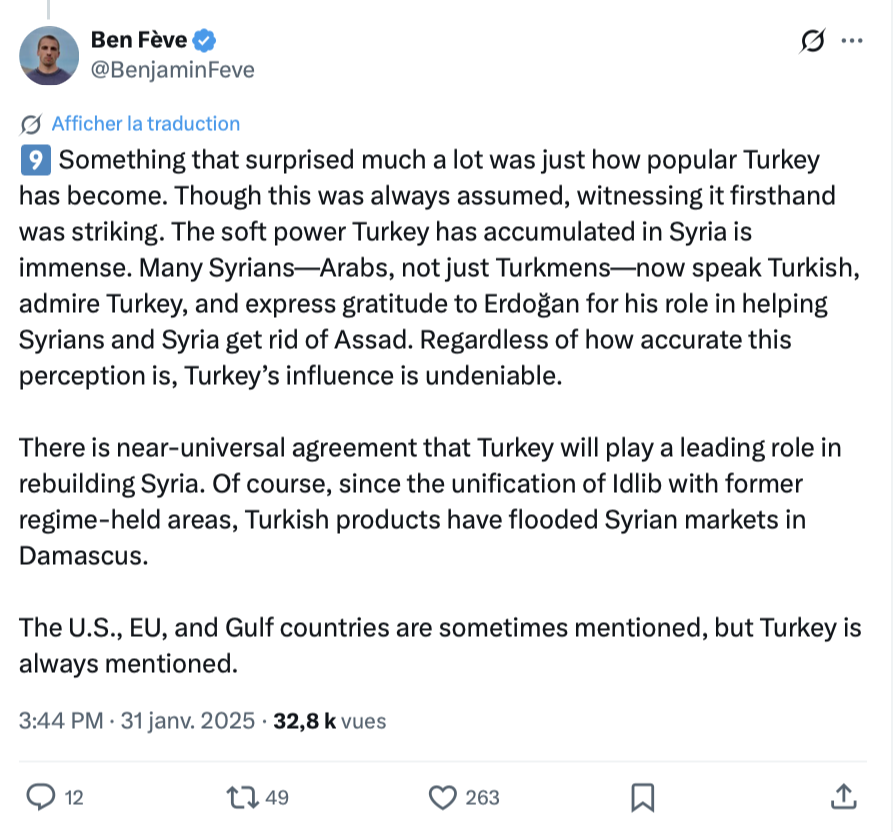
9️⃣ Something that surprised much a lot was just how popular Turkey has become. Though this was always assumed, witnessing it firsthand was striking. The soft power Turkey has accumulated in Syria is immense. Many Syrians—Arabs, not just Turkmens—now speak Turkish, admire Turkey, and express gratitude to Erdoğan for his role in helping Syrians and Syria get rid of Assad. Regardless of how accurate this perception is, Turkey’s influence is undeniable. There is near-universal agreement that Turkey will play a leading role in rebuilding Syria. Of course, since the unification of Idlib with former regime-held areas, Turkish products have flooded Syrian markets in Damascus. The U.S., EU, and Gulf countries are sometimes mentioned, but Turkey is always mentioned.

Reminds me of last week, when I was buying an ice cream somewhere in Damascus at around 10:30 p.m., and I saw a lady speaking Turkish to the ice cream seller. So I immediately asked her in Turkish, “Are you Turkish? You don’t speak Arabic?” She replied, “No no I am not Turkish, I am [European nationality].” I was visibly confused, and asked: “why would a foreigner speak Turkish to buy ice cream in Damascus?” “I just love the language, actually,” she replied. Still confused, we kept speaking Turkish together for a bit… then the ice cream seller asked me, in fluent Turkish (!), “Are you Turkish?” I replied, “No, I’m French, but I speak Turkish. What’s going on here with everyone speaking Turkish?” And there we were: two Europeans and one Syrian speaking Turkish together. Then… an older guy jumped in behind me, asking me and the lady in… Turkish: “So, are you two Turks?” “No, but are you?” we replied. He was like, “No, no! I am Syrian too!” And that’s how the four of us ended up speaking Turkish together for a few minutes in the middle of Damascus and eating like there was some glitch in the matrix. Good times. Unfathomable a few years back. Unforgettable today.

A year ago, the United States decided to give Syria a chance at greatness by lifting sanctions and opening the door to investment. The results speak for themselves: 18,000+ companies registered in Damascus, 1.5 million refugees returned, and billions of dollars in investment pledged. We are pleased to launch comprehensive Syria Investor Guides – the most detailed publicly available market intelligence report for Syria - signaling American confidence that Syria can be a credible destination for responsible investment, enterprise, and integration. Real opportunities exist across sectors – electricity, oil and gas, technology, telecommunications, real estate, and banking. American companies with their technological leadership, expertise, and standards are uniquely positioned to fill many of the gaps Syria urgently needs. These guides outline opportunities for American companies while helping connect Syria to trusted, resilient, and transparent economic partnerships that support long-term prosperity and stability. With smart governance, regional cooperation, and responsible investment, opportunity can become reality. sy.usembassy.gov/business/
What will it take for the EU's political normalization with Syria to materialize? #Policy_Memo #Syria_in_Figures May 2026

