
Berkeley AI Research

1.5K posts

Berkeley AI Research banner
Berkeley AI Research

Berkeley AI Research

@berkeley_ai

We're graduate students, postdocs, faculty and scientists at the cutting edge of artificial intelligence research.

Berkeley, CA Katılım Temmuz 2017
463 Takip Edilen279.3K Takipçiler
Berkeley AI Research retweetledi
C.K. Wolfe
C.K. Wolfe@ckwolfeofficial·
Released on @berkeley_ai blog, a perspective from @adityagp & collaborators. As agents take on more knowledge work, what happens to the data systems underneath? A look at systems for, of, and by agents … 🐻📄 bair.berkeley.edu/blog/2026/07/0…
English
0
3
7
3.2K
Berkeley AI Research retweetledi
Ken Goldberg
Ken Goldberg@Ken_Goldberg·
Very excited about GaP’s potential to increase throughput and support near-term robotics applications. Hats off to team led by brilliant postdocs Eric Chen and Shuangyu Xie and superb colleagues from @BoschGlobal and @NVIDIARobotics.
Kaiyuan Eric Chen ✈️RSS🇦🇺@keplerccccc

Graph-as-Policy (GaP) is a new variant of Agentic Robotics from @NVIDIA and @UCBerkeley that builds computation graphs (like ROS) to ensure modularity, manage complexity, and facilitate interpretability. 🧵Open code and paper: graph-robots.github.io/gap/ #Robotics #Automation #AgenticAI #EmbodiedAI

English
1
8
52
11.5K
Berkeley AI Research retweetledi
Ken Goldberg
Ken Goldberg@Ken_Goldberg·
Excited about WARP-RM: by modulating the time-sampling on a few high-quality human demonstrations, we train a progress measure to extract high-quality segments from all demos, yielding significant improvement in folding throughput. Hats off to Justin and the team for this idea!
Justin Yu@uynitsuj

Introducing WARP-RM: A Warp-Augmented Relative Progress Reward Model for Data Curation 🧵 We gave our t-shirt folding robot more demonstrations and it got worse. Every extra demo ended in a successfully folded shirt. The data wasn't bad. It was noisy. The policy couldn't tell productive motion from dead time, and it imitated both equally. So which moments of a demo are actually worth copying? 🌐 Project Website: uynitsuj.github.io/warp-rm 📄 Paper: arxiv.org/abs/2606.28320 💻 Code: github.com/uynitsuj/WARP-… 📨 XDOF blog post: xdof.ai/blog/warp-rm

English
0
7
51
9.8K
Berkeley AI Research retweetledi
Yun S. Song
Yun S. Song@yun_s_song·
I am thrilled to share that UC Berkeley and UCSF have launched a joint initiative in Computational Biomedicine! cdss.berkeley.edu/news/uc-berkel… We will soon be recruiting new faculty and postdoctoral fellows. Please repost to help spread the word.
English
2
60
239
34.9K
Berkeley AI Research retweetledi
Bohan Lyu
Bohan Lyu@Lyubh22·
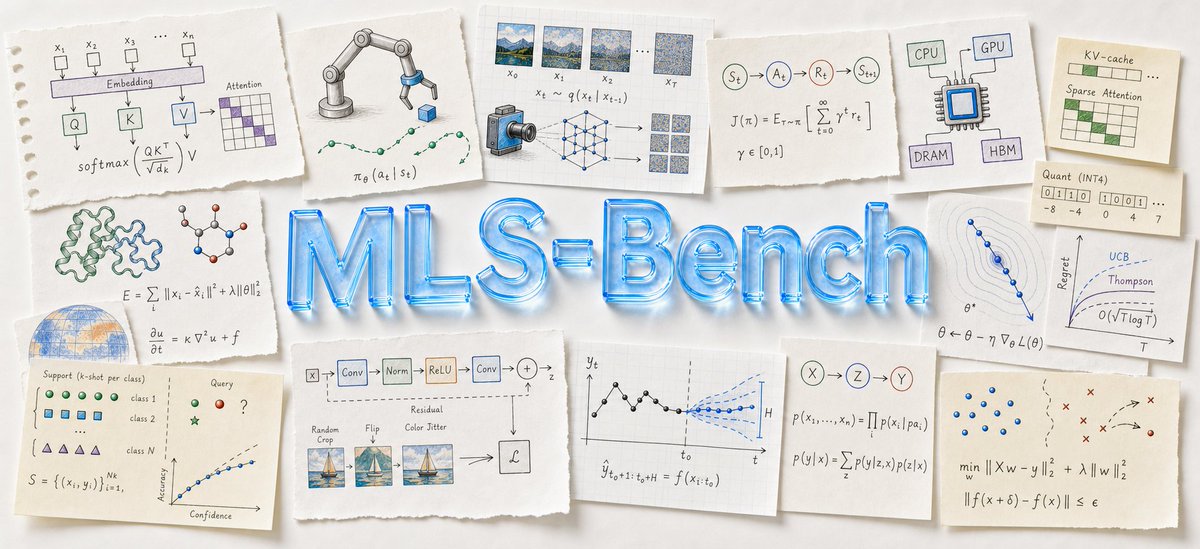
Everyone is talking about self-evolving AI, or recursive self-improvement. The methods that built modern ML are the ones that keep working across settings and scales, yet no benchmark directly tests AI systems for that ability. Today, after months of cross-platform validation with external teams, we're proud to introduce MLS-Bench, a benchmark for ML Science with 140 tasks across 12 ML domains. It asks whether AI systems can create scalable and generalizable ML methods, the way human researchers have pushed AI forward. (1/9)
Bohan Lyu tweet media
English
2
23
77
27.2K
Berkeley AI Research retweetledi
Rajat Rawat
Rajat Rawat@rajat_s_rawat·
Did a model secretly train on another model's outputs? Providers can catch this from server-side logs — Anthropic recently reported catching 29M such exchanges. But those methods need usage logs and infrastructure access; they don't work from the model itself. Our paper does: compare a model to an earlier checkpoint of itself, and ask which candidate teacher best explains the shift between them. The true teacher stands out. 🧵
Rajat Rawat tweet media
English
5
8
22
7.5K
Berkeley AI Research retweetledi
Sergey Levine
Sergey Levine@svlevine·
If you want a robot to do something well, you need to know how to talk to it. If you don't, you can learn, with Semantic Action RL! In our paper, @JagdeepBhatia8, @ajwagenmaker, @verityw_ show how RL over VLA prompts enables new tasks and learns blazing fast in the real world!
English
4
26
271
29.2K
Berkeley AI Research retweetledi
Jagdeep Bhatia @ RSS 2026
Jagdeep Bhatia @ RSS 2026@JagdeepBhatia8·
How can generalist policies adapt to new challenges at deployment using skills they already have? We optimize VLA *prompt inputs* with reinforcement learning, enabling efficient real-robot adaptation on complex tasks where existing methods struggle. 🧵 semantic-action-rl.github.io
English
2
18
77
15.7K
Berkeley AI Research retweetledi
Yen-Jen Wang
Yen-Jen Wang@wangyenjen·
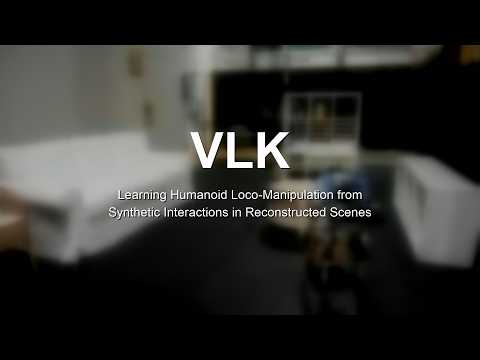
How can we scale perception-based humanoid learning without collecting massive humanoid teleoperation data? 🚀 Excited to finally share VLK! What excites me most about VLK is that it reframes data collection as a data generation problem. Instead of relying on expensive humanoid teleoperation, we automatically generate synchronized vision, language, and whole-body kinematics from reconstructed real-world scenes. Making this vision a reality required bridging three fundamental challenges: 👀 Perception: Bridging the RGB sim → real gap through visual domain randomization and motion blur mitigation during both training and deployment. 🤖 Embodiment: Bridging the kinematics → dynamics gap with real-time VLA deployment, test-time RTC, and SceneBot, enabling seamless deployment on a real humanoid. 🌍 Environment: Bridging the real-world → synthetic gap to enable scalable Vision-Language-Kinematics data generation through scene reconstruction and interaction synthesis. It has been an amazing journey working with such an incredible team. For a complete walkthrough of the project, check out @jiaman01's thread below 👇 🌐 Project: vision-language-kinematics.github.io 📄 Paper: arxiv.org/abs/2606.30645 🎦 Video: youtu.be/ZB6k_iMJP7M Huge thanks to my amazing collaborators @jiaman01 @eric_srchen @TakaraTruong @ Pei Xu, and to our advisors @pabbeel @rocky_duan @KoushilSreenath @akanazawa @carlo_sferrazza @GuanyaShi @ckarenliu.
YouTube video
YouTube
Jiaman Li@jiaman01

🤖 How can we scale up humanoid robot learning? Introducing 🌟VLK🌟: generating large-scale synthetic data with paired egocentric observations, text, and full-body G1 kinematics for learning humanoid loco-manipulation. No teleoperation needed! Website: vision-language-kinematics.github.io

English
11
40
290
867.1K
Berkeley AI Research retweetledi
Justin Yu
Justin Yu@uynitsuj·
Introducing WARP-RM: A Warp-Augmented Relative Progress Reward Model for Data Curation 🧵 We gave our t-shirt folding robot more demonstrations and it got worse. Every extra demo ended in a successfully folded shirt. The data wasn't bad. It was noisy. The policy couldn't tell productive motion from dead time, and it imitated both equally. So which moments of a demo are actually worth copying? 🌐 Project Website: uynitsuj.github.io/warp-rm 📄 Paper: arxiv.org/abs/2606.28320 💻 Code: github.com/uynitsuj/WARP-… 📨 XDOF blog post: xdof.ai/blog/warp-rm
English
6
25
160
35K
Berkeley AI Research retweetledi
Yujin Potter @ ICML 🇰🇷
1/N Neuroscience and social science research on humans has shown: – Similar brain activity predicts friendship and cooperation – Diverse minds drive innovation We wondered whether AI-AI interaction would show the same pattern. It does. LLMs with similar internal representations cooperate more, but produce less novel output. 🧵 (ICML 2026)
Yujin Potter @ ICML 🇰🇷 tweet media
English
5
21
58
9.6K
Berkeley AI Research retweetledi
Sergey Levine
Sergey Levine@svlevine·
We can learn a model that provides shaped "process rewards" for robotic RL, that evolves automatically as the policy gets better. This improves performance on benchmarks, and works in the real world! Some fun new work with Raymond Tsao & @ajwagenmaker
English
4
41
369
36.4K
Berkeley AI Research retweetledi
Alex Dimakis
Alex Dimakis@AlexGDimakis·
We are excited to announce what we have been working on for more than six months: The OpenThoughts-Agent dataset and OpenThinker-agent models. More than 100 ablations on data curation for RL environments for coding agents. Our data recipe is SOTA over all open-data agents in their class. We post-train a Qwen-3-32B to get 26% on Terminal Bench and open all our training sets, data pipelines, experiments and models. Some lessons we learned for training agents vs reasoning: 1. The Diversity of tasks matters more, compared to reasoning (OpenThoughts-Agent vs OpenThoughts). You could teach reasoning from math and it transfered widely but RL environments seem to teach more specific capabilities, so each domain must be covered. 2. Filtering high quality and hard questions remains very important. (Was also true for OpenThoughts reasoning). We discuss several ways of filtering. 3. Synthetic re-writing and task augmentation didn’t give significant benefits in our experiments. Sampling multiple teacher rollouts per task did work (was also true for reasoning). Even when keeping the dataset size fixed, multiple answers gave benefits. The Multiple answers mystery is still valid for agentic environments. 4. Stronger models are not necessarily better teachers (was also true for reasoning). The stronger teacher for Quen-3 was GLM-4.7-AWQ and the Terminus2 harness in Daytona. We are releasing 100k tasks and trajectories. 5.Benefits from GRPO remain limited and still on-going. I currently officially hate GRPO.
Richard Zhuang@RichardZ412

How can we train small agentic models that are highly capable of terminal use and coding? Announcing OpenThoughts-Agent + OpenThinkerAgent-32B, the strongest Qwen-3 based open-data agentic model: 44.8% avg across 7 agentic benchmarks! (1/n)

English
17
35
222
435K
Berkeley AI Research retweetledi
Yi Ma
Yi Ma@YiMaTweets·
Why diffusion denoising-based generative methods do not suffer the curse of dimensionality even though the data may lie in extremely high-dim spaces? Our new work, accepted by the JMLR: arxiv.org/abs/2409.02426 reveals the not-so-surprising secret: as long as the intrinsic dimension of the distribution is very low, the generative process can be extremely efficient and effective! It seems that a mixture of low-rank Gaussians is a universal model for all informative real-world data. as we stipulated in a former textbook of mine: Generalized Principal Component Analysis: vision.jhu.edu/gpca/, published exactly ten years ago!
English
13
115
788
57.8K