Narayana Bhatta

6.8K posts

Narayana Bhatta banner
Narayana Bhatta

Narayana Bhatta

@BhattaPN

GIS products| IITB| IIMC| Golf| Samskrit, Kannada, English literature

Katılım Mart 2014
175 Takip Edilen1.1K Takipçiler
Sabitlenmiş Tweet
Narayana Bhatta
Narayana Bhatta@BhattaPN·
4x - the gap has doubled, between @latlong_ai Geocoding API and Google Maps in India. What started as a way to measure our progress, has now become an obsession for our team to continue to be SOTA. Read about our POV on spatial search and algorithmic changes to set the benchmark.
latlong.ai@latlong_ai

Latlong announces that the best has gotten better. Latlong Geocoding API is now 4x more accurate than Google Maps. Read 👇 latlong.ai/pages/Blog/B11

English
0
20
30
4.8K
Narayana Bhatta retweetledi
PIB India
PIB India@PIB_India·
President Droupadi Murmu confers #PadmaBhushan upon Shatavadhani Dr. R. Ganesh for his extraordinary contribution to Indian literature and performing arts Master of Avadhana, he revived the ancient Sanskrit art of Ashtavadhanam through over a thousand performances across India and abroad #PeoplesPadma #PadmaAwards2026 #PadmaAwards @PadmaAwards
English
0
24
54
3.9K
Narayana Bhatta retweetledi
Karthik Madathil
Karthik Madathil@kmadathil·
There is usually little to add to @MisraNityanand 's takedowns of bad scholarship, but this does warrant a retelling from the grammatical perspective. The sutra येषां च विरोधः शाश्वतिकः 2.4.9 is the root of this historian myth. It says that dvandva compounds that satisfy this condition must be in the singular. What condition? "विरोधः" or counterposition/opposition. Patanjali doesn't clarify विरोधः or give examples (note! no sramanas or brahmanas or snakes or mongooses) here, he merely points out why the rule was made - to create a pre-exception to a later rule. The later rule 2.4.12 विभाषा वृक्षमृगतृणधान्यव्यञ्जनपशुशकुन्यश्ववडवपूर्वापराधरोत्तराणाम् says dvandva compounds of पशुशकुनि animals and birds (among others), are optionally singular. While discussing this, Patanjali classifies compounds into three: Only 2.4.12 operates: पशुशकुनिद्वन्द्वस्यावकाशः - महाजोरभ्रम्। महाजोरभ्राः। हंसचक्रवाकम्। हंसचक्रवाकाः ॥ Only 2.4.9 operates: येषां च विरोधः शाश्वतिकः इत्यस्यावकाशः - श्रमणब्राह्मणम् ॥ Both collide, but 2.4.9 wins: इहोभयं प्राप्नोति - काकोलूकं श्वशृगालमिति The need to call out श्रमणब्राह्मणम् is to create an example of a compound of counterposition where humans are involved and thus 2.4.12 does not operate. In ४.३.१२५ द्वन्द्वाद्वुन् वैरमैथुनिकयोः - Misraji says Patanjali mentions ahinakulikā , (snake and mongoose) as an example of adding vun in a dvandva compound of rivals - stronger word (वैर). The editions of Mahabhashya I have access to do (including Kielhorn's) not have that example, and I do not have access to the edition he cites. So, it is possible that the original Mahabhashya never even had the snake-mongoose example for anything at all. Then where did it come from? In the काशिका explanation for 2.4.9, Jayaditya mentions विरोधो वैरम् - taking a stronger position than Panini or Patanjali - and mentions अहिनकुलम् (but not श्रमणब्राह्मणम्!) as an example. He does not provide any human examples like Patanjali, but agrees that 2.4.9 is a pre-exception to 2.4.12. So the likely explanation is that some eminent historian decided to conflate examples used for different purposes by Jayaditya and Patanjali, who lived 900 years apart and had slightly divergent views on the same sutra. Not surprising then that their historical eminences are being criticized in public.
Nityānanda Miśra (मिश्रोपाख्यो नित्यानन्दः)@MisraNityanand

Romila Thapar’s false claim for 30+ years For more than thirty years, eminent historian Romila Thapar has claimed that Patañjali compared the relationship or conflict between the Brahmanas and the Shramanas to that between the snake and the mongoose. The claim is completely false. Watch to know more.

English
4
19
69
3.1K
Narayana Bhatta retweetledi
Prasanna Viswanathan
Prasanna Viswanathan@prasannavishy·
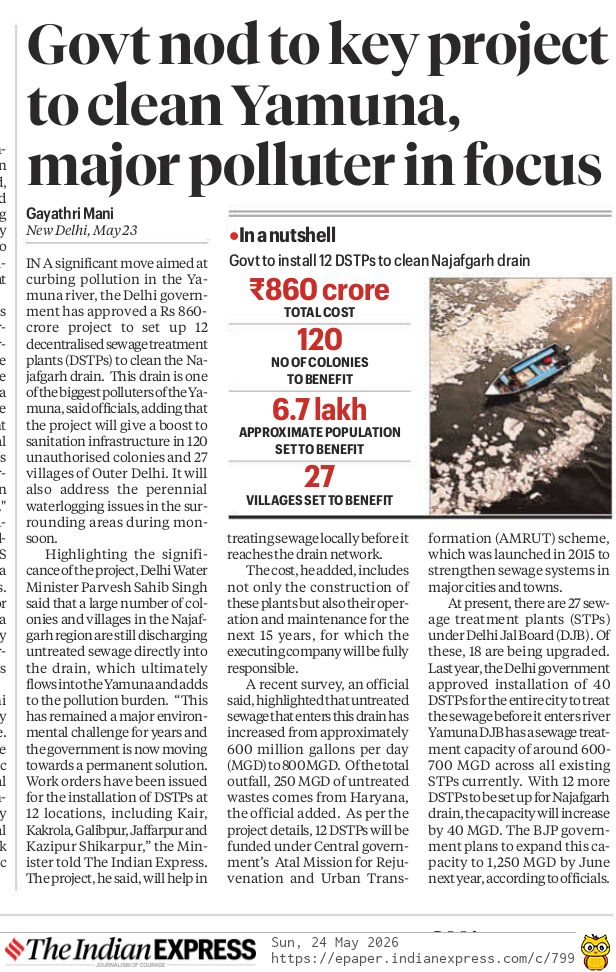
Delhi approves an ₹860 crore plan to tackle one of the Yamuna’s biggest polluters: the Najafgarh drain. 12 decentralised sewage treatment plants. 120 colonies. 27 villages. Nearly 7 lakh people covered. If executed properly, this could become the first serious attempt in years to stop untreated sewage at source and not just “clean” the river after dumping it in.
Prasanna Viswanathan tweet media
English
10
150
448
16.8K
Narayana Bhatta retweetledi
VatsRohit
VatsRohit@KesariDhwaj·
Pakistan Army and Tactical Brilliance - Nah! Its plain old stupidity. Recently @ShekharGupta wrote a piece on the tactical brilliance but strategic stupidity of the Pakistan Army since 1947. For a very long time, even I believed in this theory. But when I started re-reading the military history and other ops (I had frankly forgotten a lot of stuff), I realized that this is a very charitable explanation which we extend to what is actually repeated stupidity at play by the Pakistanis. We do this because we can't seem to digest or accept that someone can be repeatedly so stupid. So, we name it tactical brilliance. --- "Yes Sir, Three Bags Full, Sir". As they say, Pakistan doesn't have an army, the Pakistan Army has a nation. PA and its generals are not accountable to anyone. Only potential threat is an internal coup from some other general. Thats it. So, when plans are finalized within the GHQ in Rawalpindi, there is no-one to provide a counter-view. A steeply hierarchical organization coupled with a zeal to get even with the 'Kaffir' 'Hindu' 'Baniya' India is a very dangerous cocktail which does not allow critical appraisal or feedback. So, if the big man and his coeterie says GO, everyone simply follows the order. --- 'Phat Ke Flower' What follows from the above is the first thing you realize when studying the overall war objectives of Pakistan is that there is no thought given to "What-If Scenarios". Pakistanis make these simple, straight-forward and linear assumptions, and the whole war plan is predicated on this assumptions holding ground. There is no stress-testing - There is no 'What-if' scenario assessment. Pakistanis are so cocky about their reading of geopolitics, Indian politics and strategic scenario, and Indian military capabilites and leadership, that they simply don't factor for scenarios apart from the rosy pictures they've built inside their heads. The moment they counter an alternate scenario and see the script running contrary to what they had gamed (more like dreamed about), they have the proverbial 'Phat ke flower' moment. And you'll find them running around headless chicken. --- Kargil - Crown jewel of Pakistan Army's Stupidity A lot of serious and casual commentators say that the Indian Army did not see Kargil coming inspite of the intelligence warnings. My counter-question is this - What was Kargil and what should've the Indian Army foreseen coming? It is known that the Northern Command did run a table-top war-game where Pakistan Army incursion into the Kargil Sector was envisaged by a red-team (Brigadier level officers from Northern Command). But it was considered as not possible because given the terrain, logistic requirement and Pakistani+own troop disposition, it was simply not sustainable. But what was the thinking from Pakistan Army's side? --- Living in La La Land (1) The Nuclear Shield: They assumed Pakistan's nuclear weapons would completely deter India from launching a major conventional military counter-attack. (2) Localized Indian Response: They believed India's military reaction would be weak and restricted strictly to minor infantry skirmishes along the LoC. (3) International Intervention: They expected the international community to panic and force an immediate ceasefire, freezing the captured territory in Pakistan's favor. (4) Plausible Deniability: They assumed the world would believe the intruders were local Kashmiri freedom fighters rather than regular Pakistani soldiers. (5) Choking Siachen Supplies: They believed occupying the heights would permanently cut off India's vital NH 1D highway, forcing India to abandon Siachen. (6) Total Secrecy as a Strength: They assumed keeping the plan hidden from their own Air Force, Navy, and Prime Minister would ensure tactical success without consequence. --- Even enthu-cutlet defense crowd on X will tell you that all of the above assumptions are pure fantasy and have no relation to the reality as it exists on ground. I mean, just one change in Assumption (2) [Massive Indian localized retaliation with arty support and Indian Air Force being brought into picture] meant that the whole plan went for the toss!!! Forget that India had alternate Manali-Leh route to supply Siachen and Ladakh Sector or India could've widened the conflict by crossing LOC at its own area of chosing (which was actually planned and troops put in place in Kashmir for this option). --- In the end, I again ask - What was Kargil? It was a fundamentally flawed plan at land-grab to bring about a major change in the alignment of LOC and AGPL with far reaching geo-political consequenes but which was based on iffy assumptions, none of which held in the end, leading the Pakistanis to suffer another humiliating defeat. So, what was tactically brilliant about occupying un-guarded areas across LOC on Indian side when in the end it led to all-around failure? As I said earlier - We need to call out the Pakistan Army actions for what they are - plain old stupidity, and not flatter them with terms like tactical brilliance! --- Before I close, let me circle back to an earlier question - What did the Indian Army not envisage when it came to Kargil? - First, purely from military logic, the Indian Army was absolutely correct in its assessment that no operation in Kargil is sustainable by the Pakistanis given myriad of factors. - The mistake it did was to assume that Pakistan Army will think on rational lines with rigorous military logic. - That it will initiate ops based on fundamentally flawed assumptions and in the process, initiate hostilities and war. - Having committed itself to an ops without thinking through the whole scenario, Pakistanis ended up suffering another humiliating retreat and defeat. - But we paid the price in 500+ bravehearts to clean up the mess. - Any opportunity to harm India is to Pakistan Army what a shot of drugs is to a junkie - consequences be damned.
English
28
116
336
37.4K
Narayana Bhatta retweetledi
Ravi Kiran S
Ravi Kiran S@vikataravi·
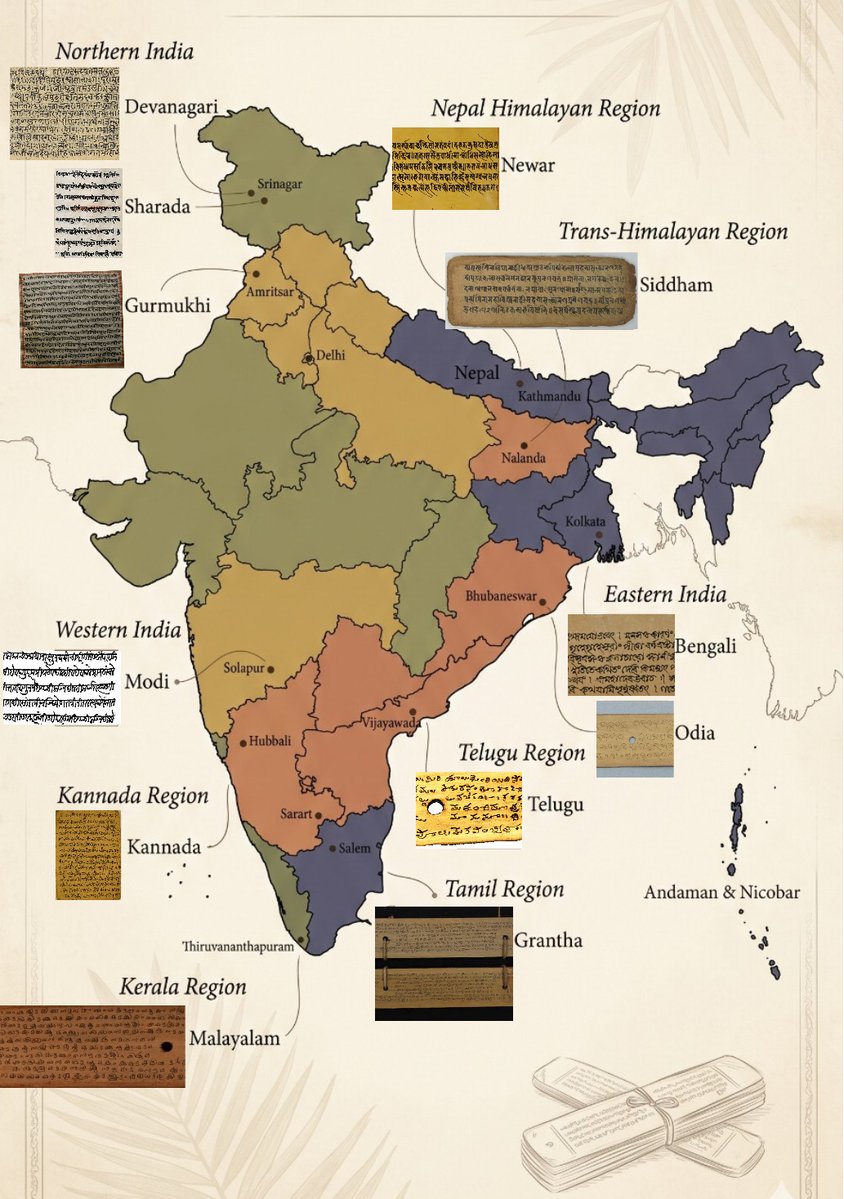
A breakthrough for Indic manuscript OCR. Introducing UniLipi - a unified Sanskrit manuscript OCR system capable of decoding across 13 scripts.
Ravi Kiran S tweet media
English
54
770
2.6K
47.5K
Narayana Bhatta retweetledi
do'o kappa
do'o kappa@viprabuddhi·
A record 17 MLAs in 126 member Assam Assembly took their oath in Sanskrit 🕉️🪷 These spanned across castes and regions with some like Pabitra Rabha being a tribal while Sanjay Kishan a tea tribe MLAs took oath in Assamese, Bodo, Bengali, Karbi, Rabha, Hindi, English as well
English
12
363
1.9K
17.9K
Narayana Bhatta
Narayana Bhatta@BhattaPN·
Richly deserved honour
PIB - Ministry of Home Affairs@PIBHomeAffairs

#PadmaAwards | Shatavadhani Dr. R. Ganesh, Karnataka’s renowned scholar and recipient of the Padma Bhushan 2026, has dedicated his life to reviving the ancient Indian art form of Avadhana — a rare literary tradition that combines poetry, memory, multitasking, and intellectual brilliance. Born in Kolar in 1962, Dr. Ganesh has mastered 18 languages, authored over 70 books, and emerged as a leading scholar of Indian literature and performing arts. Through decades of performances and cultural outreach, he has played a significant role in preserving and promoting India’s rich literary and artistic heritage for future generations. #PeoplesPadma #PadmaAwards2026 @HMOIndia @PadmaAwards @PIB_India @PIBBengaluru

English
0
3
7
124
Narayana Bhatta
Narayana Bhatta@BhattaPN·
A very richly deserved honour to Dr Ganesh
PIB - Ministry of Home Affairs@PIBHomeAffairs

#PadmaAwards | Shatavadhani Dr. R. Ganesh, Karnataka’s renowned scholar and recipient of the Padma Bhushan 2026, has dedicated his life to reviving the ancient Indian art form of Avadhana — a rare literary tradition that combines poetry, memory, multitasking, and intellectual brilliance. Born in Kolar in 1962, Dr. Ganesh has mastered 18 languages, authored over 70 books, and emerged as a leading scholar of Indian literature and performing arts. Through decades of performances and cultural outreach, he has played a significant role in preserving and promoting India’s rich literary and artistic heritage for future generations. #PeoplesPadma #PadmaAwards2026 @HMOIndia @PadmaAwards @PIB_India @PIBBengaluru

English
0
5
8
215
Narayana Bhatta retweetledi
Nityānanda Miśra (मिश्रोपाख्यो नित्यानन्दः)
Romila Thapar’s false claim for 30+ years For more than thirty years, eminent historian Romila Thapar has claimed that Patañjali compared the relationship or conflict between the Brahmanas and the Shramanas to that between the snake and the mongoose. The claim is completely false. Watch to know more.
English
133
2.2K
5K
250.5K
Narayana Bhatta retweetledi
Sringeri Math
Sringeri Math@sringerimath·
After a long gap of 60 years, Jagadguru Shankaracharya of the Sringeri Sharada Peetham is visiting Nepal. Kathmandu aastikas gathered in huge numbers to welcome the Jagadguru with great pomp and ceremony. The whole atmosphere was resounding with the chanting of the Vedas and the devout buzz of the gathered aastikas. --* Stay tuned to our official WhatsApp channel for notifications and updates: tinyurl.com/SharadaPeetham… #SanatanaDharma #Shankaracharya #Sringeri #Jagadguru #Mahaswamiji #SriSannidhanam #VijayaYatra #DharmaVijayaYatra #Nepal #Kathmandu #Pashupati #Pashupatinath #Muktinath #Budhanilkanth #Devghat #HinduDharma #Advaita #Vedanta #GuruParampara #HinduCulture #ShringeriSharadaPeetham #NepalYatra
English
13
309
1.4K
18.9K
Narayana Bhatta
Narayana Bhatta@BhattaPN·
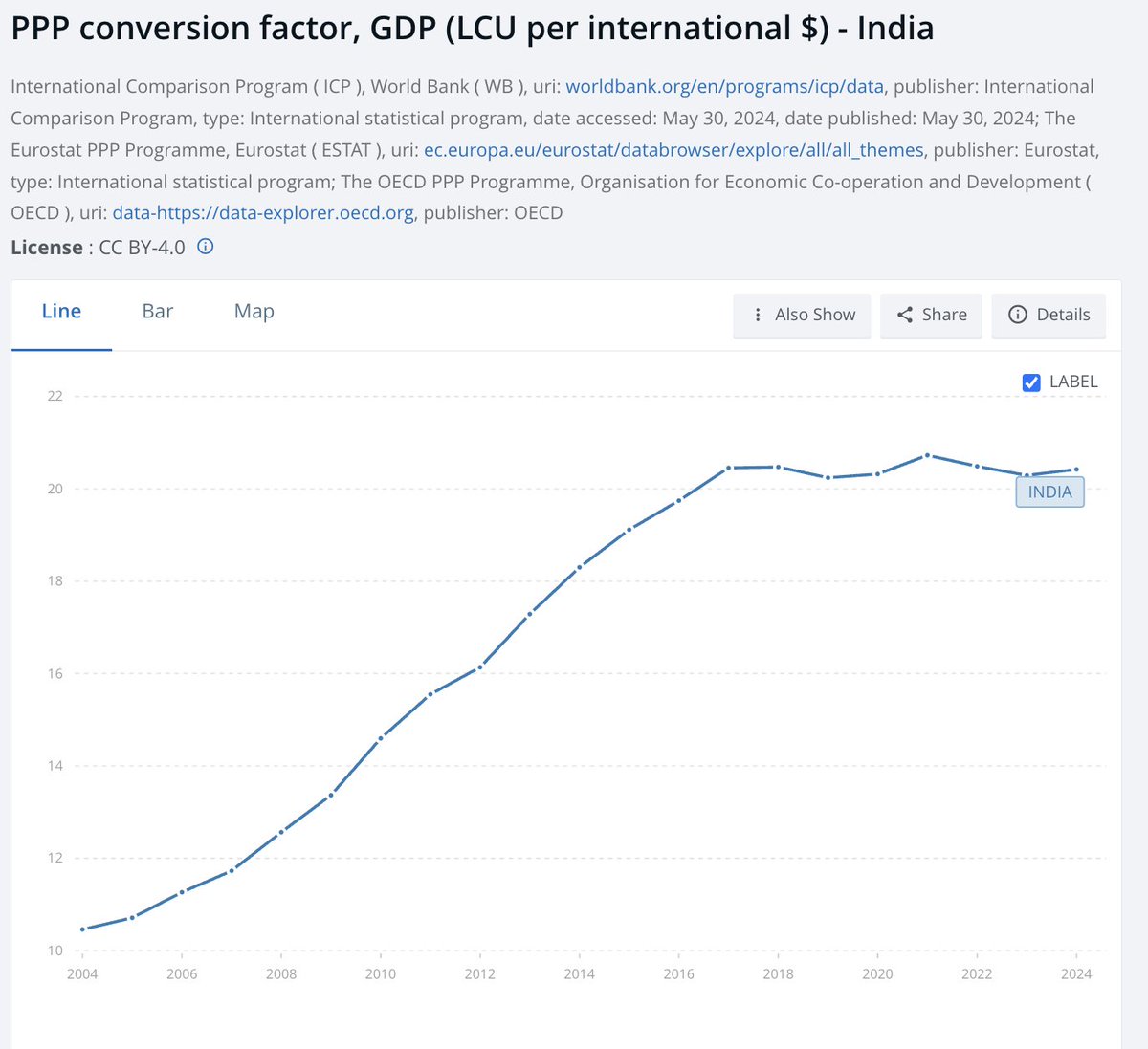
@RMantri It is amazing that professors at these universities don't understand purchasing power. Here is a PPP graph of INR, from @WorldBank. Indian Rupee (LCU) has been very stable since 2017. Ergo, no loss of purchasing power from 2017.
Narayana Bhatta tweet media
English
1
2
4
305
Rajeev Mantri
Rajeev Mantri@RMantri·
The sheer nonsense being peddled on USD/INR exchange rate is breathtaking! I repeat, for the vast majority of Indians (over 99% of the population, perhaps more than 99.9% of the population) there is no need at all to consider foreign investments or be bothered by what the USD level is at. Beware, there are some motivated financial interests and typical “intellectual” retards, which are hectoring the Govt and scaring consumers about this non-issue, or trying to pressurize the central bank to “defend” the rupee - which as the erudite Prof. @APanagariya has laid out, would not be wise at all x.com/i/status/20574… x.com/rmantri/status…
VatsRohit@KesariDhwaj

She's right. 15 years earlier, I used to buy 1 USD for INR 45 from FOREX market and use it to buy chowmien from the road side stall next to my house. Today, while the cost of chowmien has remained at 1 USD, I have to spend INR 97 to buy the same USD. Need to convince Chowmein wali didi to sell chowmein in Rupees. And her cousin how sells Momos also in USD.

English
104
74
360
75.5K
Narayana Bhatta retweetledi
Manuscripts & Inscriptions Digitization Foundation
India had free trade zones. In the 13th century. Written in stone. In 1244 CE, a king carved what may be the world's earliest maritime trade protection law onto a temple pillar in Andhra Pradesh.
Manuscripts & Inscriptions Digitization Foundation tweet media
English
1
18
23
778
Narayana Bhatta retweetledi
Prasanna Viswanathan
Prasanna Viswanathan@prasannavishy·
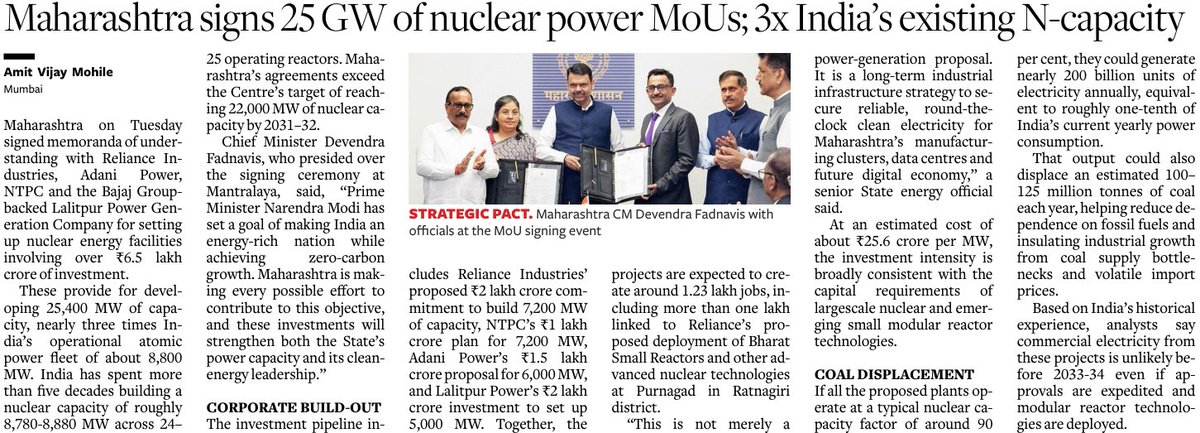
Maharashtra signs MoUs for 25,400 MW of nuclear power at total investment of ₹6.5 lakh crore. (To put the ambition in perspective. India has spent 50+ years building 8,800 MW of nuclear capacity across 25 reactors. And Maharashtra wants to add 3x that in one go) MoUs signed with → Reliance Industries 7,200 MW (₹2 lakh crore) → Adani Power 6,000 MW (₹1.5 lakh crore) → NTPC 7,200 MW (₹1 lakh crore) → Lalitpur Power (Bajaj-backed) — 5,000 MW (₹2 lakh crore) The realistic timeline 2025–28 → Site selection, regulatory clearances, land acquisition 2028–30 → Construction begins (best case) 2033–34 → First commercial power (analysts' estimate, if approvals are expedited) 2040+ → Full 25 GW capacity — optimistically MoUs have mixed track record of translating to implementation , but if it delivers the state will get 200 billion units of electricity annually plus round-the-clock clean power to run its factories, data centres and digital economy Biggest challenge will be to overcome land and local resistance. Purnagad in Ratnagiri (where Bharat Small Reactors are proposed ) is the same coastal Maharashtra belt that killed the Jaitapur nuclear project for over a decade. Fisher communities and environmental groups are already mobilised. Also the potential technology risk in deploying Small Modular Reactors (SMRs) which are still commercially unproven at scale globally. The vision of Maharashtra is right. India cannot decarbonise its industrial base without nuclear. Maharashtra, as India's biggest economic engine, making this bet is the correct strategic call. via @businessline
Prasanna Viswanathan tweet media
English
5
27
137
4.4K
Narayana Bhatta retweetledi
ESPN Insights
ESPN Insights@ESPNInsights·
According to ESPN Analytics, the Knicks win probability was as low as 0.1% 🤯 Teams trailing by 22 points in the fourth quarter of a playoff game since 1997-98 were 1-594 entering Tuesday.
ESPN Insights tweet media
English
131
803
4.6K
2.2M
Narayana Bhatta retweetledi
Swarajya
Swarajya@SwarajyaMag·
In 2014-15, Railways used 2,856 million litres of diesel. In 2024-25, it used just 977 million litres. Dependence on imported fuel reduced sharply. This happened even as railway network expanded and freight traffic surged.
Swarajya tweet media
English
1
12
76
6.1K