drain the comex

244 posts

drain the comex

drain the comex

@BigWhiteyJr

Katılım Aralık 2022
95 Takip Edilen25 Takipçiler
drain the comex
drain the comex@BigWhiteyJr·
@JoshTradeOption I bought DRAM and it was bought something like 70 cents higher than what I thought I paid. Looked harder and they attached a Sponsor Fee? I didn't like that.
English
0
0
0
81
Josh
Josh@JoshTradeOption·
If you want to invest in the huge demand for computer memory chips from AI, here are the top companies likely to see their share prices go up. 1. Micron Technology ($MU) This U.S. company makes fast memory for AI data centers. Supply is sold out through 2026. Bull case price target: $1,600 to $2,500+ per share if AI growth stays strong. 2. SK Hynix ($000660.KS) =>Interactive Brokers can be used to trade this This South Korean leader holds the biggest share of the special AI memory. It is the top supplier for many AI chips. Bull case price target: 3 million to 4 million Korean won. 3. Samsung Electronics ($005930.KS) =>Interactive Brokers can be used to trade this Another South Korean giant making memory chips and pushing hard into AI memory. Bull case price target: 500,000 to 590,000+ Korean won per share. 4. SanDisk ($SNDK) Strong in flash memory and storage drives used in AI data centers. Bull case shows big gains as storage demand explodes. 5. Western Digital ($WDC) and Seagate Technology ($STX) These companies make hard drives and storage for massive AI data centers. They benefit from the need to store huge amounts of AI data. For an easy way to buy many of these at once, check the Roundhill Memory ETF ($DRAM). It holds a basket of the top memory companies like Micron, SK Hynix, and Samsung. Always do your own research and consider the risks before investing. I'm long $MU, Samsung and $DRAM. I trade $MU daily as well. Which is your favorite and why?
English
4
2
15
2.2K
CK Capital
CK Capital@CKCapitalxx·
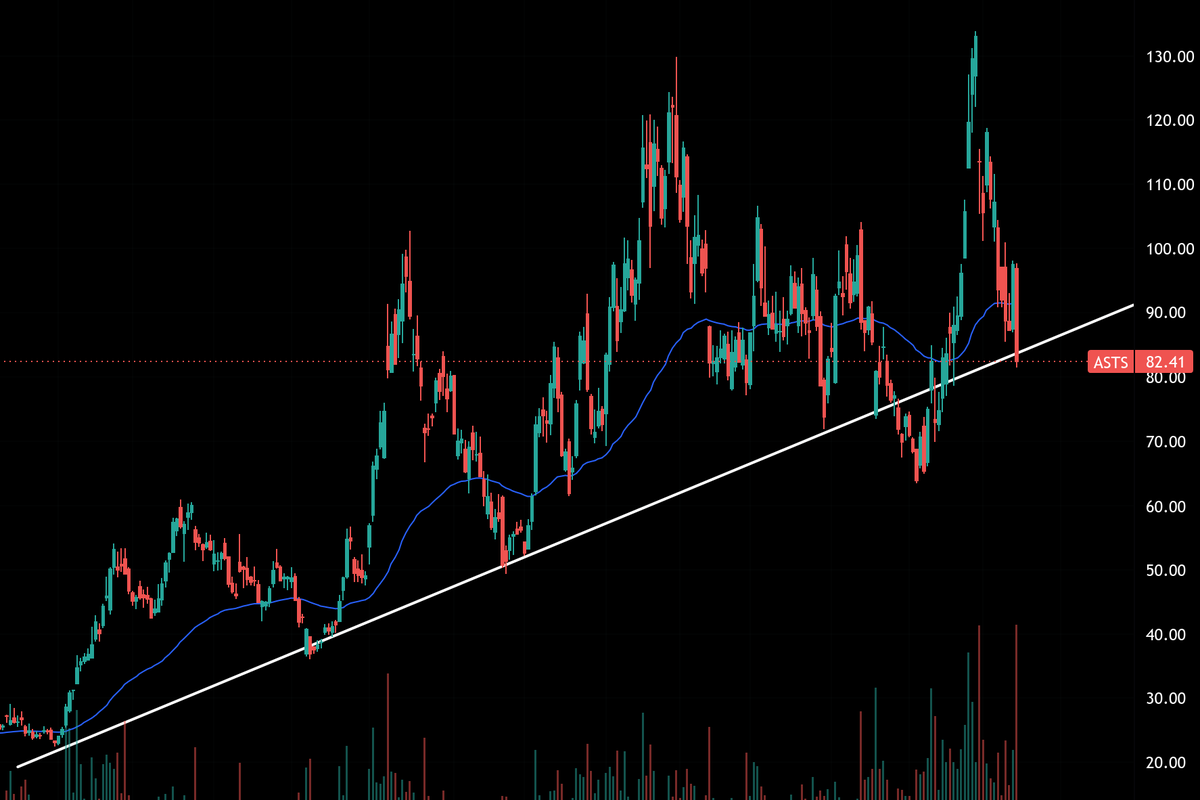
$ASTS is preparing for takeoff.
CK Capital tweet media
English
31
8
258
17.4K
CK Capital
CK Capital@CKCapitalxx·
Someone has to be making a bag by just buying $AAOI at $160 and selling at $200 everytime. Could’ve repeated this like 5 times by now.
CK Capital tweet media
English
55
12
420
43.3K
RJC
RJC@RJCcapital·
$ORCL is way too cheap
English
32
4
166
22.4K
drain the comex
drain the comex@BigWhiteyJr·
@Sandeman52 Ocean breeze is nice, but for me nothing beats those Appalachia mountains and the great roads to drive on with fewer people. I'm a motorcycle rider, what can I say.
English
2
0
7
266
SandemanStocks
SandemanStocks@Sandeman52·
Hmmm Florida is pretty awesome. This ocean breeze makes me forget about the heat. Tennessee or Florida?
English
38
6
97
16K
drain the comex
drain the comex@BigWhiteyJr·
@JoshTradeOption I bought Friday at $30, sold today quick trade at $35. I do see a lot of positive comments about them. Considering getting back in or selling puts if it drops tomorrow or later this week.
English
1
0
1
79
Josh
Josh@JoshTradeOption·
$BRUN I've got no position right now. I'm on the fence. Is this a stock to buy here? Or no? - ~$940M long-term contracted revenue backlog (growing fast) - Targeting $375M+ ARR by end-2026 - Operating 6 US data centers, building more (aiming >125 MW) - NVIDIA Preferred Cloud Provider with Blackwell GPUs - Full-stack GPU/CPU cloud platform (bare metal + Kubernetes) - FCF-positive operations vs cash-burning peers - Strong enterprise compliance (SOC2, HIPAA, ISO) - Dell financing for GPU buildout with low dilution - Heavy insider lockups until Nov 2026 - Leveraged play on AI GPU supply shortage
English
4
1
6
3.3K
drain the comex
drain the comex@BigWhiteyJr·
@mkfilko been debating w/myself all day to close or not the $30 6/18 short puts. $3.50/ea credit from last week. I can hang onto them to $26.50 before losing anything, may just let them exercise. I also hold shares at $32.
English
1
0
1
245
leki ⚔️
leki ⚔️@mkfilko·
$PL is a great company for long term, but short term price action does look weak here. My assumptions was that it would hold $30 as it has been basing around that level for awhile. If it loses that price tomorrow, I will exit my position and re-evaluate a re-entry. I may be wrong on this in terms of entry.
leki ⚔️@mkfilko

Been doing some digging on $PL for the past couple of days as I wanted some space exposure in my portfolio. It crashed from $50 to the low 30s when the filed a $1.5b ATM (12% of MC). I think the markets overreacted. Thus, when the opportunity arose, I immediately entered and alerted subs first. Now $PL forms 6% of my portfolio at a cost basis of $30.30 (I averaged up from initial purchase), subs and I are already up 4%. Here is the quick primer and the numbers: Planet Labs operates the world’s largest commercial Earth-observation fleet, roughly 200 satellites imaging the entire planet’s landmass every day at 3m resolution (PlanetScope), plus ~20 high-res SkySats and the new Pelican constellation heading toward 30cm, all feeding a 10+ year daily archive of Earth that cannot be recreated retroactively. It sells this as 99%-recurring subscriptions and, increasingly, as dedicated sovereign capacity: Germany (€240M), Sweden (national recon satellite delivered 4 months after signing), NATO, NGA, NRO, US Navy, and Japan’s JSAT ($230M for 10 Pelicans). Founded by three NASA scientists in 2010, public since 2021, $731M cash, now at the inflection from data vendor to defense-AI platform > Revenue growth: 41%, FY27 guided $425–441M✅ > Adj EBITDA: FY26 first full year of non-GAAP profitability. FY27 guided $0 to +$10M ✅(deliberately reinvesting the margin into Pelican capacity) > Rule of 40: Q1 FY27 ≈ 41 (42% growth – 1% EBITDA margin)✅ > Backlog: $906M, +72% YoY; RPOs $816M, +81% YoY, ~40% of backlog converts to revenue within 12 months, ~69% within 24 ✅ I don’t see how this doesn’t go back to at least $50 given their position in the market and their strong financials. Thanks for reading!


English
14
0
36
21.1K
ChinoAleman
ChinoAleman@chinoalemano·
Everyone uses AI now If everyone is running the same AI on the same data, AI alone won't get you ahead of the institutions. You won't find the edge before they do that way. You need something more. So I did the something more. I've spent days, full days, digging into $AMPG. This isn't a DD written by AI. This is real DD, done by a real person. And without buzzy words. Plain, simple. I went through the SEC filings, the earnings call, the patents, the partnerships, even tracked down a comment from a Telus VP buried in an industry article to figure out who their mystery customer actually is. That last part is the point. An AI summary doesn't go find a VP's quote in some random interview and connect it to an unnamed $40M order. A person willing to do the boring, patient work does. That's where the edge lives. I'm sharing all of it. My goal is simple: to help you understand the vision of this company, the good and the risky, with nothing hidden. Not financial advice. I'm long $AMPG. DYOR. 📡
ChinoAleman@chinoalemano

x.com/i/article/2066…

English
4
4
82
6.3K
Dr. Julie Gurner
Dr. Julie Gurner@drgurner·
"By 2021 he had collected over 1.7 million real-time happiness reports from 33,000 adults. When he plotted income against in-the-moment well-being, there was no plateau anywhere. The line just kept rising. People earning $200,000 were happier on average than people earning $100,000. People earning $400,000 were happier than people earning $200,000. The curve flattened slightly but never stopped climbing."
English
6
2
45
4.9K
Ihtesham Ali
Ihtesham Ali@ihtesham2005·
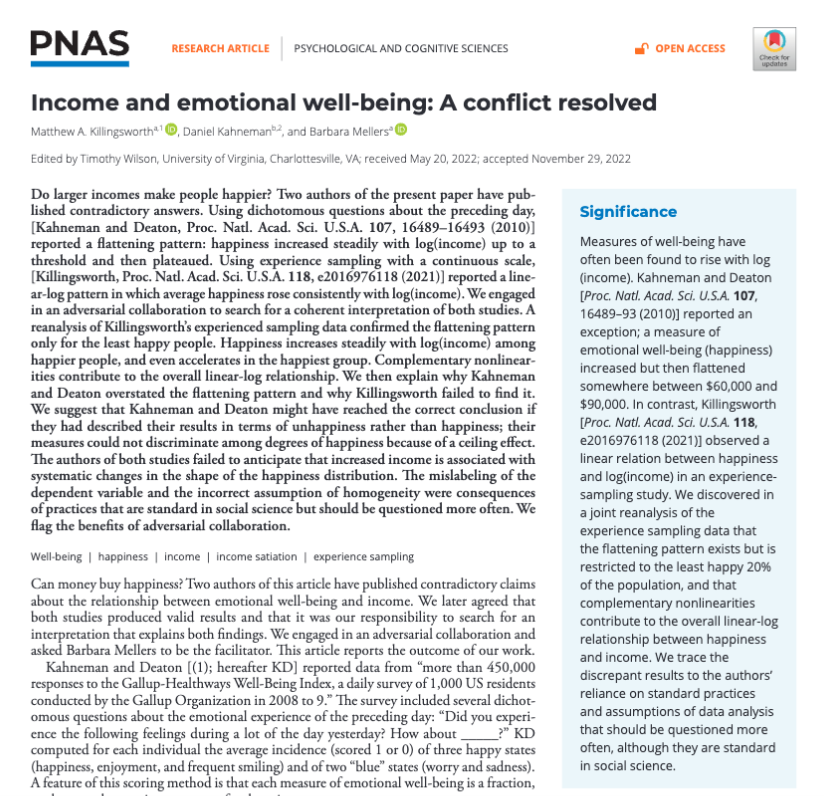
Does money buy happiness? A Princeton Nobel laureate said no above $75,000. A Penn researcher with 1.7 million data points said yes. The day they sat down together to settle the fight, the answer they reached should change how you think about your own life. The Nobel laureate is Daniel Kahneman. The Penn researcher is Matthew Killingsworth. The fight between them lasted 13 years, and the way it ended is one of the cleanest examples in modern science of two smart people being wrong in opposite directions about the same question. In 2010 Kahneman and his Princeton colleague Angus Deaton published a paper that became one of the most quoted findings in the history of social science. They analyzed 450,000 responses to the Gallup-Healthways Well-Being Index and concluded that emotional well-being rose steadily with income up to about $75,000 a year, and then flattened out completely. Above that line, the extra money was not buying any more daily happiness. The headline traveled around the world. Every news outlet ran the number. A CEO in Seattle famously cut his own salary to raise his employees to that exact threshold. The 75,000 dollar figure became cultural shorthand for the idea that the rich are not actually any happier than the rest of us once basic needs are met. For 11 years almost nobody seriously challenged it. Kahneman had a Nobel Prize in Economics, the sample size was massive, and the conclusion was emotionally satisfying in a way that made everyone feel a little better about not being wealthy. Then in 2021 a 33 year old researcher at the University of Pennsylvania published a paper that quietly destroyed the entire finding. His name is Matthew Killingsworth. He had spent the previous decade building a smartphone app called Track Your Happiness that pinged users at random moments during their day and asked them a simple question. How do you feel right now, on a scale from very bad to very good. The app was designed to catch happiness in the act, not to ask people to recall it later. By 2021 he had collected over 1.7 million real-time happiness reports from 33,000 adults. When he plotted income against in-the-moment well-being, there was no plateau anywhere. The line just kept rising. People earning $200,000 were happier on average than people earning $100,000. People earning $400,000 were happier than people earning $200,000. The curve flattened slightly but never stopped climbing. The famous $75,000 ceiling that the world had been quoting for 11 years simply did not exist in his data. Now there were two Nobel-quality findings sitting in direct contradiction with each other. One of them had to be wrong, and neither researcher was willing to walk away. What happened next is the part of the story almost nobody knows. Kahneman called Killingsworth and proposed something rare in academic science. He called it an adversarial collaboration. The two of them, joined by Penn psychologist Barbara Mellers as a neutral referee, would sit down together and reanalyze the raw data from both studies, line by line, until they figured out which one of them was wrong. The paper they co-authored was published in March 2023 in the Proceedings of the National Academy of Sciences. And the answer they reached was not what either of them had expected. Both of them had been right at the same time. They had been measuring two different populations without realizing it. When the team broke Killingsworth's 1.7 million data points apart by baseline happiness, the picture clarified completely. For the happiest 70 percent of people, more money kept buying more happiness all the way up to $500,000 a year, with no sign of slowing down. For people in the middle, the same pattern held. But for the bottom 20 percent of the sample, the ones who were already unhappy before the question of money even came up, the curve flattened almost exactly where Kahneman's original paper had said it would. Above roughly $100,000 a year, adjusted for inflation, more money did nothing for them. This is the finding that changes how the question should be asked. If you are not already unhappy, money keeps buying happiness for a much longer stretch than Kahneman's original paper suggested. The runway is wider than the world has been telling itself for a decade. If you are already unhappy, money does almost nothing past a certain point. There is a ceiling, but the ceiling is not about income. It is about the underlying state of the person collecting it. The deeper insight in Killingsworth's original research, the one almost nobody talks about, is the part that should sit with you longer than the income numbers. The Track Your Happiness app had been telling him for years that the single biggest predictor of in-the-moment well-being is not money at all. It is whether your mind is on the thing you are doing. His most cited paper, written with Daniel Gilbert at Harvard, is titled A Wandering Mind Is an Unhappy Mind. The data from the app showed that people are mentally absent from what they are doing 47 percent of the time, and that mental absence is one of the strongest predictors of unhappiness in the entire dataset. More predictive than income. More predictive than the activity itself. More predictive than almost any demographic variable you could measure. Which means the unhappy 20 percent that Kahneman's plateau actually described were probably not unhappy because they did not have enough money. They were unhappy for reasons that more money could not reach. The reason the curve flattened for them at $100,000 a year is the same reason it would have flattened at $300,000 or $700,000. The thing they were missing was not buyable. The most uncomfortable line in the entire 2023 paper is the one that nobody on the internet quotes. The authors note that the relationship between income and happiness, while real, is much weaker than the relationship between attention and happiness. A person earning $40,000 who is fully present in their own life will, on average, report higher in-the-moment well-being than a person earning $400,000 whose mind is somewhere else. The fight about money was the wrong fight the entire time. The two researchers spent 13 years arguing over whether the dollar ceiling was at $75,000 or $500,000, and the data from Killingsworth's own app was sitting there the whole time saying the ceiling was not about dollars at all. The ceiling is whether you can hold your attention on the life you actually have. You can run the experiment yourself the next time you catch your mind drifting. Stop. Put your phone down. Look at the room you are in, the person across from you, the food in front of you, the work you are actually doing. That is the part the apps cannot sell you and the salary cannot buy you. The data has been clear for over a decade. The plateau is not in your bank account. It is in your attention.
Ihtesham Ali tweet media
English
55
435
1.5K
260K
drain the comex
drain the comex@BigWhiteyJr·
@rk8215 no prob, blocked and reported, i hate these impersonators they are on every single account i follow.
English
0
0
0
12
drain the comex
drain the comex@BigWhiteyJr·
@CKCapitalxx Portfolio you posted yesterday has a cost basis of $83.10 for MXL? what am i missing here
English
3
0
1
1.1K
CK Capital
CK Capital@CKCapitalxx·
Update on the All In portfolio. Up almost 40% since we started this and our current position in $MXL is up almost 20% in a few days.
CK Capital tweet mediaCK Capital tweet media
English
18
9
196
35.4K
drain the comex
drain the comex@BigWhiteyJr·
@michaelsikand @joinautopilot I'm averaged low 170s and sold the 6/18 150 puts on Tuesday when it sank to low 160s. I'm happy either way collecting the great premium or letting them exercise.
English
1
0
4
916
Michael Sikand 🦑
Michael Sikand 🦑@michaelsikand·
Guys we need to talk about $AAOI... $AAOI is one of the most controversial stocks in the world and I enjoy the disagreement. Pretty cool that's it up 3x since I went long with many thousands of investors riding it with me up some portion of that gain on @joinautopilot. But what's cooler is that I think it's still asymmetrical here. So let's break it down and figure out where we're at $170/share today. Management argues they can get to $471M in monthly transceiver revenue by Q2 2027. If you're new to photonics, this is because transceivers are one of the hottest commodities in data centers right now (they translate electricity to light) and 3 hyperscalers are working with $AAOI on this. At management's 40% gross margin target, that's ~$5.6B in annualized revenue. Run past opex, interest, tax, dilution, we might land around $14-15 in EPS on that run rate. That's a 2028 number though because 2027 is the ramp mid year, so let's call it bull case $9 of EPS in 2027. So at $170/share right now, on these calcs, you're paying 19x 2027 earnings, falling dramatically to 12x for 2028. Don't trust management? Fair. Haircut both the revenue and the margin target by 30%, let's say we get to $4B at a 28% gross margin instead of $5.6B at 40%. You still land near ~$6 in EPS, just over the analyst mean estimate for 2027E. That's 28x at $170, still WAY cheaper than $LITE and $COHR trade right now. $LITE is at a 50x NTM forward PE per Fiscal AI. $COHR is at 47x NTM forward PE per Fiscal AI. You're paying a fraction of the multiples of its peer group for a faster growing business because execution is still a huge question mark. If you are an asymmetric trader like me, you might have a large concentrated position in $AAOI for these reasons. I do believe the stock at $170 is still a solid entry point and I began loading again heavily in the 160's.
Michael Sikand 🦑 tweet media
Michael Sikand 🦑@michaelsikand

$AAOI Up 13% AH It is the largest position in my photonics fund. - Q4 revenue: $134.3M (+34% YoY) - Gross margin: 31.2% vs 28.7% last year - $455.7M. That's double 2024's $249.4M. - Q1 2026 guide is $150M–$165M. Margins holding. Photonics is next.


English
32
40
426
153.8K
Retail Mourinho
Retail Mourinho@retail_mourinho·
$AAOI to $200+ next week.
English
19
9
292
64K
mon
mon@moninvestor·
$SNDK - You only need one stock to change your life.
mon tweet media
English
36
17
328
74.9K
drain the comex
drain the comex@BigWhiteyJr·
@CKCapitalxx i just subbed, had MXL on watchlist for a bit, figured i'd just go on ahead and buy it; in at $84ish.
English
3
0
2
967
CK Capital
CK Capital@CKCapitalxx·
All In portfolio is up over 30% now since I started about 2 weeks ago. Pretty good no? Who’s tailing along?
CK Capital tweet media
English
13
8
238
26.6K
drain the comex
drain the comex@BigWhiteyJr·
@asklivermore @Dale_L_O Thing is, if you used the EMAs to buy something like SNDK, the last buy would have been Aug 25 at $43. lol, it came close in Mar 26 but didn't touch. You'd have missed the entire run and still waiting.
English
1
0
1
14
drain the comex retweetledi
ChinoAleman
ChinoAleman@chinoalemano·
As micro watcher pointed out, look at what the market happily pays for hyped small-caps. $ALMU trades around 80x sales. $AMPX many times higher than this name. Meanwhile $AMPG sits at ~6x trailing and ~4x forward. So let me tell you the complete story of what you're actually getting at that price. 📡 THE RADIO. AMPG is the only American company to design and commercialize a 64T64R Massive MIMO O-RAN radio, the only one of its configuration certified by the DoD-backed Open6G OTIC, and the only 64T64R vendor at the latest O-RAN PlugFest. 🇨🇦 TELUS. ALREADY PRINTING. Per Telus's own VP: every Open RAN site runs AmpliTech antennas, 2 of the 5 radios per sector, live, alongside Samsung, on a Tier-1 carrier. Only ~15% of sites are Open RAN today. Starting line, not ceiling. 🤖 NVIDIA. AMPG's radio ran hand-in-hand with NVIDIA's Aerial in the world's first open-source AI-RAN demo, inside the DoD-funded Open6G hub. NVIDIA is now on its customer wall. (A collaboration/demo, not a signed supply deal, but the direction is loud.) 🛰️ AMAZON / KUIPER. Dec 2024: AMPG shipped space-qualified amplifiers to a "Fortune 50 satellite provider," LEO constellation, tens of thousands of units expected. The only Fortune 50 building its own LEO network is Amazon. Now on the customer wall too. (Still a deduction, still a prototype, but the dots keep landing.) ⚛️ QUANTUM. The only US maker of the cryogenic amplifiers superconducting qubits need, Google and IBM named as proof-of-concept recipients. (Optionality, not revenue yet, but real.) 🏛️ THE CUSTOMER WALL. This isn't a no-name. Straight from amplitechgroup.com, the logos AMPG puts under "Customers": NVIDIA, IBM, Amazon, Boeing, Lockheed Martin, Northrop Grumman, L3Harris, CPI, Fujitsu, HTC, Globecomm, C2Tech, Greins, Northeastern, Georgia Tech, University of Edinburgh, Digital Catapult, Paramount, DiscoveryPlus, Disney Channel, and more. (Honest framing: it's the company's own wall, spanning all divisions and years, including its distribution arm, so it shows who they've worked with, not the size of each deal. But you don't put Lockheed, NVIDIA and Amazon up on a whim as a public company.) 💰 THE FUNDAMENTALS. Debt-free. Gross margins 33% → 48%. $118M in LOIs across multiple carriers. A founder who started with $2 in his pocket, still owns ~10%+, and hasn't sold a share. 🇺🇸 NOW THE BIG ONE. WHY THIS IS NATIONAL SECURITY? Look at who builds the world's wireless radios: Nokia (Finnish). Ericsson (Swedish). Huawei and ZTE (Chinese — banned in the US). Read that again. The backbone of America's communications, the same networks its military, its first responders, its critical infrastructure run on, is supplied almost entirely by foreign companies. That's not a convenience problem. It's a strategic vulnerability. Whoever builds the radios sits inside the nation's nervous system, which is exactly why the US ripped Huawei out of its networks over espionage and backdoor fears. You cannot have a trusted network on untrusted, foreign-controlled hardware. So the US government's answer is Open RAN, an open, multi-vendor architecture that lets American companies supply trusted, individual pieces (a radio here, software there) instead of depending on a single foreign empire. And the tip of that spear is Open6G: the DoD-funded (OUSD R&E, via an Army Research Laboratory agreement) research hub at Northeastern, built to create a domestic, secure foundation. That's the whole point. Washington is funding an entire architecture to get foreign hardware out of the nation's networks, and at the radio layer, where it matters most, there is exactly one American company at that spec. Already defense-qualified (Lockheed, Northrop, L3Harris, Boeing). Already inside the DoD-backed hub. Already certified. Already deployed at a Tier-1 carrier. When the government decides trusted, domestic, open infrastructure is a national priority, and there's only one US company that makes the radio, that company stops being "a micro-cap" and starts being strategic. So step all the way back and look at the asymmetry: The market pays 40–80x sales for hyped names with tiny revenue and no story like this. AMPG, real revenue, real customers, a debt-free balance sheet, NVIDIA and Amazon on its wall, designed into Telus, and sitting at the center of a national-security strategy, trades at single-digit sales. That's the story. That's the gap. And the market is only starting to close it. Not financial advice. I'm long $AMPG. DYOR. 📡
ChinoAleman tweet media
micro watcher@DVLT146025

This is a well-summarized article about $AMPG. I would add that $AMPG's PSR is still less than 9, and its forward PSR is 4. $AMPX is 38x, and $ALMU is 80x.


English
5
11
78
8.5K