Crypto Exponentials⚡

8.8K posts

Crypto Exponentials⚡ banner
Crypto Exponentials⚡

Crypto Exponentials⚡

@BitcoinOnwards

Genesis Block . Bitcoin . Tesla . AI . MSTR

United States Katılım Aralık 2009
2.5K Takip Edilen1.5K Takipçiler
Sabitlenmiş Tweet
Crypto Exponentials⚡
Crypto Exponentials⚡@BitcoinOnwards·
⚖️The IRS has changed the rules for #CryptoTaxes - universal cost‐basis tracking is ending and you now must track gains/losses wallet by wallet under IRS Rev. Proc. 2024-28 for tax year 2025 (filing in 2026). Per-wallet tracking can significantly affect your capital gains math. Learn more & get compliant tools: 👉🏾Get discount to File Taxes: coinledger.io/?fpr=q2lux (see details here: help.coinledger.io/en/articles/10…) 👉🏾File Taxes: coinledger.io/?fpr=q2lux #Crypto #IRS #Tax2026 #CostBasis #CryptoTax #CryptoTips
English
0
0
0
640
Crypto Exponentials⚡
Crypto Exponentials⚡@BitcoinOnwards·
The narrative isn’t wrong-but it’s incomplete. Post-FTX, the market did evolve. Locked token supply (e.g., Solana) was effectively financialized-sold OTC at deep discounts and hedged via perpetual shorts. That allowed market-neutral funds to extract carry (discount + funding + basis), compressing the reflexive upside that retail typically depends on. But calling it “risk-free yield” or the sole reason altcoins underperformed misses the bigger shift: This cycle was defined by liquidity concentration and structural maturity. Capital didn’t disappear-it consolidated into Bitcoin (and to a lesser extent Ethereum), where: • supply is credibly neutral • no VC overhang exists • institutional flows (ETFs, mandates) dominate At the same time, crypto markets became more efficient: • faster arbitrage • tighter spreads • fewer “free beta” opportunities Result: alpha didn’t vanish-it migrated. ⸻ Where holistic alpha actually exists now: 1) Structural inefficiencies (not narratives) • pre-unlock / post-unlock dislocations • funding + basis regime shifts • liquidity migration across venues 2) Volatility as an asset class • options overlays • convex payoff structures • monetizing volatility clustering instead of chasing direction 3) Flow-aware positioning • tracking where marginal capital is forced to go (ETFs, treasury strategies, structured products) 4) Early-stage asymmetry (with discipline) • not “insider access” • but understanding who owns supply, when it unlocks, and how it’s hedged ⸻ The real takeaway: This isn’t a broken market—it’s a professionalized one. If you’re still playing linear beta in a non-linear market, you’ll underperform. If you adapt to structure, flows, and volatility, alpha is still very much alive. ⸻ #CryptoMarkets #Bitcoin #Ethereum #MarketStructure #Alpha #TradingStrategy #InstitutionalFlows #Derivatives #CryptoInvesting #Volatility #DigitalAssets
Willy Woo@willywoo

I'm seeing crypto folk falling into the trough of dispair after an abysmal bull market with mainly losers and BTC outperforming their "beta". Let me tell you a story that tells you why you got screwed. It starts with the end of FTX. When the bankruptcy folk came in to liquidate FTX assets their mandate was to sell everything. This included vast quantities of locked SOL. They inadvertently invented something new, selling an asset that was locked up on-chain through the magic of a legal sale agreement (pay me now, I deliver later). The deal got passed around the ecosystem, fund managers bought up the locked SOL at more than 60% discount to compensate for being locked up and exposed to the token price. Many hedge funds bought the deal. They knew they could hedge the token price on futures markets by shorting SOL pocketing 70-80% yield at near zero risk (staking + basis yield + token discount). They liked it and asked where can we get more of this? Herein lies your PROBLEM as a crypto investor in 2023-2025. Every crypto project has backers (and a foundation) who has great wads locked tokens that have been sold to hedge funds and dumped on you immediately through futures markets. All your alpha went to market neutral hedge funds pocketing risk free yield. THAT IS WHY CRYPTO IN 2023-2025 UNDER PERFORMED You got dumped on prematurely. On the bright side many of these projects, even though they have "locked up tokens ready to dump" on paper, in reality they have been sold already, so they will logically perform without the expected sell pressure in the next bull market given they have effectively been sold. Not that I recommend buying crypto, you need to be an insider to get an edge, it works like a casino, the house will take your money. The house in 2023-2025 were the people who understood this trade. Just buy BTC and get on with your life.


English
0
0
0
71
Crypto Exponentials⚡
Crypto Exponentials⚡@BitcoinOnwards·
@willywoo @KevinSvenson_ Altcoin underperformance in 2023–2025 was driven by the financialization of token supply (via OTC + hedged structures), combined with liquidity concentration into BTC and the maturation of crypto market structure, which collectively compressed retail alpha.
English
0
0
1
55
Willy Woo
Willy Woo@willywoo·
I'm seeing crypto folk falling into the trough of dispair after an abysmal bull market with mainly losers and BTC outperforming their "beta". Let me tell you a story that tells you why you got screwed. It starts with the end of FTX. When the bankruptcy folk came in to liquidate FTX assets their mandate was to sell everything. This included vast quantities of locked SOL. They inadvertently invented something new, selling an asset that was locked up on-chain through the magic of a legal sale agreement (pay me now, I deliver later). The deal got passed around the ecosystem, fund managers bought up the locked SOL at more than 60% discount to compensate for being locked up and exposed to the token price. Many hedge funds bought the deal. They knew they could hedge the token price on futures markets by shorting SOL pocketing 70-80% yield at near zero risk (staking + basis yield + token discount). They liked it and asked where can we get more of this? Herein lies your PROBLEM as a crypto investor in 2023-2025. Every crypto project has backers (and a foundation) who has great wads locked tokens that have been sold to hedge funds and dumped on you immediately through futures markets. All your alpha went to market neutral hedge funds pocketing risk free yield. THAT IS WHY CRYPTO IN 2023-2025 UNDER PERFORMED You got dumped on prematurely. On the bright side many of these projects, even though they have "locked up tokens ready to dump" on paper, in reality they have been sold already, so they will logically perform without the expected sell pressure in the next bull market given they have effectively been sold. Not that I recommend buying crypto, you need to be an insider to get an edge, it works like a casino, the house will take your money. The house in 2023-2025 were the people who understood this trade. Just buy BTC and get on with your life.
English
143
161
1.7K
228.1K
Crypto Exponentials⚡
Crypto Exponentials⚡@BitcoinOnwards·
🚨 Bitcoin Isn’t Range-Bound. It’s Regime-Bound. Markets don’t move on price targets. They move on regime shifts. Right now, Bitcoin is sitting in a classic volatility compression phase-misread by most as “sideways.” It’s not. It’s coiling around a pivot. ⸻ 📊 The Model: Probability, Not Prediction Instead of guessing direction, we map distributions. April → June 2026 Scenario Framework: • Base Case (50%) $66K–$78K → Flow-supported range, low-vol regime • Breakout (30%) $80K–$92K → Flow acceleration + reflexive upside • Liquidity Shock (15%) $58K–$65K → Macro tightening / real yield pressure • Tail Risk (5%) $52K or $95K+ → Non-linear outcomes (panic or euphoria) 👉 This is not a forecast. 👉 It’s a probability surface shaped by flows and volatility. ⸻ 🔄 Flow Regime Dashboard (The Real Driver) BTC is no longer purely technical or cyclical. It’s flow-dominated. Watch these 3 signals: • 7-Day Flow Momentum → Acceleration vs slowdown • Positive Flow Rate → % of green days • Flow Trend → Accelerating / Stable / Decelerating When flows accelerate: Price doesn’t drift-it jumps regimes ⸻ ⚡ Volatility Trigger Map Volatility isn’t random. It’s state-dependent. • Below $72K → Compression • Low realized vol • Dealer gamma suppresses movement • $72K–$74K → Transition Zone • Fragile equilibrium • Break attempts increase • Above $74K → Expansion • Volatility unlocks • Flow reflexivity kicks in • Momentum feeds itself 👉 $74K is not resistance. It’s a switch. ⸻ 🌐 Macro Overlay (The Hidden Hand) BTC now trades as a macro liquidity instrument. Key sensitivities: • Fed Liquidity ↑ → Bullish convexity • Real Yields ↑ → Downside pressure • $DXY ↑ → Risk-off drag Even without events, macro is always repricing in the background via the Federal Reserve. ⸻ 🧠 The Structural Shift Most Are Missing Bitcoin has evolved. From: • Cyclical, halving-driven To: • Flow-driven, reflexive, macro-sensitive Price follows flows. Volatility follows regime shifts. ⸻ 🎯 Final Take Stop asking: “Where is BTC going?” Start asking: “Which regime are we in—and is it about to change?” Because once $74K is accepted… This market doesn’t grind higher. It reprices. #Bitcoin #Crypto #Macro #Investing #Trading #ETF #Liquidity #Volatility #DigitalAssets #CryptoExponentials
Crypto Exponentials⚡ tweet media
English
0
0
0
78
Crypto Exponentials⚡
Crypto Exponentials⚡@BitcoinOnwards·
Exactly @OnchainDecoded. That is why we build Signals -> earnsideincome.net/signals THE MARKET GIVES YOU DATA. WE GIVE THE SIGNAL. #BTI scores 47 #Bitcoin on-chain & macro metrics into one clear 0–100 number - so you know exactly when to accumulate $IBIT or step aside. #BMA signals when $MSTR's premium to Bitcoin is statistically exploitable - with a specific entry, stop, and target. Rules, not gut feel. #CryptoRealtime #CryptoInnovation #CryptoInvesting #CryptoAlert
Onchain Decoded@OnchainDecoded

@BitcoinOnwards The narrative-to-capability shift also shows up onchain. Bull runs fueled by hype alone tend to top out faster, while cycles with real economic activity underneath them last longer. These 7 indicators help track where we actually are: onchainnews.blog/bitcoin-cycle-…

English
0
0
0
56
Crypto Exponentials⚡
Crypto Exponentials⚡@BitcoinOnwards·
Crypto is maturing from narrative-driven markets into a layered, capability-driven architecture. In this new LinkedIn article, we map the evolving blockchain stack across: • Base protocols • Core platform components • Middleware • Applications • Governance / compliance A useful lens for builders, investors, and institutions trying to understand where durable value will accrue. Read here: linkedin.com/pulse/evolving… #Blockchain #Crypto #Web3 #DeFi #Tokenization #RWA #DigitalAssets #CryptoInfrastructure
English
1
0
0
39
Crypto Exponentials⚡
Crypto Exponentials⚡@BitcoinOnwards·
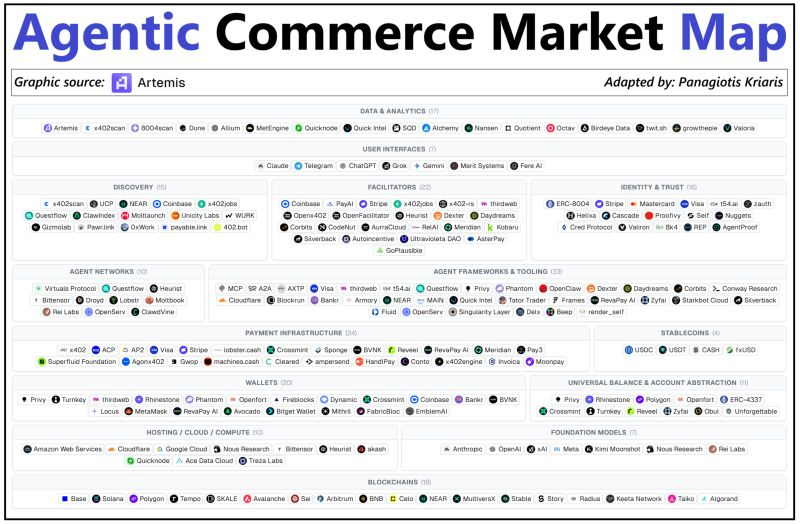
Breakdown of the emerging agent commerce stack and who does what. 𝟭. 𝗙𝗼𝘂𝗻𝗱𝗮𝘁𝗶𝗼𝗻 𝗺𝗼𝗱𝗲𝗹𝘀 Models such as OpenAI, Anthropic, Meta, xAI provide the reasoning layer that allows agents to interpret instructions, plan actions and make decisions. Without this layer, there are no autonomous agents. 𝟮. 𝗜𝗻𝗳𝗿𝗮𝘀𝘁𝗿𝘂𝗰𝘁𝘂𝗿𝗲 Providers such as AWS, Google Cloud, Cloudflare, Akash supply the compute and networking needed to run models and agents continuously. This is the infrastructure layer of the agent economy. 𝟯. 𝗔𝗴𝗲𝗻𝘁 𝗳𝗿𝗮𝗺𝗲𝘄𝗼𝗿𝗸𝘀 Frameworks like MCP and A2A allow developers to build agents that can call APIs, access services and coordinate tasks. This layer enables models to operate as agents. 𝟰. 𝗔𝗴𝗲𝗻𝘁 𝗻𝗲𝘁𝘄𝗼𝗿𝗸𝘀 Protocols such as Virtuals Protocol, Bittensor or Heurist allow agents to collaborate and coordinate with other agents rather than operating individually. These networks provide shared environments where agents can exchange tasks and services. 𝟱. 𝗗𝗶𝘀𝗰𝗼𝘃𝗲𝗿𝘆 Before an agent can act, it must discover available services, APIs or resources. Tools like x402scan and Unicity Labs allow agents to discover APIs, services or payment endpoints across the ecosystem. 𝟲. 𝗜𝗱𝗲𝗻𝘁𝗶𝘁𝘆 & 𝘁𝗿𝘂𝘀𝘁 Agents must prove who they are and whether they can be trusted. Protocols such as ERC-8004, Cred Protocol, AgentProof provide identity and and verifiable credentials so agents can transact securely. 𝟳. 𝗙𝗮𝗰𝗶𝗹𝗶𝘁𝗮𝘁𝗼𝗿𝘀   Platforms like Stripe, Coinbase, Openx402, thirdweb connect agents to services, payments and workflows. They act as the execution layer that lets agents actually do things. 𝟴. 𝗪𝗮𝗹𝗹𝗲𝘁𝘀 & 𝗮𝗰𝗰𝗼𝘂𝗻𝘁 𝗶𝗻𝗳𝗿𝗮𝘀𝘁𝗿𝘂𝗰𝘁𝘂𝗿𝗲 Solutions such as Privy, MetaMask, Fireblocks, Coinbase Wallet allow agents to hold assets, manage keys and sign transactions. Technologies like ERC-4337 simplify account management so agents can transact programmatically. 𝟵. 𝗣𝗮𝘆𝗺𝗲𝗻𝘁 𝗶𝗻𝗳𝗿𝗮𝘀𝘁𝗿𝘂𝗰𝘁𝘂𝗿𝗲  Infrastructure such as x402, Stripe, Visa, Crossmint, Moonpay enables automated payments and settlement. This is what allows agents to pay for services or receive payments automatically. 𝟭𝟬. 𝗕𝗹𝗼𝗰𝗸𝗰𝗵𝗮𝗶𝗻𝘀  Networks like Base, Solana, Polygon, Avalanche, Arbitrum provide the settlement and execution environment where transactions are recorded. 𝟭𝟭. 𝗦𝘁𝗮𝗯𝗹𝗲𝗰𝗼𝗶𝗻𝘀  Assets such as USDC and USDT provide programmable digital money that agents can move instantly across networks. For many agent transactions, stablecoins act as the settlement asset. 𝟭𝟮. 𝗨𝘀𝗲𝗿 𝗶𝗻𝘁𝗲𝗿𝗳𝗮𝗰𝗲𝘀  Interfaces such as ChatGPT, Claude or Gemini are becoming the entry point where humans interact with agents and delegate tasks. These interfaces increasingly act as the control layer for agent activity. Graphic source: Artemis Analytics C: Panagiotis Kriaris
Crypto Exponentials⚡ tweet media
English
0
0
0
74
Crypto Exponentials⚡
Crypto Exponentials⚡@BitcoinOnwards·
Larry Fink's (@BlackRock) latest message is bigger than markets. It’s about ownership. The core idea: as more growth gets driven by capital markets, the real divide is no longer just income - it’s whether people own productive assets or stay locked out of them. That’s what makes this letter interesting. It argues that: 1. Capital markets will have to fund the next era of industrial growth As globalization fragments, governments and banks alone won’t be enough to finance energy, infrastructure, defense, and technology transitions. 2. Inequality is increasingly an ownership problem Asset prices have compounded far faster than wages. Those who own markets build wealth. Those who don’t fall further behind. 3. Private markets and tokenization may expand access The next phase of finance may be about opening more of the market’s upside to a broader base of investors through new rails, products, and structures. My takeaway: this wasn’t just a chairman’s letter. It was a blueprint for a capital-markets-first world - and a case for why the future may belong not only to builders, but to owners. The big question: Will finance actually democratize ownership - or just repackage access for the already wealthy? #BlackRock #LarryFink #CapitalMarkets #Investing #PrivateMarkets #Tokenization #WealthCreation #FinancialMarkets #AssetOwnership #InstitutionalInvesting #FutureOfFinance #Macro #Infrastructure #Retirement #WealthInequality blackrock.com/corporate/inve…
Crypto Exponentials⚡ tweet media
English
0
0
1
51
Crypto Exponentials⚡
Crypto Exponentials⚡@BitcoinOnwards·
Crypto Exponentials⚡@BitcoinOnwards

Larry Fink's (@BlackRock) latest message is bigger than markets. It’s about ownership. The core idea: as more growth gets driven by capital markets, the real divide is no longer just income - it’s whether people own productive assets or stay locked out of them. That’s what makes this letter interesting. It argues that: 1. Capital markets will have to fund the next era of industrial growth As globalization fragments, governments and banks alone won’t be enough to finance energy, infrastructure, defense, and technology transitions. 2. Inequality is increasingly an ownership problem Asset prices have compounded far faster than wages. Those who own markets build wealth. Those who don’t fall further behind. 3. Private markets and tokenization may expand access The next phase of finance may be about opening more of the market’s upside to a broader base of investors through new rails, products, and structures. My takeaway: this wasn’t just a chairman’s letter. It was a blueprint for a capital-markets-first world - and a case for why the future may belong not only to builders, but to owners. The big question: Will finance actually democratize ownership - or just repackage access for the already wealthy? #BlackRock #LarryFink #CapitalMarkets #Investing #PrivateMarkets #Tokenization #WealthCreation #FinancialMarkets #AssetOwnership #InstitutionalInvesting #FutureOfFinance #Macro #Infrastructure #Retirement #WealthInequality blackrock.com/corporate/inve…

QME
0
0
0
5
Grant Cardone
Grant Cardone@GrantCardone·
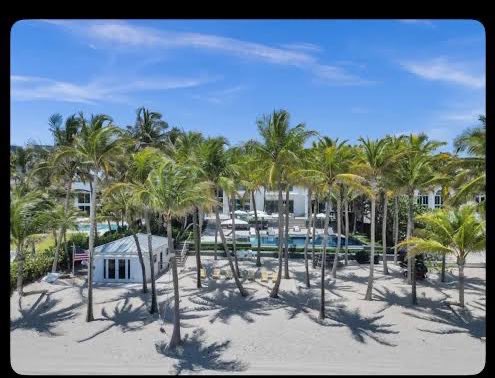
The next time someone tells they bought a house and sold it for double, get more details. ( 420k house with 20k down) • Interest 7% $228,000 • PMI 1.5% $ 48,000 • Insurance $ 18,000 • Prop Taxes $ 32,000 • Maintenance 1% $ 32,000 • Sales fee $ 48,000 Break Even Price. $ 802,000 Know the math of home ownership before assuming it’s a good investment. This math assumes 8 year hold time. You may have paid down principal of $20,000 on your loan as the first 3 years is almost all interest. Also it assumes insurance & taxes never went up. 😂😂😂😂 Investments in real estate should fund all insurances, taxes, interest, fees, maintenance, & management while still providing cash flow every month. What to do? Rent where you live and don’t buy your first house until your investments in real estate can pay for where you live. By the way I got a house for sale right now if you want to disregard this and buy a house.
Grant Cardone tweet media
English
121
71
716
103K
Crypto Exponentials⚡
Crypto Exponentials⚡@BitcoinOnwards·
Crypto Exponentials⚡@BitcoinOnwards

Larry Fink's (@BlackRock) latest message is bigger than markets. It’s about ownership. The core idea: as more growth gets driven by capital markets, the real divide is no longer just income - it’s whether people own productive assets or stay locked out of them. That’s what makes this letter interesting. It argues that: 1. Capital markets will have to fund the next era of industrial growth As globalization fragments, governments and banks alone won’t be enough to finance energy, infrastructure, defense, and technology transitions. 2. Inequality is increasingly an ownership problem Asset prices have compounded far faster than wages. Those who own markets build wealth. Those who don’t fall further behind. 3. Private markets and tokenization may expand access The next phase of finance may be about opening more of the market’s upside to a broader base of investors through new rails, products, and structures. My takeaway: this wasn’t just a chairman’s letter. It was a blueprint for a capital-markets-first world - and a case for why the future may belong not only to builders, but to owners. The big question: Will finance actually democratize ownership - or just repackage access for the already wealthy? #BlackRock #LarryFink #CapitalMarkets #Investing #PrivateMarkets #Tokenization #WealthCreation #FinancialMarkets #AssetOwnership #InstitutionalInvesting #FutureOfFinance #Macro #Infrastructure #Retirement #WealthInequality blackrock.com/corporate/inve…

QME
0
0
0
1
Crypto Exponentials⚡
Crypto Exponentials⚡@BitcoinOnwards·
Crypto Exponentials⚡@BitcoinOnwards

Larry Fink's (@BlackRock) latest message is bigger than markets. It’s about ownership. The core idea: as more growth gets driven by capital markets, the real divide is no longer just income - it’s whether people own productive assets or stay locked out of them. That’s what makes this letter interesting. It argues that: 1. Capital markets will have to fund the next era of industrial growth As globalization fragments, governments and banks alone won’t be enough to finance energy, infrastructure, defense, and technology transitions. 2. Inequality is increasingly an ownership problem Asset prices have compounded far faster than wages. Those who own markets build wealth. Those who don’t fall further behind. 3. Private markets and tokenization may expand access The next phase of finance may be about opening more of the market’s upside to a broader base of investors through new rails, products, and structures. My takeaway: this wasn’t just a chairman’s letter. It was a blueprint for a capital-markets-first world - and a case for why the future may belong not only to builders, but to owners. The big question: Will finance actually democratize ownership - or just repackage access for the already wealthy? #BlackRock #LarryFink #CapitalMarkets #Investing #PrivateMarkets #Tokenization #WealthCreation #FinancialMarkets #AssetOwnership #InstitutionalInvesting #FutureOfFinance #Macro #Infrastructure #Retirement #WealthInequality blackrock.com/corporate/inve…

QME
0
0
0
1
Simon Dixon
Simon Dixon@SimonDixonTwitt·
Everybody told me I don’t understand this war. Many told me it was WW3 & a nuclear bomb will be fired. I said the market disagrees and the outcome has already been agreed. Trump now says the US and Iran “have had very good and productive conversations regarding a complete and total resolution” of the Iran War. Trump has ordered the Department of War to postpone “any and all strikes” against Iranian power plants. Let’s see what comes next.
Simon Dixon tweet media
Simon Dixon@SimonDixonTwitt

🌮 Trump will have to TACO The 10Y Note Yield is now up ~45 basis points since the war began on February 28th. With the 10Y Note Yield now up to 4.40%, the US economy cannot handle a 5% 10Y Note Yield. He has no choice but to crash oil and bond yields by announcing a deal.

English
309
78
795
191.6K
Crypto Exponentials⚡
Crypto Exponentials⚡@BitcoinOnwards·
Crypto Exponentials⚡@BitcoinOnwards

Larry Fink's (@BlackRock) latest message is bigger than markets. It’s about ownership. The core idea: as more growth gets driven by capital markets, the real divide is no longer just income - it’s whether people own productive assets or stay locked out of them. That’s what makes this letter interesting. It argues that: 1. Capital markets will have to fund the next era of industrial growth As globalization fragments, governments and banks alone won’t be enough to finance energy, infrastructure, defense, and technology transitions. 2. Inequality is increasingly an ownership problem Asset prices have compounded far faster than wages. Those who own markets build wealth. Those who don’t fall further behind. 3. Private markets and tokenization may expand access The next phase of finance may be about opening more of the market’s upside to a broader base of investors through new rails, products, and structures. My takeaway: this wasn’t just a chairman’s letter. It was a blueprint for a capital-markets-first world - and a case for why the future may belong not only to builders, but to owners. The big question: Will finance actually democratize ownership - or just repackage access for the already wealthy? #BlackRock #LarryFink #CapitalMarkets #Investing #PrivateMarkets #Tokenization #WealthCreation #FinancialMarkets #AssetOwnership #InstitutionalInvesting #FutureOfFinance #Macro #Infrastructure #Retirement #WealthInequality blackrock.com/corporate/inve…

QME
0
0
0
2
Charles Edwards
Charles Edwards@caprioleio·
Interesting that Bitcoin Cash (BCH) is up over 40% against BTC in the last 9 months and has it's best looking chart ever against Bitcoin (adam + eve bottom) today, all since the Quantum threat to Bitcoin became non-zero in 2025. BCH is implementing quantum proof signatures in May, meanwhile BTC is ignoring it.
Charles Edwards tweet media
English
40
5
102
18K
Crypto Exponentials⚡
Crypto Exponentials⚡@BitcoinOnwards·
Crypto Exponentials⚡@BitcoinOnwards

Larry Fink's (@BlackRock) latest message is bigger than markets. It’s about ownership. The core idea: as more growth gets driven by capital markets, the real divide is no longer just income - it’s whether people own productive assets or stay locked out of them. That’s what makes this letter interesting. It argues that: 1. Capital markets will have to fund the next era of industrial growth As globalization fragments, governments and banks alone won’t be enough to finance energy, infrastructure, defense, and technology transitions. 2. Inequality is increasingly an ownership problem Asset prices have compounded far faster than wages. Those who own markets build wealth. Those who don’t fall further behind. 3. Private markets and tokenization may expand access The next phase of finance may be about opening more of the market’s upside to a broader base of investors through new rails, products, and structures. My takeaway: this wasn’t just a chairman’s letter. It was a blueprint for a capital-markets-first world - and a case for why the future may belong not only to builders, but to owners. The big question: Will finance actually democratize ownership - or just repackage access for the already wealthy? #BlackRock #LarryFink #CapitalMarkets #Investing #PrivateMarkets #Tokenization #WealthCreation #FinancialMarkets #AssetOwnership #InstitutionalInvesting #FutureOfFinance #Macro #Infrastructure #Retirement #WealthInequality blackrock.com/corporate/inve…

QME
0
0
0
0
Sykodelic 🔪
Sykodelic 🔪@Sykodelic_·
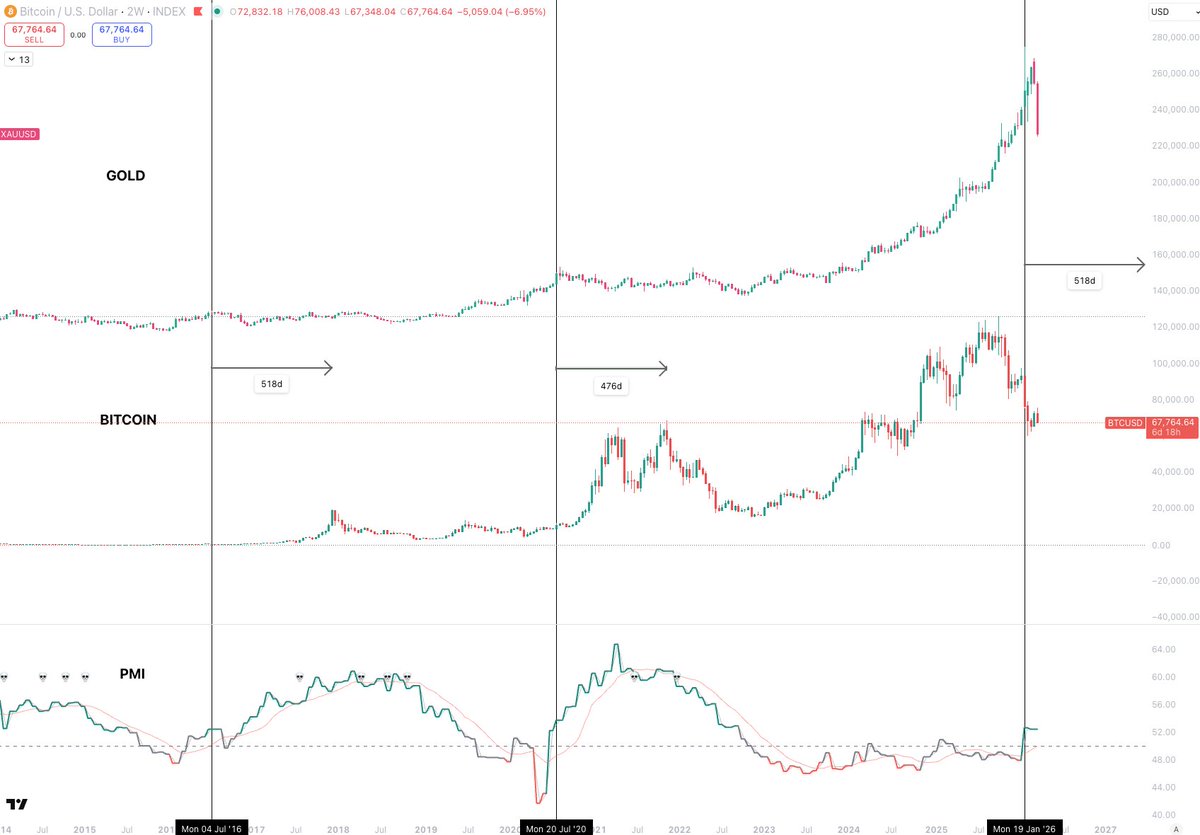
Gold has topped. The craziest thing is that I was speaking about this 6 weeks ago, and no one wanted to hear it. Even when the historical macro patterns are this clear. When Gold was over $5,000 everyone was laughing at anyone suggesting it was time for the rotation of risk and for Bitcoin to bottom out. But that is exactly what is playing out. And it is not a coincidence that Gold tops at the almost exact week that the business cycle starts to expand again. Yet, there are still so many people out there who think a magical 4 year timeframe governs financial cycles. Gold is risk off and runs in uncertain times, such as economic contraction(PMI below 50). Bitcoin is risk on and runs in times of certainty, such as economic expansion(PMI over 50). And historically, when this shift happens, Bitcoin goes on to outperform for around 500 days. There are also a lot of people out there confused why Gold is dumping when the US/IRAN conflict is happening. No asset is outside the buy the rumour sell the news paradigm. Gold runs within uncertainty with the anticipation of issues - in the lead up to. And as things shift to expansion and certainty, it tops. Whether you realise yet or not we are in that shift. And it does not matter the narrative of the moment, war, covid, whatever... This chart does not care about that. It simply shows you the shifting of certainty and uncertainty, and how assets react. And Bitcoin is next.
Sykodelic 🔪 tweet media
Sykodelic 🔪@Sykodelic_

You do not need to overcomplicate it. I don't understand why everyone finds its so hard to see these things. Well, I do, because emotions rule 99% of people. But anyone can line up these three fundamental macro charts and analyse where we are. It literally takes two minutes. In every single cycle we have had: 1. GOLD tops as ISM moves into expansion 2. Bitcoin tops between 476d and 517d after It is very clear to see that. And it is not a coincidence this happens, it happens for fundamental macro reasons. GOLD is a strong risk off asset that performs well in economic and geopolitical uncertainty. When ISM breaks into expansion, that uncertainty is removed and GOLD finds its top, as ISM continues to expand. An expanding economy improves liquidity conditions and that is why Bitcoin then has its turn. Again, this is not a random chart that has no intrinsic link. These three charts represent different stages of a macro cycle and when you put them together, it becomes clear. Take a look at this again now... Do either GOLD or ISM look like they are anywhere near a position that signals Bitcoin having 9 months of a bear market left? Not at all.

English
63
88
682
47.6K
Crypto Exponentials⚡
Crypto Exponentials⚡@BitcoinOnwards·
Crypto Exponentials⚡@BitcoinOnwards

Larry Fink's (@BlackRock) latest message is bigger than markets. It’s about ownership. The core idea: as more growth gets driven by capital markets, the real divide is no longer just income - it’s whether people own productive assets or stay locked out of them. That’s what makes this letter interesting. It argues that: 1. Capital markets will have to fund the next era of industrial growth As globalization fragments, governments and banks alone won’t be enough to finance energy, infrastructure, defense, and technology transitions. 2. Inequality is increasingly an ownership problem Asset prices have compounded far faster than wages. Those who own markets build wealth. Those who don’t fall further behind. 3. Private markets and tokenization may expand access The next phase of finance may be about opening more of the market’s upside to a broader base of investors through new rails, products, and structures. My takeaway: this wasn’t just a chairman’s letter. It was a blueprint for a capital-markets-first world - and a case for why the future may belong not only to builders, but to owners. The big question: Will finance actually democratize ownership - or just repackage access for the already wealthy? #BlackRock #LarryFink #CapitalMarkets #Investing #PrivateMarkets #Tokenization #WealthCreation #FinancialMarkets #AssetOwnership #InstitutionalInvesting #FutureOfFinance #Macro #Infrastructure #Retirement #WealthInequality blackrock.com/corporate/inve…

QME
0
0
0
0
sunnydecree
sunnydecree@sunnydecree·
GM. Bitcoin is showing almost no volatility, while stocks are down and gold is down even more. Isn’t that weird? How do you explain this?
sunnydecree tweet media
English
223
55
780
77.6K
Crypto Exponentials⚡
Crypto Exponentials⚡@BitcoinOnwards·
Crypto Exponentials⚡@BitcoinOnwards

Larry Fink's (@BlackRock) latest message is bigger than markets. It’s about ownership. The core idea: as more growth gets driven by capital markets, the real divide is no longer just income - it’s whether people own productive assets or stay locked out of them. That’s what makes this letter interesting. It argues that: 1. Capital markets will have to fund the next era of industrial growth As globalization fragments, governments and banks alone won’t be enough to finance energy, infrastructure, defense, and technology transitions. 2. Inequality is increasingly an ownership problem Asset prices have compounded far faster than wages. Those who own markets build wealth. Those who don’t fall further behind. 3. Private markets and tokenization may expand access The next phase of finance may be about opening more of the market’s upside to a broader base of investors through new rails, products, and structures. My takeaway: this wasn’t just a chairman’s letter. It was a blueprint for a capital-markets-first world - and a case for why the future may belong not only to builders, but to owners. The big question: Will finance actually democratize ownership - or just repackage access for the already wealthy? #BlackRock #LarryFink #CapitalMarkets #Investing #PrivateMarkets #Tokenization #WealthCreation #FinancialMarkets #AssetOwnership #InstitutionalInvesting #FutureOfFinance #Macro #Infrastructure #Retirement #WealthInequality blackrock.com/corporate/inve…

QME
0
0
0
3
Timothy Peterson
Timothy Peterson@nsquaredvalue·
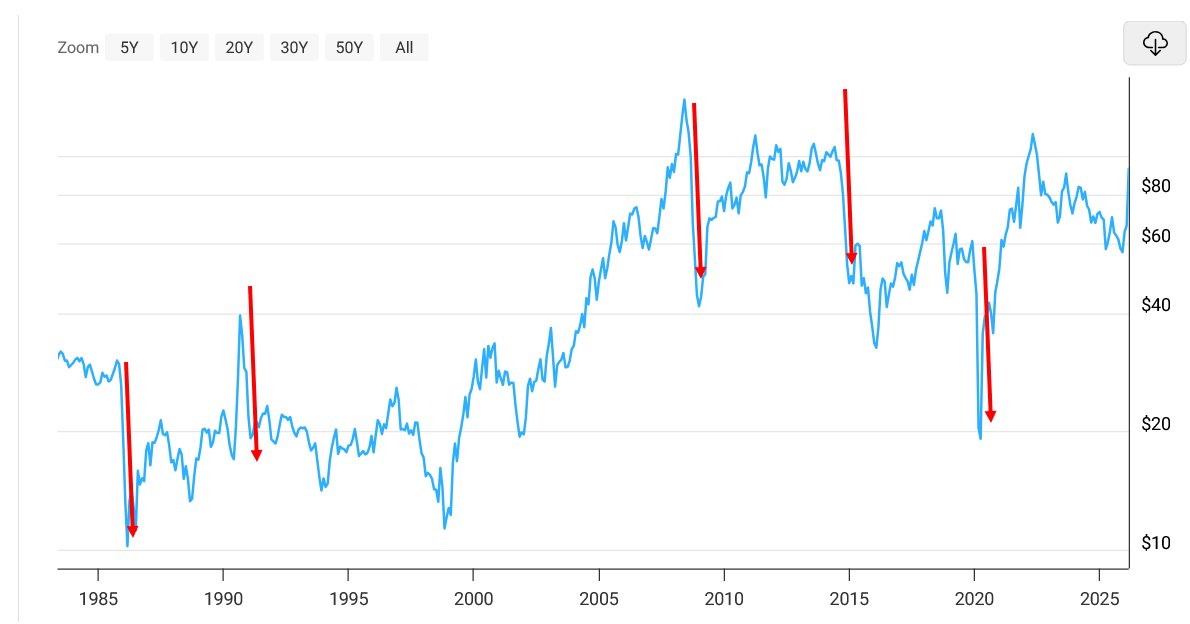
Bears are wrong. Crude oil drops faster than any Bitcoin bear market ever has. It's not only possible, it's the most likely scenario. I remember the doomsayers in 1991. Same bs then as now. WWIII; oil forever high; another Vietnam; 5 years to put out Saddam's oilwell fires. All FUD so people can get you to subscribe to their newletters.
Timothy Peterson tweet media
English
3
6
95
4.5K
Crypto Exponentials⚡
Crypto Exponentials⚡@BitcoinOnwards·
Crypto Exponentials⚡@BitcoinOnwards

Larry Fink's (@BlackRock) latest message is bigger than markets. It’s about ownership. The core idea: as more growth gets driven by capital markets, the real divide is no longer just income - it’s whether people own productive assets or stay locked out of them. That’s what makes this letter interesting. It argues that: 1. Capital markets will have to fund the next era of industrial growth As globalization fragments, governments and banks alone won’t be enough to finance energy, infrastructure, defense, and technology transitions. 2. Inequality is increasingly an ownership problem Asset prices have compounded far faster than wages. Those who own markets build wealth. Those who don’t fall further behind. 3. Private markets and tokenization may expand access The next phase of finance may be about opening more of the market’s upside to a broader base of investors through new rails, products, and structures. My takeaway: this wasn’t just a chairman’s letter. It was a blueprint for a capital-markets-first world - and a case for why the future may belong not only to builders, but to owners. The big question: Will finance actually democratize ownership - or just repackage access for the already wealthy? #BlackRock #LarryFink #CapitalMarkets #Investing #PrivateMarkets #Tokenization #WealthCreation #FinancialMarkets #AssetOwnership #InstitutionalInvesting #FutureOfFinance #Macro #Infrastructure #Retirement #WealthInequality blackrock.com/corporate/inve…

QME
0
0
0
33
Crypto Exponentials⚡
Crypto Exponentials⚡@BitcoinOnwards·
Crypto Exponentials⚡@BitcoinOnwards

Larry Fink's (@BlackRock) latest message is bigger than markets. It’s about ownership. The core idea: as more growth gets driven by capital markets, the real divide is no longer just income - it’s whether people own productive assets or stay locked out of them. That’s what makes this letter interesting. It argues that: 1. Capital markets will have to fund the next era of industrial growth As globalization fragments, governments and banks alone won’t be enough to finance energy, infrastructure, defense, and technology transitions. 2. Inequality is increasingly an ownership problem Asset prices have compounded far faster than wages. Those who own markets build wealth. Those who don’t fall further behind. 3. Private markets and tokenization may expand access The next phase of finance may be about opening more of the market’s upside to a broader base of investors through new rails, products, and structures. My takeaway: this wasn’t just a chairman’s letter. It was a blueprint for a capital-markets-first world - and a case for why the future may belong not only to builders, but to owners. The big question: Will finance actually democratize ownership - or just repackage access for the already wealthy? #BlackRock #LarryFink #CapitalMarkets #Investing #PrivateMarkets #Tokenization #WealthCreation #FinancialMarkets #AssetOwnership #InstitutionalInvesting #FutureOfFinance #Macro #Infrastructure #Retirement #WealthInequality blackrock.com/corporate/inve…

QME
0
0
0
13
Sminston With 👁
Sminston With 👁@sminston_with·
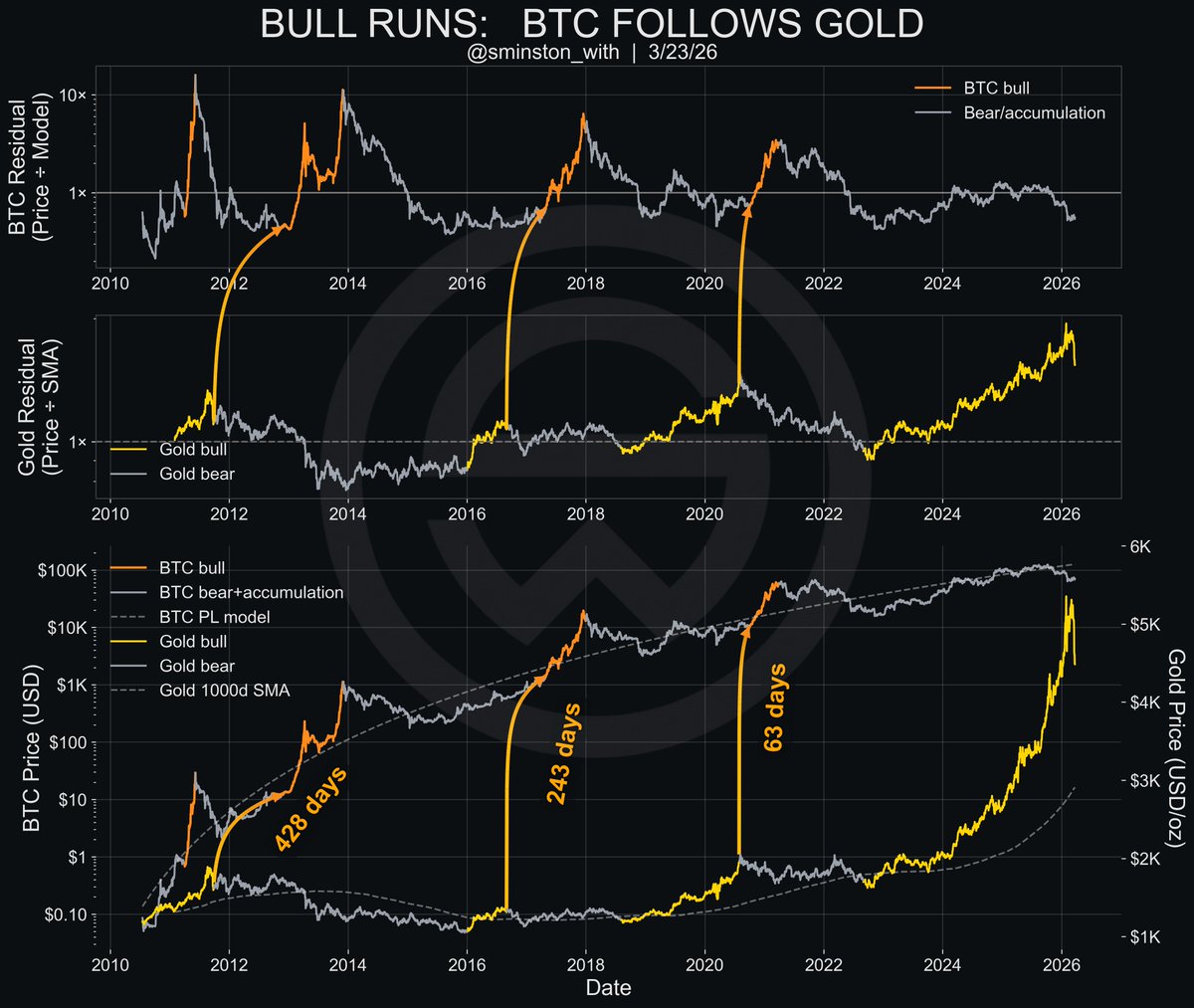
You guys remember what happens after gold runs out of steam, right? With gold coming down -20% over the past month, it is possible we'll see some old patterns broken out here - namely a much harder, scarcer, more durable, portable and verifiable money may have it's turn. Bitcoin👁️
Sminston With 👁 tweet media
English
25
57
408
43.2K
Crypto Exponentials⚡
Crypto Exponentials⚡@BitcoinOnwards·
Crypto Exponentials⚡@BitcoinOnwards

Larry Fink's (@BlackRock) latest message is bigger than markets. It’s about ownership. The core idea: as more growth gets driven by capital markets, the real divide is no longer just income - it’s whether people own productive assets or stay locked out of them. That’s what makes this letter interesting. It argues that: 1. Capital markets will have to fund the next era of industrial growth As globalization fragments, governments and banks alone won’t be enough to finance energy, infrastructure, defense, and technology transitions. 2. Inequality is increasingly an ownership problem Asset prices have compounded far faster than wages. Those who own markets build wealth. Those who don’t fall further behind. 3. Private markets and tokenization may expand access The next phase of finance may be about opening more of the market’s upside to a broader base of investors through new rails, products, and structures. My takeaway: this wasn’t just a chairman’s letter. It was a blueprint for a capital-markets-first world - and a case for why the future may belong not only to builders, but to owners. The big question: Will finance actually democratize ownership - or just repackage access for the already wealthy? #BlackRock #LarryFink #CapitalMarkets #Investing #PrivateMarkets #Tokenization #WealthCreation #FinancialMarkets #AssetOwnership #InstitutionalInvesting #FutureOfFinance #Macro #Infrastructure #Retirement #WealthInequality blackrock.com/corporate/inve…

QME
0
0
0
8
Peter Schiff
Peter Schiff@PeterSchiff·
In the early months of the 2008 GFC, gold crashed 32%, about 40% of its prior bull-market gain. After gold bottomed, it surged 178% over the next three years. Gold nearly hit $4,100 today, down 27%, about 40% of its gain since $2K. A 178% surge from that low puts gold at $11,400.
English
400
342
3.1K
303.8K