Blue Bear

13.2K posts

Blue Bear banner
Blue Bear

Blue Bear

@Bluebearmonkey

I’m a little bear

Beijing Katılım Ekim 2023
633 Takip Edilen2K Takipçiler
Sabitlenmiş Tweet
Blue Bear
Blue Bear@Bluebearmonkey·
@htownharley If you strike Doggy down, he will become hornier than you can possibly imagine.

Blue Bear tweet media
English
14
3
112
48.5K
𐌕 🍂
𐌕 🍂@fwtimini·
Jobs are gone. Thrifting is ruined. Music and movies are getting worse. No housing. Romance is dead. Authenticity is dying. Genuinely, what is there to live for?
English
330
700
4.8K
147.7K
Blue Bear
Blue Bear@Bluebearmonkey·
@MikeAda40676830 But I’m a winner today and you are a loser. How do you like them apples?
English
0
0
0
15
Blue Bear
Blue Bear@Bluebearmonkey·
O. M. G. It’s “only in China” because wypipos can’t do mafs. If Detroit or Stuttgart got unlimited loans, they still wouldn’t be able to pull it off. Apple had unlimited cash and look how far they got.
GIF
Michael Pettis@michaelxpettis

Very good piece by Joshua Busby on China's EV production. I only have one quibble. Busby says: "Xiaomi’s attempt to take on Apple and Tesla seems like one of those only-in-China stories. China’s scale of manufacturing — and the vast supplier ecosystems this sustains — make China arguably the only country where a mobile phone maker can try to become an EV maker as well." I would argue that the real reason a mobile phone maker in China can quickly pivot to becoming a major EV maker is because of near-unlimited financing at very accommodative terms. Anyone in China interested in expanding production capabilities in sectors deemed strategic by the government can raise enormous amounts of financing very easily, with little concern about eventually hitting hard budget constraints. But China's ability to do this wasn't an only-in-China story. It was also the story of Japan in the 1970s and 1980s. Every time Tokyo deemed a manufacturing sector to be of strategic importance, Japanese manufacturers quickly dominated that sector globally. For a while Japanese manufacturers in one sector after another seemed unassailable, but ultimately a country's debt capacity is always the constraint. No country can maintain global competitiveness forever if this competitiveness requires permanent increases in debt to fund the sources of its competitiveness (i.e., direct and indirect subsidies). The cost to Japan was a surge in overall debt that ultimate caused the whole strategy to reverse after 1990-91 in the form of an extremely difficult adjustment. China already has one of the highest debt-to-GDP ratios in the world (second only to Japan's), and it is rising at perhaps the fastest rate in history. Like Japan's, in other words, China's manufacturing success depends ultimately on an unsustainable increase in the country's debt burden. But while this cannot go on forever, Busby is right to say that EV producers in the US (and Europe) should nonetheless be very concerned. As the history of the US chemical industries demonstrates, a county's productive capacity in a particular sector can be undermined in a very short period, but it is extremely difficult to rebuild. thewirechina.com/2026/07/12/ame…

English
4
1
25
760
Blue Bear
Blue Bear@Bluebearmonkey·
Xiaomi did not take on debt to fund its expansion into cars. It raised equity and used FCF. Debt to assets is below 50%. Debt to assets of China’s car industry is ~65%. The US, ~80%. Germany, ~65%. Japan, ~60%. Do you ever check data or do you jess say things?
Michael Pettis@michaelxpettis

Very good piece by Joshua Busby on China's EV production. I only have one quibble. Busby says: "Xiaomi’s attempt to take on Apple and Tesla seems like one of those only-in-China stories. China’s scale of manufacturing — and the vast supplier ecosystems this sustains — make China arguably the only country where a mobile phone maker can try to become an EV maker as well." I would argue that the real reason a mobile phone maker in China can quickly pivot to becoming a major EV maker is because of near-unlimited financing at very accommodative terms. Anyone in China interested in expanding production capabilities in sectors deemed strategic by the government can raise enormous amounts of financing very easily, with little concern about eventually hitting hard budget constraints. But China's ability to do this wasn't an only-in-China story. It was also the story of Japan in the 1970s and 1980s. Every time Tokyo deemed a manufacturing sector to be of strategic importance, Japanese manufacturers quickly dominated that sector globally. For a while Japanese manufacturers in one sector after another seemed unassailable, but ultimately a country's debt capacity is always the constraint. No country can maintain global competitiveness forever if this competitiveness requires permanent increases in debt to fund the sources of its competitiveness (i.e., direct and indirect subsidies). The cost to Japan was a surge in overall debt that ultimate caused the whole strategy to reverse after 1990-91 in the form of an extremely difficult adjustment. China already has one of the highest debt-to-GDP ratios in the world (second only to Japan's), and it is rising at perhaps the fastest rate in history. Like Japan's, in other words, China's manufacturing success depends ultimately on an unsustainable increase in the country's debt burden. But while this cannot go on forever, Busby is right to say that EV producers in the US (and Europe) should nonetheless be very concerned. As the history of the US chemical industries demonstrates, a county's productive capacity in a particular sector can be undermined in a very short period, but it is extremely difficult to rebuild. thewirechina.com/2026/07/12/ame…

English
1
0
11
389
Blue Bear
Blue Bear@Bluebearmonkey·
@michaelxpettis Xiaomi did not take on debt to fund its expansion into cars. It raised equity and used FCF. Debt to assets is below 50%. Debt to assets of China’s car industry is ~65%. The US, ~80%. Germany, ~65%. Japan, ~60%. Do you ever check data or do you jess say things?
English
1
0
11
167
Michael Pettis
Michael Pettis@michaelxpettis·
Very good piece by Joshua Busby on China's EV production. I only have one quibble. Busby says: "Xiaomi’s attempt to take on Apple and Tesla seems like one of those only-in-China stories. China’s scale of manufacturing — and the vast supplier ecosystems this sustains — make China arguably the only country where a mobile phone maker can try to become an EV maker as well." I would argue that the real reason a mobile phone maker in China can quickly pivot to becoming a major EV maker is because of near-unlimited financing at very accommodative terms. Anyone in China interested in expanding production capabilities in sectors deemed strategic by the government can raise enormous amounts of financing very easily, with little concern about eventually hitting hard budget constraints. But China's ability to do this wasn't an only-in-China story. It was also the story of Japan in the 1970s and 1980s. Every time Tokyo deemed a manufacturing sector to be of strategic importance, Japanese manufacturers quickly dominated that sector globally. For a while Japanese manufacturers in one sector after another seemed unassailable, but ultimately a country's debt capacity is always the constraint. No country can maintain global competitiveness forever if this competitiveness requires permanent increases in debt to fund the sources of its competitiveness (i.e., direct and indirect subsidies). The cost to Japan was a surge in overall debt that ultimate caused the whole strategy to reverse after 1990-91 in the form of an extremely difficult adjustment. China already has one of the highest debt-to-GDP ratios in the world (second only to Japan's), and it is rising at perhaps the fastest rate in history. Like Japan's, in other words, China's manufacturing success depends ultimately on an unsustainable increase in the country's debt burden. But while this cannot go on forever, Busby is right to say that EV producers in the US (and Europe) should nonetheless be very concerned. As the history of the US chemical industries demonstrates, a county's productive capacity in a particular sector can be undermined in a very short period, but it is extremely difficult to rebuild. thewirechina.com/2026/07/12/ame…
English
20
44
131
29.5K
Elon Musk
Elon Musk@elonmusk·
SpaceX has Boeing, Lockheed, Europe (Ariane) and Russia (Proton/Soyuz) near checkmate in rocket technology. End game is all about China.
English
84
205
2.4K
0
Blue Bear retweetledi
Blue Bear
Blue Bear@Bluebearmonkey·
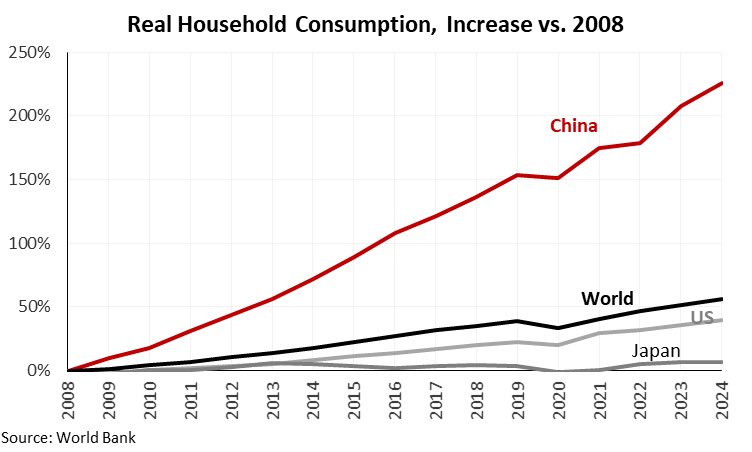
@michaelxpettis And China lowballs GDP by ~2x. Its debt to equity is ~150%, not ~300%… among the lowest of industrial economies. That’s why it’s still able to grow ~5%. Jess use half you brain, folks.
English
1
2
22
319
meh
meh@deadlyneurotoxn·
@Bluebearmonkey Question regarding China's helium supply: are they going to be disrupted by the ongoing attacks on energy infrastructure or are they self-sufficient for the most part?
English
1
0
0
23
Blue Bear
Blue Bear@Bluebearmonkey·
@moonagedaydrm9 @elonmusk Have you any idea how fast AI is going? Generations of researchers turn over like fruit flies. Where did you do your engineering degree?
English
1
0
0
28
Blue Bear
Blue Bear@Bluebearmonkey·
@moonagedaydrm9 @elonmusk Those guys are ancient history dude. The Tsinghua guys are the new sheriffs in town and run circles around those YouTube talking heads. My god you’re slow.
English
2
0
0
45
thelorax9999
thelorax9999@moonagedaydrm9·
@Bluebearmonkey @elonmusk lol not even true. Not a single of the 8 of the people on the Google transformer paper were Chinese. Ilya Sutskever is the most Important researcher in contemporary AI. Alec Radfors lead the GPT work. The most important foundational AI people aren’t Chinese (Yoshua, Hinton, etc)
English
1
0
0
36
Michael Pettis
Michael Pettis@michaelxpettis·
1/5 Bloomberg: "Beijing has been open to exploring how to increase imports from the EU but less keen to find ways to tame its own exports. Both are key to the EU given the vast trade gap as well as China’s market barriers and moderate consumption levels." bloomberg.com/news/articles/…
English
14
32
153
26.4K
Blue Bear
Blue Bear@Bluebearmonkey·
@moonagedaydrm9 @elonmusk Bro… wypipos can’t do mafs. All the top researchers are Chinese. There is a global elite of Tsinghua graduates who hopscotch back and forth between China and Silicon Valley. Nobody else is qualified to do so. They drive all the innovation. China will not fall behind. 😈
English
1
0
1
70
thelorax9999
thelorax9999@moonagedaydrm9·
@Bluebearmonkey @elonmusk Yes it does matter because future foundational work will also be done in the west. All the best researchers are here. China will stay behind indefinitely.
English
1
0
0
30
Blue Bear
Blue Bear@Bluebearmonkey·
@moonagedaydrm9 @elonmusk Does it matter when China is about to overtake the US? The majority of tokens are generated on Chinese models. The west built the wrong thing and doesn’t even know it.
English
1
0
0
38
thelorax9999
thelorax9999@moonagedaydrm9·
@Bluebearmonkey @elonmusk I meant 90% of the foundational work to get to LLMs were in the west and actually it’s probably much higher 😹 China didn’t do shit
English
1
0
0
24