

@GuthmannR I guess this discussion illustrates the challenge with this whole macro development concept. Both stories are plausible, and it’s hard to adjudicate which is true without strong identification.
English
Bogdan Tereshchenko🇺🇦
4K posts
@BogdanTereshch3
Attorney with interests in economics and international affairs


It's certainly true that cross-country growth regressions suffer from all kinds of identification problems, but I think we've still learned far more about what generates material improvements in living standards from macro-dev than micro-dev. Empirical macro-dev research isn't bad just because it lacks clean causal identification. That's an impossible bar to meet for macro in general (at least if we want to explain a significant fraction of the economically meaningful variation). There are lots of very bad empirical macro-dev papers, of course, but there are also some good ones. Take Dani Rodrik's 2008 paper on undervaluation and growth (brookings.edu/wp-content/upl…). The main observation is that real exchange rate depreciation (relative to where a country's exchange rate "ought" to be based on its initial level of development) triggers persistent growth in developing countries, but not developed ones. Rodrik's hypothesis is that market imperfections (e.g. financial frictions) that are pervasive in developing countries disproportionately affect the tradable sector (manufacturing relies more on external financing than services in the Rajan-Zingales sense), and depreciation alleviates the effects of these frictions by raising the relative price of tradables. This is important because it tells policymakers that even when fixing the underlying institutional causes of poverty is hard, there may be some second-best options that involve distorting relative prices away from the laissez-faire equilibrium. The paper shows convincing evidence that this is indeed the operative channel: undervaluation reallocates resources from services to industry, and the association between growth and undervaluation is largely explained by this reallocation in a two-stage regression. (IVs can be used to learn something about economics, not just to get identification!) Rodrik is also not just cherry-picking Asian tigers: appreciation hurts growth in lots of African countries in his sample through the same channel. This, in and of itself, provides an important (if underappreciated) cautionary tale about the unintended consequences of foreign aid. Rodrik's identification isn't clean (as Mike Woodford explains in a follow-on comment) and the paper wasn't published in a prestigious outlet (it's in the BPEA), but I think it teaches us more about development than the vast majority of micro-dev papers published in QJE & AER. Moreover, macro-dev isn't just empirics, it's also theory and quantitative modeling. Take the 2019 Econometrica by Itskhoki and Moll (onlinelibrary.wiley.com/doi/abs/10.398…).* I love this paper because it illustrates how market imperfections create a role for government to accelerate growth, but also highlights the tradeoffs and distributional tensions inherent in doing so: "The optimal policy intervention involves pro-business policies like suppressed wages in early stages of the transition, resulting in higher entrepreneurial profits and faster wealth accumulation." Finally, even focusing specifically on the empirical part of macro-dev, it isn't just growth regressions. Like many other subfields of macro, it's also increasingly come to emphasize rigorous microdata work, despite the challenges in collecting this data in developing countries. My colleague, Diego Restuccia, exemplifies this trend with his work on African farm-level data. Overall, I think this research program has been far more successful than many people think. Conversely, the elevation of clean identification as the primary goal of research in development economics has been far less successful in yielding useful insights than many people think. As John Cochrane argues (grumpy-economist.com/p/causation-do…), the primary goal of economic research should always be to explain economically-meaningful variation, even if doing so is inherently messy. * This is the paper I tried (and largely failed) to write in grad school when I was thinking about Rodrik's empirical work. My attempt is preserved for posterity here: joesteinberg.com/pdf/rerpaper. It's amazing to look back and see how far I've come as a researcher in 15 years!

While I am sympathetic to view that micro development has become too dominant, this whole discourse seems to miss the reason macro dev faded to begin with: it was bad! Cross country regs using a handful of obs w/ bad underlying data did not solve the mystery of growth

A fundamental lesson from my posts these last two weeks on modernization, industrial policy, and development is that development economics should be about understanding why South Korea got rich but Bolivia did not. The current field has largely given up on that question. Sharply identified RCTs on small micro programs are a fine way to publish in the AER and get tenure at a fancy university, but a profession that knows everything about microfinance impact evaluations and almost nothing about industrialization has misallocated its own intellectual capital on a pretty heroic scale. Four images of Seoul:

Far more poverty has been alleviated by growth than by any RCT type aid or poverty alleviation program. Like orders of magnitude. Compare China to sub-Saharan Africa.


With student A.I. use/abuse now ubiquitous, professors and teachers are killing off take-home essays and papers. Students are writing inside the classroom, often by hand. It's part of the big rethink happening on tech and learning. My new report here: nytimes.com/2026/04/30/us/…




One argument for the pied-à-terre tax is that it will discourage the warehousing of housing units. Though the number of privately-owned $5M+ pieds-à-terre is negligible, the argument has a surface plausibility because there really is an “underuse” problem — it’s the tens of thousands of rent-stabilized units that are being used unlawfully as pieds-à-terre, despite the fact that the point of rent stabilization (I think?) is to provide stability to renters who need it. See @JKetcham91’s latest: city-journal.org/article/new-yo…





Cesky Krumlov feels like a place frozen in time.....winding streets, red rooftops, and a quiet that only shows up after the crowds leave.

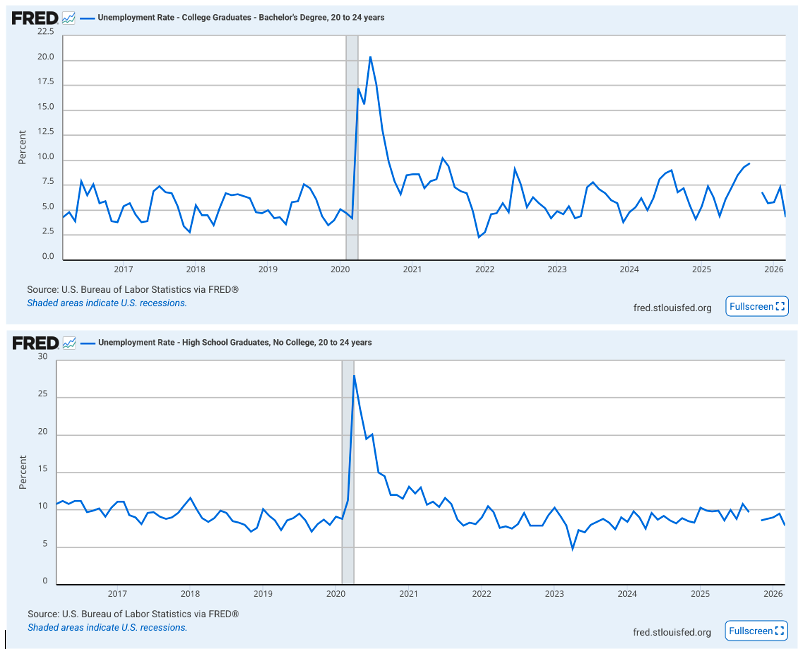
A lot of people, myself included, have written about youth unemployment over the past year, so it’s worth pointing out that age 20-24 unemployment has plunged over the last 6 months:


