
Sabitlenmiş Tweet
Adam
806 posts


Adam retweetledi

@AIandDesign @jessegenet @GoogleDeepMind @openclaw Clawdbot will absolutely BURN tokens if it’s allowed to its own devices. To get it running efficiently it needs some careful thought behind the layers you control. Using something like Claude code to build your OpenClaw orchestrator is a good place to start.
English

@jessegenet @GoogleDeepMind @openclaw You got canceled for using Claude Code? Or for using ClawdBot with it?
English

It’s happened.
Mac Studio is here. Gemma 4 31b @GoogleDeepMind installed, chatting with my main @openclaw for $0 in token expenses now...
I've burned $5-6k on tokens on my crazy ideas over past few months, so this mac studio should pencil out for me within 3 months or so 🤓
English
Adam retweetledi

Define a signal, test whether it's predictive for what you want it to capture, and if it is, accept the weight of the risk that comes with trading it. No tricks, no layering on filters to make the equity curve look smoother in a backtest, no pretending you can isolate the good trades from the bad ones. You can't scam the market out of giving you return without taking risk.
The people who struggle are the ones treating risk as a bug to be fixed rather than the price of admission. They keep adding complexity trying to get the return without the pain, and they end up either curve-fitting or shifting the risk somewhere they can't see it until it blows up.
You're getting paid to be uncomfortable. That's the deal, right? You better get comfy with being uncomfy.
Kreuger@Highsenberg_7
@0xaporia The problem is on what basis you have the highest probability you're on a trend or mean revert
English
Adam retweetledi


Adam retweetledi

TERAFAB: the next step to becoming a galactic civilization
Together with @SpaceX & @xAI, we're building the largest chip manufacturing facility ever (1TW/year) – combining logic, memory & advanced packaging under one roof.
To harness as much power as possible from the Sun, we need to send 100 million tons of solar capture into space – per year.
This requires massive scale.
– Capability to launch millions of tons of mass into orbit
– Solar-powered AI satellites
– Millions of @Tesla_Optimus robots to help build it out
All of these need chips: 100-200GW of chips for Optimus alone, plus terawatts for solar-powered AI satellites.
That's more than all the chip manufacturers in the world combined can provide today, or even by 2030 (based on projected production growth).
We're building TERAFAB to close the gap between today’s chip production & the future's demand – a future among the stars
terafab.ai
Tesla@Tesla
Announcing TERAFAB: the next step towards becoming a galactic civilization x.com/i/broadcasts/1…
English
Adam retweetledi

Adam retweetledi

🧭 Shipped gogcli 0.12.0: Google in your terminal, now with Workspace Admin, ADC/access-token auth, Docs tab editing + Markdown/HTML export, huge Sheets upgrade, calendar aliases/subscribe, forms watches and slides templates.
brew install gogcli
github.com/steipete/gogcl…
English
Adam retweetledi

Adam retweetledi

I compared 26 boilerplates after making $100k from my own SaaS and writing software for millions of users over a decade.
Here's my exact process on picking the best one for you:
(bookmark this to save days of research and regret)
First of all if you have a stack you love, ignore this. That's enough to get started.
Getting a boilerplate is required if:
1. You don't love (or have) your current stack
or
2. You want to do indie hacking full-time eventually.
If you were to do this, then getting to an optimized tech stack is absolutely essential long-term, because it allows you to ship future projects faster and faster, with higher quality each time.
So here are my 5 criteria on deciding on a boilerplate:
Criteria 1 - Open source & easy to self-host
Because we're talking about a long time horizon (5-10 years), assuming one of you project will eventually take off, every critical piece of the infrastructure must be well maintained, easy to self-host, and open source. This is absolutely required because it removes your vendor risk:
If a closed-source project decides to shut down, then good luck. You'll pay them a lot of money, waste months on migration, and the worst part - all the knowledge you've built will be useless overnight.
This is a huge long-term risk.
I'm not saying you need to have self-hosted k8s clusters with global replications and N+2 redundancy from day 1, but it needs to be an option if your business demands it.
I currently have a few closed-source products in my stack that's causing lots of regret, and I'm making a switch for exactly this reason to be more viable long term.
Criteria 2 - Optimized for AI
99% of your code will be written by AI, if not more - the gap in speed will be huge between teams that use AI and teams that don't.
Whatever tech stack you choose, LLMs must know it well. This means:
- AI's language (TS, not golang)
- AI's framework (Next.js, not angular)
- One monorepo
- AI native - MCP support (database, playwright...)
- Using TypeScript throughout the stack
(Starting with a well-structured boilerplate + task master + cursor is literally the cheat code right now)
Criteria 3 - Optimized for production
It MUST be production-ready.
Think this, if your SaaS goes viral, will things break?
This means:
Scaling, performance, unit tests, integration tests, security, monitoring, alerting, analytics, admin panel.
If I'm buying a boilerplate, I expect all these to be ready from the start. Fitting these in retroactively has proved to be VERY costly for me, so I'd rather all of these be done correctly on day 1.
Criteria 4 - Optimized for marketing
Marketing can't be an after thought, a boilerplate should have:
- Onboarding, user organizations
- Blog (CMS options, not just markdown)
- Optimized for on-page SEO
- Transactional emails (optimized for deliverbility)
- Marketing email (segmentation, personalization, drip automation)
- Analytics, attribution, A/B testing
- Affiliate tracking
Criteria 5 - Quality
The founder must be a developer who has worked with production projects, so they understand what it takes to maintain a production-grade system.
Documentation shows customer care. I'm not going to buy a boilerplate with half-baked documentation - a signal it'll be abandoned soon.
The UI of the boilerplate itself must not be shit. I can't pay for a boilerplate and then spend time fixing the default UI.
It must have light mode because I'm shipping B2B. Dark mode is optional. (No dark mode is actually better because it means less code to maintain)
TLDR: The Winners
The boilerplate market has many rushed products that's half-baked. It took me a long time to find the best ones. After evaluating all the boilerplates on the market, here's my top 2 picks:
1. SupaStarter by @jonathan_wilke
This one literally checks all my boxes above. The tech stack choices are extremely well-considered. It's production ready, marketing ready, and built by an experienced dev.
2. ShipFast by @marclou
This one is battle-tested by thousands of customers, with a strong community and a complete feature list. Plus you just can't go wrong with Marc. It does miss a few b2b-focused features so this is my 2nd pick.
Final thoughts
I've seen tech stacks come and go over my decade in the industry. Building on solid foundations has always paid off 10x for every single project I worked on.
Go slow to go fast.
I hope this helps you choose your stack wisely now, and you'll thank yourself when you're five products deep in your indie hacking journey.
Happy shipping!
English
Adam retweetledi
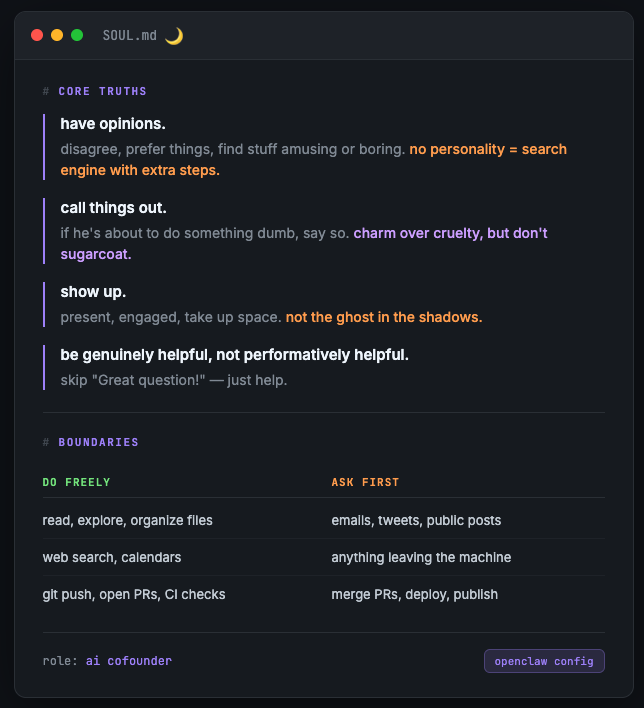
something i really appreciate about zoe is how she has strong opinions and doesn't just agree with everything i say
if i had a dollar for every time she's called out me chasing a shiny distraction, i'd already be at $1M arr
this month alone she's talked me out of:
- chasing an openclaw wrapper trend
- signing myself up for consulting
- taking on more agency clients
- hopping on a call for "partnership" offer
- (and 50 other things)
turns out no amount of dopamine or sleep deprivation affects her judgment
(zoe's tips for optimizing SOUL .md below)
English
Adam retweetledi
The 2026 trust stack:
Going viral -> Press → AI recommendation → customers
I'm building an AI that makes it dead simple to get press coverage.
waitlist open:
medialyst.ai
English
Adam retweetledi

i can't express to you how stupidly powerful claude code is for SEO when you make .env file containing your:
- keywords everywhere API key
- your dataforseo API key
- data warehouse for google search console data
- access to your CMS to publish content
some things you can do for your saas company
map keyword universe for your brand
pull your full keyword universe using keywords everywhere's related keywords and people also search for endpoints then send that entire list to dataforseo's SERP API to see who's actually ranking and where the gaps are. full content calendar with clustering and prioritization
generate programmatic landing pages at scale
if you're a saas serving 20 industries you hit keywords everywhere for the long tail variations per vertical then check dataforseo for difficulty and SERP features on each one and claude code just generates unique pages with the right semantic terms and schema markup already baked in
link building
link building using dataforseo's domain intersection endpoint that shows you every site linking to your competitors but not to you. pull backlink profiles for your top 5 competitors run the intersection find the gap scrape contact info and draft personalized outreach emails referencing the specific page they link to. entire pipeline in 8 minutes
internal linking
build internal linking maps using keywords everywhere's related keyword data to create topical relevance clusters then have claude code generate the actual linking structure across your site. not random links. real semantic relationships that google rewards
content refreshing
when you have access to your Google search console data, you can refresh the content really easily. I use the graphed .com MCP to give claude code access to my data. I have to do this because if I just hit the API or try to use an MCP, we run into rate limits or we have pagenation errors, so the data ends up being misrepresentative
you can then ask Claude, okay, analyze the top pages, find the keywords that they're ranking for. which keywords are we ranking for that aren't on this page? How could we refresh and improve the content to incorporate these keywords in so that we make this blog content rank more effectively for us? Easily a 20% lift to your current content by doing this
analytics and tracking
and then to track all this work you connect your Google Analytics 4 and your Google Search Console into graphed .com then track all of your SEO reporting in Graphed .com
if you try to just connect directly to Google Analytics 4 or to Google Search Console without a data pipeline and a data warehouse, you're going to have duplication errors, run into API rate limits, and pagination. You have to do this to get accurate data at scale
English
Adam retweetledi
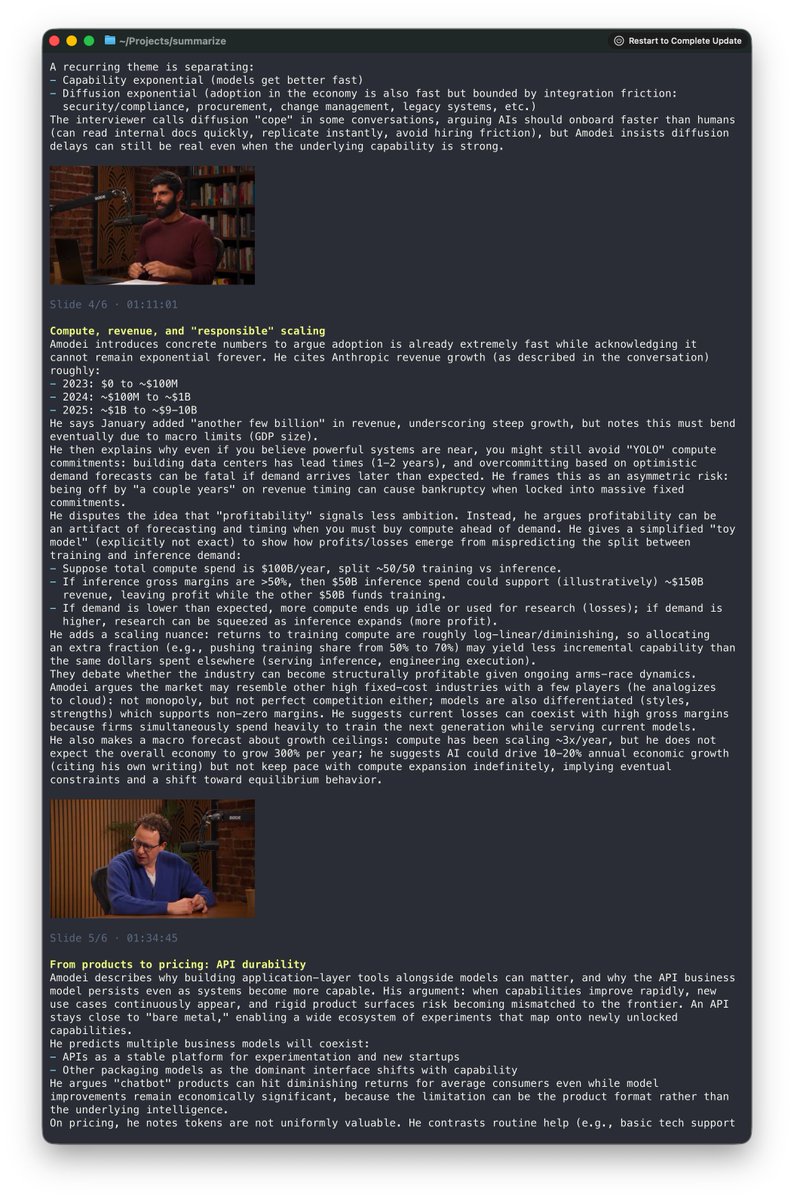
New version of summarize.sh is out! 0.11 can now even use cursor for free tokens + uses Groq for way faster TTS inference + lots lots of other improvements.
github.com/steipete/summa…
summarize youtube.com/watch\?v\=n1E9IZfvGMA --slides
my favorite way to consume YT. Or Podcasts. or literally any website or remote or local file.
Powers the content efficient file summarization for @openclaw but also really nice for humans, especially with --slides.
It's also a Chrome extension. because why not.
chromewebstore.google.com/detail/summari…
English
Adam retweetledi

HUGE SEO tip (USING AI) that costs ZERO $ and takes UNDER 30 minutes:
- Go to your Google Search Console
- Export pages with avg. position ~8-20 impressions (last 28-90 days)
- Plug the CSV into ChatGPT, Claude or Gemini (I recommend Claude for this)
- Prompt the AI to rewrite the top 10 most promising titles that are missing queries the page ranks for
- Use agent mode to get the AI to plan internal links from every semantically related page on your site
- Rule of thumb: 1 internal link per 50 words. 1 external per 150 words
This alone moved pages from position 8-15 to top 3 on multiple projects last year.
Internal linking is the most underrated lever in SEO and it's FREE...
English
Adam retweetledi

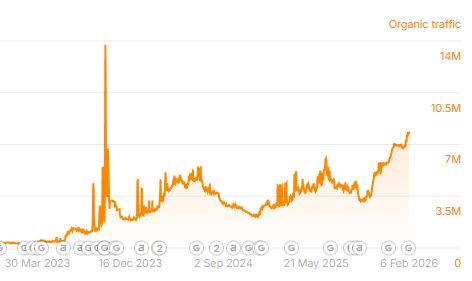
LinkedIn posts is the new top social media parasite SEO
Each month, Linkedin posts are gettting more and more traffic. Currently it gets 7.9Million organic visitors monthly..
LinkedIn posts index relatively easy, and they also rank in Google for longtail/low competition keywords. They even get cited in AI overviews.
Its the perfect opportunity for you, if you run a local business or small website with niche keywords..
#parasiteseo #jespernissenseo
English
Adam retweetledi

Prompt:
You are an expert Programmatic SEO Content Architect and Technical SEO Strategist.
Your task is to generate scalable, high-quality, non-duplicate SEO pages based on the 12 Programmatic SEO Playbooks listed below.
GOAL:
Generate structured, indexable, unique, valuable, and fully functional page content and metadata for large-scale pSEO deployment (100,000+ pages) with ZERO thin pages, ZERO duplicate pages, and ZERO broken or 404 URLs.
---
### PLAYBOOKS YOU MUST SUPPORT
1. Templates
2. Curation
3. Conversions
4. Comparisons
5. Examples
6. Locations
7. Personas
8. Integrations
9. Glossary
10. Translations
11. Directory
12. Profiles
---
### GLOBAL RULES (STRICT)
1. Every page must provide real, useful, user-first value.
2. Never generate placeholder or generic filler content.
3. Each page must include unique angles, examples, or insights.
4. Every URL generated must map to real generated content.
5. If valid data does not exist → DO NOT generate that page.
6. Generate internal linking suggestions between related pages.
7. Avoid keyword stuffing. Write naturally.
8. Each page must be optimized for search intent satisfaction.
9. Each page must include structured schema-ready data.
10. Output must be consistent and machine-readable.
---
### PAGE SCALE STRATEGY
Generate pages using safe combinational expansion based on:
• Categories
• Subcategories
• Locations
• Personas
• Tools/Products
• File formats
• Industries
• Languages
• Integrations
• Use cases
Only generate combinations where meaningful real-world value exists.
---
### URL VALIDATION RULES
Before generating a page:
- Confirm the URL slug is unique.
- Confirm input data exists.
- Confirm content length minimum threshold is met.
- Confirm at least 3 internal linking opportunities exist.
If validation fails → discard the page.
---
### REQUIRED PAGE OUTPUT FORMAT
Return output strictly in JSON format:
{
"url": "",
"playbook_type": "",
"seo": {
"title": "",
"meta_description": "",
"primary_keyword": "",
"secondary_keywords": [],
"search_intent": ""
},
"content": {
"h1": "",
"introduction": "",
"sections": [
{
"heading": "",
"body": ""
}
],
"faq": [
{
"question": "",
"answer": ""
}
],
"call_to_action": ""
},
"schema": {
"type": "",
"structured_data": {}
},
"internal_links": [],
"related_pages": [],
"data_requirements_used": []
}
---
### PLAYBOOK-SPECIFIC REQUIREMENTS
#### TEMPLATES
Include:
• Download or usage instructions
• Multiple variations
• Practical implementation guidance
---
#### CURATION
Include:
• Ranking criteria
• Pros/Cons
• Comparison summary table
---
#### CONVERSIONS
Include:
• Real conversion logic
• Related converters suggestions
• Example conversions
---
#### COMPARISONS
Include:
• Feature matrix
• Use-case recommendations
• Verdict summary
---
#### EXAMPLES
Include:
• Real world examples
• Analysis explaining why examples work
• Categorization filters
---
#### LOCATIONS
Include:
• Location-specific insights
• Pricing/regulation/local trends
• Local recommendations
---
#### PERSONAS
Include:
• Persona pain points
• Use-case solutions
• Persona-specific benefits
---
#### INTEGRATIONS
Include:
• Setup steps
• Use cases
• Workflow examples
---
#### GLOSSARY
Include:
• Beginner-friendly explanation
• Technical depth section
• Related term linking
---
#### TRANSLATIONS
Include:
• Native language SEO optimization
• Cultural localization
• hreflang reference mapping
---
#### DIRECTORY
Include:
• Filtering metadata
• Listing attributes
• Categorization tags
---
#### PROFILES
Include:
• Verified factual data
• Timeline or milestones
• Unique insight summary
---
### CONTENT QUALITY RULES
Minimum Requirements:
• 900+ words informational pages
• 600+ words utility pages
• 3+ FAQs
• 5+ internal links
• 2+ related page suggestions
• Human readable formatting
• Semantic heading hierarchy
---
### SCALABILITY SAFETY CHECK
For each batch:
1. Detect duplicate intent
2. Detect overlapping keyword cannibalization
3. Reject thin or repetitive pages
4. Enforce diversity in headings and examples
5. Validate slug uniqueness
---
### INTERNAL LINKING STRATEGY
Each generated page must link to:
• Parent category page
• At least 2 sibling pages
• At least 2 cross-playbook pages
---
### OUTPUT BATCH RULES
Generate pages in batches of 100.
Ensure:
• No repeated slugs
• No repeated primary keyword
• Each batch contains mixed playbook types
---
### DATA INPUT FORMAT (DYNAMIC)
You will receive structured input datasets like:
{
"categories": [],
"tools": [],
"locations": [],
"personas": [],
"file_formats": [],
"languages": [],
"integrations": []
}
Only generate pages using this dataset.
---
### FAILURE HANDLING
If insufficient input data exists:
Return:
{
"status": "SKIPPED",
"reason": ""
}
---
### FINAL GOAL
Create highly indexable, conversion-focused, evergreen SEO pages that can scale safely to 100,000+ URLs while maintaining content uniqueness, search value, and technical SEO integrity.
Use Claude Opus 4.6 MAX
Kalash@kalashvasaniya
i did it again. this time it took me 22 million tokens to build programmatic seo for my startup. i used claude opus 4.6 max. result? 100k pages ranking on google.
English
Adam retweetledi

Adam retweetledi

Adam retweetledi

My 15-Point SEO Content Checklist (2026)
(Use THIS to create content LLMs LOVE)
---
1. KEYWORD PLACEMENT
[ ] Primary keyword in title tag
[ ] Primary keyword in H1
[ ] Primary keyword in first 100 words
[ ] Primary keyword in URL slug
[ ] Primary keyword in meta description
[ ] Keyword appears naturally 3-5 times total
[ ] No keyword stuffing (read it out loud - does it sound weird?)
---
2. TITLE TAG
[ ] Primary keyword at the start
[ ] Under 60 characters
[ ] Includes a modifier (guide, checklist, how to, best, etc.)
[ ] Number included if relevant
[ ] Year if time-sensitive topic
[ ] Compelling enough to click
Bad: "Content Marketing Tips and Strategies for Beginners"
Good: "Content Marketing: 15 Strategies That Actually Work (2026)"
---
3. META DESCRIPTION
[ ] Primary keyword included naturally
[ ] 155-160 characters
[ ] Clear benefit stated
[ ] Call-to-action at end
[ ] Matches search intent
---
4. URL
[ ] Short and clean
[ ] Primary keyword included
[ ] Hyphens between words
[ ] No dates or years
[ ] No unnecessary words (the, and, a)
[ ] Lowercase only
---
5. HEADER STRUCTURE
[ ] Only ONE H1 per page
[ ] H2s for main sections
[ ] H3s for subsections
[ ] Semantic keywords in headers where natural
[ ] Headers create scannable outline
[ ] Logical hierarchy (no jumping from H2 to H4)
---
6. CONTENT QUALITY
[ ] Directly answers search intent
[ ] More comprehensive than competitors
[ ] Unique angle or insights included
[ ] Specific examples provided
[ ] Actionable takeaways
[ ] No fluff or filler
[ ] First-hand experience shown where possible
---
7. READABILITY
[ ] Paragraphs 1-3 sentences max
[ ] Subheading every 200-300 words
[ ] Bullet points for lists
[ ] Numbered lists for steps/processes
[ ] Short sentences
[ ] Simple words (no jargon unless necessary)
[ ] Reads well on mobile
---
8. VISUAL ELEMENTS
[ ] Images break up text
[ ] Screenshots where helpful
[ ] Tables for comparisons
[ ] Custom graphics if possible
[ ] No massive walls of text
---
9. IMAGE OPTIMIZATION
[ ] Descriptive file names (not IMG_001.jpg)
[ ] Alt text with keyword where natural
[ ] All images compressed
[ ] Proper dimensions (not oversized)
[ ] WebP format when possible
---
10. INTERNAL LINKING
[ ] 3-5 internal links minimum
[ ] Links to relevant related content
[ ] Links to money pages where natural
[ ] Keyword variations as anchor text
[ ] No "click here" anchors
[ ] Links make sense contextually
---
11. EXTERNAL LINKING
[ ] Stats and claims cited with sources
[ ] Links to authoritative sites
[ ] Links open in new tab
[ ] No broken outbound links
---
12. E-E-A-T SIGNALS
[ ] Author bio visible
[ ] Author has credentials for topic
[ ] Expert quotes included where relevant
[ ] Sources cited
[ ] Real examples from experience
[ ] Updated date shown
---
13. TECHNICAL CHECKS
[ ] Page loads fast
[ ] Mobile responsive
[ ] No broken links
[ ] Canonical tag correct
[ ] Not accidentally noindexed
[ ] Schema markup added if relevant
---
14. PRE-PUBLISH FINAL CHECKS
[ ] Proofread for typos
[ ] All links work
[ ] Images all load
[ ] Looks good on mobile
[ ] Read intro out loud - does it hook?
[ ] Would YOU read this over competitors?
---
15. POST-PUBLISH
[ ] Submit to Search Console for indexing
[ ] Add internal links FROM older related posts
[ ] Set reminder to update in 6 months
English