Boris Long 💙

71K posts

Boris Long 💙

Boris Long 💙

@BorisLong4

I won't live my life in an echo chamber. #BewareOfFreeports #InVordersWeTrust #MIPO #ImWithNye #FriendsOfSangita #TuftonStreetMustFall #BeMoreDarren 🦋

Katılım Şubat 2022
4.8K Takip Edilen1.3K Takipçiler
Boris Long 💙
Boris Long 💙@BorisLong4·
@Simon_dttia @larryandpaul Yes, of course the Left are so factional, unlike the right who took us into the Common Market and famously didn't spend 30 years fighting about how/why to get us out again?
English
0
0
0
16
Boris Long 💙 retweetledi
Liz Webster
Liz Webster@LizWebsterSBF·
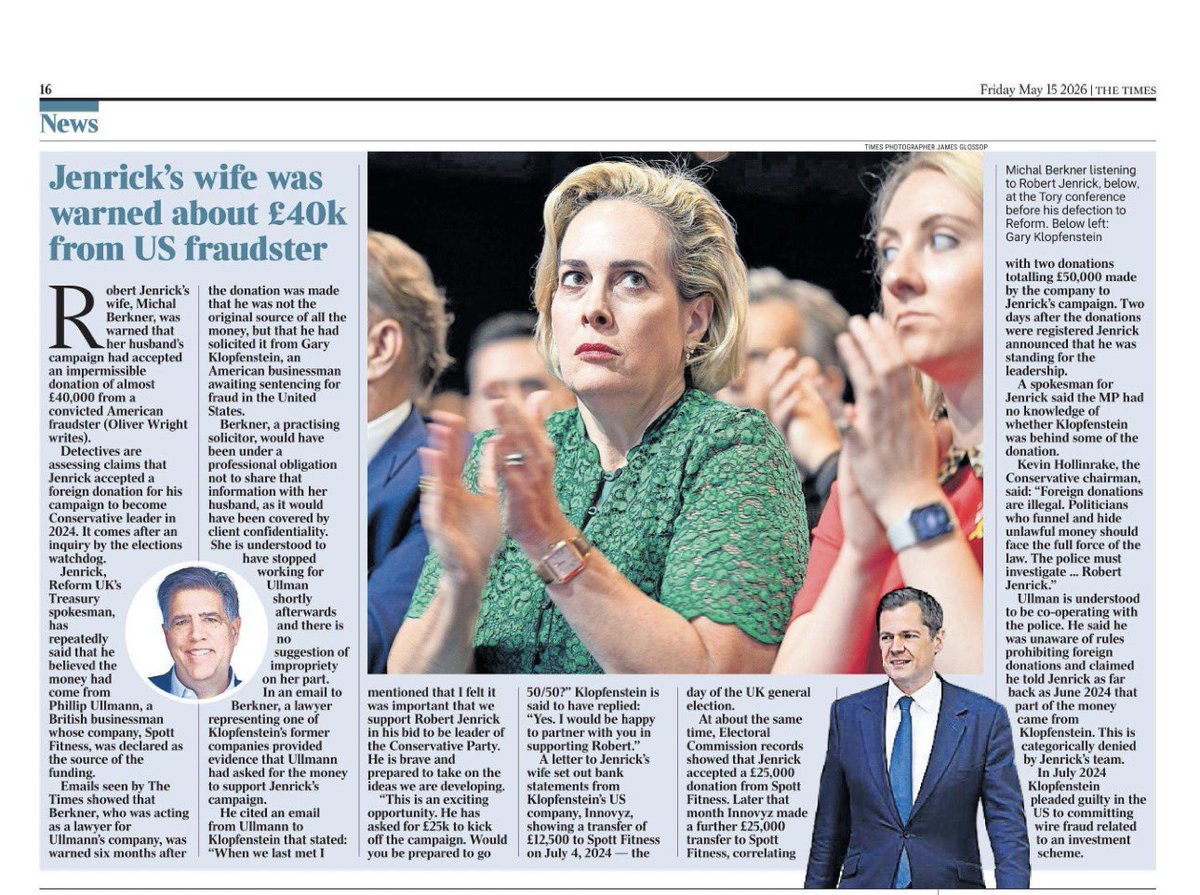
🚨 Another day, another Reform/Tory scandal. Robert Jenrick’s 2024 Tory leadership campaign accepted a £40,000 donation linked to convicted US fraudster Gary Klopfenstein. Jenrick’s wife, solicitor Michal Berkner, was reportedly warned about the source of the money. The donation was routed through a UK company and police are now investigating potential breaches of foreign donation rules. Jenrick says he had no knowledge.
Liz Webster tweet media
English
56
1.3K
1.9K
25.9K
Boris Long 💙 retweetledi
Richard Murphy
Richard Murphy@RichardJMurphy·
The bond market is being treated by the media as if it has a veto over any Labour move to the left. The media are, then, complicit in the whole conspiracy to make sure democracy cannot deliver what people want and need so that the wealthy might gain. bloomberg.com/news/articles/…
English
119
576
1K
19.3K
Boris Long 💙 retweetledi
Prem Sikka
Prem Sikka@premnsikka·
England water companies to have one of worst ever years for pollution. The Environment Agency blames wet weather, ageing infrastructure, increased inspections. Last week companies hinted at water cuts because of dry spring/winter. People fleeced. archive.ph/TTIIs
English
10
211
313
3.7K
Boris Long 💙 retweetledi
The Finance Guy
The Finance Guy@OneFinanceGuy·
Oh dear... @PrivateEyeNews asked @IsabelOakeshott about her media company breaching UAE law (live posting on attacks against the country) and she didn't reply?
The Finance Guy tweet media
The Finance Guy@OneFinanceGuy

Hey @IsabelOakeshott you either forgot to tell Companies House you moved to UAE or you forgot to tell us you moved back.... which one is it? Company registered yesterday, but not the only one that failed to mention UAE.

English
6
357
727
37.3K
Boris Long 💙 retweetledi
Patriotic Millionaires
Patriotic Millionaires@PatrioticMills·
Hey, here's a number we hate: $147,408,930,000 That's because that's how much 310 companies avoided in federal income tax on $1.1 trillion of profit in 2025. You can keep track of this number, too, thanks to @iteptweets's corporate tax avoidance tracker: itep.org/corporate-tax-…
English
1
9
12
318
Boris Long 💙 retweetledi
Misan Harriman
Misan Harriman@misanharriman·
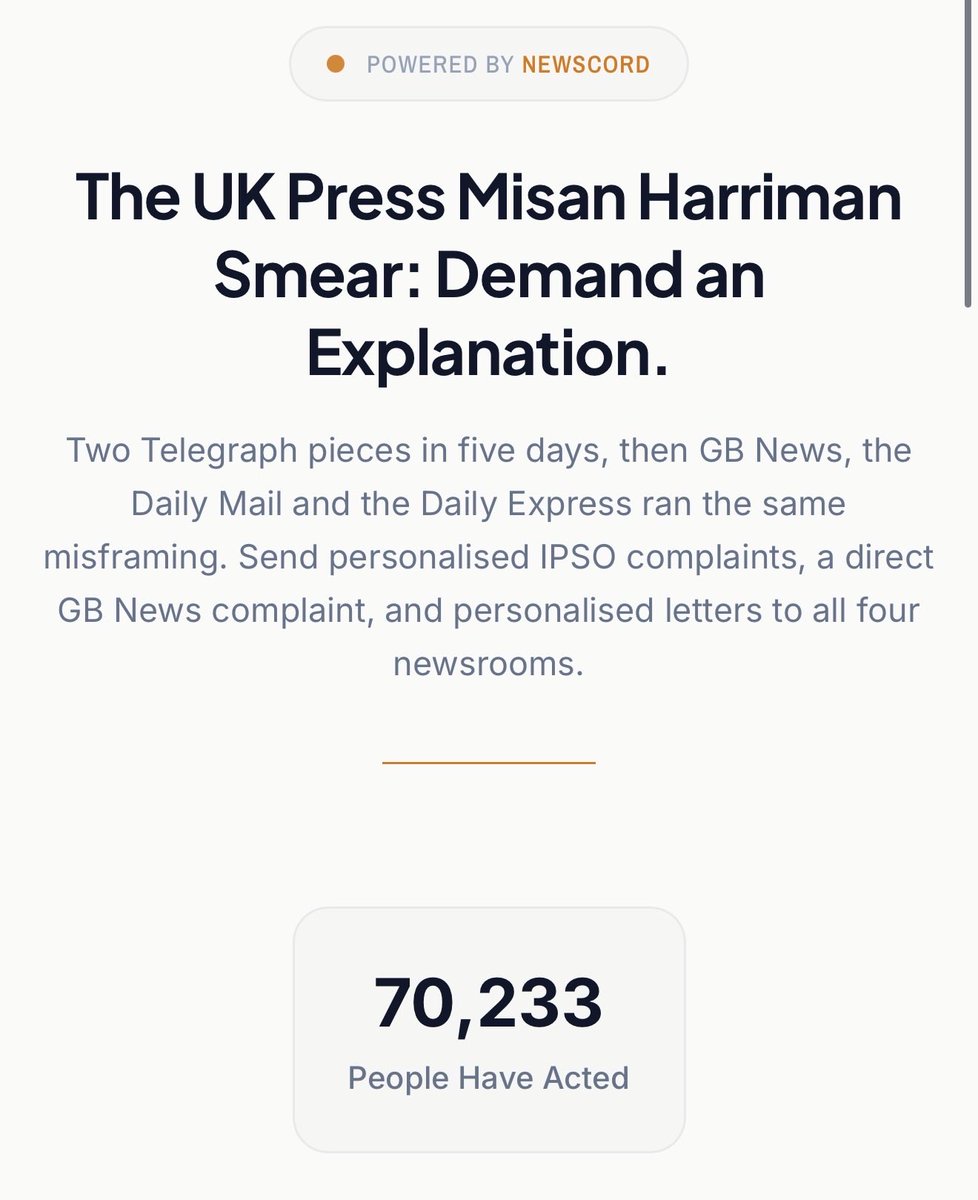
Truly a watershed moment: 70k complaints is by far the most in UK publishing history. Thank you again for the support, folks. newscord.org/action/telegra…
Misan Harriman tweet media
English
32
631
2K
28.6K
Boris Long 💙 retweetledi
Carole Cadwalladr
Carole Cadwalladr@carolecadwalla·
My colleagues & I have taken a huge gamble to set up @thenerve_news. We’re trying to build a new independent publication from the ground up. Social media is our only distribution for now. Sharing this article in your networks would make a huge difference. Thank you! 🙏🙏🙏
Carole Cadwalladr@carolecadwalla

NEW: The British politician, his Russian intelligence handler & a Kremlin plot against the US & Ukraine. My new piece about Nathan Gill and Nigel Farage for @thenerve_news in which we ask: Why, even now, is no-one asking questions?

English
368
10.7K
12.4K
859K
Boris Long 💙 retweetledi
Carole Cadwalladr
Carole Cadwalladr@carolecadwalla·
The problem @louismosley is that this is your boss. Do you think his statements about killing people inspires confidence as the trusted custodian of our most sensitive data? How does publishing a militaristic manifesto with white supremacist overtones inspire patient confidence? These are genuine questions. You behave as you’re a normal company CEO & the BBC invites you on to speak calmly & plausibly but your leadership is saying something else entirely. It is proudly ideologically driven & that ideology is frankly scary. It’s militarism + nationalism + surveillance & control. x.com/BrettKrieger12…
English
1
5
7
230
Boris Long 💙 retweetledi
Sangita Myska
Sangita Myska@SangitaMyska·
💥1/2. My latest ‘ Long Story Short’ video has just dropped! Donald Trump is the most corrupt president in US history - that’s the accusation levelled at the 47th President with as much vigour as it’s been rejected by the White House. I’ve brought together the evidence, so you can make up your own mind. Watch the full episode of Long Story Short on @MiddleEastEye ‘s YouTube channel now (see next tweet) Here’s a taster 👇🏽
English
27
718
1.6K
27.1K
Boris Long 💙
Boris Long 💙@BorisLong4·
@elonmusk @spacepioneer211 Nah!!! He's just a rich guy wanking his own ego and screwing the poor. He's so unoriginal in his ambition, there are folks the same in every period of known history. Unfortunately, they take us all down with them.
English
0
0
0
69
Boris Long 💙
Boris Long 💙@BorisLong4·
@premnsikka Of course he does. Nothing is ever his fault. What on earth do they teach children at private school? It's certainly not ethics/morals/responsibility.
English
0
0
1
15
Boris Long 💙 retweetledi
Prem Sikka
Prem Sikka@premnsikka·
Nigel Farage blames “computer-hacking” for public revelation of his £5m gift from a billionaire living in Thailand. Gift not disclosed to authorities. Foreign money funds Reform. What have the tax exiles been promised? What else has not been disclosed? archive.ph/kowpN
English
33
539
842
8K
Angela Rayner
Angela Rayner@AngelaRayner·
Our party has suffered a historic defeat. Many good Labour colleagues have lost their seats despite working hard for those they represented. We have lost good Labour administrations and lost the chance for more. What we are doing isn’t working, and it needs to change. This may be our last chance. The Labour Party must now live up to our name: we must be the party of working people. We’ve heard the same on the doorstep as we’ve seen in the polls - the cost of living is the top issue for voters of all parties. People have turned to populists and nationalists because we have not done enough to fix it. Living standards are barely higher than they were a decade and a half ago. People feel hopeless - that the cost of living crisis will never end, and now they see oil and gas companies use global instability to post record profits. Once again, ordinary people are paying the price for decisions they didn’t make. It’s no wonder that across the UK, working people feel the system is rigged against them. Things can be so much better than this. Countries including Spain and Canada have shown that economies can grow and people can thrive when governments stay true to labour and social democratic values and put people first. We need to learn from that. In London, we lost young people who fear they will never afford a home. In my patch and across the north, we lost working people whose wages are too low and costs too high. In Scotland and Wales, people do not currently see Labour as the answer.  We are in danger of becoming a party of the well-off, not working people. The Peter Mandelson scandal showed a toxic culture of cronyism.  Decisions like cutting winter fuel allowance just weren’t what people expected from a Labour government. For too long, successive governments have allowed wealth and power to concentrate at the top without a plan to ensure the benefits of economic growth are shared fairly. The result is an economy that does not work for the majority, with wealth concentrated in too few hands. This level of inequality, alongside squeezed living standards, is the outcome of a model built on deregulation, privatisation, and trickle-down economics. But we have the chance to fix this.  1/2
English
8K
754
6.1K
2.8M
Clive Lewis MP
Clive Lewis MP@labourlewis·
Westminster may finally be about to have the argument it has spent 40 years avoiding. If Andy Burnham returns to Parliament, the political class will know how to cover it. A leadership drama. Who is up, who is down, whether Keir Starmer can survive, whether Labour is once again turning inward. The familiar machinery of Westminster psychodrama will whirr into life. That framing misses the larger point. Burnham’s possible return matters not because of what it says about Labour’s leadership, but because of what it reveals about the British state: what it can still do, what it has forgotten how to do, and what kind of country it must become if it is serious about resilience. Britain is finally having a more serious conversation about national security. The Strategic Defence Review, the pivot back towards Europe, the recognition that hybrid warfare turns citizens, infrastructure and civic institutions into part of the front line: all of it marks a real shift in how the state thinks about its own survival. But at the centre of that conversation lies a question that the defence establishment, and most of Westminster, still does not want to answer. What kind of society do you need to be before resilience is possible? Finland is now the model everyone cites. Comprehensive security. Whole-of-society defence. Civilian preparedness woven into military planning. British strategists admire the Finnish system and ask how it might be copied. But the admiration stops short of the uncomfortable question: why does it work there? The answer is not geography or history or some mysterious quality of Finnish national character. It is structural. Nearly 80% of Finns say they would defend their country if attacked. In Britain, the figure is closer to 33%. That gap is not an accident. It exists because Finland has spent decades building a society in which people have a genuine stake in what they are being asked to defend. Energy is affordable. Housing is available. Public services function. Institutions command trust. The Nordic welfare state is not a sentimental add-on to Finnish security policy. It is the foundation of it. You cannot ask people to defend a country that does not work for them. Britain has spent 40 years building the opposite. The privatisation of essentials – energy, water, transport, housing – transferred wealth upwards from households to shareholders while making the basics of everyday life more expensive. The state, stripped of the tools to control costs at source, has been reduced to compensating after the fact. Out of every pound the Government spends on housing, 88p goes to subsidising private rents. Just 12p goes to building homes. When energy prices spiked in 2022, the Government spent £40bn in a single winter cushioning the blow, not because it had a resilient energy system but because it lacked one. Debt interest now consumes more than £100bn a year. Britain has the highest debt servicing costs in the G7: the compounding price of financing failure rather than eliminating it at source. This is what bond market dependency actually looks like. It is not an abstract fiscal condition. It is the consequence of a state that has been stripped of the supply-side tools that would let it cure the problems it now pays, indefinitely, to manage. And here is the paradox the Treasury refuses to confront. The countries that borrow most cheaply are often those that have retained the public investment model Britain abandoned. The spread between UK and Dutch borrowing costs has widened sharply not because markets fear public investment, but because they have lost confidence in a model that borrows to subsidise private failure while never addressing its causes. This is the connection Britain’s defence debate is missing. The familiar framing, that social spending is what must be sacrificed to meet the NATO target, is not merely politically toxic. It is strategically illiterate. Cutting the foundations of social cohesion to fund the hardware of national defence is self-defeating. You end up with planes and no pilots, submarines and no crew, an army that cannot recruit because the society it is meant to protect has stopped believing in itself. I think Burnham understands this. That is why his programme is more interesting than the leadership gossip suggests. What he has been building in Greater Manchester – public control of transport, expanded social housing, investment in the productive foundations of the city economy – is not a nostalgic rerun of postwar nationalisation. It is a proof of concept for a different kind of state. The Bee Network is the most visible example, but the argument behind it travels. A state that can shape markets is not condemned to subsidise their failures. A state that produces affordable energy through public generation does not need to spend tens of billions cushioning every price shock. A state with a serious public housebuilding programme does not need housing benefit to rise endlessly in line with private rents. A state that builds institutions people can see, use and trust begins to restore the civic confidence on which resilience depends. The real constraint on Britain is not money. It is capacity: the workers, institutions, supply chains and public purpose needed to turn national will into national renewal. Britain’s tragedy is not that it has run out of money. It is that after 40 years of hollowing out the state, it has made itself less able to act. Burnham’s critics will reach for the familiar warning. Borrow more, spend more, spook the gilt markets, repeat the Truss disaster. But this misunderstands both the problem and the opportunity. Bond markets do not have ideological preferences. They have functional ones. They prefer clarity, credible revenue streams, productive investment, and a state with a plan. What they punish is not public ambition but incoherence. A properly designed productive state programme would not be a leap into fiscal fantasy. It would be an attempt to end the much costlier fantasy that Britain can keep borrowing to compensate for broken markets while refusing to repair them. The defence conversation and the economic conversation need to become the same conversation. Finland did not build national resilience by choosing between welfare and security. It built resilience by understanding that they are inseparable: that a country in which the basics work, where people trust one another and the institutions around them, is one that can face danger with something more than anxiety. That is the deeper argument Burnham represents. Westminster will be tempted to treat him as a leadership story. It should resist the temptation. The question is not whether Burnham can return to parliament. It is whether Britain can return to the idea that the state should make life work. Because a country that cannot command the confidence of its people cannot truly defend itself.
Clive Lewis MP tweet media
English
234
217
845
492.8K
Boris Long 💙
Boris Long 💙@BorisLong4·
@reformexposed Starmer told people to leave if they didn't like his changed party, so they did in their thousands?
English
0
0
0
97
Boris Long 💙 retweetledi
The Observer
The Observer@ObserverUK·
NOT FOR SALE: GET HARBORNE OUT Pick up a copy of the Observer tomorrow - available nationwide - and subscribe on our website: bit.ly/4spzX71
The Observer tweet media
English
19
522
1.1K
27.3K
Boris Long 💙 retweetledi
Prem Sikka
Prem Sikka@premnsikka·
Google developers significantly misstate carbon emissions of proposed UK datacentres. Just 3 will generate emissions equivalent to those of a city such as Bristol. Datacentres consume excessive amount of water/electricity, generate few permanent jobs. theguardian.com/technology/202…
English
31
609
749
18.4K