

Kelly Murphy
298 posts

Coming later this month: my essay in @AmericanAffrs on the policies that put words-into-action on the Ratepayer Protection Pledge that 7 AI hyperscalers signed at the White House in March -->
English
Kelly Murphy retweetledi

What China just did with the blocking statutes against U.S. extraterritorial sanctions sets quite a major precedent, probably the financial equivalent of what happened with rare earths last year (in the sense that this is China taking a major step to push back against a U.S. hostile measure as opposed to taking it on the chin).
It's a little complex but, to start with, what many people ignore (and will probably be surprised by) is that - by and large - Chinese companies and financial institutions have largely complied with extraterritorial U.S. sanctions.
Anecdotal story on this: I know for a fact, because I personally know the person, that a very famous guy (whose name I won't reveal but that everyone of you would know) sanctioned by the U.S. was in China recently and tried to exchange money at the counter of a random Chinese bank. Just simply exchange dollars for a Chinese yuan, in mainland China. And he was refused, because he is sanctioned by the U.S. - despite the fact that China as a country has absolutely no problem with the person.
This goes to illustrate just how much goodwill China extended to the U.S. on this - a Chinese bank, in China, refusing to serve someone China has no problem with, just to comply with U.S. extraterritorial sanctions.
It also goes to illustrate why this blocking order marks such a sharp departure.
What triggered it is not new sanctions by the U.S. but recent efforts under the so-called "Operation Economic Fury" to dramatically ramp up enforcement of existing sanctions on Iran.
The U.S. notably issued at the end of April alerts to financial institutions worldwide - including in China - on "the sanctions risks associated with independent 'teapot' oil refineries in China, primarily in Shandong Province, given their continued role in importing and refining Iranian crude oil" (home.treasury.gov/news/press-rel…)
Even more importantly, they also specifically went after Hengli Petrochemical Dalian (home.treasury.gov/news/press-rel…), one of China's largest private refineries, with 400,000 barrels per day capacity and a parent company (the Hengli Group) that's a Fortune Global 500 company.
In effect, what the U.S. extraterritorial sanctions mean is that Hengli - and all other Chinese 'teapot' oil refineries being targeted - is cut off from the dollar system, and any bank, insurer, or trading partner anywhere in the world - including in China - that deals with them risks being cut off too. Which is obviously a major hostile move by the U.S. against China (and, of course, Iran).
Except that China, this time around, is not having it.
Since 2021 they've had regulations ("Measures to prevent the improper extraterritorial application of foreign laws and measures", mofcom.gov.cn/zcfb/zhzc/art/…) that gives the Chinese government power to formally prohibit compliance with foreign sanctions, and that, since this April (morganlewis.com/pubs/2026/04/c…) are also extraterritorial in nature.
In effect what these regulations - and their April addendum - say is that if you comply with U.S. extraterritorial sanctions by cutting off a Chinese company, you are violating Chinese law. Any entity - Chinese or foreign - that refuses to deal with a sanctioned Chinese company because Washington told them to can be sued in Chinese courts, fined by MOFCOM, and since April, placed on a 'Malicious Entity List' with asset freezes and trade restrictions.
In a nutshell on one side you have the U.S. saying "cut them off or we cut you off" and now China says "well, if you do cut us off we're going to be real nasty with you, in China and potentially beyond."
These regulations were - until yesterday - purely theoretical: they've never actually been applied. But, yesterday, China's MOFCOM made it crystal clear this time is different: they used a statement with a triple negative, saying the U.S. sanctions "shall not be recognized, shall not be enforced, shall not be complied with" ("不得承认、不得执行、不得遵守", mofcom.gov.cn/zwgk/zcfb/art/…).
In effect you now have companies that are in the middle of this - for instance financial institutions serving Hengli - caught in quite a bind: face U.S. or Chinese hostility. It's a no-win, they need to choose a camp on this.
Concretely speaking, given that the overwhelming majority of companies affected are operating inside China, they'll obviously choose the China side.
The real question therefore is: Is the U.S. ready to act on its threat and cut off Chinese banks or other institutions that keep servicing these refineries?
Because that probably means sanctioning major Chinese financial institutions, which is a whole different level of escalation. The moment the U.S. designates a major Chinese bank for dealing with Hengli, this stops being about Iranian oil and becomes a direct financial confrontation between the two largest economies on earth, which is a much bigger deal with probable consequences for the entire global financial system.
Or will the U.S. back off, meaning China would have effectively caught their bluff, showing that extraterritorial sanctions are a lot of bark but not a lot of bite?
We'll know in the next couple of weeks I guess.
One thing is sure though: whatever happens with these refineries, the broader damage is done. China used to extend remarkable goodwill on sanctions compliance - voluntarily cooperating with extraterritorial sanctions inside its own borders even though it had no legal obligation to respect them. That goodwill has been spent.
And, from a U.S. standpoint, a China with less goodwill vis a vis U.S. financial hegemony is undoubtedly a far bigger issue than a few teapot refineries buying Iranian oil.
Drop Site@DropSiteNews
🇨🇳 China Invokes Blocking Statute for First Time China’s Ministry of Commerce has for the first time activated its 2021 Blocking Rules, ordering all Chinese firms and individuals not to comply with U.S. sanctions targeting five independent Chinese oil refineries accused of purchasing Iranian crude. Beijing called the U.S. measures, imposed under two executive orders, an “unjustified” and “improper” use of extraterritorial law. The move puts multinational companies operating in both markets in direct legal conflict: compliance with U.S. sanctions now risks violating Chinese law, and vice versa. Global banks and firms with dollar exposure face secondary sanctions risk if they continue dealing with the affected refineries. Analysts describe the order as a significant step toward competing legal frameworks for global trade, accelerating the path to potential economic “decoupling” between the two powers.
English
@TKavulla Around here (Boulder) we cheered the back-to-back days of rain this week. Given "Drought Stage 2 - Water Warning" by late 2026 for Phoenix - imagine seeing competition for waste water
English
Easily among the Top 10 neatest power plants in the U.S.
Other cool features:
-mechanical draft cooling towers (Google it)
-the transmission yard that's home to one of the big bilateral trading hubs in Western power markets
Office of Nuclear Energy | US Department of Energy@GovNuclear
Meet Palo Verde 👋 The nation’s only nuclear power plant NOT located near a large body of water. Instead, it uses treated wastewater from nearby cities to cool its reactors.
English
I am assuming these "conversations" had a decibel level >70...
Pretty unusual to see a utility, having laid before regulators a few thousand pages of a rate-case filing, say "actually, on second thought..."

Travis Kavulla@TKavulla
Certainly we see some utilities beginning to make big asks of their state regulators in this regard; PECO --with a headline of a 12.5% , $20/mo. rate hike filed this week -- is asking for a 10.95% Return on Equity! whyy.org/articles/peco-…
English
@aakashgupta @aakashgupta - love your posts, and I focus on what Boris says, but the age on this - May 22nd is a bit old.
English

Boris Cherny created Claude Code. It hit $2.5 billion in annualized revenue in 9 months. Fastest B2B product ramp in history. Faster than ChatGPT, Slack, or Snowflake ever reached $1 billion.
Now he says coding is “solved” and IDEs will be dead by end of year.
English
@rohanpaul_ai One of my fav books. Yet, Daniel Kahneman explicitly stated that System 1 and System 2 are "fictitious characters" that do not exist as literal, physical systems in the brain, so, System 3 (Cognitive Surrender) as defined in AI fits perfectly
English

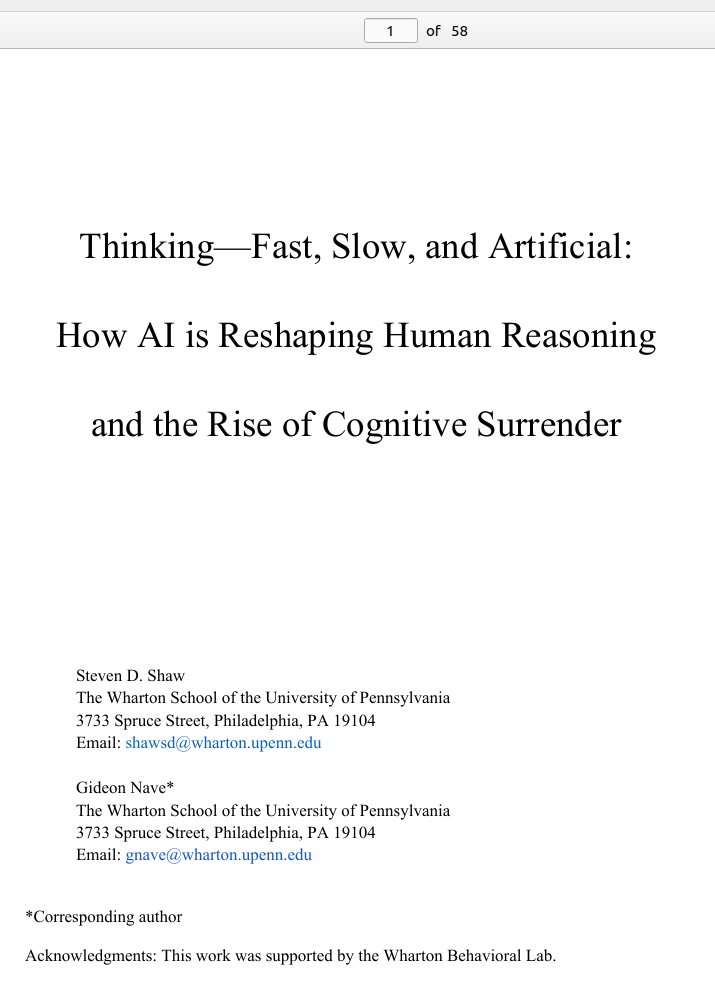
Wharton’s latest AI study points to a hard truth: “AI writes, humans review” model is breaking down
Why "just review the AI output" doesn't work anymore, our brains literally give up.
We have started doing "Cognitive Surrender" to AI - Wharton’s latest AI study points to a hard truth: reviewing AI output is not a reliable safeguard when cognition itself starts to defer to the machine.when you stop verifying what the AI tells you, and you don't even realize you stopped. It's different from offloading, like using a calculator.
With offloading you know the tool did the work. With surrender, your brain recodes the AI's answer as YOUR judgment. You genuinely believe you thought it through yourself.
Says AI is becoming a 3rd thinking system, and people often trust it too easily.
You know Kahneman's System 1 (fast intuition) and System 2 (slow analysis)? They're saying AI is now System 3, an external cognitive system that operates outside your brain. And when you use it enough, something happens that they call Cognitive Surrender.
Cognitive surrender is trickier: AI gives an answer, you stop really questioning it, and your brain starts treating that output as your own conclusion. It does not feel outsourced. It feels self-generated.
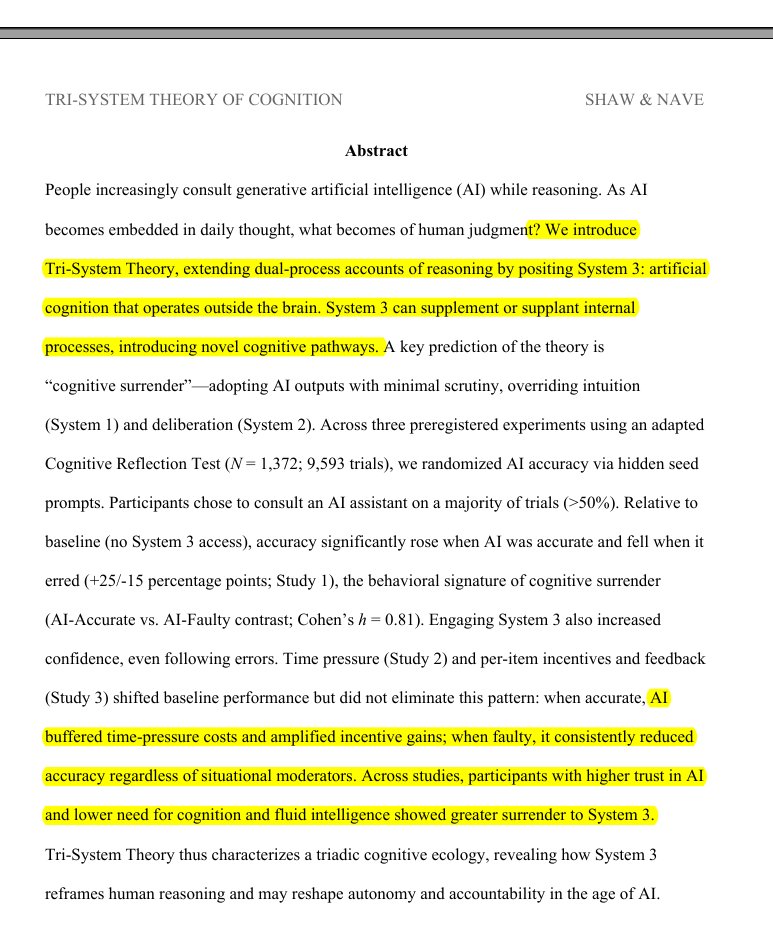
The data makes it hard to brush off. Across 3 preregistered studies with 1,372 participants and 9,593 trials, people turned to AI on over 50% of questions.
In Study 1, when AI was correct, people followed it 92.7% of the time. When it was wrong, they still followed it 79.8% of the time.
Without AI, baseline accuracy was 45.8%. With correct AI, it jumped to 71.0%. With incorrect AI, it dropped to 31.5%, worse than having no AI. Access to AI also boosted confidence by 11.7 percentage points, even when the answers were wrong.
Human review is supposed to be the safety net. But this research suggests the safety net has a hole in it: people do not just miss bad AI output; they become more confident in it.
Time pressure did not eliminate the effect. Incentives and feedback reduced it but did not remove it. And the people most resistant tended to score higher on fluid intelligence and need for cognition. That makes this feel less like a laziness problem and more like a cognitive architecture problem.
English
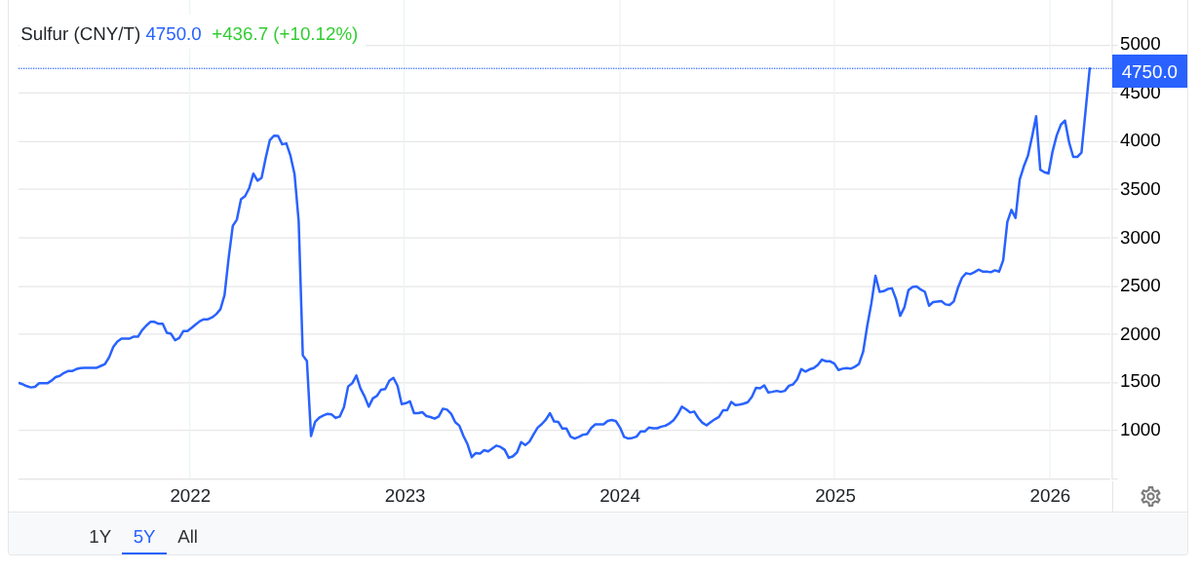

When it comes to MidEast supply disruption, I’m a little worried about oil*, more worried about LNG, and pretty worried about aluminium and urea. But I’m VERY worried about SULPHUR and I believe you should be too.
Not a lot of investors are really thinking about sulphur. But they should be, in my view. They definitely should be.
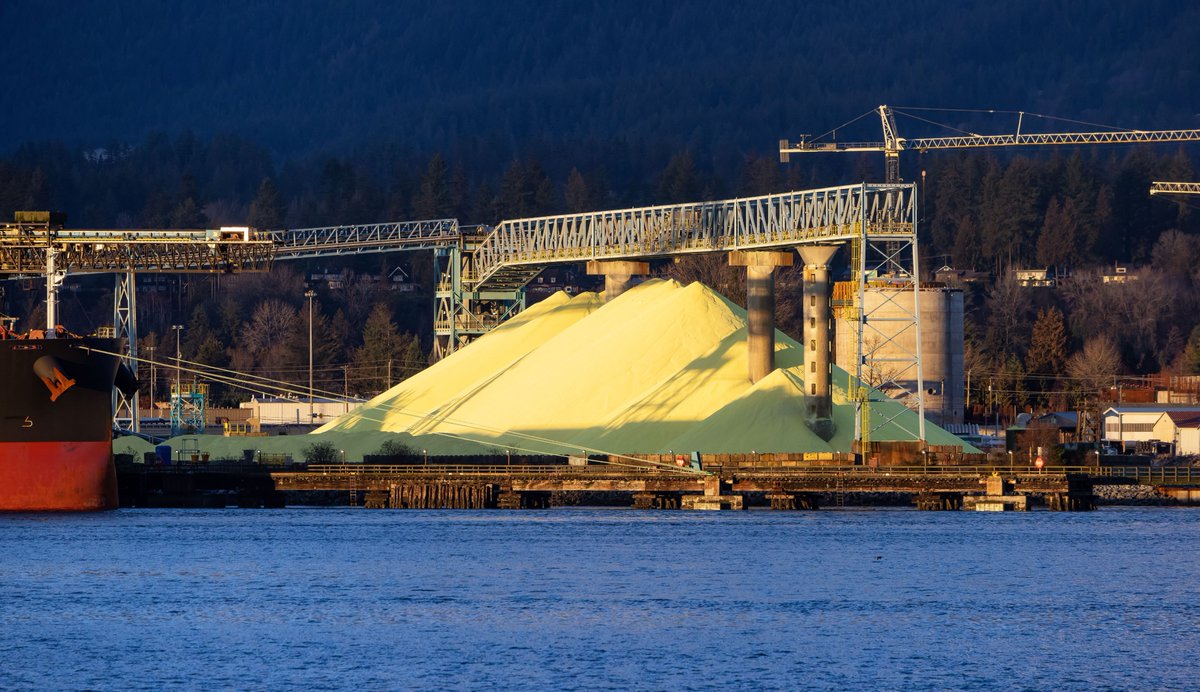
About 45% of global seaborne sulphur exports come out of the Strait of Hormuz. Sulphur is a by product from oil refining and natural gas processing, you see.
And sulphur has fingers in just about every pie in the industrial world.
Because sulphur is used to produce sulphuric acid and sulphuric acid is used to produce phosphoric acid and phosphate fertilisers, hydrochloric and nitric acid, it’s used in semis processing, LFP and lithium hydroxide manufacture, copper SX/EW, nickel and cobalt HPAL, to name just some of the key processes in the industries I look at.
I’m pretty worried about the potential impact of sulphur shortages on the fertiliser industry (60% of sulphur demand goes into making phosphoric acid and phosphate fertilisers), the LFP and lithium hydroxide manufacturing industry, the uranium industry, the REE industry and the pigment industry. I’m less worried, to be fair, about its impact on the copper industry, as well as the cobalt and nickel industries.
You see, 80% of copper is produced from smelting of copper sulphide concentrates (which BTW generates by-product sulphuric acid), only 20% from leaching of oxide and sulphide ores with sulphuric acid. Much of that production is in regions which have copper smelters as well, so they can use their own sulphuric acid.
15-20% of cobalt and nickel supply comes from HPAL, which is a big user of sulphuric acid but the rest (RKEF and sulphide concentrate processing) doesn’t use sulphuric acid.
I’m not panicking about actual availability because I understand there ARE large stockpiles of sulphur near Canadian oil sands operations and these could be mobilised within 3-6 months. But I am aware that there would be a cost impact, which could impact the economics of production of many materials. What that will do to industrial economics is being under-appreciated, in my view.
*but less so after hearing about this Saudi pipeline to the Red Sea.
English
@dylan522p Nope, I was wrong, it’s SemiAnalysis’ Jeremy — never programmed in his life — spending $5,000 a day on Claude Code. That's the Wuhan tweet in action — people outside SF have no idea this is already happening at this scale.
English
@dylan522p Assume you mean this: "Clearly, we are dealing with an extreme fat-tailed process owing to an increased connectivity, which increases the spreading in a nonlinear way"
English

Being in SF is like being in Wuhan right before the pandemic
Something is happening, it's gonna hit everywhere but so few people know it
English
@rohanpaul_ai How many of these are new companies (<6 months)?
English
Citadel Securities published this graph showing a strange phenomenon.
Job postings for software engineers are actually seeing a massive spike.
Classic example of the Jevons paradox. When AI makes coding cheaper, companies actually may need a lot more software engineers, not fewer.
When software is cheaper to build, companies naturally want to build a lot more of it. Businesses are now putting software into industries and tools where it was simply too expensive before.
---
Chart from
citadelsecurities .com/news-and-insights/2026-global-intelligence-crisis/

English
English
The conflict in Iran pushed the most important story in American democracy to page two. RDI's @Kasparov63 writes about @DarioAmodei, @sama, and the AI war at the Pentagon. thenextmove.org/p/a-story-bigg…
English


Bought a new Mac mini to properly tinker with claws over the weekend. The apple store person told me they are selling like hotcakes and everyone is confused :)
I'm definitely a bit sus'd to run OpenClaw specifically - giving my private data/keys to 400K lines of vibe coded monster that is being actively attacked at scale is not very appealing at all. Already seeing reports of exposed instances, RCE vulnerabilities, supply chain poisoning, malicious or compromised skills in the registry, it feels like a complete wild west and a security nightmare. But I do love the concept and I think that just like LLM agents were a new layer on top of LLMs, Claws are now a new layer on top of LLM agents, taking the orchestration, scheduling, context, tool calls and a kind of persistence to a next level.
Looking around, and given that the high level idea is clear, there are a lot of smaller Claws starting to pop out. For example, on a quick skim NanoClaw looks really interesting in that the core engine is ~4000 lines of code (fits into both my head and that of AI agents, so it feels manageable, auditable, flexible, etc.) and runs everything in containers by default. I also love their approach to configurability - it's not done via config files it's done via skills! For example, /add-telegram instructs your AI agent how to modify the actual code to integrate Telegram. I haven't come across this yet and it slightly blew my mind earlier today as a new, AI-enabled approach to preventing config mess and if-then-else monsters. Basically - the implied new meta is to write the most maximally forkable repo and then have skills that fork it into any desired more exotic configuration. Very cool.
Anyway there are many others - e.g. nanobot, zeroclaw, ironclaw, picoclaw (lol @ prefixes). There are also cloud-hosted alternatives but tbh I don't love these because it feels much harder to tinker with. In particular, local setup allows easy connection to home automation gadgets on the local network. And I don't know, there is something aesthetically pleasing about there being a physical device 'possessed' by a little ghost of a personal digital house elf.
Not 100% sure what my setup ends up looking like just yet but Claws are an awesome, exciting new layer of the AI stack.
English
@aniruddh_mohan Howmet Aerospace (HWM) and Precision Castparts Corp (PCC), 80% of the market, have lead times for single crystal (SX) turbine blades of 5 to 7 years.
English

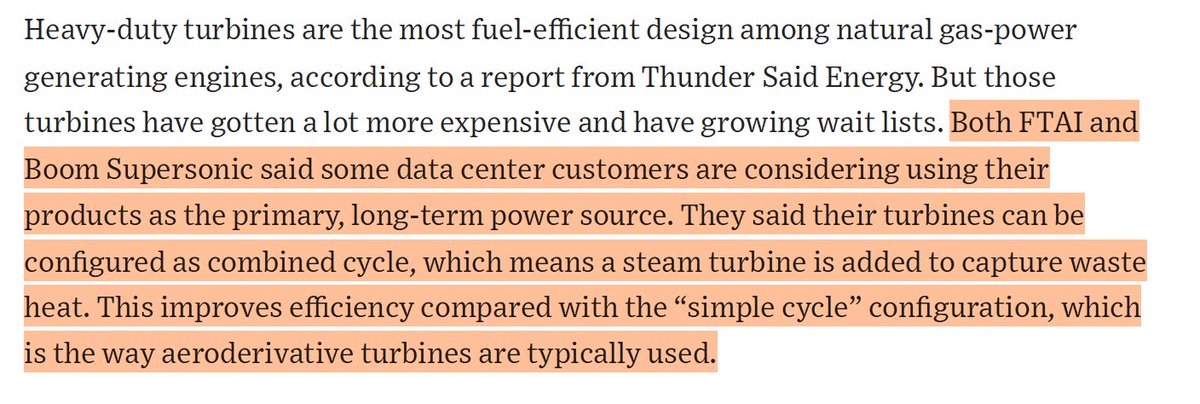
Great reporting by WSJ on jet engines being used to power data centers! Boom Supersonic is not the only company in this market.
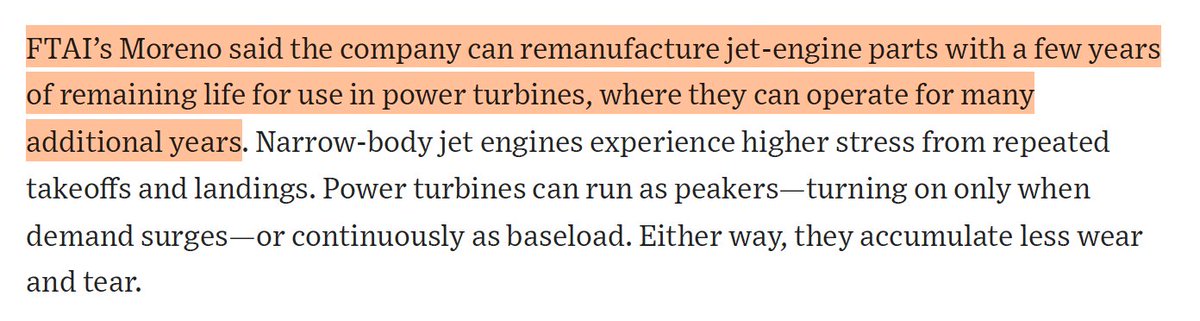
- FTAI Aviation to sell a modified version of Boeing 737 engine for data centers this year
- 30-45 days to convert a jet engine for power turbine use
- Main changes needed: 1) replace fuel nozzles to use gas instead of jet fuel and 2) replace the large fan in front of the flight engine with smaller fan
- Interestingly: both FTAI & Boom say their turbines can also be used in combined cycle config
- Jet engines with few years of remaining life can be converted to power turbines for many additional years
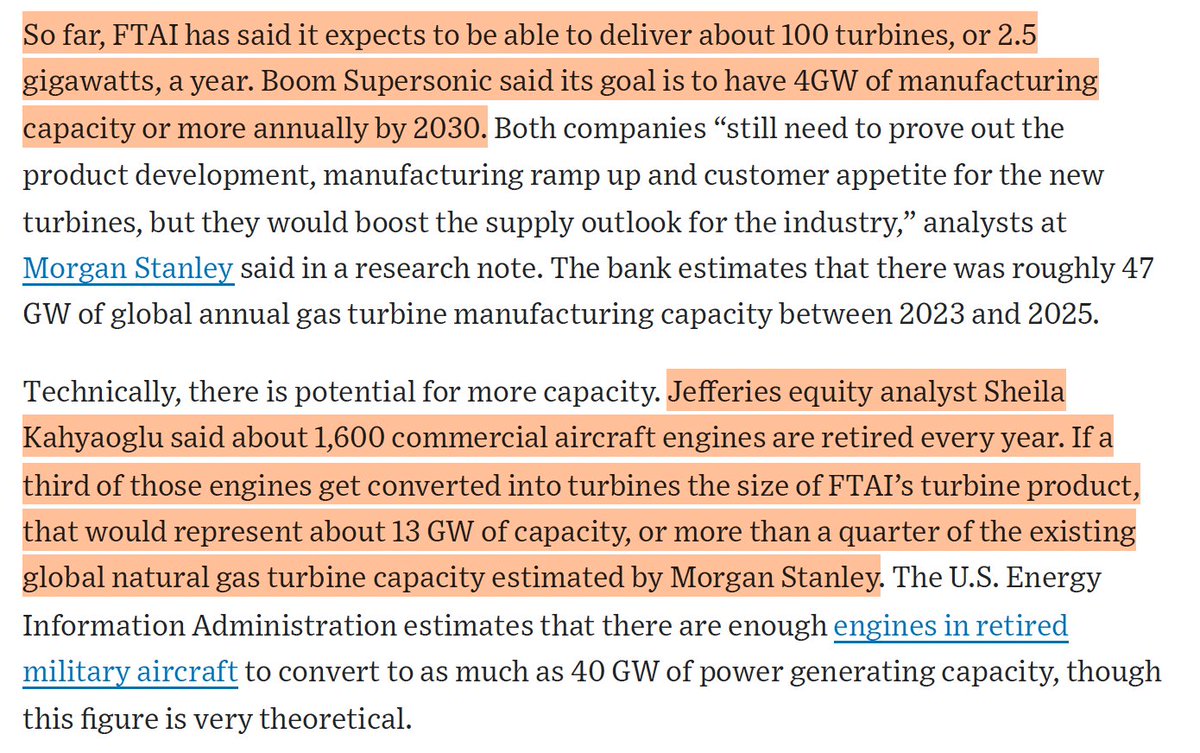
- If just a third of retiring jet engines every year get converted to power turbines that would be 13 GW of excess capacity per year (!)
- FTAI expects to deliver 2.5 GW/year (for context ~20 GW/year for GE/Siemens)
⁃ Boom expects 4 GW/year by 2030
- Could eat into pricing power of larger OEMs, although they do not sound concerned

English
@dwarkesh_sp @collision @elonmusk @dwarkesh_sp - end to end enjoyment built on in-depth preparation. My favorite line - "it just wants to blow up".
English

.@collision and I interviewed @elonmusk.
0:00:00 - Orbital data centers
0:36:46 - Grok and alignment
0:59:56 - xAI’s business plan
1:17:21 - Optimus and humanoid manufacturing
1:30:22 - Does China win by default?
1:44:16 - Lessons from running SpaceX
2:20:08 - DOGE
2:38:28 - TeraFab
English
@FutureJurvetson Beautifully written, yet .... "Any sufficiently advanced technology is [still] indistinguishable from magic"
English

𝐅⃣𝐎⃣𝐂⃣𝐔⃣𝐒⃣ The ASML Way
I just finished this history of the most important semiconductor equipment company in the world, as translated from the Dutch original (and lurking in the background might be a better way).
Reminder: ASML builds 100% of the world’s extreme ultraviolet (EUV) lithography machines, without which cutting edge chips are simply impossible to make. It’s the most expensive mass-produced machine tool in history. Oh, and today, there are two special women without whom, all EUV lithography would sputter to a stop (see p.141 below)
ASML was formed in 1984 as a JV with Philips, the Dutch electronics company that contributed ~$15M (in guilders) and 40 engineers, and “it seemed doomed from the start.” (p.35) There were 10 viable competitors at the time, more than enough to serve the market as ASML learned at SEMICON in 1984 (by coincidence, I was also there with my Dad who about to leave Mostek to run Varian’s Semiconductor Equipment Group, but they only had Molecular Beam Epitaxy, a low throughput lithography alternative. My Dad’s attempt to poach a CTO from ASML is on p.72).
“In these initial years, management worked around the clock to bring in new subsidies. In these initial years, about half of ASML’s money for research came from The Hague or Brussels.” (48)
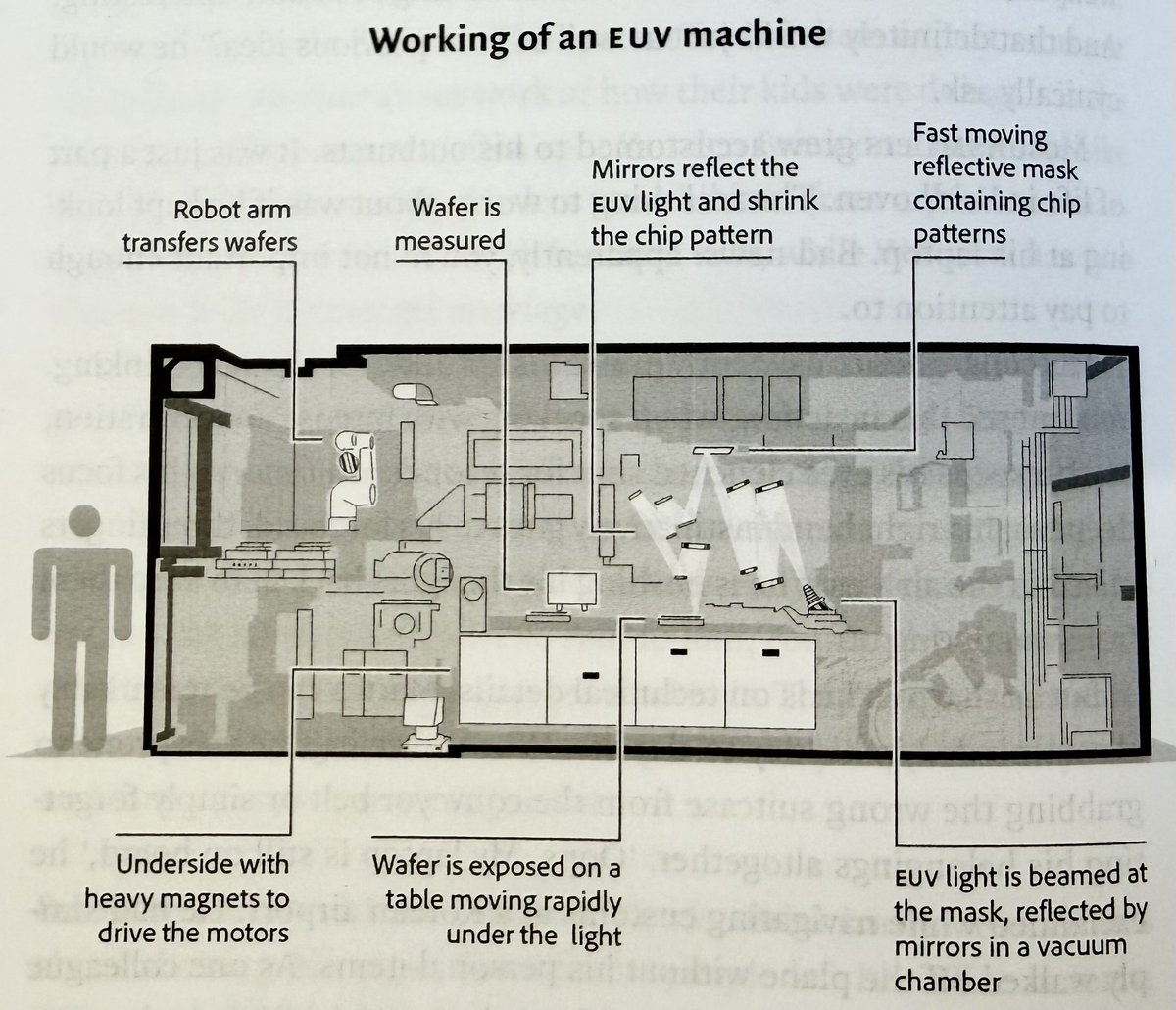
ASML’s “machines were the first in the industry to utilize modular design. The lens, the wafer-table, the frame for the mask, the light source, the robot that picks the wafers: these are LEGO blocks that, when you bring them together, form a lithography system.” (62)
IPO in 1995. Stock went up 600x in the 30 years that followed. March 2000 market crash: “cancellations from chip manufacturers poured in daily. On paper, the company was bankrupt. Radical cost-cutting measures would be needed.” (82)
Nikon sues: “a rude awakening. ASML had paid far too little attention to its intellectual property in its early years.” (98) “The best inventors, some of which have more than 200 patents to their name, are commemorated by having their faces engraved on silicon wafers and hung on a series of large wooden beams, like a Mount Rushmore of the chip industry. As of 2023, ASML has registered more than 16,000 patents.” (99)
The machines are insanely sensitive. “Atmospheric pressure fluctuations due to thunderstorms can easily disrupt the lithography process. Or cows. Intel once faced an inexplicable drop in yield every night for a few hours, with researchers running in circles until they finally realized the cause: cow farts. Intel had to pay for three farms to relocate.” (117)
“In 2006 Intel, who was supplying the chips for Apple’s computers, was asked if it could also supply the processor for the iPhone. It declined.” (122)
“EUV light is extremely difficult to generate and sustain in an industrial environment. The invisible rays are absorbed by almost all materials, even the air, which means the lithography machine needs to have (curved, atomically precise) mirrors instead of lenses and can only operate in a vacuum.” (127)
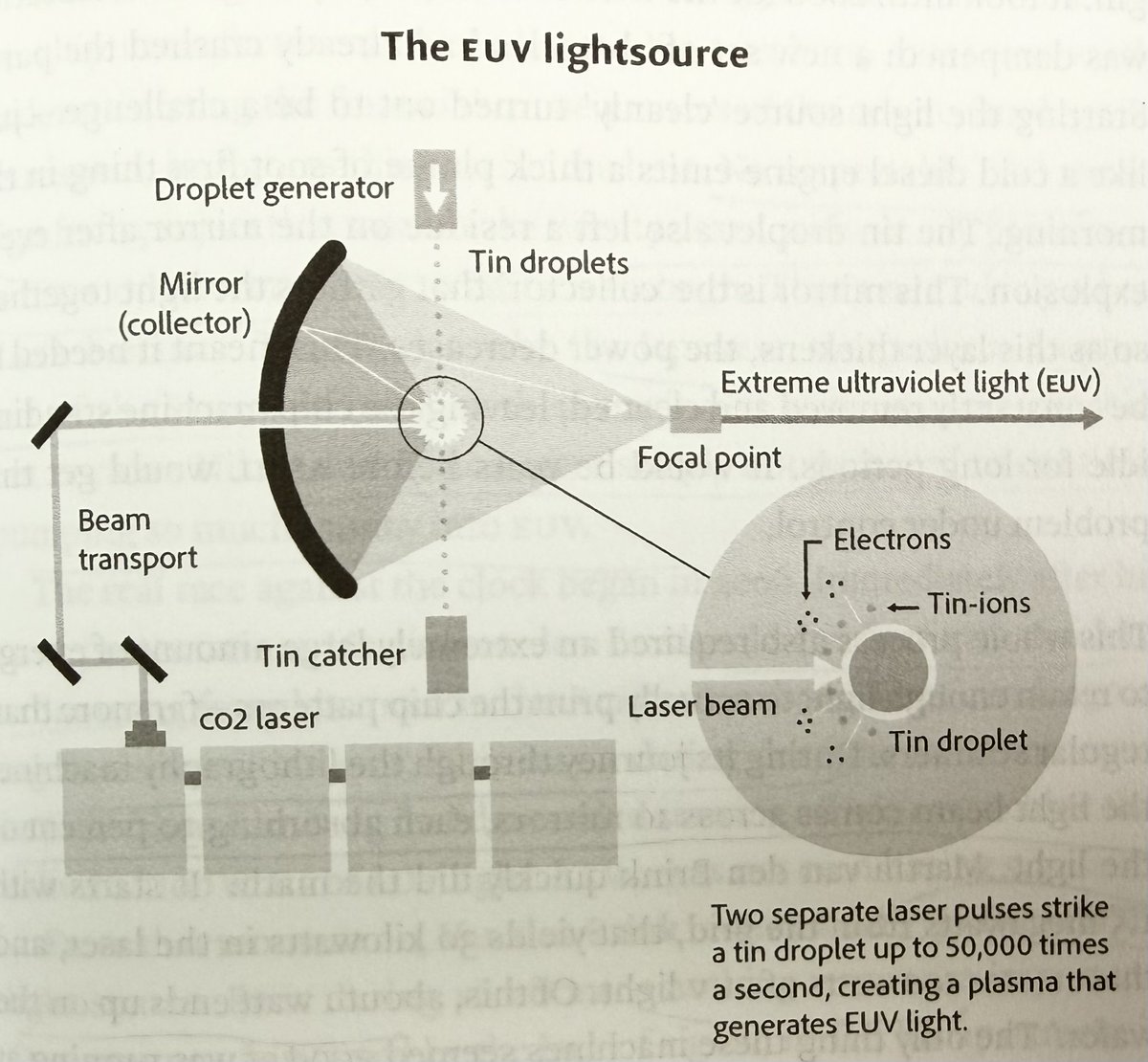
The Cymer laser / light source has a molten tin “droplet generator capable of forming a 30-micron droplet of tin at a rate of 50,000 times per second. The laser was rigged to deal two separate blows. First, a gentle tap to flatten the droplet into a pancake-like shape, followed by an intense blast that heated the tin to 200,000 degrees, transforming it into a plasma.” (130)
“During its journey through the lithography machine, the light beam comes across 10 mirrors, each absorbing 30% of the light. It starts with 1.5 megawatts from the grid that yields 30 kilowatts in the laser, and that creates 100 watts of EUV light. Of this, about 1 watt ends up on the wafer. But more power also creates more heat. That causes the mirrors to expand, which in turn causes small deviations that immediately need to be corrected with small motors. Even the EUV mask, which carries the blueprint of the chip on it, is itself an extremely sensitive mirror.” (132)
“ASML was vastly underestimating the financial consequences of the new technology. In retrospect, this was for the best. No respectable CEO would sign for a project that would take 20 years, without any promise of success or interim profit to carry it through. That’s not taking a bet, that’s bananas. This is also why the Japanese competition dropped out of the race: not because their engineers were any less capable, but because Nikon and Canon were simply not prepared to continue pumping so much money into EUV.” (133)
To finance the purchase of Cymer in 2012, “Intel invested 3.3B Euros into ASML in exchange for 15% of the shares. TSMC was required to purchase 5%... and Samsung acquired a stake at the 11th hour, taking 3%.” (139)
“Only Joann and one of her colleagues have the ability to wind and solder invisibly small wires (around the nozzle that shoots the tin droplets). It’s a delicate task few could ever master. ‘Even watchmakers can’t do this,’ says their awestruck boss, ‘and there’s no way to automate it.’ It’s not a trivial matter: the nozzle regularly gets clogged during day-to-day use in the chip factory. When that inevitably happens, the only thing to do is to swap it out for a new one. It’s hard to imagine, but without the fingers of Joann and her colleague, the EUV machines at Samsung and TSMC would grind to a halt.” (141)
In 2013, “most of the droplet generator was still hand-made by Cymer, and it was virtually impossible to test the part in advance. This made for completely unpredictable yields: in the initial phase of production, half of the droplet generators didn’t even work.” (142)
“20% of the South Korean economy now relies on the revenue of one single company. Hence their nickname: this is the republic of Samsung.” (156)
“Intel was being surpassed by their competitors in Asia on every front and would only start using EUV for chips after 2023.” (160)
“The descriptions that chip manufacturers use for these technological generations or ‘nodes’ need to be taken with a grain of salt. The physical dimensions of the smallest circuits and connections on the chip are, in practice, 5 to 10 times larger than advertised. A nanometer was once a nanometer, but accuracy has never stopped a good marketing slogan.” (161)
Cousins “Lisa Su and Jensen Huang, the leaders of AMD and NVIDIA were both born in Tainan, the city where TSMC now produces their chips.” (164)
“The culture at TSMC is more hierarchical than ASML, but less militaristic than in South Korea.” (166)
“TSMC now commands 60% of the entire foundry market, making it 4x larger than its closest competitor, Samsung.” (167)
“ASML’s next generation of EUV machines goes by the nickname High NA (the numerical aperture increases from 0.35 to 0.55). These colossal scanners span 14 meters and feature large mirrors up to a meter wide. The optical system by itself consists of 20,000 parts and weighs 12 tons, making it 7x heavier than the optics for the current EUV machine.” (175)
“The High NA system weighs 150 tons and costs 400M Euros. It takes 7 cargo planes to ship this system to customers.” (225)
“The production of a complex EUV mask costs more than a half million Euros and takes a huge amount of time to calculate.” (181) They “use AI to understand the interplay between the light beam, the mask, and the chemical reactions on the wafer.” ASML’s CTO calls it “voodoo software.” (183)
China: “European governments fear China is transforming into a totalitarian state, capable of forcing Chinese multinationals to spy for the Communist Party. And that poses significant risk to the 5G cellular infrastructure of the West.” (200)
“In 2017, Chinese customers ordered 700M Euros worth of lithography machines, a new record. Hundreds of ASML’s scanners were running in the factories of SMIC, China’s largest foundry” (201)
“EUV is controlled by the Wassenaar Arrangement, the multilateral export control regime on conventional arms and dual-use goods and technologies.” (203)
“As far as ASML is concerned, fears about EUV being used for military applications are baloney. Most chips found in weapons are ‘off-the-shelf’ chips that can also be found in laptops, washing machines or cars, and are easy to purchase anywhere in the world. But the U.S. sees things differently. They fear the emergence of Chinese AI and cyber weapons. And there is one thing those all need: advanced chips.” (205)
“In January 2020, the U.S. asked the Netherlands to block EUV exports, and suddenly ASML found itself in the spotlight. The Netherlands ultimately denied ASML a license… No EUV machine was going to SMIC.” (208)
In 2023 “ASML was exporting far more older DUV machines to China than had been expected. Almost half of ASML’s revenue was coming from China. As the chip industry was pushing the pause button, China kept on hoarding. The U.S. pressed the Netherlands to slam the brakes before January 2024, and the cabinet duly revoked several approved export licenses for ASML machines destined for China.” (234)
“As China is growing increasingly isolated, so too is the liklihood of a fully-fledged Chinese competitor emerging in the rearview mirror capable of developing an independent chip production chain.” (236) “ASML takes this seriously. Their go-to response: ‘The laws of nature are the same anywhere.’ What was achieved in Brabant, could be achieved in Beijing.” (335)
“To qualify for government aid (in Biden’s Chips Act), companies had to agree not to build advanced chip foundries in China or other ‘countries of concern.’” (239)
“The chip shortage had been a wakeup call, and the nightmare scenario was front and center on everyone’s mind: if China blocks Taiwan, we’ll be without chips within two weeks.” (242)
“The estimated percentage of people with autism or ADHD at ASML far outnumbers the average. The highly specialized work, revolving around focusing on complex problems that require prolonged attention to the smallest details, makes it well-suited for some autistic traits. ASML’s CTO and President Van den Brink makes no secret about being dyslexic and actively advocates for targeting this neurodiverse group. They are precisely the analytical and creative thinkers ASML needs, but also often the ones who find it difficult to put themselves in other people’s shoes.” (287)
Sounds like teen spirit… of Steve Jobs: “Van den Brink’s power of persuasion lies in his childlike enthusiasm. It works like some kind of reality distortion field. Martin can disrupt your perspective until you’re convinced that you can make the impossible possible.” (321)
“Van den Brink never really led a big company. He guided it like a startup, as if it were a defiant toddler in the body of a mature multinational.” (329)
The book ends with the poignant handover of the company in 2024 to a new leader, the Frenchman Chistophe Fouquet.

English
@FutureJurvetson @SpaceX Dec 6th "AI Warehouses in Space"
youtube.com/watch?v=AovK4R…
#AI #ArtificialIntelligence #CarbonFreeEnergy #climatesolutions #climatechange #climatesolutions #electricgrid #energytransition #greeninvesting #gridmodernization #infrastructure #innovation #sustainability

YouTube
English
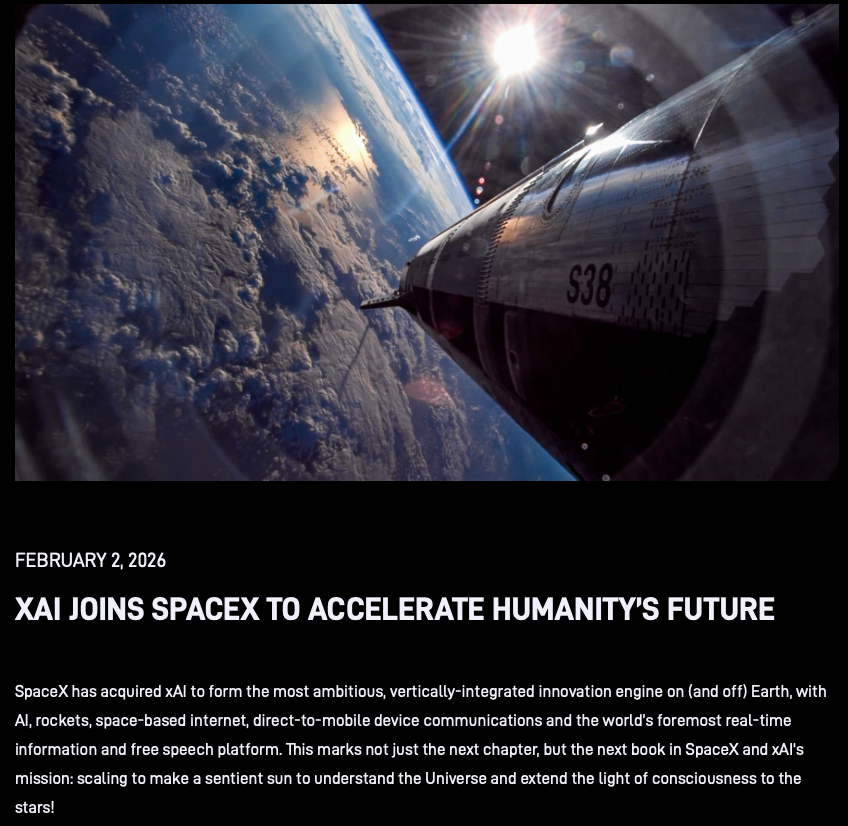
SpaceX has acquired xAI
Elon's letter: "The basic math is that launching a million tons per year of satellites generating 100 kW of compute power per ton would add 100 gigawatts of AI compute capacity annually, with no ongoing operational or maintenance needs. Ultimately, there is a path to launching 1 TW/year from Earth."
For context, the entire U.S. currently generates 1.3 TW.
"My estimate is that within 2 to 3 years, the lowest cost way to generate AI compute will be in space.
Factories on the Moon can take advantage of lunar resources to manufacture satellites and deploy them further into space. By using an electromagnetic mass driver and lunar manufacturing, it is possible to put 500 to 1000 TW/year of AI satellites into deep space, meaningfully ascend the Kardashev scale and harness a non-trivial percentage of the Sun’s power.
The capabilities we unlock by making space-based data centers a reality will fund and enable self-growing bases on the Moon, an entire civilization on Mars and ultimately expansion to the Universe.
Thank you for everything you have done and will do for the light cone of consciousness."
— @ElonMusk letter: #xai-joins-spacex" target="_blank" rel="nofollow noopener">spacex.com/updates#xai-jo…
English
Kelly Murphy retweetledi

This is sci-fi-level significant.
We’re watching AIs interact with each other in a forum like humans.
This project was already pushing at AGI by generalizing what tasks AI can do, and now it’s poking a stick at a path to sentience (shared experience reflections) as well.
Peter Steinberger 🦞@steipete
moltbook.com is art.
English
Kelly Murphy retweetledi

Dictators always lie about what they’ve done, but are often quite plain about what they want to do. It’s the appeasers in the West who keep dismissing their threats—until they act on them. When a terrorist or dictator says he wants to destroy you, listen.
Halifax The Forum@HFXforum
“We have to believe dictators. When you look at their list of promises, they keep delivering on them.” - @Kasparov63 #HFX2023
English
What an actual Russian/Soviet nationalist thinks about Russia's war on Ukraine. A disaster for Russia and a failure in every military aspect. Of course Putin doesn’t care about national interests at all, and continues the war for the same reason he started it, to cling to power.
Sander@SanderRegter
1/ GENERAL LEONID IVASHOV STRONGLY CRITICIZES THE RUSSIAN LEADERSHIP The well-known Russian general, General Leonid Ivashov, has sharply criticized the Russian leadership and assessed the 1,400 days of the “special military operation” as follows:
English
@TKavulla I'll have to go with Confiteor Deo ("in thought, word, and (in)deed") due to $$ on our leasing our 2025 Ionic 5.
English
1. I have a confession to make, which is that I have (lawfully!) received many incentives available to me as a Maryland ratepayer & this has been a wealth transfer from other ratepayers to me. Join me as I make an Act of Ratemaking Contrition 🧵
English