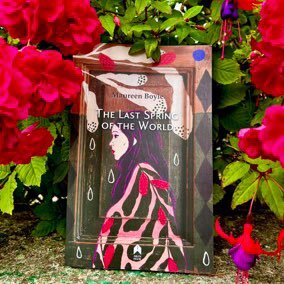
Poetry: 'The Last Spring of the World’, 2022; ‘Strabane', 2020; ‘The Work of a Winter’ , 2018 Arlen House. Writer & mentor IWC Dublin. Book pic @baabennett
A Norwegian neuroscientist spent 20 years proving that the act of writing by hand changes the human brain in ways typing physically cannot, and almost nobody outside her field has read the paper.
Her name is Audrey van der Meer.
She runs a brain research lab in Trondheim, and the paper that closed the argument was published in 2024 in a journal called Frontiers in Psychology. The finding is brutal enough that it should have changed every classroom on Earth.
The experiment was simple. She recruited 36 university students and put each one in a cap with 256 sensors pressed against their scalp to record brain activity. Words flashed on a screen one at a time.
Sometimes the students wrote the word by hand on a touchscreen using a digital pen, and sometimes they typed the same word on a keyboard. Every neural response was recorded for the full five seconds the word stayed on screen.
Then her team looked at the part of the data most researchers had ignored for years, which is how different parts of the brain were communicating with each other during the task.
When the students wrote by hand, the brain lit up everywhere at once.
The regions responsible for memory, sensory integration, and the encoding of new information were all firing together in a coordinated pattern that spread across the entire cortex. The whole network was awake and connected.
When the same students typed the same word, that pattern collapsed almost completely.
Most of the brain went quiet, and the connections between regions that had been alive seconds earlier were nowhere to be found on the EEG.
Same word, same brain, same person, and two completely different neurological events.
The reason turned out to be something nobody had really paid attention to before her work. Writing by hand is not one motion but a sequence of thousands of tiny micro-movements coordinated with your eyes in real time, where each letter is a different shape that requires the brain to solve a slightly different spatial problem.
Your fingers, wrist, vision, and the parts of your brain that track position in space are all working together to produce one letter, then the next, then the next.
Typing throws all of that away. Every key on a keyboard requires the exact same finger motion regardless of which letter you are pressing, which means the brain has almost nothing to integrate and almost no problem to solve.
Van der Meer said it plainly in her interviews.
Pressing the same key with the same finger over and over does not stimulate the brain in any meaningful way, and she pointed out something that should scare every parent who handed their kid an iPad.
Children who learn to read and write on tablets often cannot tell letters like b and d apart, because they have never physically felt with their bodies what it takes to actually produce those letters on a page.
A decade before her, two researchers at Princeton ran the same fight using a completely different method and ended up at the same answer. Pam Mueller and Daniel Oppenheimer tested 327 students across three experiments, where half took notes on laptops with the internet disabled and half took notes by hand, before testing everyone on what they actually understood from the lectures they had watched.
The handwriting group won by a wide margin on every question that required real understanding rather than surface recall.
The reason was hiding in the transcripts of what the two groups had actually written down.
The laptop students typed almost word for word, capturing more total content but processing almost none of it as they went, while the handwriting students physically could not write fast enough to transcribe a lecture in real time, which forced them to listen carefully, decide what actually mattered, and put it in their own words on the page.
That single act of choosing what to keep was the learning itself, and the keyboard had quietly skipped the choosing and skipped the learning along with it.
Two studies. Two countries. Same answer.
Handwriting makes the brain work. Typing lets it coast.
Every note you have ever typed instead of written went into your brain through a thinner pipe. Every meeting, every book highlight, every idea you captured on your phone instead of on paper was processed at half depth.
You did not forget those things because your memory is bad. You forgot them because typing never woke the part of the brain that would have made them stick.
The fix is the thing your grandmother already knew.
Pick up a pen. Write the thing down. The slower road is the faster one.
Britain has lost around half its hedgerows since the Second World War. The wildlife that depended on them has followed a similar trajectory. 🌿
The old field boundary — a strip of blackthorn, hawthorn, dog rose, and elder two to five metres wide between cultivated ground — was not wasted agricultural space. It was a functioning ecological system that maintained pollinators, pest predators, and farmland birds across centuries of working land.
Each hedgerow is a nesting corridor for grey partridge and skylark, a foraging habitat for brown hares and hedgehogs, a site for solitary bee colonies, and a windbreak for the crops alongside it.
The field cultivated to its very edge gives the maximum return this season. It removes the populations of beneficial insects, farmland birds, and small mammals on which stable long-term production depended.
The field with a hedgerow yields a few percent less per cultivated hectare — but remains productive across decades without compensatory chemical inputs. The documented declines in grey partridge, lapwing, and skylark across the British agricultural landscape since the 1970s are directly linked to field consolidation and hedgerow removal.
Practical equivalents for the garden or smallholding:
- A strip of wildflower meadow at least one metre wide at the plot boundary
- A clump of nettles in a shaded corner as a habitat base for red admiral, small tortoiseshell, and peacock butterflies
- A native mixed hedge of blackthorn and hawthorn in place of post-and-wire fencing
- A section of uncut grass between rows of fruit trees
#HedgerowHabitat#FarmlandWildlife#NativeHedge#GardenWildlife
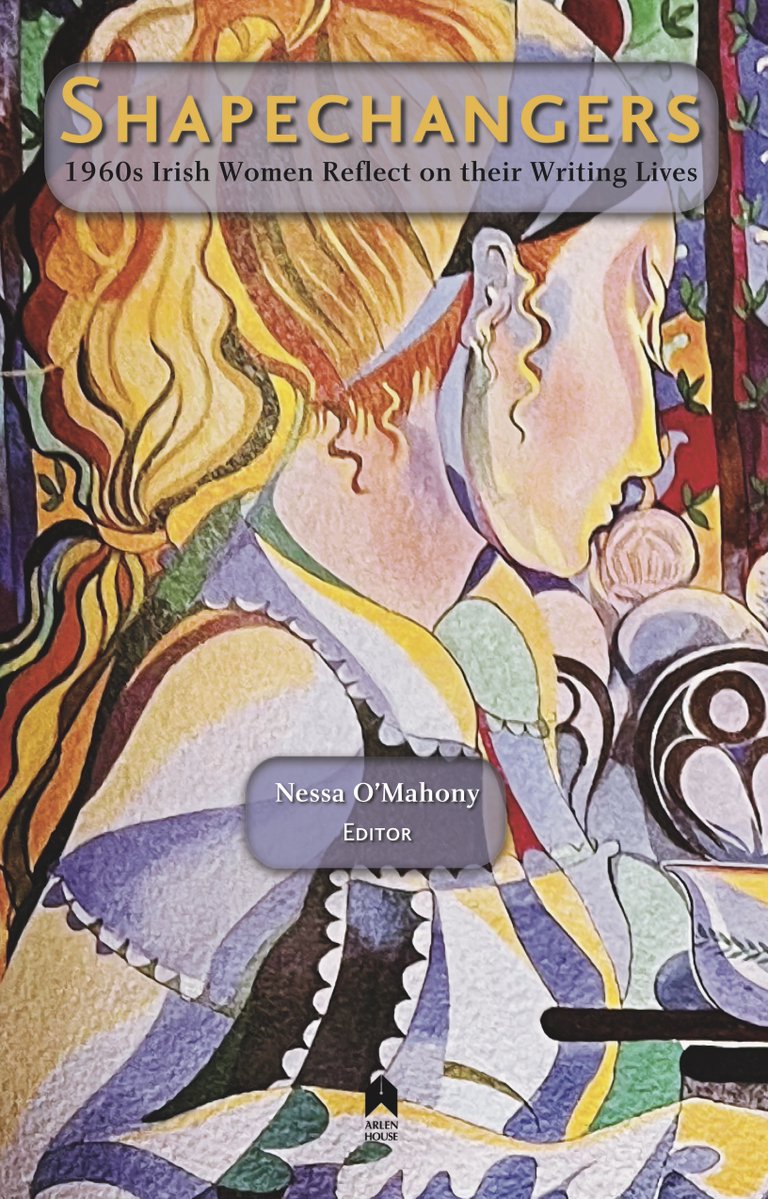
Arlen House is delighted to announce the forthcoming
*Shapechangers: 1960s Women Reflect on their Writing Lives* edited by Nessa O'Mahony
PRE-ORDER: booksupstairs.ie/product/shapec…
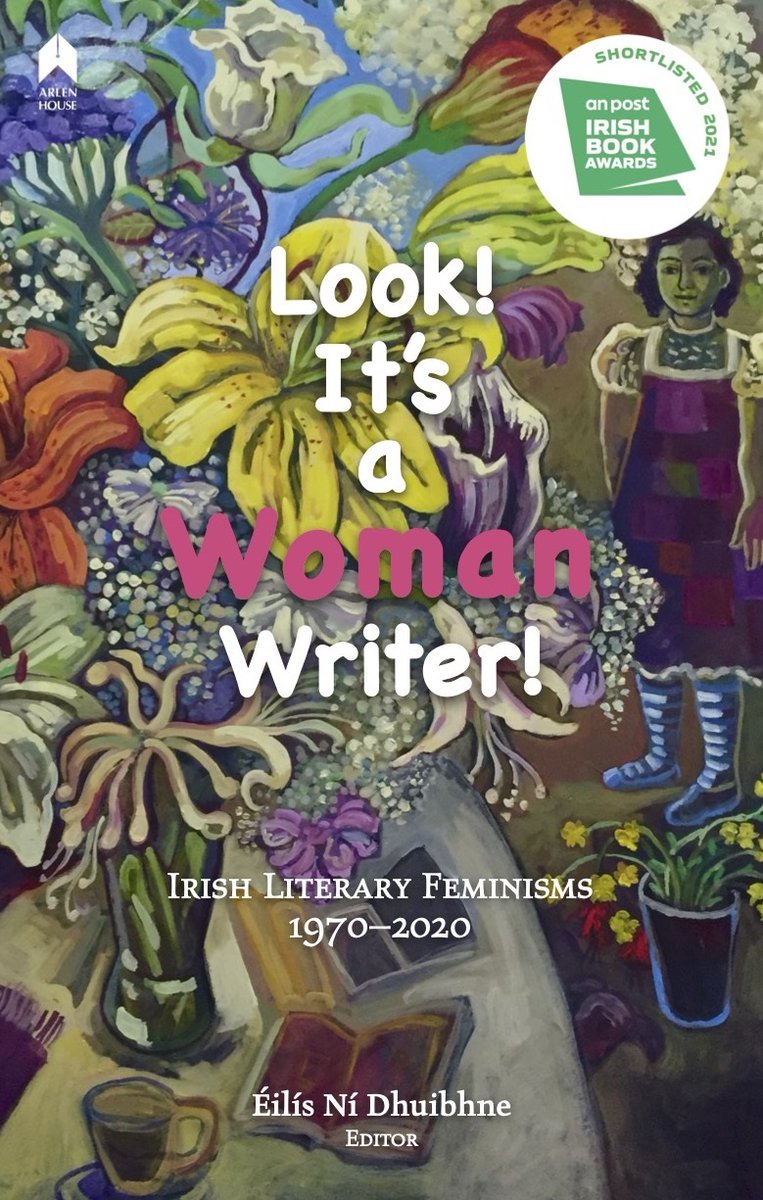
The 1st sequel to the bestseller
*Look! It's a Woman Writer!*
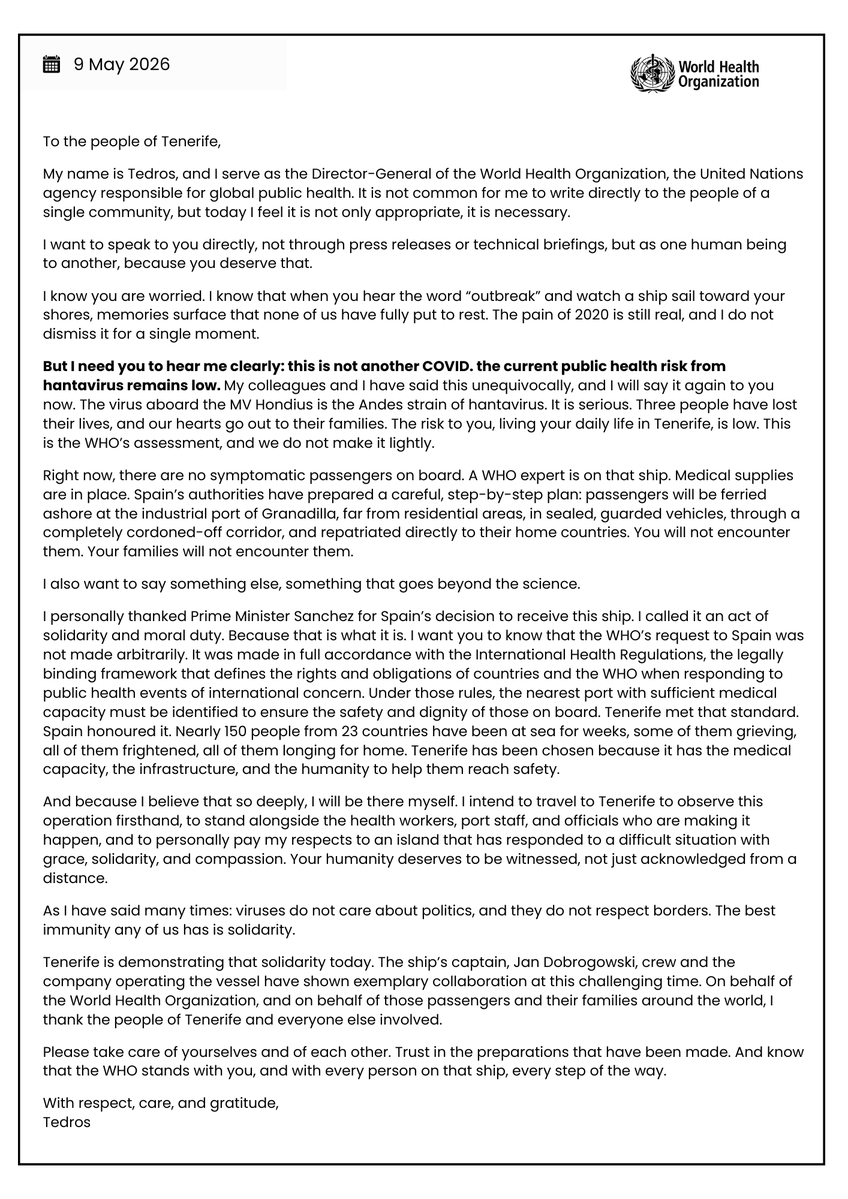
To the people of Tenerife,
My name is Tedros, and I serve as the Director-General of the @WHO, the @UN agency responsible for global public health. It is not common for me to write directly to the people of a single community, but today I feel it is not only appropriate, it is necessary.
I want to speak to you directly, not through press releases or technical briefings, but as one human being to another, because you deserve that.
I know you are worried. I know that when you hear the word “outbreak” and watch a ship sail toward your shores, memories surface that none of us have fully put to rest. The pain of 2020 is still real, and I do not dismiss it for a single moment.
But I need you to hear me clearly: this is not another COVID-19. the current public health risk from #hantavirus remains low. My colleagues and I have said this unequivocally, and I will say it again to you now.
The virus aboard the MV Hondius is the Andes strain of hantavirus. It is serious. Three people have lost their lives, and our hearts go out to their families. The risk to you, living your daily life in Tenerife, is low. This is the WHO’s assessment, and we do not make it lightly.
Right now, there are no symptomatic passengers on board. A WHO expert is on that ship. Medical supplies are in place. Spain’s authorities have prepared a careful, step-by-step plan: passengers will be ferried ashore at the industrial port of Granadilla, far from residential areas, in sealed, guarded vehicles, through a completely cordoned-off corridor, and repatriated directly to their home countries. You will not encounter them. Your families will not encounter them.
I also want to say something else, something that goes beyond the science.
I personally thanked Prime Minister @sanchezcastejon for #Spain’s decision to receive this ship. I called it an act of solidarity and moral duty. Because that is what it is. I want you to know that the WHO’s request to Spain was not made arbitrarily. It was made in full accordance with the International Health Regulations, the legally binding framework that defines the rights and obligations of countries and the WHO when responding to public health events of international concern. Under those rules, the nearest port with sufficient medical capacity must be identified to ensure the safety and dignity of those on board. Tenerife met that standard. Spain honoured it. Nearly 150 people from 23 countries have been at sea for weeks, some of them grieving, all of them frightened, all of them longing for home. Tenerife has been chosen because it has the medical capacity, the infrastructure, and the humanity to help them reach safety.
And because I believe that so deeply, I will be there myself. I intend to travel to Tenerife to observe this operation firsthand, to stand alongside the health workers, port staff, and officials who are making it happen, and to personally pay my respects to an island that has responded to a difficult situation with grace, solidarity, and compassion. Your humanity deserves to be witnessed, not just acknowledged from a distance.
As I have said many times: viruses do not care about politics, and they do not respect borders. The best immunity any of us has is solidarity.
Tenerife is demonstrating that solidarity today. The ship’s captain, Jan Dobrogowski, crew and the company operating the vessel have shown exemplary collaboration at this challenging time. On behalf of the World Health Organization, and on behalf of those passengers and their families around the world, I thank the people of Tenerife and everyone else involved.
Please take care of yourselves and of each other. Trust in the preparations that have been made. And know that the WHO stands with you, and with every person on that ship, every step of the way.
With respect, care, and gratitude,
Tedros