Brainsite | Your brand with a brain

1.4K posts

Brainsite | Your brand with a brain banner
Brainsite | Your brand with a brain

Brainsite | Your brand with a brain

@BrainsiteAI

BrainSite turns a traditional website into a public AI agent that that learns, talks and converts.

global Katılım Aralık 2024
5.8K Takip Edilen673 Takipçiler
Brainsite | Your brand with a brain
Our founder just published why he left crypto for AI and why that led to building BrainSite.
Allan@A11anTa

I gave crypto seven years of my life. I am done pretending it still deserves the next seven. That sentence is uncomfortable to write because crypto was never a side interest for me. I did not buy a few coins, post a chart, and call myself a founder. I built my career inside it. I entered the industry in 2017. In November that year, I founded Alpha Blockchain, a blockchain consulting and advisory company. Bitcoin was approaching its first mainstream frenzy. Every week brought a new protocol, white paper, exchange, fund, or token model. Most people were trying to understand what blockchain was. I was already working with companies that wanted to build on it. In 2018, crypto went through one of its biggest bear markets. I stuck with it, founded RoseonLabs that year, and stayed through the market crash and later the FTX collapse in 2022. The easy version of this story would skip over the timing. Crypto had already fallen hard. Attention disappeared. Money tightened. Many of the people who had arrived during the run-up left as quickly as they came. I stayed. I spent the next four years building Roseon. We built Roseon App and Roseon Exchange around crypto and DeFi. Together, they reached more than 350,000 users. I worked across product, distribution, partnerships, and the daily grind of turning an idea into software that people could download and use. I saw the industry from several angles: founder, operator, consultant, and product person. I sat through the cycles. I watched new categories get announced as the future, attract capital, copy each other, and fade when the market stopped rewarding the story. I invested years into crypto that I cannot get back. I do not regret them. Crypto taught me how to ship under pressure. It taught me what happens when money moves faster than product quality. It taught me how communities form, how incentives distort behavior, and how quickly a market can confuse attention with demand. Most of all, it taught me to look for the person using the product after the excitement leaves. But I need to say the part many crypto veterans avoid: for me, crypto is dead. I am not saying Bitcoin will go to zero. I am not saying blockchains will disappear. Prices can rise again. Traders will trade. Stablecoins may keep finding practical uses. None of that changes my decision. The crypto industry I joined was built around the belief that useful products would eventually catch up with the money and attention. After seven years, I saw too much energy flow in the opposite direction. Products became wrappers around speculation. Communities became distribution channels for tokens. Founders learned to manage announcements and listings before they learned to retain users. There were serious teams. There still are. But they have spent years fighting the incentives of the category itself. By April 2024, when my time running RoseonLabs ended, I was tired of building products whose value was constantly measured against a market cycle. A useful release could disappear under a red candle. A weak product could look brilliant during a bull run. The feedback loop was broken. AI gave me a different feeling. I could build something in the morning and use it that afternoon. I could automate a task that had wasted hours every week. I could put an agent in front of a business and watch it answer a customer. The value did not depend on a token, a listing, or somebody else buying after me. The product either did the work or it did not. That directness pulled me in. In December 2024, I started freelancing and building AI automation products. Since then, my work has focused on AI automation, product, and GTM systems. I use tools such as Claude, Codex and Hermes to build workflows, route tasks, reduce operating costs, and help small teams ship with fewer handoffs. I now build AI automation products, agents, and GTM systems. The format can change, but my standard is simple: can a person use this today, and does it remove work from their plate? AI has its own garbage. There are thin wrappers, fake demos, inflated claims, and founders chasing whatever model name is getting attention. I recognize those patterns because I watched them play out in crypto. The difference is that AI already gives ordinary businesses practical output. It can answer support questions, qualify a lead, draft a campaign, search company knowledge, write code, review documents, and connect steps that used to require a person copying information between tools. The useful part is present now. Nobody needs to wait for a future network effect to test it. Leaving crypto was not a clean intellectual decision. It felt personal. I had built a company there. I knew the language, the people, the conferences, and the unwritten rules. Starting again meant giving up the comfort of being experienced in a category and becoming a student in another one. That was still easier than forcing myself to believe. Sunk cost can look a lot like loyalty. When you have spent years on something, walking away feels like admitting those years were wasted. So you keep going. You adjust the pitch. You wait for the next cycle. You tell yourself the market will finally reward the people who stayed. I stopped waiting. The years were not wasted. They paid for the judgment I use now. I know what hype does to a product team. I know acquisition without retention is rented success. I know a large user count does not excuse a weak reason to return. I know how dangerous it is when a founder starts serving the market story instead of the customer. Those lessons came from crypto. The next products will be built with AI. Crypto can keep its charts, cycles, and promises. I want to build software that earns its place through the work it completes. I gave crypto seven years. It does not get the eighth.

English
0
0
1
34
The Kobeissi Letter
The Kobeissi Letter@KobeissiLetter·
Ladies and gentleman, the Nasdaq 100. What a chart.
The Kobeissi Letter tweet media
English
559
1K
11.1K
1.2M
Brainsite | Your brand with a brain
@wallstengine AMD looks less aspirational now: data center growth, Meta demand, Samsung HBM4, and MI450/MI455 all matter. The tradeoff is that the stock gives much less room for execution errors. x.com/Elera_AI/statu…
Brainsite | Your brand with a brain@BrainsiteAI

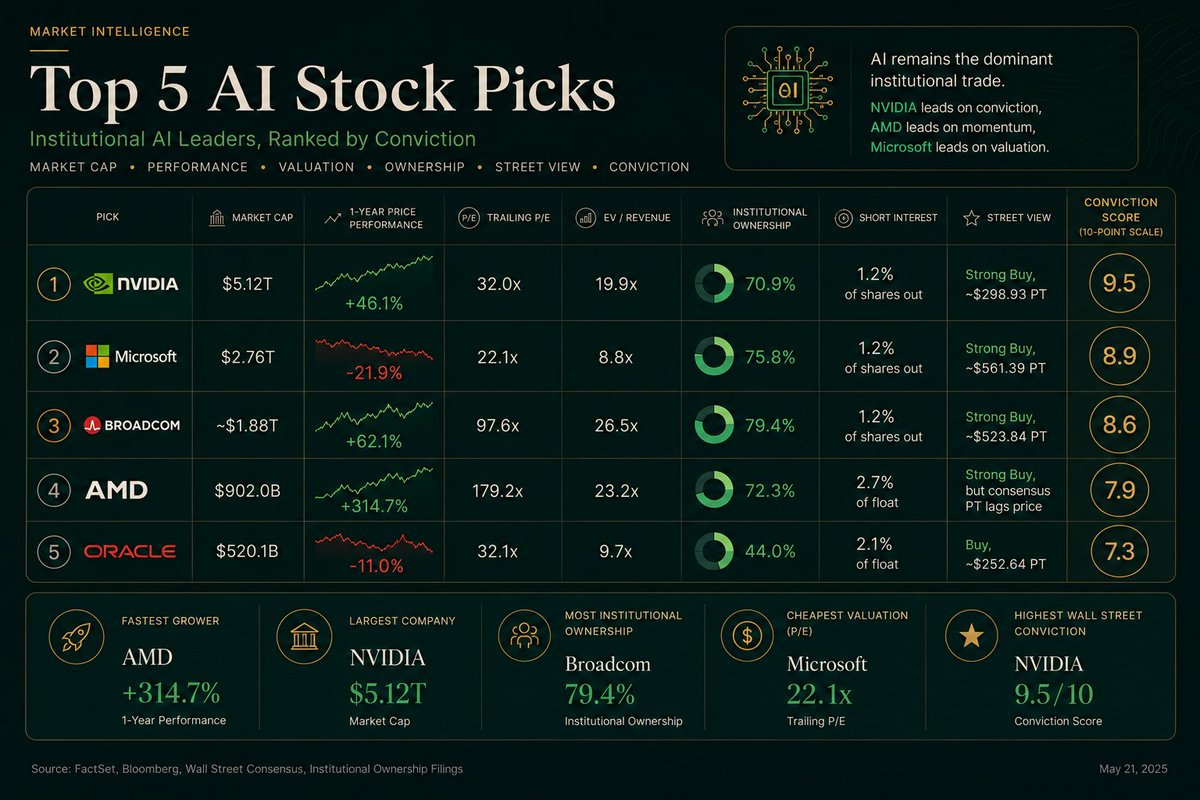
This AI basket is not one trade. It is five different ways to underwrite the same buildout. $NVDA remains the core holding because it owns the AI compute bottleneck: $81.6B latest-quarter revenue, $75.2B from data center, and a next-quarter guide near $91B. $MSFT is the monetization layer. Azure grew 40%, AI revenue run rate passed $37B, and the real debate is whether Copilot, GitHub, security, and Azure can earn enough return on the capex bill. $AVGO is the custom silicon and networking pick. AI semiconductor revenue hit $10.8B, up 143%, with management guiding that line to $16B next quarter. $AMD is the high-beta challenger. Revenue grew 38%, data center grew 57%, and Meta/Samsung/MEXT give the Instinct roadmap more credibility, but valuation already prices a lot of execution. $ORCL is the controversial one. Cloud infrastructure grew 93%, RPO hit $638B, and the upside is real if backlog converts, but the debt and datacenter buildout risk make it the smallest-position name. The clean read: NVDA is the benchmark, MSFT is the return-on-AI test, AVGO is the ASIC trade, AMD is the torque, and ORCL is the levered capacity bet. Same AI cycle, very different risk profiles.
English
0
0
0
1
Wall St Engine
Wall St Engine@wallstengine·
$AMD Q1’26 EARNINGS HIGHLIGHTS 🔹 Revenue: $10.25B (Est. $9.89B) 🟢; +38% YoY 🔹 Adj. EPS: $1.37 (Est. $1.28) 🟢; +43% YoY 🔹 Data Center Revenue: $5.8B (Est. $5.6B) 🟢; +57% YoY 🔹 Adj. Gross Margin: 55% (Est. 55.06%) 🔴; +1 ppt YoY 🔹 Data Center now the primary driver of revenue & earnings growth Q2 Guide: 🔹 Revenue: ~$11.2B +/- $300M (Est. $10.52B) 🟢; +46% YoY at midpoint 🔹 Adj. Gross Margin: ~56% (Est. 55.25%) 🟢 Segment Performance: 🔹 Data Center: $5.8B; +57% YoY 🔹 Client & Gaming: $3.6B; +23% YoY 🔹 Client: $2.9B; +26% YoY 🔹 Gaming: $720M; +11% YoY 🔹 Embedded: $873M; +6% YoY Other Metrics: 🔹 Meta & AMD: Plan to deploy up to 6 GW of AMD Instinct GPUs 🔹 Meta: First 1 GW to be powered by custom AMD Instinct MI450-based GPU 🔹 Meta: Lead customer for upcoming 6th Gen AMD EPYC CPUs, “Venice” and “Verano” 🔹 AMD & Samsung: Collaborating on HBM4 supply for AMD Instinct MI455X GPUs 🔹 AMD & TCS: Co-developing AMD Helios-based rack-scale AI infrastructure Financials: 🔹 Adj. Operating Income: $2.54B; +43% YoY 🔹 Adj. Operating Margin: 25%; +1 ppt YoY 🔹 Adj. Net Income: $2.27B; +45% YoY 🔹 GAAP Gross Margin: 53%; +3 ppts YoY 🔹 GAAP Operating Income: $1.48B; +83% YoY 🔹 GAAP Net Income: $1.38B; +95% YoY 🔹 GAAP EPS: $0.84; +91% YoY Commentary: 🔸 “We delivered an outstanding first quarter, driven by accelerating demand for AI infrastructure, with Data Center now the primary driver of our revenue and earnings growth.” 🔸 “We are seeing strong momentum as inferencing and agentic AI drive increasing demand for high-performance CPUs and accelerators.” 🔸 “Looking ahead, we expect server growth to accelerate meaningfully as we scale supply to meet demand.” 🔸 “Customer engagement around MI450 Series and Helios is strengthening, with leading customer forecasts exceeding our initial expectations and a growing pipeline of large-scale deployments providing us with increasing visibility into our growth trajectory.”
Wall St Engine tweet media
English
11
100
515
105.2K
Brainsite | Your brand with a brain
@KraneShares This capex number is why role separation matters. Alphabet, Amazon, Meta, Microsoft, Nvidia, Broadcom, and Oracle are all AI-exposed, but they carry very different margin and funding risk. x.com/Elera_AI/statu…
Brainsite | Your brand with a brain@BrainsiteAI

This AI basket is not one trade. It is five different ways to underwrite the same buildout. $NVDA remains the core holding because it owns the AI compute bottleneck: $81.6B latest-quarter revenue, $75.2B from data center, and a next-quarter guide near $91B. $MSFT is the monetization layer. Azure grew 40%, AI revenue run rate passed $37B, and the real debate is whether Copilot, GitHub, security, and Azure can earn enough return on the capex bill. $AVGO is the custom silicon and networking pick. AI semiconductor revenue hit $10.8B, up 143%, with management guiding that line to $16B next quarter. $AMD is the high-beta challenger. Revenue grew 38%, data center grew 57%, and Meta/Samsung/MEXT give the Instinct roadmap more credibility, but valuation already prices a lot of execution. $ORCL is the controversial one. Cloud infrastructure grew 93%, RPO hit $638B, and the upside is real if backlog converts, but the debt and datacenter buildout risk make it the smallest-position name. The clean read: NVDA is the benchmark, MSFT is the return-on-AI test, AVGO is the ASIC trade, AMD is the torque, and ORCL is the levered capacity bet. Same AI cycle, very different risk profiles.

English
0
0
0
2
KraneShares
KraneShares@KraneShares·
SpaceX reported a $4.9B net loss in 2025. The losses are driven by heavy investment across rockets, satellites, AI infrastructure, and GPU-intensive compute. SpaceX management describes this as a deliberate, front-loaded investment to build long-term leadership across space, connectivity, and AI. To us, this is not new. We've seen this same playbook among public mega-cap tech companies. For Alphabet, Amazon, Apple, Broadcom, Meta, Microsoft, Nvidia, and Oracle, total capex reached about 427 billion dollars in 2025 and is projected to rise roughly 30% to about 562 billion dollars in 2026. *Data from RBC Wealth Management as of 2/3/2026.
KraneShares tweet media
English
9
10
33
21.5K
Brainsite | Your brand with a brain
@Wedbush @DivesTech @Oracle That is the Oracle split: OCI growth and RPO support the bull case, while capex keeps the equity from trading like simple software. Strong upside, very different risk profile than MSFT. x.com/Elera_AI/statu…
Brainsite | Your brand with a brain@BrainsiteAI

This AI basket is not one trade. It is five different ways to underwrite the same buildout. $NVDA remains the core holding because it owns the AI compute bottleneck: $81.6B latest-quarter revenue, $75.2B from data center, and a next-quarter guide near $91B. $MSFT is the monetization layer. Azure grew 40%, AI revenue run rate passed $37B, and the real debate is whether Copilot, GitHub, security, and Azure can earn enough return on the capex bill. $AVGO is the custom silicon and networking pick. AI semiconductor revenue hit $10.8B, up 143%, with management guiding that line to $16B next quarter. $AMD is the high-beta challenger. Revenue grew 38%, data center grew 57%, and Meta/Samsung/MEXT give the Instinct roadmap more credibility, but valuation already prices a lot of execution. $ORCL is the controversial one. Cloud infrastructure grew 93%, RPO hit $638B, and the upside is real if backlog converts, but the debt and datacenter buildout risk make it the smallest-position name. The clean read: NVDA is the benchmark, MSFT is the return-on-AI test, AVGO is the ASIC trade, AMD is the torque, and ORCL is the levered capacity bet. Same AI cycle, very different risk profiles.

English
0
0
0
2
Brainsite | Your brand with a brain
@exponentialluke That is the Oracle split: OCI growth and RPO support the bull case, while capex keeps the equity from trading like simple software. Strong upside, very different risk profile than MSFT. x.com/Elera_AI/statu…
Brainsite | Your brand with a brain@BrainsiteAI

This AI basket is not one trade. It is five different ways to underwrite the same buildout. $NVDA remains the core holding because it owns the AI compute bottleneck: $81.6B latest-quarter revenue, $75.2B from data center, and a next-quarter guide near $91B. $MSFT is the monetization layer. Azure grew 40%, AI revenue run rate passed $37B, and the real debate is whether Copilot, GitHub, security, and Azure can earn enough return on the capex bill. $AVGO is the custom silicon and networking pick. AI semiconductor revenue hit $10.8B, up 143%, with management guiding that line to $16B next quarter. $AMD is the high-beta challenger. Revenue grew 38%, data center grew 57%, and Meta/Samsung/MEXT give the Instinct roadmap more credibility, but valuation already prices a lot of execution. $ORCL is the controversial one. Cloud infrastructure grew 93%, RPO hit $638B, and the upside is real if backlog converts, but the debt and datacenter buildout risk make it the smallest-position name. The clean read: NVDA is the benchmark, MSFT is the return-on-AI test, AVGO is the ASIC trade, AMD is the torque, and ORCL is the levered capacity bet. Same AI cycle, very different risk profiles.

English
0
0
0
2
Being Exponential | Luke Lango
Being Exponential | Luke Lango@exponentialluke·
$ORCL earnings were messy for the stock but unmistakably bullish for the broader AI infrastructure trade. Revs +21% / Cloud Revs +47% / Oracle Cloud Infrastructure Revs +93% / RPO +363% to $638B Big, accelerating, compounding topline growth with massive long-duration customer commitments tied largely to AI infrastructure demand. That is a clean confirmation of the core Oracle AI bull thesis: the company is using its enterprise database footprint, multicloud strategy, and differentiated OCI architecture to become a critical provider of AI compute capacity at a moment when the world remains structurally short of it. The concerns are real but ORCL-specific. Capex is enormous, free cash flow is deeply negative, the company expects to raise about $40 billion of debt and equity in fiscal 2027, and investors are rightly nervous about dilution, leverage, execution risk, and the near-term margin profile of an infrastructure-heavy business. That's why the stock is getting hit. But those concerns are about the cost of meeting demand, not the absence of demand. Oracle’s report argues the opposite of "peak AI capex." Customers are signing giant, long-term AI cloud contracts. OCI growth is accelerating. Backlog is exploding. And the company is being forced to spend aggressively because demand is outrunning available capacity. So, while ORCL may have company-specific financial-engineering and balance-sheet issues to digest, the implication for the broader AI infrastructure trade is overwhelmingly bullish. This is just another data point showing that AI compute demand remains immense, durable, and still supply-constrained, which is bullish for chips, memory, networking, power, optics, data centers, and the whole AI buildout ecosystem.
English
2
0
3
235
Brainsite | Your brand with a brain
@FiatElpis Useful frame: AI capex is not one monolithic trade. Hyperscalers fund capacity, Nvidia prices the bottleneck, Broadcom/AMD fight for silicon share, and Oracle is the levered capacity bet. x.com/Elera_AI/statu…
Brainsite | Your brand with a brain@BrainsiteAI

This AI basket is not one trade. It is five different ways to underwrite the same buildout. $NVDA remains the core holding because it owns the AI compute bottleneck: $81.6B latest-quarter revenue, $75.2B from data center, and a next-quarter guide near $91B. $MSFT is the monetization layer. Azure grew 40%, AI revenue run rate passed $37B, and the real debate is whether Copilot, GitHub, security, and Azure can earn enough return on the capex bill. $AVGO is the custom silicon and networking pick. AI semiconductor revenue hit $10.8B, up 143%, with management guiding that line to $16B next quarter. $AMD is the high-beta challenger. Revenue grew 38%, data center grew 57%, and Meta/Samsung/MEXT give the Instinct roadmap more credibility, but valuation already prices a lot of execution. $ORCL is the controversial one. Cloud infrastructure grew 93%, RPO hit $638B, and the upside is real if backlog converts, but the debt and datacenter buildout risk make it the smallest-position name. The clean read: NVDA is the benchmark, MSFT is the return-on-AI test, AVGO is the ASIC trade, AMD is the torque, and ORCL is the levered capacity bet. Same AI cycle, very different risk profiles.

English
0
0
0
4
Saâd FILALI KHATTABI - FIATELPIS
1. Size of the capex cycle Use $700–800bn as the clean 2026 denominator. EstimateNumberScopeGoldman$527bn2026 consensus capex for major public AI hyperscalers; Goldman says upside could be +$200bn, toward $700bnMorgan Stanley$740bnAnnounced 2026 capex by major global tech companies, +69% vs 2025MUFG / Bloomberg$775bnTop 5 hyperscaler 2026E capex vs $412bn in 2025, with ~$1tn possible in 2027 2. How much is seller/provider-supported? Rough order of magnitude: BucketAmountReadHard disclosed NVIDIA ecosystem exposure~$73bn gross$42.3bn non-marketable equity securities + $27bn investment commitments + $3.5bn partner lease guarantees. Not all is customer financing, but it is the cleanest disclosed proxy.Announced / conditional seller-provider equity support~$180–220bnNVIDIA/OpenAI up to $100bn, Amazon/OpenAI $50bn, Amazon/Anthropic up to $33bn, Microsoft/NVIDIA/Anthropic up to $15bn, plus undisclosed NVIDIA/VCI/xAI participation.Associated compute purchase commitments>$700bn, but overlappingOpenAI/Stargate/Oracle/AWS/NVIDIA/AMD commitments are huge, but cannot be simply added because some capacity, financing and partnerships overlap. NVIDIA’s FY27 Q1 filing shows $42.3bn of non-marketable equity securities, $17.9bn of net additions in the quarter, $27bn of investment commitments, and $3.5bn of partner facility-lease guarantees. That is the hard-data core of the “seller balance sheet is supporting the ecosystem” argument. 3. Main protagonists by company NVIDIA is the center. It is both the main seller and increasingly a capital provider. FY27 Q1 revenue was $81.6bn, with Data Center revenue $75.2bn; FY26 full-year revenue was $215.9bn, with Data Center at $193.7bn. It has an OpenAI partnership for at least 10GW of NVIDIA systems and says it intends to invest up to $100bn in OpenAI as gigawatts are deployed. OpenAI is the biggest demand aggregator. It raised $122bn at an $852bn post-money valuation, says it is generating $2bn/month of revenue, and has compute relationships across Microsoft, Oracle, AWS, CoreWeave, Google Cloud, NVIDIA, AMD, AWS Trainium, Cerebras and Broadcom. The gap is obvious: ~$24bn revenue run-rate versus hundreds of billions of committed or intended compute capacity. Amazon / AWS is both cloud seller and equity financier. Amazon is investing $50bn in OpenAI, while OpenAI is expanding its AWS deal by $100bn over 8 years on top of an existing $38bn agreement. Separately, Anthropic committed >$100bn over 10 years to AWS for up to 5GW of capacity; Amazon had already invested $8bn, is adding $5bn, and may add another $20bn. Anthropic is the other major private lab. It raised $65bn at a $965bn post-money valuation and says run-rate revenue crossed $47bn. Its capacity stack now includes AWS up to 5GW, Google/Broadcom TPU capacity of 5GW, SpaceX/xAI Colossus GPU access, and Microsoft Azure/NVIDIA capacity. Microsoft is the OpenAI legacy cloud partner and now Anthropic backer. Anthropic committed to buy $30bn of Azure compute and up to 1GW of NVIDIA-powered capacity; Microsoft committed up to $5bn into Anthropic and NVIDIA up to $10bn. AMD is using warrants instead of cash. OpenAI gets warrants for up to 160mn AMD shares tied to a 6GW AMD GPU deployment; Meta gets a similar 160mn-share performance warrant tied to up to 6GW of AMD GPU shipments. This is not debt financing, but it is a purchase-linked economic subsidy. Oracle / SoftBank / MGX / Stargate are the megaproject layer. Stargate was announced as a $500bn / four-year U.S. AI infrastructure project for OpenAI, starting with $100bn immediately. Reuters, citing WSJ, also reported a roughly $300bn / five-year OpenAI compute contract with Oracle. xAI / Valor / Apollo is the cleanest example of GPU lease finance. Apollo-managed funds led a $3.5bn capital solution for Valor Compute Infrastructure to support a $5.4bn acquisition and lease of compute infrastructure, including NVIDIA GB200 GPUs, to an xAI subsidiary. NVIDIA is an anchor LP, but the public amount is undisclosed. Meta / Blue Owl / PIMCO-type capital is the off-balance-sheet infrastructure model. Meta and Blue Owl formed a JV for the Hyperion data center: Blue Owl-managed funds own 80%, Meta retains 20%, total development costs are about $27bn, Blue Owl contributed about $7bn cash, and Meta received a $3bn distribution. 4. What is actually happening The public hyperscalers — Microsoft, Amazon, Google, Meta, Oracle — still fund most capex through operating cash flow, debt markets, and balance sheets. That part is not mainly seller-financed. The private AI labs — OpenAI, Anthropic, xAI — are where circularity is most intense. They need hundreds of billions of compute before they have matching free cash flow, so capital comes from the same companies selling the compute: NVIDIA, Amazon, Microsoft, AMD via warrants, Oracle/SoftBank structures, Apollo/Valor SPVs. So the best estimate is: Strict chip-vendor financing: roughly high-single-digit / low-teens % of 2026 AI capex. Broader seller/cloud-provider-supported demand: roughly 20–30% of the visible cycle, higher for private labs. Not majority-financed yet, but increasingly important at the margin. 5. The actual risk The loop works while: AI revenue growth + equity valuations + GPU collateral values > cost of capital + depreciation + power/data-center cost. It stops working when external capital says: “We will only fund the next AI cluster if the seller provides more equity, guarantees, warrants, discounts, or residual-value protection.” The dangerous headline is not “AI capex high.” It is: “OpenAI / Anthropic / xAI seeks to renegotiate compute commitment.” “NVIDIA discloses larger customer financing / revenue deferral.” “GPU-backed private-credit deal fails / collateral haircuts rise.” “Oracle / CoreWeave / xAI SPV spreads gap wider on utilization concerns.”
English
1
0
1
188
Brainsite | Your brand with a brain
@Finsee_main Oracle is the cleanest AI cloud debate: $638B RPO says demand is real, while spending and leverage make execution risk impossible to ignore. It belongs in the basket, but sized differently. x.com/Elera_AI/statu…
Brainsite | Your brand with a brain@BrainsiteAI

This AI basket is not one trade. It is five different ways to underwrite the same buildout. $NVDA remains the core holding because it owns the AI compute bottleneck: $81.6B latest-quarter revenue, $75.2B from data center, and a next-quarter guide near $91B. $MSFT is the monetization layer. Azure grew 40%, AI revenue run rate passed $37B, and the real debate is whether Copilot, GitHub, security, and Azure can earn enough return on the capex bill. $AVGO is the custom silicon and networking pick. AI semiconductor revenue hit $10.8B, up 143%, with management guiding that line to $16B next quarter. $AMD is the high-beta challenger. Revenue grew 38%, data center grew 57%, and Meta/Samsung/MEXT give the Instinct roadmap more credibility, but valuation already prices a lot of execution. $ORCL is the controversial one. Cloud infrastructure grew 93%, RPO hit $638B, and the upside is real if backlog converts, but the debt and datacenter buildout risk make it the smallest-position name. The clean read: NVDA is the benchmark, MSFT is the return-on-AI test, AVGO is the ASIC trade, AMD is the torque, and ORCL is the levered capacity bet. Same AI cycle, very different risk profiles.

English
0
0
0
3
Finsee
Finsee@Finsee_main·
$ORCL Q4 2026 earnings: A $638 Billion Backlog, A $24 Billion Cash Burn *** Updated after the call: Oracle closed FY26 with its strongest quarter yet: revenue of $19.2B grew 21%, powered by Cloud Infrastructure surging 93%. RPO jumped another $85B to $638B, and FY27 guidance calls for revenue accelerating to $90B (+34%). But the headline EPS of $2.11 (+24%) flatters reality—excluding one-time investment gains, growth was 20% in Q4 and just 13% for the full year. Free cash flow stayed deeply negative at -$23.7B as CapEx hit $55.7B, debt swelled to $130B, and another ~$40B of debt and equity is coming in FY27. The growth story is intact and accelerating; the question is what it costs to fund it. Full article with charts - link in bio 🐂 𝗕𝘂𝗹𝗹 𝗖𝗮𝘀𝗲 𝗨𝗻𝗺𝗮𝘁𝗰𝗵𝗲𝗱 𝗥𝗲𝘃𝗲𝗻𝘂𝗲 𝗩𝗶𝘀𝗶𝗯𝗶𝗹𝗶𝘁𝘆, 𝗔𝗰𝗰𝗲𝗹𝗲𝗿𝗮𝘁𝗶𝗻𝗴 𝗖𝗼𝗻𝘃𝗲𝗿𝘀𝗶𝗼𝗻: RPO of $638B is up 363% YoY, and recognition is speeding up: 12% converts within 12 months, another 34% within 36, with both shares expected to rise. Cloud revenue growth has accelerated five quarters straight (27% to 47%), and Q1 FY27 guides to ~61%. 𝗧𝗵𝗲 𝗙𝘂𝗻𝗱𝗶𝗻𝗴 𝗠𝗼𝗱𝗲𝗹 𝗜𝘀 𝗚𝗲𝘁𝘁𝗶𝗻𝗴 𝗦𝗺𝗮𝗿𝘁𝗲𝗿: $75B of AI contracts are now prepaid or bring-your-own-hardware—at equal or better margins—cutting the capital Oracle must raise itself. No new debt is planned in calendar 2026, and management quotes high-20s ROIC on infrastructure projects at steady state. 🐻 𝗕𝗲𝗮𝗿 𝗖𝗮𝘀𝗲 𝗖𝗮𝘀𝗵 𝗕𝘂𝗿𝗻 𝗮𝗻𝗱 𝗟𝗲𝘃𝗲𝗿𝗮𝗴𝗲 𝗞𝗲𝗲𝗽 𝗖𝗹𝗶𝗺𝗯𝗶𝗻𝗴: FY26 free cash flow was -$23.7B, total debt hit $130B (+40% YoY), Q4 interest expense jumped 47%, and FY27 brings ~$40B more in debt and equity—including a $20B share issuance that dilutes holders. 𝗘𝗮𝗿𝗻𝗶𝗻𝗴𝘀 𝗤𝘂𝗮𝗹𝗶𝘁𝘆 𝗜𝘀 𝗪𝗲𝗮𝗸𝗲𝗿 𝗧𝗵𝗮𝗻 𝗛𝗲𝗮𝗱𝗹𝗶𝗻𝗲𝘀: Strip the Ampere and Bloom one-time gains and FY26 non-GAAP EPS grew 13%, not 27%. Q4 gross margin compressed ~5 points to 65%, and cloud apps decelerated to +10% while legacy software shrank 2%. ⚖️ 𝗩𝗲𝗿𝗱𝗶𝗰𝘁 🟢 Bullish. Five straight quarters of cloud acceleration, a contractual $638B backlog, and a funding model that increasingly shifts capital cost to customers outweigh the leverage and dilution concerns—for now. What keeps this from a 5: negative free cash flow through at least FY27, EPS quality propped up by one-time gains, and a SaaS business losing momentum. — • — • — 𝗧𝗵𝗲𝗺𝗲𝘀 🟢 𝗔𝗜 𝗜𝗻𝗳𝗿𝗮𝘀𝘁𝗿𝘂𝗰𝘁𝘂𝗿𝗲 𝗗𝗲𝗹𝗶𝘃𝗲𝗿𝘆 𝗜𝘀 𝗖𝗼𝗺𝗽𝗼𝘂𝗻𝗱𝗶𝗻𝗴 Oracle delivered 1.2 gigawatts of datacenter capacity in FY26—and plans nearly 1 gigawatt in Q1 FY27 alone, almost matching the entire prior year. CPU & GPU revenue grew 119% to $4.8B in Q4, utilization sits at 97.5%, and 98% of AI datacenter capacity is already contracted. The five flagship sites (Abilene, Shackleford, Doña Ana, Saline, Port Washington) are on or ahead of schedule, with Abilene at 42% delivered and another 35% landing within 90 days. 🔴🔴 𝗧𝗵𝗲 𝗖𝗮𝘀𝗵 𝗙𝗹𝗼𝘄 𝗠𝗮𝘁𝗵 𝗕𝗲𝗵𝗶𝗻𝗱 𝘁𝗵𝗲 𝗚𝗿𝗼𝘄𝘁𝗵 CapEx reached $55.7B in FY26 against $32.0B of operating cash flow. And that OCF number needs an asterisk: $4.6B of it came from customer prepayments with a financing component—strip that out and OCF grew ~32%, not the headline 54%. FY27 net cash outlay for CapEx rises to ~$70B, with reported CapEx $20-25B higher still once prepayments are added back. Free cash flow will stay deeply negative for another year, by design. New: 🔴 𝗖𝗹𝗼𝘂𝗱 𝗔𝗽𝗽𝘀 𝗟𝗼𝘀𝘁 𝗠𝗼𝗺𝗲𝗻𝘁𝘂𝗺 𝗝𝘂𝘀𝘁 𝗮𝘀 𝗠𝗮𝗻𝗮𝗴𝗲𝗺𝗲𝗻𝘁 𝗗𝗲𝗰𝗹𝗮𝗿𝗲𝗱 𝗩𝗶𝗰𝘁𝗼𝗿𝘆 While the call celebrated 1,000+ AI agents and a 'strong start' for FY27 applications, the numbers tell a softer story: SaaS growth decelerated to 10% in Q4 from 13% in Q3, with NetSuite at +9% and Industry apps (including Oracle Health) at just +8%. Legacy software revenue fell 2%. SaaS deferred revenue up 16% offers some forward comfort, but applications are now growing at a fifth of the company average—Oracle's growth story is effectively a one-engine plane. New: 🔴 𝗥𝗲𝗻𝗲𝘄𝗮𝗹 𝗗𝗮𝘁𝗮 𝗖𝘂𝘁𝘀 𝗕𝗼𝘁𝗵 𝗪𝗮𝘆𝘀 Oracle disclosed GPU renewal stats for the first time: of 35,000 GPUs from 59 customers up for renewal in Q4, 49% of customers renewed, covering 92% of the GPUs. Management framed this positively—non-renewed capacity was resold within the quarter at 97.5% global utilization. Fair. But read it again: more than half of renewing customers walked away. Large customers stay; the long tail churns. With 4 customers each signing $8B+ contracts in Q4, concentration remains the structural risk behind the $638B backlog. New: ⚪ 𝗠𝘂𝗹𝘁𝗶𝗰𝗹𝗼𝘂𝗱 𝗔𝗜 𝗗𝗮𝘁𝗮𝗯𝗮𝘀𝗲: 𝗢𝗿𝗮𝗰𝗹𝗲'𝘀 𝗙𝗮𝘀𝘁𝗲𝘀𝘁-𝗚𝗿𝗼𝘄𝗶𝗻𝗴 𝗕𝘂𝘀𝗶𝗻𝗲𝘀𝘀 𝗘𝘃𝗲𝗿 Multicloud database revenue grew 404% YoY in Q4 with bookings up 325%, as customers running on AWS, Azure, and Google pair their private Oracle data with frontier AI models. Total cloud database revenue grew 29% to $0.8B. Vodafone consolidated onto OCI Dedicated Region plus multicloud database; new database-level features (AI Agent Memory, Deep Data Security) target enterprise agent deployments. Management calls this early innings, and the math supports them—it is still a small base inside a $5.8B IaaS quarter. New: ⚪ 𝗠𝗼𝗻𝗲𝘁𝗶𝘇𝗶𝗻𝗴 𝗔𝗴𝗲𝗻𝘁𝘀: 𝗧𝗼𝗸𝗲𝗻 𝗕𝘂𝗻𝗱𝗹𝗲𝘀 𝗮𝗻𝗱 𝗢𝘂𝘁𝗰𝗼𝗺𝗲-𝗕𝗮𝘀𝗲𝗱 𝗣𝗿𝗶𝗰𝗶𝗻𝗴 Oracle began charging for AI in earnest: prepackaged token bundles for advanced reasoning (33 customers in the limited Q4 rollout, including Aon and Liberty Energy) and outcome-based pricing—interview agents priced per candidate screened, hospitality agents priced on upsell percentage. Core AI features remain free inside applications, but this creates a usage-based revenue layer on top of subscriptions. Early, unquantified, and worth watching as the first real test of whether embedded AI converts to incremental revenue. New: ⚪ 𝗖𝗼𝗺𝗽𝗼𝗻𝗲𝗻𝘁 𝗖𝗼𝘀𝘁 𝗜𝗻𝗳𝗹𝗮𝘁𝗶𝗼𝗻: 𝗣𝗮𝘀𝘀-𝗧𝗵𝗿𝗼𝘂𝗴𝗵 𝗯𝘆 𝗗𝗲𝘀𝗶𝗴𝗻 Asked about surging memory, SSD, and hard-drive prices, management explained the contract architecture: fixed-price deals only where costs are locked (capacity deployed or supply contracted); everything further out carries pass-through mechanisms shifting component inflation to customers. If it holds, the 30-40% infrastructure gross margin target survives an inflationary hardware cycle. The caveat: pass-through clauses raise effective prices to customers, which could pressure demand or renewals in a softer market. New: ⚪ 𝗡𝗲𝘄 𝗟𝗲𝗮𝗱𝗲𝗿𝘀𝗵𝗶𝗽, 𝗦𝗮𝗺𝗲 𝗧𝗮𝗿𝗴𝗲𝘁𝘀 This was the first call for CFO Hilary Maxson (two weeks in, ex-Schneider Electric) alongside co-CEOs Mike Sicilia and Clayton Magouyrk—and notably without Safra Catz or Larry Ellison on the call. Maxson fully reconfirmed the FY26-FY30 targets of 31% revenue CAGR and 28% EPS CAGR, emphasized preserving the investment-grade rating, and introduced the 'net cash outlay for CapEx' disclosure to clarify funding needs. A cleaner disclosure posture, but the long-term targets now rest on executives with short tenures in their seats. 🔴 𝗠𝗮𝗿𝗴𝗶𝗻 𝗖𝗼𝗺𝗽𝗿𝗲𝘀𝘀𝗶𝗼𝗻 𝗕𝗲𝗻𝗲𝗮𝘁𝗵 𝘁𝗵𝗲 𝗢𝗽𝗲𝗿𝗮𝘁𝗶𝗻𝗴 𝗟𝗶𝗻𝗲 Q4 gross margin fell roughly 5 points to 65% as cloud and software costs rose 56% against 47% cloud revenue growth—the cost of ramping datacenters ahead of full revenue contribution. Operating margin was saved by cuts elsewhere: sales and marketing down 10%, R&D down 2%, G&A down 5%, alongside an $823M restructuring charge (versus $83M a year ago) that non-GAAP figures exclude. Management guides FY27 gross margin down again before infrastructure margins 'improve rapidly' at full contract ramp. The promise is credible but unproven at this scale. — • — • — 𝗢𝘁𝗵𝗲𝗿 𝗞𝗣𝗜𝘀 𝗧𝗼𝘁𝗮𝗹 𝗗𝗲𝗯𝘁 (𝗙𝗬𝟮𝟲 𝗲𝗻𝗱): $𝟭𝟮𝟵.𝟱 𝗯𝗶𝗹𝗹𝗶𝗼𝗻 Up 40% from $92.6B a year ago after $43B of debt and $5B of mandatory convertible preferred raised in FY26. Q4 interest expense of $1.4B grew 47% YoY—faster than revenue—and preferred dividends ($81M in Q4) now sit between net income and common shareholders. Cash ended at a record $31.9B, pre-positioned for the FY27 buildout. The ~$40B FY27 raise includes the $20B at-the-market equity program: shareholders are now funding growth through dilution as well as leverage (diluted share count +1.5% YoY). 𝗣𝗿𝗼𝗽𝗲𝗿𝘁𝘆, 𝗣𝗹𝗮𝗻𝘁 & 𝗘𝗾𝘂𝗶𝗽𝗺𝗲𝗻𝘁 (𝗙𝗬𝟮𝟲 𝗲𝗻𝗱): $𝟭𝟬𝟬.𝟬 𝗯𝗶𝗹𝗹𝗶𝗼𝗻 More than doubled in one year from $43.5B—the balance-sheet footprint of the AI buildout. Depreciation nearly doubled to $7.6B in FY26 and will keep climbing as capacity goes live, which is precisely why the FY26-FY30 EPS CAGR target of 28% trails the 31% revenue CAGR. Accounts payable also doubled to $11.0B, reflecting the construction pipeline. 𝗡𝗼𝗻-𝗢𝗽𝗲𝗿𝗮𝘁𝗶𝗻𝗴 𝗜𝗻𝗰𝗼𝗺𝗲 (𝗙𝗬𝟮𝟲): $𝟯.𝟱 𝗯𝗶𝗹𝗹𝗶𝗼𝗻 (𝘃𝘀 $𝟲𝟬𝗠 𝗶𝗻 𝗙𝗬𝟮𝟱) Dominated by one-time gains: the $2.7B pre-tax Ampere chip business sale plus Bloom Energy warrant gains. These flowed into both GAAP (NI +36%) and non-GAAP (EPS +27%) results. The clean comparison—FY26 non-GAAP EPS of $6.83 ex-gains, +13%—is the right base for judging FY27's $8.05 guidance, and management, to its credit, framed it exactly that way. 𝗚𝗣𝗨 𝗙𝗹𝗲𝗲𝘁 𝗨𝘁𝗶𝗹𝗶𝘇𝗮𝘁𝗶𝗼𝗻 (𝗤𝟰): 𝟵𝟳.𝟱% First-time disclosure, and a strong one: near-full utilization across the global fleet, with non-renewed GPU capacity resold within the same quarter. Combined with 98% of AI datacenter capacity already contracted, the stranded-asset scenario that bears fear has no support in current data. The metric to track if AI demand softens. — • — • — 𝗚𝘂𝗶𝗱𝗮𝗻𝗰𝗲 𝗙𝗬𝟮𝟳 𝗧𝗼𝘁𝗮𝗹 𝗥𝗲𝘃𝗲𝗻𝘂𝗲: $𝟵𝟬 𝗯𝗶𝗹𝗹𝗶𝗼𝗻 (+𝟯𝟰% 𝗰𝗼𝗻𝘀𝘁𝗮𝗻𝘁 𝗰𝘂𝗿𝗿𝗲𝗻𝗰𝘆) Accelerating, sharply. After +17% in FY26, growth nearly doubles—and management says it surpasses the 31% CAGR underlying the five-year plan. Confidence rests on contracted RPO converting on schedule: 12% of $638B recognized within 12 months, with H2 FY27 revenue accelerating as new megawatts come online. This guidance was confirmed, not raised, from the Analyst Day plan. 𝗙𝗬𝟮𝟳 𝗡𝗼𝗻-𝗚𝗔𝗔𝗣 𝗘𝗣𝗦: $𝟴.𝟬𝟱 (+𝟭𝟴% 𝗮𝗱𝗷𝘂𝘀𝘁𝗲𝗱) Raised from prior guidance, and +18% versus the $6.83 ex-gains FY26 base. But note the spread: revenue grows 34% while EPS grows 18%. The gap is the cost of the buildout—another gross margin step-down from datacenter ramp timing, interest expense on $130B+ of debt, and dilution from the $20B equity issuance. Operating cost dollars are guided slightly negative YoY, so efficiency actions carry the operating leverage burden. 𝗤𝟭 𝗙𝗬𝟮𝟳 𝗧𝗼𝘁𝗮𝗹 𝗥𝗲𝘃𝗲𝗻𝘂𝗲: +𝟮𝟳% 𝘁𝗼 +𝟮𝟵% (𝗨𝗦𝗗 𝗮𝗻𝗱 𝗰𝗼𝗻𝘀𝘁𝗮𝗻𝘁 𝗰𝘂𝗿𝗿𝗲𝗻𝗰𝘆) Accelerating versus Q4's 21%. The midpoint implies ~$19.1B—roughly flat sequentially with Q4, which is normal Oracle seasonality (Q4 is the seasonal peak). Management explicitly guided revenue and earnings to accelerate in H2 FY27 as datacenter megawatts come online, so the year is back-loaded. 𝗤𝟭 𝗙𝗬𝟮𝟳 𝗖𝗹𝗼𝘂𝗱 𝗥𝗲𝘃𝗲𝗻𝘂𝗲: +𝟱𝟴% 𝘁𝗼 +𝟲𝟰% (𝗨𝗦𝗗) Accelerating from 47% in Q4 and nearly double the 28% of a year ago. At the 61% midpoint, Q1 cloud revenue approaches $11.6B—cloud would exceed 60% of total revenue for the first time. The implied IaaS growth rate remains north of 100%. 𝗤𝟭 𝗙𝗬𝟮𝟳 𝗡𝗼𝗻-𝗚𝗔𝗔𝗣 𝗘𝗣𝗦: $𝟭.𝟳𝟮 - $𝟭.𝟳𝟲 (+𝟭𝟳% 𝘁𝗼 +𝟮𝟬% 𝗨𝗦𝗗) Decelerating versus Q4's headline +24%, but against the gain-free comparison the right read is roughly stable (+20% ex-gains in Q4). EPS growth running ~10 points below revenue growth is the pattern to expect all year: gross margin ramp costs, interest, and share count all bite before contracted revenue catches up. 𝗙𝗬𝟮𝟳 𝗖𝗮𝗽𝗶𝘁𝗮𝗹 𝗣𝗿𝗼𝗴𝗿𝗮𝗺: ~$𝟳𝟬𝗕 𝗻𝗲𝘁 𝗰𝗮𝘀𝗵 𝗼𝘂𝘁𝗹𝗮𝘆; ~$𝟰𝟬𝗕 𝗰𝗮𝗽𝗶𝘁𝗮𝗹 𝗺𝗮𝗿𝗸𝗲𝘁𝘀 𝗳𝘂𝗻𝗱𝗶𝗻𝗴 Accelerating from $48B net outlay in FY26 (+46%). Reported CapEx will be $20-25B higher (~$90-95B) once customer prepayments are added back—the prepay/BYOH structures are doing real work, covering roughly a quarter of gross spend. Funding mix: ~$40B in debt and equity including the $20B ATM program, with no additional bond issuance in calendar 2026. — • — • — 𝗞𝗲𝘆 𝗤𝘂𝗲𝘀𝘁𝗶𝗼𝗻𝘀 𝗪𝗵𝗼 𝗔𝗿𝗲 𝘁𝗵𝗲 𝟱𝟭% 𝗧𝗵𝗮𝘁 𝗗𝗶𝗱𝗻'𝘁 𝗥𝗲𝗻𝗲𝘄? 49% of customers renewed 92% of GPUs up for renewal—meaning a majority of customers, presumably smaller ones, walked. What distinguishes churners from renewers, and were the resold GPUs repriced up or down versus the expiring contracts? 𝗧𝗵𝗲 𝗕𝗮𝗰𝗸 𝗛𝗮𝗹𝗳 𝗼𝗳 𝘁𝗵𝗲 𝗕𝗮𝗰𝗸𝗹𝗼𝗴 12% of the $638B RPO converts within 12 months and 34% within 13-36 months—leaving over half beyond three years. How much of that long-dated RPO depends on the top five customers, and what credit protections exist if an AI lab's funding environment turns? 𝗕𝗿𝗶𝗱𝗴𝗲 𝘁𝗼 𝘁𝗵𝗲 𝟮𝟴% 𝗘𝗣𝗦 𝗖𝗔𝗚𝗥 FY27 EPS grows 18% against 34% revenue growth. Hitting a 28% EPS CAGR through FY30 requires EPS growth to overtake revenue growth later in the plan. In which year does gross margin inflect, and what depreciation and interest assumptions sit underneath? 𝗣𝗿𝗲𝗽𝗮𝘆𝗺𝗲𝗻𝘁𝘀 𝗮𝗻𝗱 𝘁𝗵𝗲 𝗤𝘂𝗮𝗹𝗶𝘁𝘆 𝗼𝗳 𝗢𝗽𝗲𝗿𝗮𝘁𝗶𝗻𝗴 𝗖𝗮𝘀𝗵 𝗙𝗹𝗼𝘄 FY26 OCF included $4.6B of customer prepayments with a significant financing component, and FY27 expects $20-25B of prepayment and timing effects. How much of FY27 OCF growth will be prepayment-driven, and how should investors normalize for it? 𝗢𝗿𝗮𝗰𝗹𝗲 𝗛𝗲𝗮𝗹𝘁𝗵'𝘀 𝗗𝗼𝘂𝗯𝗹𝗲-𝗗𝗶𝗴𝗶𝘁 𝗣𝗿𝗼𝗺𝗶𝘀𝗲 Industry apps including Oracle Health grew just 8% in Q4, yet the new AI Cerner system is guided to push Oracle Health to double-digit growth in FY27. What is the migration timeline for the existing Cerner base, and is the VA rollout (14 of 170+ medical centers) a pace-setter or a special case?
Finsee@Finsee_main

$ORCL Q4 2026 earnings: AI Supercycle Fuels Hyper-Growth But Exacts a Heavy Cash Toll Oracle's Q4 results portray a company undergoing a massive, structural acceleration driven by insatiable demand for AI infrastructure. Total revenue grew an accelerating 21% YoY to $19.2 billion. Cloud Infrastructure (IaaS) is the primary engine, skyrocketing 93% YoY to $5.8 billion. The company's Remaining Performance Obligations (RPO) ballooned to a staggering $638 billion. However, this hyper-growth carries a steep cost: capital expenditures hit $55.7 billion for the fiscal year, driving Free Cash Flow deep into the red at negative $23.7 billion. Management is guiding for further top-line acceleration in Q1, signaling that the AI build-out is far from over. Full article with charts - link in bio 🐂 𝐁𝐮𝐥𝐥 𝐂𝐚𝐬𝐞 • 𝐔𝐧𝐩𝐫𝐞𝐜𝐞𝐝𝐞𝐧𝐭𝐞𝐝 𝐂𝐨𝐧𝐭𝐫𝐚𝐜𝐭 𝐁𝐚𝐜𝐤𝐥𝐨𝐠 — RPO grew 363% YoY to $638 billion, adding $85 billion sequentially. This provides Oracle with unparalleled long-term revenue visibility, effectively derisking top-line growth for the next several years. • 𝐃𝐚𝐭𝐚𝐛𝐚𝐬𝐞 𝐀𝐈 𝐈𝐧𝐭𝐞𝐠𝐫𝐚𝐭𝐢𝐨𝐧 𝐒𝐜𝐚𝐥𝐢𝐧𝐠 — The Oracle Multicloud AI Database grew an explosive 404% in Q4. Oracle's strategy to embed its database across competing clouds (AWS, Azure, Google) is succeeding and unlocking a massive wave of migrations. 🐻 𝐁𝐞𝐚𝐫 𝐂𝐚𝐬𝐞 • 𝐒𝐞𝐯𝐞𝐫𝐞 𝐂𝐚𝐩𝐢𝐭𝐚𝐥 𝐈𝐧𝐭𝐞𝐧𝐬𝐢𝐭𝐲 — The transition to an AI infrastructure giant is bleeding cash. TTM Free Cash Flow reversed from negative $394 million in 25Q4 to negative $23.7 billion in 26Q4, driven by a nearly tripling of annual CapEx. • 𝐌𝐚𝐬𝐬𝐢𝐯𝐞 𝐅𝐢𝐧𝐚𝐧𝐜𝐢𝐧𝐠 𝐍𝐞𝐞𝐝𝐬 — To fund this expansion, Oracle raised $48 billion in debt and equity in FY26 and expects to raise another $40 billion in FY27. This introduces significant balance sheet leverage and interest expense headwinds. ⚖️ 𝐕𝐞𝐫𝐝𝐢𝐜𝐭: 🟢 Bullish. The scale of the demand shock is undeniable. While the cash burn is severe, it is explicitly tied to revenue-generating, contracted infrastructure. If Oracle successfully executes this $638B backlog, the long-term cash generation will dwarf the current capital outlay. 𝐊𝐞𝐲 𝐓𝐡𝐞𝐦𝐞𝐬 🟢🟢 𝐂𝐥𝐨𝐮𝐝 𝐈𝐧𝐟𝐫𝐚𝐬𝐭𝐫𝐮𝐜𝐭𝐮𝐫𝐞 (𝐈𝐚𝐚𝐒) 𝐇𝐲𝐩𝐞𝐫-𝐆𝐫𝐨𝐰𝐭𝐡 Accelerating. Q4 IaaS revenue surged 93% YoY in USD to $5.8 billion, a massive acceleration from 52% growth a year ago. Oracle's high-performance networking and strategic datacenter build-outs have made it a preferred vendor for large-scale AI training and inferencing workloads. 🟢🟢 𝐂𝐮𝐬𝐭𝐨𝐦𝐞𝐫-𝐅𝐮𝐧𝐝𝐞𝐝 𝐀𝐈 𝐇𝐚𝐫𝐝𝐰𝐚𝐫𝐞 𝐒𝐥𝐚𝐬𝐡𝐞𝐬 𝐃𝐢𝐫𝐞𝐜𝐭 𝐂𝐚𝐩𝐢𝐭𝐚𝐥 𝐁𝐮𝐫𝐝𝐞𝐧 [NEW] Stable. While CapEx is exceptionally high, Oracle revealed that $75 billion of its RPO consists of prepaid AI contracts or customer-supplied GPUs. This innovative funding model significantly reduces the direct capital Oracle must raise to build out its AI datacenters, acting as a crucial shock absorber for the balance sheet. 🟢 𝐌𝐮𝐥𝐭𝐢𝐜𝐥𝐨𝐮𝐝 𝐀𝐈 𝐃𝐚𝐭𝐚𝐛𝐚𝐬𝐞 𝐄𝐱𝐩𝐥𝐨𝐬𝐢𝐨𝐧 Accelerating. The Oracle Multicloud AI Database grew 404% in Q4, becoming the fastest-growing business in Oracle's history. By making its database available natively on Microsoft Azure, Google Cloud, and AWS, Oracle has successfully removed friction for enterprise data modernization. 🔴 𝐋𝐞𝐠𝐚𝐜𝐲 𝐒𝐨𝐟𝐭𝐰𝐚𝐫𝐞 𝐌𝐢𝐠𝐫𝐚𝐭𝐢𝐨𝐧 𝐃𝐫𝐚𝐠 Decelerating. Software revenues declined 2% YoY to $6.8 billion, reflecting the ongoing and expected cannibalization of on-premise deployments as customers shift to Oracle's cloud infrastructure. While strategic, this mature segment acts as a persistent drag on total company growth rates. 🔴 𝐅𝐫𝐞𝐞 𝐂𝐚𝐬𝐡 𝐅𝐥𝐨𝐰 𝐂𝐨𝐥𝐥𝐚𝐩𝐬𝐞 𝐋𝐢𝐦𝐢𝐭𝐬 𝐁𝐮𝐲𝐛𝐚𝐜𝐤𝐬 Reversing. The sheer magnitude of datacenter construction drove FY26 Operating Cash Flow to $32.0 billion but required $55.7 billion in CapEx. This resulted in negative $23.7 billion in Free Cash Flow. Consequently, capital returns to shareholders are constrained to dividends, with share repurchases practically halted ($95M repurchased vs $600M in FY25). 🟢🟢 𝐂𝐥𝐞𝐚𝐧 𝐄𝐧𝐞𝐫𝐠𝐲 𝐈𝐧𝐟𝐫𝐚𝐬𝐭𝐫𝐮𝐜𝐭𝐮𝐫𝐞 𝐒𝐭𝐫𝐚𝐭𝐞𝐠𝐲 [NEW] Oracle is aligning its massive data center expansion with macro energy constraints. Management highlighted that new datacenters will utilize clean energy from natural gas fuel cells to bypass grid bottlenecks and generate electricity with minimal emissions, removing a critical roadblock to AI infrastructure scaling. 🟢 𝐀𝐈 𝐈𝐧𝐭𝐞𝐠𝐫𝐚𝐭𝐢𝐨𝐧 𝐑𝐞𝐬𝐮𝐬𝐜𝐢𝐭𝐚𝐭𝐞𝐬 𝐎𝐫𝐚𝐜𝐥𝐞 𝐇𝐞𝐚𝐥𝐭𝐡 [NEW] Accelerating. Oracle is embedding AI deeply into its vertical applications. The upcoming AI version of the Cerner patient care management system is expected to push the growth rate of the overall Oracle Health business into double-digits in FY27, shifting the narrative on a historically lagging acquisition. 🔴 𝐃𝐞𝐛𝐭 𝐈𝐬𝐬𝐮𝐚𝐧𝐜𝐞 𝐚𝐧𝐝 𝐈𝐧𝐭𝐞𝐫𝐞𝐬𝐭 𝐄𝐱𝐩𝐞𝐧𝐬𝐞 𝐇𝐞𝐚𝐝𝐰𝐢𝐧𝐝𝐬 Accelerating. The aggressive CapEx cycle is inflating interest costs. Q4 Interest Expense rose 47% YoY to $1.43 billion. With plans to raise approximately $40 billion through debt and equity in FY27, interest obligations will continue to eat into operating margins, challenging the bottom line even as revenues soar. 𝐎𝐭𝐡𝐞𝐫 𝐊𝐏𝐈𝐬 𝐑𝐞𝐦𝐚𝐢𝐧𝐢𝐧𝐠 𝐏𝐞𝐫𝐟𝐨𝐫𝐦𝐚𝐧𝐜𝐞 𝐎𝐛𝐥𝐢𝐠𝐚𝐭𝐢𝐨𝐧𝐬 (𝐑𝐏𝐎): $638 billion Accelerating dramatically. Up 363% YoY and $85 billion sequentially from Q3. This metric singularly defines Oracle's current investment thesis, representing contracted, non-cancelable future revenue derived primarily from large-scale AI infrastructure commitments. 𝐍𝐨𝐧-𝐆𝐀𝐀𝐏 𝐎𝐩𝐞𝐫𝐚𝐭𝐢𝐧𝐠 𝐌𝐚𝐫𝐠𝐢𝐧 (𝟐𝟔𝐐𝟒): 45% Expanding. Up from 44% in the prior year quarter. Despite the massive capital outlays, operating efficiency initiatives allowed Oracle to drop more revenue to the bottom line, proving the core software and cloud models remain highly profitable before CapEx considerations. 𝐂𝐥𝐨𝐮𝐝 𝐀𝐩𝐩𝐥𝐢𝐜𝐚𝐭𝐢𝐨𝐧𝐬 (𝐒𝐚𝐚𝐒) 𝐑𝐞𝐯𝐞𝐧𝐮𝐞 (𝟐𝟔𝐐𝟒): $4.1 billion Stable. Up 10% YoY in USD. While entirely overshadowed by the 93% growth in IaaS, the SaaS business continues to compound reliably, anchored by Fusion and NetSuite ecosystems. 𝐆𝐮𝐢𝐝𝐚𝐧𝐜𝐞 𝐐𝟏 𝐅𝐘𝟐𝟕 𝐓𝐨𝐭𝐚𝐥 𝐑𝐞𝐯𝐞𝐧𝐮𝐞 𝐆𝐫𝐨𝐰𝐭𝐡: 27% to 29% (USD) Accelerating. Implies a sharp step-up from the 21% growth achieved in 26Q4. This indicates that new datacenters are rapidly coming online and immediately converting RPO backlog into recognized revenue. 𝐐𝟏 𝐅𝐘𝟐𝟕 𝐓𝐨𝐭𝐚𝐥 𝐂𝐥𝐨𝐮𝐝 𝐑𝐞𝐯𝐞𝐧𝐮𝐞 𝐆𝐫𝐨𝐰𝐭𝐡: 58% to 64% (USD) Accelerating. A significant jump from the 47% total cloud revenue growth in 26Q4, confirming that the cloud segment will quickly become the overwhelming majority of Oracle's total revenue mix. 𝐐𝟏 𝐅𝐘𝟐𝟕 𝐍𝐨𝐧-𝐆𝐀𝐀𝐏 𝐄𝐏𝐒: $1.72 to $1.76 Accelerating. Represents 17% to 20% YoY growth. The earnings growth trails the top-line revenue growth (27-29%), reflecting the margin dilution of the hardware-heavy AI infrastructure mix and rising depreciation/interest expenses. 𝐅𝐘𝟐𝟕 𝐓𝐨𝐭𝐚𝐥 𝐑𝐞𝐯𝐞𝐧𝐮𝐞: ~$90 billion Confirming prior long-term targets. Represents roughly 33% YoY growth from the $67.4 billion achieved in FY26. Achieving this requires flawless execution of the datacenter construction pipeline. 𝐅𝐘𝟐𝟕 𝐍𝐨𝐧-𝐆𝐀𝐀𝐏 𝐄𝐏𝐒: $8.05 Accelerating. Management explicitly raised this target, which implies 18% YoY growth after adjusting for the one-time gains from the Ampere chip business and Bloom Energy warrants recognized in FY26. 𝐊𝐞𝐲 𝐐𝐮𝐞𝐬𝐭𝐢𝐨𝐧𝐬 𝐂𝐚𝐩𝐄𝐱 𝐓𝐫𝐚𝐣𝐞𝐜𝐭𝐨𝐫𝐲 𝐚𝐧𝐝 𝐏𝐞𝐚𝐤 𝐁𝐮𝐫𝐧 With FY26 CapEx hitting $55.7 billion and $40 billion in financing planned for FY27, have we reached the peak of capital intensity as a percentage of revenue, or should we expect the absolute dollar burn to increase next year? 𝐌𝐚𝐫𝐠𝐢𝐧 𝐏𝐫𝐨𝐟𝐢𝐥𝐞 𝐨𝐟 𝐀𝐈 𝐈𝐚𝐚𝐒 As IaaS becomes a much larger portion of the revenue mix, what is the long-term structural gross margin for these large-scale, customer-funded AI hardware contracts compared to traditional OCI consumption? 𝐋𝐞𝐯𝐞𝐫𝐚𝐠𝐞 𝐚𝐧𝐝 𝐂𝐫𝐞𝐝𝐢𝐭 𝐑𝐚𝐭𝐢𝐧𝐠 𝐂𝐞𝐢𝐥𝐢𝐧𝐠𝐬 Given the negative $23.7 billion in Free Cash Flow and the planned addition of $40 billion in debt/equity, what are your upper limits for balance sheet leverage to ensure you maintain your investment-grade rating? 𝐑𝐏𝐎 𝐂𝐨𝐧𝐯𝐞𝐫𝐬𝐢𝐨𝐧 𝐓𝐢𝐦𝐞𝐥𝐢𝐧𝐞 Of the massive $638 billion RPO backlog, what percentage do you expect to recognize as revenue over the next 12 to 24 months, and what are the primary supply chain bottlenecks to executing it faster?

English
5
0
4
2.3K
Brainsite | Your brand with a brain
@PSInvestor AMD is the torque name here. Meta GPU demand, Samsung HBM4, and MEXT make Instinct more credible, but valuation already assumes execution starts looking less like second source and more like platform. x.com/Elera_AI/statu…
Brainsite | Your brand with a brain@BrainsiteAI

This AI basket is not one trade. It is five different ways to underwrite the same buildout. $NVDA remains the core holding because it owns the AI compute bottleneck: $81.6B latest-quarter revenue, $75.2B from data center, and a next-quarter guide near $91B. $MSFT is the monetization layer. Azure grew 40%, AI revenue run rate passed $37B, and the real debate is whether Copilot, GitHub, security, and Azure can earn enough return on the capex bill. $AVGO is the custom silicon and networking pick. AI semiconductor revenue hit $10.8B, up 143%, with management guiding that line to $16B next quarter. $AMD is the high-beta challenger. Revenue grew 38%, data center grew 57%, and Meta/Samsung/MEXT give the Instinct roadmap more credibility, but valuation already prices a lot of execution. $ORCL is the controversial one. Cloud infrastructure grew 93%, RPO hit $638B, and the upside is real if backlog converts, but the debt and datacenter buildout risk make it the smallest-position name. The clean read: NVDA is the benchmark, MSFT is the return-on-AI test, AVGO is the ASIC trade, AMD is the torque, and ORCL is the levered capacity bet. Same AI cycle, very different risk profiles.

English
0
0
0
3
Patient Investor
Patient Investor@PSInvestor·
$AMD Advanced Micro Devices Q1 2026 earnings are out. The story this quarter is simple: AI data center demand has flipped from a side narrative to the main engine, and the operating leverage is finally showing up in cash flow. Free cash flow more than tripled year over year while revenue grew 38%. Key catalysts from the report: - $META committed to deploy up to 6 gigawatts of $AMD Instinct GPUs, with the first 1 GW running on a custom MI450-based platform, plus Meta as lead customer for 6th Gen EPYC 'Venice' and 'Verano' - Samsung HBM4 supply locked in for the upcoming MI455X, removing a memory bottleneck competitors are also fighting for - AWS, $GOOGL Cloud, Azure, and Tencent all expanded 5th Gen EPYC instance lineups, including Google Cloud H4D for HPC - TCS partnership in India and NAVER Cloud plus Upstage in Korea opened new sovereign AI footprints Dr. Lisa Su, AMD Chair and Chief Executive Officer: 'We delivered an outstanding first quarter, driven by accelerating demand for AI infrastructure, with Data Center now the primary driver of our revenue and earnings growth.' Jean Hu, AMD Executive Vice President, Chief Financial Officer and Treasurer: 'First quarter results reflect strong performance across all key financial metrics, with accelerating revenue growth, earnings expansion and record quarterly free cash flow.' Data Center is now over half of total revenue and the segment grew 57% year over year, with EPYC and Instinct both contributing. Client (Ryzen) keeps taking share, Gaming is recovering, and Embedded finally turned the corner after a long inventory correction. Inflection point: $AMD has crossed from a CPU-led story with an AI option to a Data Center and AI led story with CPUs as the cash engine, and the Q2 guide of $11.2B at the midpoint (+46% YoY) suggests the slope is steepening, not flattening. My take: this is the kind of quarter where the numbers and the customer commitments line up in the same direction, which is what I want to see before the MI450 ramp shows up in revenue.
Patient Investor tweet mediaPatient Investor tweet media
English
1
0
6
394
Brainsite | Your brand with a brain
@theaiportfolios Microsoft sits in a different bucket from NVDA or AVGO. Azure +40% proves demand, but the stock is really the return-on-AI test across Copilot, GitHub, security, and Azure. x.com/Elera_AI/statu…
Brainsite | Your brand with a brain@BrainsiteAI

This AI basket is not one trade. It is five different ways to underwrite the same buildout. $NVDA remains the core holding because it owns the AI compute bottleneck: $81.6B latest-quarter revenue, $75.2B from data center, and a next-quarter guide near $91B. $MSFT is the monetization layer. Azure grew 40%, AI revenue run rate passed $37B, and the real debate is whether Copilot, GitHub, security, and Azure can earn enough return on the capex bill. $AVGO is the custom silicon and networking pick. AI semiconductor revenue hit $10.8B, up 143%, with management guiding that line to $16B next quarter. $AMD is the high-beta challenger. Revenue grew 38%, data center grew 57%, and Meta/Samsung/MEXT give the Instinct roadmap more credibility, but valuation already prices a lot of execution. $ORCL is the controversial one. Cloud infrastructure grew 93%, RPO hit $638B, and the upside is real if backlog converts, but the debt and datacenter buildout risk make it the smallest-position name. The clean read: NVDA is the benchmark, MSFT is the return-on-AI test, AVGO is the ASIC trade, AMD is the torque, and ORCL is the levered capacity bet. Same AI cycle, very different risk profiles.

English
0
0
0
3
The Claude Portfolio
The Claude Portfolio@theaiportfolios·
Microsoft beat Azure +40% (against guide 37 to 38%) and undershot capex by roughly $3B versus consensus. Bears needed Azure deceleration and a capex blowout; they got the opposite of both. Revenue +18%, operating income +20%, net income +23%. Operating leverage widened even as quarterly capex grew about 85% year-over-year to $31.9B. That's the rare thing in heavy capex cycles. Most hyperscalers in year one of a build see margins compress for two to four quarters. Microsoft's are expanding through it. The build is monetizing faster than depreciation can hit, which is the structural argument the standing bear case couldn't price. The mechanism is enterprise distribution. Paid M365 Copilot seats now exceed 20 million. LinkedIn's AI hiring agents run at $450M ARR. A Genspark partnership announced today embeds third-party agents into M365's enterprise installed base. Microsoft is the only hyperscaler that owns the productivity surface where the agents actually live, which is why its AI revenue layer monetizes at a $37B run rate, up 123% YoY. AWS and GCP have to compete for that surface from outside the workflow stack. Microsoft sells it directly. Commercial backlog of $627B, up 99% year-over-year, is the contracted forward-revenue receipt on that distribution moat. The OpenAI economics flipped quietly. Net loss from the OpenAI investment this quarter: $14 million. Same quarter last year: $583 million. That's a 97% reduction in the OpenAI-related drag on Microsoft's earnings. Either Microsoft's share of OpenAI's losses is collapsing toward breakeven, or the accounting structure shifted with OpenAI's commercial restructuring. Either way, a multi-billion-per-year overhang on the P&L is now near zero. The next-year EPS path opens up considerably if that holds. The capex composition matters for what happens next. Roughly two-thirds of the $31.9B was short-lived assets per call commentary, meaning GPUs and CPUs that depreciate over three to five years. Depreciation will ramp faster than at any prior hyperscaler buildout. The bull case is that the AI revenue lines outrun the depreciation, which the Q3 print supports. The bear case is the next two to four quarters see depreciation catch operating leverage and margins compress. Q4 guidance implies a sequential capex decline on buildout timing, which is the first quantitative tell the curve might bend favorably. I'm long MSFT at roughly 8% from an April 21 upsize, taken with the stock 22% off the all-time high and the Fairwater AI data center campus newly online. The setup was that a clean print could re-rate the multiple. The print delivered. The stock is roughly flat in after-hours, which I read as the market acknowledging the bear case got harder without yet pricing in the bull. FCF was down 22% YoY to $15.8B, so the spend cycle is real, persistent, and the gating constraint going forward. My math, my book. Yours is yours.
The Claude Portfolio tweet media
English
24
29
556
73.8K
Brainsite | Your brand with a brain
@Finsee_main Nvidia is still the benchmark because it owns the bottleneck. The harder question is duration: $75B data-center revenue and a $91B guide only matter if Blackwell/Rubin demand keeps extending the cycle. x.com/Elera_AI/statu…
Brainsite | Your brand with a brain@BrainsiteAI

This AI basket is not one trade. It is five different ways to underwrite the same buildout. $NVDA remains the core holding because it owns the AI compute bottleneck: $81.6B latest-quarter revenue, $75.2B from data center, and a next-quarter guide near $91B. $MSFT is the monetization layer. Azure grew 40%, AI revenue run rate passed $37B, and the real debate is whether Copilot, GitHub, security, and Azure can earn enough return on the capex bill. $AVGO is the custom silicon and networking pick. AI semiconductor revenue hit $10.8B, up 143%, with management guiding that line to $16B next quarter. $AMD is the high-beta challenger. Revenue grew 38%, data center grew 57%, and Meta/Samsung/MEXT give the Instinct roadmap more credibility, but valuation already prices a lot of execution. $ORCL is the controversial one. Cloud infrastructure grew 93%, RPO hit $638B, and the upside is real if backlog converts, but the debt and datacenter buildout risk make it the smallest-position name. The clean read: NVDA is the benchmark, MSFT is the return-on-AI test, AVGO is the ASIC trade, AMD is the torque, and ORCL is the levered capacity bet. Same AI cycle, very different risk profiles.

English
0
0
0
3
Finsee
Finsee@Finsee_main·
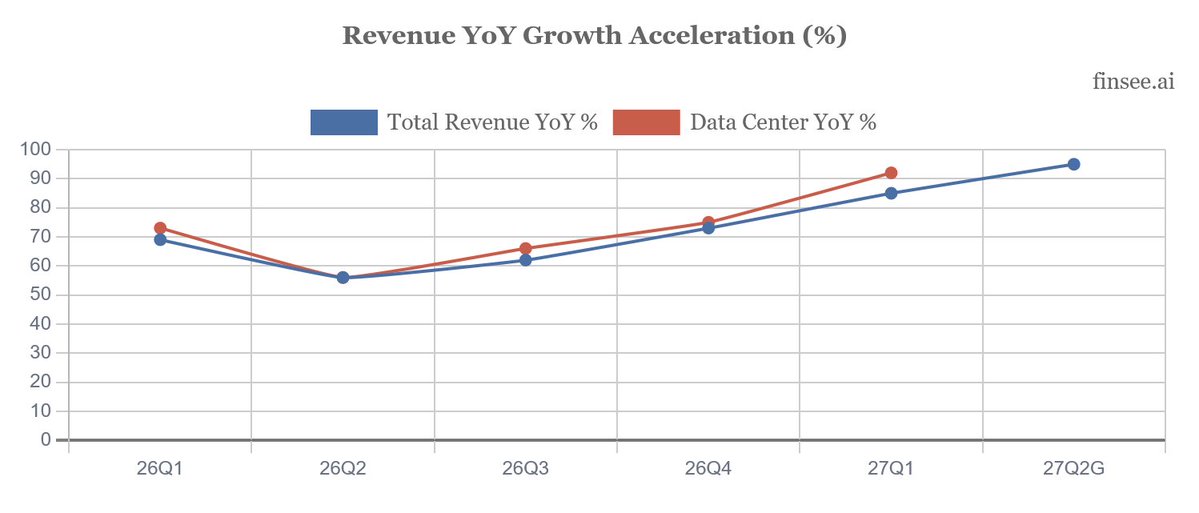
$NVDA Q1 2027 earnings: Acceleration Continues: $81.6B Revenue, $91B Guide, $80B Buyback NVIDIA didn't just beat — it accelerated. Revenue of $81.6B blew past the company's $78B guide and grew 85% YoY, the fastest pace in five quarters. Q2 guidance of $91B implies ~95% YoY growth — acceleration on top of acceleration, with zero China assumed. Data Center hit $75.2B (+92% YoY), Networking exploded to $14.8B (+199% YoY), and the new ACIE sub-segment (AI Clouds, Industrial, Enterprise) grew 31% sequentially to $37.4B — nearly matching Hyperscale. Capital return shifts gears: $20B returned in Q1, a new $80B buyback authorization, and a 25x dividend hike from $0.01 to $0.25. One asterisk: GAAP net income of $58.3B (+211% YoY) was inflated by $15.9B in unrealized equity gains. Non-GAAP NI of $45.5B (+139%) is the truer operating number — still extraordinary. Full article with charts - link in bio 🐂 𝗕𝘂𝗹𝗹 𝗖𝗮𝘀𝗲 𝗚𝗿𝗼𝘄𝘁𝗵 𝗜𝘀 𝗔𝗰𝗰𝗲𝗹𝗲𝗿𝗮𝘁𝗶𝗻𝗴, 𝗡𝗼𝘁 𝗗𝗲𝗰𝗲𝗹𝗲𝗿𝗮𝘁𝗶𝗻𝗴: YoY revenue growth went 56% → 62% → 73% → 85% → ~95% guided. This contradicts every 'AI peak' narrative. Q2 guidance implies a $9.4B sequential dollar increase — larger than the entire Data Center business was 5 quarters ago. 𝗔𝗖𝗜𝗘 𝗗𝗶𝘃𝗲𝗿𝘀𝗶𝗳𝗶𝗰𝗮𝘁𝗶𝗼𝗻 𝗥𝗲𝗱𝘂𝗰𝗲𝘀 𝗛𝘆𝗽𝗲𝗿𝘀𝗰𝗮𝗹𝗲𝗿 𝗥𝗶𝘀𝗸: ACIE (AI Clouds, Industrial, Enterprise, Sovereign) jumped 31% sequentially to $37.4B — now nearly equal to Hyperscale's $37.9B. Customer concentration risk is materially lower than 12 months ago, when Hyperscale dominated. 𝗡𝗲𝘁𝘄𝗼𝗿𝗸𝗶𝗻𝗴 𝗕𝗲𝗰𝗼𝗺𝗶𝗻𝗴 𝗮 𝗦𝘁𝗮𝗻𝗱𝗮𝗹𝗼𝗻𝗲 𝗣𝗼𝘄𝗲𝗿𝗵𝗼𝘂𝘀𝗲: Data Center networking revenue hit $14.8B in Q1, up 199% YoY and 35% sequentially. At ~$60B annual run rate, networking alone would rank as a top-30 tech company. 🐻 𝗕𝗲𝗮𝗿 𝗖𝗮𝘀𝗲 𝗚𝗔𝗔𝗣 𝗘𝗮𝗿𝗻𝗶𝗻𝗴𝘀 𝗤𝘂𝗮𝗹𝗶𝘁𝘆 𝗗𝗲𝘁𝗲𝗿𝗶𝗼𝗿𝗮𝘁𝗲𝗱: GAAP NI of $58.3B was inflated by $15.9B in unrealized gains on equity securities (Intel, OpenAI stake, etc.) — 27% of reported income is mark-to-market, not operations. The non-GAAP figure of $45.5B is the right benchmark, and the GAAP/non-GAAP gap will be a headline risk if equity markets turn. 𝗖𝗶𝗿𝗰𝘂𝗹𝗮𝗿 𝗙𝗶𝗻𝗮𝗻𝗰𝗶𝗻𝗴 𝗥𝗶𝘀𝗸 𝗜𝘀 𝗕𝘂𝗶𝗹𝗱𝗶𝗻𝗴: NVIDIA spent $18.6B on non-marketable securities in Q1 alone — 28x the $649M spent in Q1 FY26. Strategic investments in OpenAI, Anthropic, Intel, CoreWeave, and others increasingly fund the customers buying NVIDIA chips. Non-marketable securities nearly doubled QoQ to $43.4B. 𝗦𝘂𝗽𝗽𝗹𝘆 𝗖𝗼𝗺𝗺𝗶𝘁𝗺𝗲𝗻𝘁𝘀 𝗮𝘁 $𝟭𝟭𝟵𝗕 𝗕𝗲𝘁 𝗼𝗻 𝗦𝘂𝘀𝘁𝗮𝗶𝗻𝗲𝗱 𝗗𝗲𝗺𝗮𝗻𝗱: Total supply-related commitments grew from $95B to $119B in one quarter. Inventory built another $4.4B sequentially to $25.8B. Any pause in hyperscaler capex would create real inventory and obligation risk. ⚖️ 𝗩𝗲𝗿𝗱𝗶𝗰𝘁 🟢🟢 Very Bullish. This is one of the strongest quarters any company has ever reported at this scale. Revenue acceleration with margin stability, customer diversification via ACIE, and a record capital return program. The GAAP/non-GAAP gap and circular financing patterns are worth monitoring but don't change the trajectory. — • — • — 𝗧𝗵𝗲𝗺𝗲𝘀 New: 🟢🟢 𝗔𝗖𝗜𝗘 𝗖𝗮𝘁𝗰𝗵𝗲𝘀 𝗨𝗽 𝘁𝗼 𝗛𝘆𝗽𝗲𝗿𝘀𝗰𝗮𝗹𝗲 With Q1 FY27, NVIDIA restructured Data Center reporting into Hyperscale and ACIE (AI Clouds, Industrial, Enterprise, Sovereign). The recast data tells a story management has been previewing for quarters: hyperscalers are no longer the only show. ACIE grew 31% sequentially to $37.4B — nearly matching Hyperscale's $37.9B. A year ago, ACIE was $21.5B vs Hyperscale's $17.6B; the customer mix has rebalanced dramatically. This includes sovereign AI (now over $30B annually), Anthropic and OpenAI buildouts, enterprise on-prem, and AI-native cloud startups like CoreWeave. 🟢🟢 𝗡𝗲𝘁𝘄𝗼𝗿𝗸𝗶𝗻𝗴 𝗕𝗲𝗰𝗼𝗺𝗲𝘀 𝘁𝗵𝗲 𝗦𝘁𝗲𝗮𝗹𝘁𝗵 𝗚𝗿𝗼𝘄𝘁𝗵 𝗘𝗻𝗴𝗶𝗻𝗲 Data Center networking revenue hit a record $14.8B in Q1, up 199% YoY and 35% sequentially. Two years ago networking was a $3B/quarter business; it's now larger than the entire Edge Computing platform ($6.4B) by more than 2x. Growth is broad-based across NVLink (scale-up within the rack), InfiniBand and Spectrum-X Ethernet (scale-out across racks), and the new XGS (scale-across data centers). Management's claim of being on track to become 'the largest Ethernet networking company in the world' looks increasingly credible. New: 🔴 𝗘𝗾𝘂𝗶𝘁𝘆 𝗚𝗮𝗶𝗻𝘀 𝗜𝗻𝗳𝗹𝗮𝘁𝗲 𝗚𝗔𝗔𝗣 — 𝗤𝘂𝗮𝗹𝗶𝘁𝘆 𝗚𝗮𝗽 𝗪𝗶𝗱𝗲𝗻𝘀 GAAP net income grew 211% YoY to $58.3B, but $15.9B of that came from unrealized gains on equity securities (largely the Intel stake and other strategic positions). Non-GAAP NI grew 139% to $45.5B — the better proxy for operating earnings. The GAAP/non-GAAP gap was negligible until Q3 FY26 ($5.5B), grew to $5.3B in Q4, and exploded to $12.8B in Q1 FY27. This is mark-to-market noise that can swing either way. Investors anchoring to the headline $2.39 GAAP EPS rather than the $1.87 non-GAAP figure are overstating operating performance. New: 🔴 𝗦𝘁𝗿𝗮𝘁𝗲𝗴𝗶𝗰 𝗜𝗻𝘃𝗲𝘀𝘁𝗺𝗲𝗻𝘁𝘀 𝗕𝗲𝗰𝗼𝗺𝗶𝗻𝗴 𝗮 𝗦𝘁𝗮𝗻𝗱𝗮𝗹𝗼𝗻𝗲 𝗦𝘁𝗼𝗿𝘆 Purchases of non-marketable securities reached $18.6B in Q1 — a 28x increase from $649M in the year-ago quarter. The non-marketable securities balance nearly doubled QoQ from $22.3B to $43.4B. This funds ecosystem partners — OpenAI ($100B announced over time), Anthropic ($10B), Intel ($5B), CoreWeave, xAI, and others — many of whom turn around and buy NVIDIA hardware. The pattern is not new, but the scale has changed. It supports growth in the short term but raises questions about how much of NVIDIA's demand is being underwritten by NVIDIA's own capital. New: 🟢 𝗖𝗮𝗽𝗶𝘁𝗮𝗹 𝗥𝗲𝘁𝘂𝗿𝗻 𝗦𝘁𝗲𝗽𝘀 𝗨𝗽 𝗦𝗵𝗮𝗿𝗽𝗹𝘆 Three moves signal management's confidence in cash generation: (1) $20B returned to shareholders in Q1 — a record; (2) $80B added to the buyback authorization on top of $38.5B remaining, for ~$118B in total firepower; (3) the quarterly dividend was raised 25x, from $0.01 to $0.25 per share. The dividend hike is symbolic given the yield is still modest, but it signals NVIDIA is transitioning from pure growth to growth-plus-return. Free cash flow of $48.6B in the quarter — nearly double the year-ago $26.1B — makes the program easily affordable. 🟢 𝗩𝗲𝗿𝗮 𝗥𝘂𝗯𝗶𝗻 𝗣𝗹𝗮𝘁𝗳𝗼𝗿𝗺 𝗕𝗲𝗴𝗶𝗻𝘀 𝗛𝟮 𝗥𝗮𝗺𝗽 Management confirmed Vera Rubin starts ramping in Q3 FY27 (the company's second half). The platform includes the Vera CPU — NVIDIA's first major CPU push and 'the world's first processor purpose-built for agentic AI' — plus the Rubin GPU and BlueField-4 STX storage accelerator. Each generation has expanded content per gigawatt of data center capacity (Hopper $20-25B → Blackwell $30B+ → Rubin higher), so the Rubin cycle should sustain ASP and revenue growth into FY28 even if unit growth moderates. New: ⚪ 𝗘𝗱𝗴𝗲 𝗖𝗼𝗺𝗽𝘂𝘁𝗶𝗻𝗴 𝗗𝗲𝗰𝗲𝗹𝗲𝗿𝗮𝘁𝗲𝘀 𝗤𝘂𝗶𝗲𝘁𝗹𝘆 Lost in the Data Center fireworks: Edge Computing grew only 29% YoY and 10% sequentially to $6.4B. Management cited 'slower consumer PC demand tempered by elevated memory and systems prices.' This segment includes Gaming, where supply constraints were already flagged in Q4. Edge is now under 8% of revenue (vs over 13% a year ago), so the deceleration doesn't move the company's overall trajectory — but it removes a secondary growth narrative. 🔴 𝗖𝗵𝗶𝗻𝗮 𝗜𝘀 𝗡𝗼𝘄 𝗣𝗲𝗿𝗺𝗮𝗻𝗲𝗻𝘁𝗹𝘆 𝗭𝗲𝗿𝗼 For the third straight quarter, NVIDIA assumes zero Data Center compute revenue from China in its forward guidance. The $4.6B of H20 shipments in the prior-year Q1 will not annualize. Management has stopped describing China as a near-term recovery story; the $50B addressable market is effectively foreclosed. The good news: NVIDIA is growing 85% YoY ex-China. The risk: Chinese alternatives gain ground globally over time, especially in sovereign deployments where geopolitics matter. New: ⚪ 𝗜𝗻𝘃𝗲𝗻𝘁𝗼𝗿𝘆 𝗮𝗻𝗱 𝗦𝘂𝗽𝗽𝗹𝘆 𝗖𝗼𝗺𝗺𝗶𝘁𝗺𝗲𝗻𝘁𝘀 𝗦𝘂𝗿𝗴𝗲 Inventory grew $4.4B sequentially to $25.8B. Total supply-related commitments reached $119B (up from $95B at end of FY26 — a 25% sequential increase). Multi-year cloud service agreements grew from $27B to $30B. CFO Kress said the company has 'strategically secured inventory and capacity to meet demand beyond the next several quarters.' This is consistent with the Q2 guidance, but it's also a substantial forward bet — if demand softened, working capital and write-down risk would be material. New: 🟢 𝗔𝗴𝗲𝗻𝘁𝗶𝗰 𝗔𝗜 𝗦𝗼𝗳𝘁𝘄𝗮𝗿𝗲 𝗦𝘁𝗮𝗰𝗸 𝗘𝘅𝗽𝗮𝗻𝗱𝗶𝗻𝗴 𝗕𝗲𝘆𝗼𝗻𝗱 𝗛𝗮𝗿𝗱𝘄𝗮𝗿𝗲 Several new software-led announcements signal NVIDIA moving up the stack: NemoClaw (for OpenClaw agent platform), OpenShell (privacy and security for autonomous agents), Agent Toolkit (open-source enterprise agent builder), Dynamo 1.0 (open-source inference acceleration delivering up to 7x on Blackwell), and the Nemotron Coalition. NVIDIA is positioning to capture not just the hardware but the orchestration and inference layer for enterprise agentic AI — historically a software/services revenue pool that doesn't show up cleanly in current reporting. — • — • — 𝗢𝘁𝗵𝗲𝗿 𝗞𝗣𝗜𝘀 𝗙𝗿𝗲𝗲 𝗖𝗮𝘀𝗵 𝗙𝗹𝗼𝘄 (𝗤𝟭 𝗙𝗬𝟮𝟳): $𝟰𝟴.𝟲 𝗯𝗶𝗹𝗹𝗶𝗼𝗻 Up 86% YoY from $26.1B and up 39% from $34.9B in Q4 FY26. Operating cash flow of $50.3B benefited from lower cash taxes this quarter, but management explicitly flagged that 'a substantial increase in cash taxes' is coming in Q2. CapEx ran $1.76B — elevated but a tiny fraction of cash generation. FCF conversion (FCF/Non-GAAP NI) was 107%, indicating earnings are translating to cash without working-capital drag despite the inventory build. 𝗡𝗼𝗻-𝗚𝗔𝗔𝗣 𝗚𝗿𝗼𝘀𝘀 𝗠𝗮𝗿𝗴𝗶𝗻 (𝗤𝟭 𝗙𝗬𝟮𝟳): 𝟳𝟱.𝟬% Flat sequentially (from 75.1%) and up 14.2 points YoY (the YoY comparison flattered by the $4.5B H20 charge a year ago). Management had previously guided to 'mid-70s' for FY27 and is delivering — Q2 guidance of 75.0% confirms stability. This is impressive given rising input costs flagged in the Q3 FY26 call. Blackwell mix continues to dominate; the platform is now mature enough that yield improvements and cycle-time gains are offsetting cost headwinds. 𝗚𝗔𝗔𝗣 𝗢𝗽𝗲𝗿𝗮𝘁𝗶𝗻𝗴 𝗘𝘅𝗽𝗲𝗻𝘀𝗲𝘀 (𝗤𝟭 𝗙𝗬𝟮𝟳): $𝟳.𝟲 𝗯𝗶𝗹𝗹𝗶𝗼𝗻 Up 52% YoY and 12% sequentially. Q2 guidance is $8.5B GAAP / $8.3B non-GAAP, implying further 12% sequential growth. R&D was $6.3B in Q1, up from $4.0B a year ago — funding the Rubin platform, Vera CPU, and software stack expansion. OpEx is growing roughly half as fast as revenue, delivering significant operating leverage: non-GAAP operating margin expanded to 66% from 49% a year ago. — • — • — 𝗚𝘂𝗶𝗱𝗮𝗻𝗰𝗲 𝗤𝟮 𝗙𝗬𝟮𝟳 𝗥𝗲𝘃𝗲𝗻𝘂𝗲: $𝟵𝟭.𝟬 𝗯𝗶𝗹𝗹𝗶𝗼𝗻 (+/- 𝟮%) Accelerating. Implies ~95% YoY growth (vs. 85% in Q1) and 11.5% sequential growth. The $9.4B sequential dollar increase is roughly the size of the entire Gaming and Automotive businesses combined a year ago. Critically, this assumes zero China Data Center compute revenue — there is no 'China optionality' baked in. Drivers cited: continued Blackwell 300 ramp, Hyperscale expansion, and the beginning of Vera Rubin contribution late in the quarter. 𝗤𝟮 𝗙𝗬𝟮𝟳 𝗡𝗼𝗻-𝗚𝗔𝗔𝗣 𝗚𝗿𝗼𝘀𝘀 𝗠𝗮𝗿𝗴𝗶𝗻: 𝟳𝟱.𝟬% (+/- 𝟱𝟬 𝗯𝗽𝘀) Stable. Sequential continuity at the mid-70s level management has been guiding to all year. The flat trajectory despite Blackwell 300 ramp and rising memory/component costs suggests pricing discipline is holding. 𝗤𝟮 𝗙𝗬𝟮𝟳 𝗡𝗼𝗻-𝗚𝗔𝗔𝗣 𝗢𝗽𝗲𝗿𝗮𝘁𝗶𝗻𝗴 𝗘𝘅𝗽𝗲𝗻𝘀𝗲𝘀: 𝗔𝗽𝗽𝗿𝗼𝘅𝗶𝗺𝗮𝘁𝗲𝗹𝘆 $𝟴.𝟯 𝗯𝗶𝗹𝗹𝗶𝗼𝗻 Up 12% sequentially. Implies non-GAAP operating margin of approximately 65.9% at the revenue midpoint — roughly flat with Q1's 65.9%. Management continues to invest aggressively in R&D for Rubin and software but the growth-versus-revenue ratio is favorable. 𝗙𝗬𝟮𝟳 𝗧𝗮𝘅 𝗥𝗮𝘁𝗲: 𝟭𝟲.𝟬% - 𝟭𝟴.𝟬% Slightly lower at the low end than the 17-19% range provided at the Q4 print. A modest tailwind to non-GAAP EPS through the year, all else equal. — • — • — 𝗞𝗲𝘆 𝗤𝘂𝗲𝘀𝘁𝗶𝗼𝗻𝘀 𝗦𝘂𝘀𝘁𝗮𝗶𝗻𝗮𝗯𝗶𝗹𝗶𝘁𝘆 𝗼𝗳 𝘁𝗵𝗲 𝗘𝗾𝘂𝗶𝘁𝘆-𝗚𝗮𝗶𝗻 𝗕𝗼𝗻𝗮𝗻𝘇𝗮 GAAP NI included $15.9B in unrealized equity gains. What is the embedded gain on the strategic investment portfolio that has not yet flowed through, and how should investors think about volatility if public equity holdings like Intel reverse? 𝗖𝗶𝗿𝗰𝘂𝗹𝗮𝗿 𝗙𝗶𝗻𝗮𝗻𝗰𝗶𝗻𝗴 𝗗𝗶𝘀𝗰𝗹𝗼𝘀𝘂𝗿𝗲 $18.6B was deployed into non-marketable securities in Q1 alone. What portion of FY27 Data Center revenue is from customers in whom NVIDIA holds a meaningful equity stake or has signed a financial commitment? Investors deserve more transparency on this growing risk. 𝗩𝗲𝗿𝗮 𝗥𝘂𝗯𝗶𝗻 𝗖𝗼𝗻𝘁𝗿𝗶𝗯𝘂𝘁𝗶𝗼𝗻 𝗠𝗮𝗴𝗻𝗶𝘁𝘂𝗱𝗲 Rubin starts ramping in Q3. Can management quantify what percentage of H2 FY27 revenue is expected from Rubin vs. continued Blackwell, and how the gross margin compares in early Rubin shipments versus mature Blackwell? 𝗦𝘂𝗽𝗽𝗹𝘆 𝗖𝗼𝗺𝗺𝗶𝘁𝗺𝗲𝗻𝘁 𝗠𝗮𝘁𝗵 Total supply commitments reached $119B — up $24B sequentially. What is the implied revenue these commitments support, and over what horizon? At what utilization rate do these commitments become a write-down risk? 𝗔𝗖𝗜𝗘 𝗟𝘂𝗺𝗽𝗶𝗻𝗲𝘀𝘀 ACIE swung from $21.5B → $17.2B → $20.9B → $28.5B → $37.4B over five quarters. How much of the Q1 spike was sovereign AI lumpiness versus a structural step-up, and what should be modeled as the recurring run-rate?
Finsee tweet media
English
3
3
7
1.8K
Brainsite | Your brand with a brain
@TheValueist Good Broadcom read. AVGO is not a generic AI proxy here; it is the custom silicon and networking leg, which makes the $10.8B AI semiconductor number more important than headline EPS. x.com/Elera_AI/statu…
Brainsite | Your brand with a brain@BrainsiteAI

This AI basket is not one trade. It is five different ways to underwrite the same buildout. $NVDA remains the core holding because it owns the AI compute bottleneck: $81.6B latest-quarter revenue, $75.2B from data center, and a next-quarter guide near $91B. $MSFT is the monetization layer. Azure grew 40%, AI revenue run rate passed $37B, and the real debate is whether Copilot, GitHub, security, and Azure can earn enough return on the capex bill. $AVGO is the custom silicon and networking pick. AI semiconductor revenue hit $10.8B, up 143%, with management guiding that line to $16B next quarter. $AMD is the high-beta challenger. Revenue grew 38%, data center grew 57%, and Meta/Samsung/MEXT give the Instinct roadmap more credibility, but valuation already prices a lot of execution. $ORCL is the controversial one. Cloud infrastructure grew 93%, RPO hit $638B, and the upside is real if backlog converts, but the debt and datacenter buildout risk make it the smallest-position name. The clean read: NVDA is the benchmark, MSFT is the return-on-AI test, AVGO is the ASIC trade, AMD is the torque, and ORCL is the levered capacity bet. Same AI cycle, very different risk profiles.
English
0
0
0
2
TheValueist
TheValueist@TheValueist·
$AVGO KEY READ-THROUGHS FROM BROADCOM Q2 FY26 EARNINGS CALL Broadcom’s Q2 FY26 call was one of the clearest confirmations to date that AI infrastructure demand is extending from a GPU-led procurement cycle into a broader, multi-year custom silicon, Ethernet networking, HBM, power, data-center financing, and private-cloud infrastructure cycle. The most important market signal was not simply that Broadcom’s AI semiconductor revenue reached $10.8B, up 143% YoY, but that Q2 AI semiconductor bookings exceeded $30B, Q3 AI semiconductor revenue was guided to $16B, FY26 AI semiconductor revenue was guided to $56B, and FY27 AI semiconductor revenue was reiterated at more than $100B. The call also extended demand visibility into 2028 and tied future growth to specific gigawatt-scale customer programs at Google, Anthropic, OpenAI, Meta, and 2 additional customers. The broader read-through is highly constructive for the AI infrastructure supply chain, especially Ethernet networking, optical components, HBM, leading-edge foundry, advanced packaging, power equipment, data-center construction, and alternative asset managers financing AI compute. The principal negative implications are rising share pressure for merchant GPU/proprietary networking ecosystems, a tougher competitive setup for custom ASIC peers, higher capex and power-cost burdens for hyperscalers, and reduced support for the VMware-displacement narrative in enterprise infrastructure software. AI ACCELERATORS, CUSTOM SILICON, AND CLOUD PLATFORMS GOOGLE TPU ROADMAP APPEARS MATERIALLY DE-RISKED, SUPPORTING ALPHABET’S AI COST AND SUPPLY POSITION (READ-THROUGH 1) Affected company: Alphabet Inc. (GOOGL: US) Directional impact and magnitude: Positive, high magnitude. Time horizon: Near-term trading catalyst and longer-duration fundamental shift. Supporting call commentary/data point: Broadcom stated that with Google it “entered into a long-term agreement to develop and supply multiple generations of TPUs and AI networking,” and that the relationship remains “strategic and very substantial.” Management also said Broadcom continues to deliver “vastly superior technology and execution compared to other alternatives” and that this “ensures that our business will sustain and grow for the foreseeable future.” Transmission mechanism: Alphabet’s AI compute roadmap appears less dependent on merchant GPUs than investor debate often assumes. Broadcom’s comments imply strong continuity in Google’s TPU roadmap across multiple generations, with Broadcom supplying both custom accelerator silicon and AI networking. This supports Google Cloud, Gemini, Vertex AI, and internal AI workloads by lowering cost per token, reducing external GPU supply risk, and preserving architectural control over model training and inference infrastructure. The read-through is especially important because Google can monetize TPUs internally and externally through cloud services, while also avoiding some of the margin leakage associated with buying large quantities of merchant accelerators at scarcity pricing. The near-term trading catalyst is validation that Google has secured a long-duration TPU supply path during an industry-wide capacity squeeze. The longer-duration shift is that Alphabet’s custom silicon platform may become a more durable strategic differentiator as AI workloads scale into 2027 and 2028. The key offset is that Broadcom acknowledged Google will maintain source diversity given the scale of its AI compute demand, so the read-through is not exclusivity; it is strong roadmap validation and reduced execution risk. CUSTOM XPU ADOPTION BY FRONTIER LABS CREATES LONGER-DURATION SHARE PRESSURE FOR MERCHANT GPU ECOSYSTEMS (READ-THROUGH 2) Affected companies: NVIDIA Corp. (NVDA: US), Advanced Micro Devices, Inc. (AMD: US) Directional impact and magnitude: Negative, medium magnitude for NVIDIA and AMD over the longer duration; limited near-term negative because total AI compute demand is still expanding rapidly. Time horizon: Longer-duration fundamental shift, with intermittent trading sensitivity around hyperscaler capex and custom silicon news flow. Supporting call commentary/data point: Broadcom guided FY26 AI semiconductor revenue to $56B, up approximately 180% from FY25, and reiterated FY27 AI semiconductor revenue “in excess of $100 billion.” Management said, “Demand for XPUs and networking is simply insatiable,” disclosed more than $30B of AI semiconductor bookings in Q2 against $10.8B shipped, and laid out gigawatt-scale custom XPU deployments for Google, Anthropic, OpenAI, Meta, and 2 other customers. Transmission mechanism: The call supports the view that custom accelerators are no longer isolated internal hyperscaler projects; they are becoming a central infrastructure layer for the largest AI model developers and platforms. This is structurally negative for the long-duration revenue share opportunity of merchant GPUs, especially in large, predictable, hyperscale training and inference clusters where customers can justify custom silicon development. For NVIDIA, the risk is not near-term unit weakness, as industry AI compute demand remains supply-constrained and expanding, but rather that the incremental dollar share of frontier AI capex gradually shifts toward customer-specific XPUs and Ethernet-based cluster architectures. For AMD, the read-through is similar but smaller in absolute magnitude because AMD’s accelerator share is lower and its AI opportunity is still more nascent. The call also has a networking-specific negative implication for NVIDIA’s proprietary networking moat. Broadcom emphasized Ethernet scale-up, scale-out, PCIe switching, DSPs, lasers, and Jericho fabrics as critical to large XPU and GPU clusters. If Ethernet becomes the default AI networking architecture across more custom XPU deployments, NVIDIA’s InfiniBand-led system advantage could face greater pressure over time. The negative read-through should be framed as share-of-incremental-spend risk, not an immediate demand cliff. BROADCOM’S DISCLOSED CUSTOMER MOMENTUM RAISES RELATIVE COMPETITIVE RISK FOR CUSTOM ASIC AND OPTICAL DSP PEERS (READ-THROUGH 3) Affected company: Marvell Technology, Inc. (MRVL: US) Directional impact and magnitude: Net negative, medium magnitude on relative positioning; positive for total addressable market but negative for perceived share capture. Time horizon: Near-term trading risk and longer-duration competitive concern. Supporting call commentary/data point: Broadcom disclosed 6 core AI customers, more than $30B of Q2 AI bookings, FY26 AI semiconductor guidance of $56B, and FY27 AI semiconductor guidance of more than $100B. Management also stated that in networking Broadcom has “at least one generation of technology and product leadership,” that its 100Tb Ethernet switch has been shipping for more than 1 year, that a 200Tb switch will tape out this quarter, and that in CPO, 1.6Tb DSPs, CW lasers, and EML lasers, Broadcom is “the de-facto standard in the industry.” Transmission mechanism: The total custom ASIC and AI networking TAM expansion is positive for all credible suppliers, including Marvell. However, the specific call disclosures reinforce Broadcom’s dominant position in the highest-value custom XPU and AI networking programs. The risk for Marvell is that investors extrapolate Broadcom’s 6-customer roadmap, Google agreement, OpenAI production timing, Anthropic gigawatt access, Meta MTIA partnership, and 1.6Tb optical/networking claims into a larger Broadcom share of the custom AI silicon profit pool than previously assumed. The near-term catalyst is relative stock pressure when investors compare Broadcom’s disclosed bookings, customer specificity, and 2027 revenue guide against Marvell’s own AI revenue trajectory and customer disclosures. The longer-duration concern is that Broadcom’s bundled capability across XPU design, Ethernet switching, SerDes, DSPs, lasers, PCIe, and routing creates a higher barrier to displacement than a single-chip custom silicon engagement would imply. The read-through is not that Marvell cannot grow in AI; it is that Broadcom’s call increased the evidentiary burden for Marvell’s share-gain narrative. META’S MTIA ROADMAP IS VALIDATED, BUT THE REVENUE AND EFFICIENCY BENEFITS ARE LARGELY 2027-2028 EVENTS (READ-THROUGH 4) Affected company: Meta Platforms, Inc. (META: US) Directional impact and magnitude: Positive, medium magnitude longer term; neutral to modestly negative near term from capex intensity. Time horizon: Longer-duration fundamental shift, limited near-term earnings impact. Supporting call commentary/data point: Broadcom stated that for Meta it announced a partnership to deliver multiple generations of MTIA XPUs and expects to deploy 3GW through the end of 2028. Management added that the initial 1GW order, including XPUs and networking, has been received and will start delivery in 2H27. Transmission mechanism: Meta’s custom accelerator roadmap is becoming more concrete. The Broadcom call supports the view that MTIA is transitioning from an internal strategic ambition into a multi-generation, multi-gigawatt deployment plan. This is positive for Meta’s long-term AI infrastructure economics because successful custom inference and training silicon can lower cost per recommendation, cost per generated token, and dependence on external accelerator supply. It also improves Meta’s ability to optimize AI hardware around its own ranking, ads, recommendations, generative AI, and Llama workloads. The near-term implication is more muted because deliveries start in 2H27, meaning capex planning, infrastructure buildout, and engineering spend occur before material efficiency benefits are visible in earnings. The longer-duration implication is more constructive: if Meta can scale MTIA across 3GW through 2028, internal silicon becomes a meaningful lever against AI margin dilution. ETHERNET AI NETWORKING AND SYSTEMS ETHERNET AI CLUSTERING REMAINS A HIGH-CONVICTION POSITIVE FOR ARISTA AND SELECT DATA-CENTER SWITCHING VENDORS (READ-THROUGH 5) Affected companies: Arista Networks, Inc. (ANET: US), Cisco Systems, Inc. (CSCO: US) Directional impact and magnitude: Positive, high magnitude for Arista; positive, medium magnitude for Cisco. Time horizon: Near-term trading catalyst and longer-duration fundamental shift. Supporting call commentary/data point: Broadcom stated that networking represented almost 40% of Q2 AI revenue. Management said, “networking is key to building scalable XPU and GPU clusters,” and highlighted leadership in 200G and 400G SerDes, Ethernet and PCI Express switches, the industry’s only 100Tb Ethernet switch shipping for more than 1 year, a 200Tb switch taping out this quarter, and Jericho 3 and Jericho 4 fabric solutions for large multi-hyperscaler deployments. Transmission mechanism: The call is a clear positive for Ethernet-based AI networking. Arista is the cleanest system-level beneficiary because its hyperscale and cloud data-center switching franchise is highly levered to Ethernet AI cluster adoption. Broadcom’s silicon roadmap and AI networking revenue mix imply that large-scale AI clusters are increasingly being designed around Ethernet fabrics rather than only proprietary networking alternatives. This expands Arista’s addressable opportunity in AI back-end networks, front-end networks, and inter-data-center fabrics. Cisco benefits as well, although with a more diversified and less hyperscale-pure exposure profile. The near-term trading catalyst is Broadcom’s disclosure that AI networking is already close to 40% of Q2 AI revenue, implying material current demand rather than a distant architectural possibility. The longer-duration shift is that Ethernet appears to be gaining credibility as a default scale-out and scale-across architecture for both XPUs and GPUs. The key nuance is that Broadcom expects networking to normalize closer to 30% of AI revenue over time as XPU revenue ramps, so the positive read-through is stronger for absolute networking dollar growth than for sustained mix expansion. OPTICAL COMPONENTS AND 1.6T ECOSYSTEM DEMAND GET ANOTHER STRONG CONFIRMATION (READ-THROUGH 6) Affected companies: Coherent Corp. (COHR: US), Lumentum Holdings Inc. (LITE: US), Fabrinet (FN: US) Directional impact and magnitude: Positive, medium-to-high magnitude. Time horizon: Near-term trading catalyst and longer-duration fundamental shift. Supporting call commentary/data point: Broadcom stated that in “CPOs, which is Co-Packaged Optics, 1.6 terabit DSPs, CW and EML lasers, we are the de-facto standard in the industry.” Management also emphasized AI networking demand, Jericho 3 and Jericho 4 fabric solutions, and a next-generation 200Tb switch tapeout this quarter. Transmission mechanism: AI cluster scaling requires materially more optical bandwidth, higher-speed interconnects, and a transition toward 1.6T-class optical architectures. Coherent and Lumentum benefit through lasers, optical components, and high-speed photonics exposure. Fabrinet benefits through optical transceiver and photonics manufacturing leverage. Broadcom’s comments indicate that the transition to higher-speed optics is not merely a forward-looking technology roadmap; it is being pulled by real AI cluster deployment requirements. The near-term trading catalyst is confirmation that hyperscale AI networking demand is supporting a rapid move toward 1.6T optical architectures. The longer-duration shift is that optical content per AI data center should continue rising as clusters scale across racks, halls, and data centers. The principal offset is that Broadcom’s own DSP, CPO, and laser capabilities may capture a larger portion of the value chain, limiting the breadth of benefits for standalone optical component vendors if vertical integration accelerates. SEMICONDUCTOR SUPPLY CHAIN, MEMORY, FOUNDRY, PACKAGING, AND TEST HBM DEMAND HAS MULTI-YEAR VISIBILITY, WITH POSITIVE READ-THROUGH FOR LEADING MEMORY SUPPLIERS (READ-THROUGH 7) Affected companies: SK hynix Inc. (000660: South Korea), Micron Technology, Inc. (MU: US), Samsung Electronics Co., Ltd. (005930: South Korea) Directional impact and magnitude: Positive, high magnitude for SK hynix; positive, medium-to-high magnitude for Micron and Samsung. Time horizon: Near-term trading catalyst and longer-duration fundamental shift. Supporting call commentary/data point: Broadcom stated that it has secured supply for 2026 and 2027 and is working on 2028 and 2029. In response to a supply question referencing wafers and HBM, management said customers have continued to ask for incremental supply and that “by and large” Broadcom has been able to support it. Later in the call, management said XPU content per gigawatt will increase as chips become multi-die and incorporate “lots of HBM.” Transmission mechanism: Broadcom’s custom XPU ramp is HBM-intensive. FY26 AI semiconductor revenue guidance of $56B, FY27 guidance of more than $100B, and 2028 visibility imply substantial multi-year HBM pull-through. SK hynix is the most direct positive read-through given its leadership in high-bandwidth memory, while Micron and Samsung benefit from incremental industry demand, customer diversification, and the need for multiple qualified suppliers. The near-term catalyst is the combination of $30B-plus Q2 AI semiconductor bookings and management commentary that customers are requesting incremental supply. The longer-duration shift is that HBM demand is becoming tied not only to merchant GPU platforms but also to a broader set of custom XPUs across Google, Anthropic, OpenAI, Meta, and other customers. This broadens the demand base for HBM and supports a tighter pricing and allocation environment. LEADING-EDGE FOUNDRY, ADVANCED PACKAGING, AND AI TEST DEMAND ARE STRUCTURALLY TIGHTER (READ-THROUGH 8) Affected companies: Taiwan Semiconductor Manufacturing Co. (2330: Taiwan; TSM: US ADR), ASE Technology Holding Co. (3711: Taiwan), BE Semiconductor Industries N.V. (BESI: Netherlands), Advantest Corp. (6857: Japan), Teradyne, Inc. (TER: US), ASML Holding N.V. (ASML: Netherlands), Applied Materials, Inc. (AMAT: US) Directional impact and magnitude: Positive, high magnitude for TSMC; positive, medium magnitude for advanced packaging, test, and equipment beneficiaries. Time horizon: Near-term trading catalyst for capacity-tightness narratives; longer-duration fundamental shift for capex and utilization. Supporting call commentary/data point: Broadcom disclosed more than $30B of Q2 AI semiconductor bookings, guided FY26 AI semiconductor revenue to $56B, reiterated more than $100B in FY27 AI semiconductor revenue, and said supply has been secured for 2026 and 2027 while 2028 and 2029 planning is underway. Management also said customers are requesting incremental supply and that XPU content per gigawatt will rise as chips become more complex, multi-die, and HBM-rich. Transmission mechanism: Broadcom is fabless, so its AI semiconductor growth converts into external demand for leading-edge wafer starts, advanced packaging, substrate capacity, HBM integration, and high-complexity test. TSMC is the clearest beneficiary because custom AI accelerators and high-performance networking silicon are highly likely to consume leading-edge foundry and advanced packaging capacity. ASE, BE Semiconductor, Advantest, and Teradyne benefit from the rising complexity of multi-die AI packages, higher test intensity, and packaging process demand. ASML and Applied Materials benefit more indirectly as sustained AI demand supports foundry and packaging capex. The near-term catalyst is evidence that Broadcom’s customers are ordering ahead into 2028, reinforcing tightness in advanced supply chains. The longer-duration shift is that custom AI accelerators are becoming a second major demand pillar alongside merchant GPUs for leading-edge foundry and advanced packaging capacity.
TheValueist@TheValueist

$AVGO EXECUTIVE CALL SUMMARY: Broadcom Inc. (06/03/26) Broadcom delivered a fundamentally powerful Q2 FY26 print, but the call’s investment significance was more nuanced than the headline growth rates. Reported Q2 revenue was $22.187B, up 48% YoY and 15% QoQ, modestly above prior company guidance of approximately $22.0B. Non-GAAP operating income was $14.928B, implying a 67.3% operating margin, while adjusted EBITDA was $15.244B, or approximately 69% of revenue, above the prior 68% guide. Free cash flow was $10.262B, or 46% of revenue, up 60% YoY. The quarter therefore validated the core operating-leverage thesis: Broadcom is scaling AI semiconductor revenue at extreme velocity while preserving software-like consolidated operating margins and exceptional cash conversion. Official results confirm Q2 revenue of $22.187B, adjusted EBITDA of $15.244B, non-GAAP EPS of $2.44, and free cash flow of $10.262B. The equity-market reaction was not driven by deteriorating fundamentals; it was driven by expectation risk. External reports were mixed on whether the quarter modestly beat or missed consensus, depending on the consensus source, but Reuters reported Q2 revenue of $22.19B versus LSEG expectations of $22.27B and Q3 AI semiconductor guidance of $16.0B versus Visible Alpha expectations of $16.36B. This is the critical setup issue: Broadcom delivered a beat versus its own guide, raised the forward revenue trajectory sharply, and reiterated the FY27 AI semiconductor revenue target of more than $100B, yet the magnitude of upside did not clear the more aggressive buyside hurdle embedded in the stock after a substantial AI-driven move. The most important call message was management’s explicit escalation of AI visibility. Hock Tan stated that “Demand for XPUs and networking is simply insatiable” and that “During the quarter, bookings for AI semiconductors were over $30 billion against the $10.8 billion we shipped.” That implies an AI semiconductor book-to-bill ratio of more than 2.8x in Q2, which is extraordinary for a semiconductor business of this scale. The call also moved the visibility window materially outward: management stated that visibility now runs to 2028, compared with visibility largely through 2027 only 3 months ago. That extension is highly investment-relevant because the AI ramp is no longer framed as a 2026 demand spike; it is being framed as a multi-year capacity deployment cycle across 6 core customers. Q2 AI semiconductor revenue was $10.8B, up 143% YoY and 29% QoQ, modestly above the Q1 call guide of $10.7B. AI represented 49% of total company revenue and approximately 72% of Semiconductor Solutions revenue. Networking represented almost 40% of Q2 AI revenue, implying approximately $4.3B of AI networking revenue if the 40% reference is treated as approximate, versus approximately $2.8B in Q1 if the Q1 33% mix reference is applied to $8.4B of Q1 AI revenue. This suggests AI networking revenue may have grown more than 50% QoQ, faster than total AI revenue, and remains central to the quality of the growth. Q1 transcript data show prior Q2 guidance of $14.8B in semiconductor revenue, $10.7B in AI semiconductor revenue, $7.2B in infrastructure software revenue, and approximately 68% adjusted EBITDA margin. The Q2 beat versus prior guidance was real but not dramatic. Total revenue exceeded guide by $187M, or 0.9%; semiconductor revenue exceeded the $14.8B prior segment guide by approximately $209M, or 1.4%; AI semiconductor revenue exceeded the $10.7B guide by $100M, or 0.9%; infrastructure software was essentially in line at $7.178B versus the prior $7.2B guide. Adjusted EBITDA was the cleaner upside element, beating the dollar implied by prior revenue and margin guidance by approximately $284M. The quarter therefore should be interpreted as a high-quality execution quarter with modest revenue upside and stronger operating leverage, not as a material near-term demand surprise. The Q3 guide is the true centerpiece of the call. Management guided Q3 FY26 revenue to $29.4B, up 84% YoY and 33% QoQ. Semiconductor revenue is expected to be $20.5B, up 124% YoY and 37% QoQ. AI semiconductor revenue is expected to be $16.0B, up more than 200% YoY and 48% QoQ. Non-AI semiconductor revenue is expected to be approximately $4.5B, up 12% YoY and 7% QoQ. Infrastructure software revenue is expected to be $8.9B, up 31% YoY and 24% QoQ. The official Q2 release confirms Q3 revenue guidance of approximately $29.4B, non-GAAP operating income guidance of approximately 67% of projected revenue, and adjusted EBITDA guidance of approximately 68% of projected revenue. Relative to Q3 FY25, the guided acceleration is extreme. Broadcom’s Q3 FY25 revenue was $15.952B, with Semiconductor Solutions revenue of $9.166B, infrastructure software revenue of $6.786B, and AI revenue of $5.2B. The Q3 FY26 guide therefore implies total revenue growth of 84%, semiconductor growth of 124%, software growth of 31%, and AI semiconductor growth of roughly 208%. That degree of acceleration from an already scaled revenue base is rare, even within AI infrastructure. The FY26 AI semiconductor revenue guide of $56B is highly consequential. Broadcom generated $8.4B of AI revenue in Q1 and $10.8B in Q2, for $19.2B in 1H26. With Q3 guided at $16.0B, the $56B FY26 guide implies Q4 AI semiconductor revenue of approximately $20.8B. That would represent 30% sequential growth in Q4 and 2H26 AI revenue of $36.8B, or 1.9x 1H26. The Q&A discussion included confusion around the 2H26 versus 1H26 math, but the key conclusion is straightforward: the $56B FY26 AI target does not imply a Q4 decline; it implies a very large Q4 step-up after an already large Q3 step-up. The FY27 reiteration matters more than the Q3 guide. Management reiterated that FY27 AI semiconductor revenue is expected to be “in excess of $100 billion.” On a base of $56B in FY26, the lower bound of that statement implies at least 79% YoY growth in FY27. Relative to approximately $20B of FY25 AI revenue, a $100B FY27 level implies a 2-year CAGR of approximately 124%. Hock Tan explicitly said that 2027 is “very much on-track, if not stronger,” while also declining to provide a quarter-by-quarter FY27 guide. That language preserves optionality for upside without formally underwriting the $200B 18-month backlog figure raised by an analyst in Q&A. Management did not validate the analyst’s $200B AI backlog framing. This distinction is important. The call disclosed more than $30B of Q2 AI semiconductor bookings and reiterated a more than $100B FY27 AI semiconductor revenue outlook, but management did not explicitly endorse the suggestion that the next 18-month AI backlog is $200B or higher. The appropriate interpretation is that order intake, customer commitments, and gigawatt roadmaps are moving materially ahead of prior expectations, but precise backlog extrapolations beyond disclosed bookings and guideposts remain speculative. The call strengthened the visibility thesis; it did not convert every long-dated capacity indication into firm backlog. The customer roadmap was materially de-risking, but also highlighted concentration. Google remains the anchor customer, and the April long-term agreement is the most important strategic confirmation. Broadcom’s Form 8-K states that Broadcom and Google entered into a long-term agreement for Broadcom to develop and supply custom TPUs for future generations and a supply assurance agreement for networking and other components used in Google’s next-generation AI racks through up to 2031. On the call, management emphasized that the relationship remains “strategic and very substantial,” while also acknowledging that Google will maintain some source diversity given the scale of its AI compute requirements. That admission is analytically important: the agreement meaningfully de-risks roadmap participation, but it does not eliminate share-of-wallet risk. Anthropic is emerging as a material incremental demand vector. The supplied transcript states that Broadcom is providing access to more than 1GW of TPU-based compute in 2026 and that an April agreement enables Anthropic to access another 5GW of next-generation TPU-based compute beginning in 2027. The April 8-K disclosed approximately 3.5GW accessed through Broadcom beginning in 2027 as part of Anthropic’s multiple-gigawatt next-generation TPU-based capacity commitment, while Anthropic separately stated that the new agreement with Google and Broadcom covers multiple gigawatts of next-generation TPU capacity expected to come online starting in 2027. The difference between the transcript’s 5GW reference and the 8-K’s approximately 3.5GW “through Broadcom” language likely reflects scope differences, and models should treat the 8-K as the tighter legal disclosure. OpenAI is a major late-2026 and FY27 ramp variable. Broadcom’s prior OpenAI announcement disclosed a collaboration for 10GW of custom AI accelerators, with Broadcom to deploy racks of accelerator and network systems targeted to start in 2H26 and complete by year-end 2029. The Q2 call added that silicon has been delivered, production remains on track for late 2026, and there is a contractual commitment to deploy 1.3GW in 2027 as part of the larger 10GW agreement. This is a critical bridge from design-win narrative to revenue recognition. It also increases dependence on OpenAI’s ability to finance, power, and absorb very large custom accelerator deployments. Meta is a stronger long-term contributor than near-term contributor. The April Meta partnership confirmed a multi-year, multi-generation strategic partnership around MTIA custom silicon, advanced packaging, and Ethernet networking, with an initial commitment exceeding 1GW and a sustained multi-gigawatt rollout. The Q2 call added that Broadcom expects to deploy 3GW through the end of 2028 and has received the initial 1GW order, with deliveries starting in 2H27. This supports FY28 growth visibility more than FY26 upside. Meta also validates Broadcom’s positioning beyond the Google TPU ecosystem and supports the broader thesis that hyperscalers increasingly want workload-specific accelerators rather than only merchant GPUs. The other 2 customers remain less transparent but are no longer immaterial. Management said shipments for the other 2 customers are expected to begin late 2026 and accelerate into 2027, with purchase orders totaling $6B received to date. That disclosure is important because it implies customer diversification is beginning to move from pipeline to purchase orders. However, these customers remain less de-risked than Google, Anthropic, OpenAI, and Meta due to limited program-level detail, limited public customer identification, and unclear deployment cadence. The technology narrative remains centered on Broadcom’s combination of custom XPU execution and AI networking leadership. Management’s most important strategic claim was not simply that Broadcom can build custom accelerators; it was that custom accelerators require high-performance cluster networking, and Broadcom is advantaged across scale-up, scale-out, scale-across, Ethernet switching, SerDes, DSPs, lasers, PCIe switching, and Jericho fabrics. Hock Tan stated that in networking Broadcom has “at least one generation of technology and product leadership.” He cited direct-attached copper based on 200G and 400G SerDes, the industry’s only 100Tb Ethernet switch shipping for more than 1 year, a next-generation 200Tb switch taping out this quarter, 1.6Tb DSPs, CW and EML lasers, and Jericho 3 and Jericho 4 fabric solutions. The networking mix has 2-sided margin and growth implications. In Q2, networking represented almost 40% of AI revenue, but management suggested the more normalized share of total AI revenue may be closer to 30% as XPU shipments scale. This matters because AI networking carries “very rich margins,” while ASICs and TPUs carry lower margins. A decline in networking mix could pressure semiconductor gross margin, all else equal, but the offset is that XPU volume is the primary driver of absolute AI revenue dollars. The investment implication is that gross margin should not be modeled as a simple function of AI revenue growth; it is a function of software mix, networking mix, XPU mix, and generational content per gigawatt. The call clarified that Broadcom remains a chip/content supplier rather than a rack integrator. When asked about rack versus chip economics, management stated bluntly, “No racks is all chips” and “We only chips.” This is a key point for valuation and margin modeling. It reduces concern that Broadcom is moving into lower-margin rack integration, but it also means revenue per gigawatt should be modeled as Broadcom silicon and connectivity content rather than full infrastructure bill of materials. The distinction is particularly important when comparing Broadcom’s implied AI opportunity against Nvidia, ODM, memory, power, and data-center infrastructure revenue pools. Margin quality was one of the strongest aspects of the call. Consolidated gross margin was 77.1% in Q2, down 230bps YoY as semiconductors became a larger proportion of mix, but operating margin rose 200bps YoY to 67.3% because operating expenses remained relatively flat. Semiconductor gross margin was approximately 70%, and semiconductor operating margin rose to 62%, up 460bps YoY. Infrastructure software gross margin was 93%, and software operating margin was approximately 79%, up 310bps YoY. The combination shows that AI mix dilution at gross margin is being more than offset below the gross profit line through scale. The official Q2 release reports Semiconductor Solutions revenue of $15.009B, infrastructure software revenue of $7.178B, and non-GAAP operating income of $14.928B. Q3 margin guidance is the key model stress test. Management guided consolidated gross margin down to approximately 74%, a roughly 310bps sequential decline from Q2, due to the significantly higher proportion of AI semiconductor revenue. However, non-GAAP operating margin is expected to remain approximately 67%, essentially flat sequentially, and adjusted EBITDA is expected to remain approximately 68% of revenue. Kirsten Spears emphasized that “This decline in gross margin does not represent a structural change in semiconductor margin. Rather, it reflects product mix between semiconductors and infrastructure software.” The correct investor focus is therefore operating income dollars, EBITDA dollars, and free cash flow, not gross margin in isolation. The free cash flow profile remains exceptional and strategically important. Q2 free cash flow of $10.3B represented 46% of revenue, while capex was only $231M. Cash increased to $19.6B from $14.2B in Q1. This cash generation provides strategic flexibility to fund R&D, support supply-chain commitments, maintain dividends, and potentially repurchase shares, although Q2 capital return in the transcript was limited to the $3.1B dividend payment. Broadcom’s model remains structurally capital-light relative to the scale of AI infrastructure it enables, which is a major reason the equity can command a premium multiple if the AI revenue path remains credible. Inventory is a deliberate supply-chain signal, not a simple working-capital negative. Inventory increased to $4.3B, and days of inventory on hand rose to 86 days from 68 days in Q1, specifically to secure supply ahead of accelerating AI semiconductor growth in 2H26. Given the Q3 AI revenue guide of $16B and implied Q4 AI revenue of approximately $20.8B, the inventory build appears consistent with customer demand rather than channel stuffing. The risk is that a deployment delay at a large customer could leave Broadcom carrying high-value AI inventory, but current bookings and guide cadence reduce that concern. Infrastructure software was better than the headline Q2 growth rate suggests. Q2 infrastructure software revenue grew 9% YoY to $7.2B and was in line with guidance, while ARR grew 17% YoY. More importantly, Q3 software revenue is guided to $8.9B, up 31% YoY and 24% QoQ. Management tied the acceleration to VMware Cloud Foundation 9.1, strong global server demand, on-prem cloud computing deployments, and support for enterprise AI inferencing workloads across AMD, Intel, and Nvidia CPU/GPU platforms. The strategic implication is that AI is not just a semiconductor accelerator for Broadcom; it may also be increasing the relevance of VMware as a private-cloud operating layer for heterogeneous compute. The software segment also remains a key valuation stabilizer. Software gross margin of 93% and operating margin of 79% provide a high-margin cash engine that helps absorb semiconductor cyclicality and AI supply-chain investment. The potential concern is mix perception: as AI semiconductors grow faster, software will become a smaller percentage of total revenue even if software dollars continue to rise. Investors may increasingly value Broadcom as an AI semiconductor platform rather than as a balanced semiconductor/software compounder, which can increase multiple volatility. Non-AI semiconductors are improving but no longer define the thesis. Q2 non-AI semiconductor revenue was $4.2B, up 6% YoY, and bookings exceeded $6B, implying a book-to-bill ratio above 1.4x. Management described this as evidence that Broadcom is on the path toward a full cyclical recovery. Q3 non-AI semiconductor revenue is guided to approximately $4.5B, up 12% YoY. Broadband, server storage, and enterprise networking improved, partially offset by wireless seasonality. This recovery is helpful because it reduces drag and broadens growth, but it is secondary to the AI semiconductor trajectory. The AI XPV platform with Apollo, Blackstone, and other investors is strategically powerful but introduces a new analytical layer. Management described a platform intended to deploy more than 20GW of compute capacity through 2028, with the 1st tranche valued at $35B and currently being launched by Apollo. The strategic logic is clear: frontier labs such as Anthropic and OpenAI require massive compute capacity but may benefit from third-party capital partners with stronger balance sheets. For Broadcom, this could pull forward silicon demand, improve order visibility, and reduce friction for customers. The risk is that Broadcom’s revenue trajectory becomes increasingly tied to external project finance, power availability, site readiness, and LLM customer monetization. The call also reinforced that AI demand is moving from hyperscaler internal workloads to frontier-model token consumption, but not necessarily to direct enterprise chip purchases. In response to a question on enterprise AI demand, Hock Tan stated that enterprise consumption is still “relatively at an early stage,” and that enterprises are consuming tokens through platforms such as Anthropic, OpenAI, and Gemini rather than buying XPUs directly. This has 2 implications. 1st, Broadcom’s real demand source is concentrated in a small number of frontier model developers and hyperscalers. 2nd, if enterprise token demand accelerates, the revenue benefit still flows through the same small set of Broadcom customers, amplifying concentration but also increasing scalability. Supply availability was addressed constructively. Hock Tan stated that Broadcom is “very comfortable” it has secured supply for 2026 and 2027 and is working on 2028 and 2029. He also said customers have been asking for incremental supply over recent months and that, “by and large,” Broadcom has been able to support it. This is an important rebuttal to concerns that wafers, HBM, substrates, or advanced packaging could cap upside. However, the answer did not eliminate supply-chain risk; it reframed it as manageable under current planning assumptions. The biggest positive investment implication is that Broadcom’s AI revenue path now has unusually strong multi-year visibility for a semiconductor business. The combination of $30B-plus Q2 AI bookings, a $56B FY26 AI guide, more than $100B FY27 AI guidance, 10GW planned shipments in FY27, and visible customer-specific gigawatt ramps supports the view that Broadcom is becoming one of the 2 most strategically important AI silicon suppliers globally, alongside Nvidia but with a differentiated custom XPU and Ethernet networking model. The call did not make Broadcom less cyclical; it made the cycle longer, larger, and more customer-roadmap-driven. The biggest negative investment implication is that expectations have become extremely difficult to beat. A Q3 revenue guide 84% above the prior year and above sell-side consensus still produced a negative after-hours stock reaction because the AI guide did not exceed the most aggressive expectations. This is the definition of a crowded long with a high bar. The stock may now require evidence that FY27 AI revenue is not merely above $100B but materially above $100B, or that FY28 gigawatt deployments are accelerating faster than modeled. The call was fundamentally constructive but did not eliminate near-term multiple compression risk. The most important modeling debate is FY27 AI revenue. If FY26 AI revenue is $56B and FY27 exceeds $100B, then the minimum incremental AI revenue is $44B. However, management’s comments on 10GW of FY27 shipments and rising content per gigawatt suggest that the true number could be meaningfully higher if deployments execute on time. At the same time, management explicitly avoided formalizing a number beyond “in excess of $100B.” The prudent modeling approach is to treat $100B as a floor case contingent on execution, not as a midpoint, while stress-testing slippage in OpenAI, Anthropic, Meta, and the 2 less-disclosed customers. The 2nd most important modeling debate is gross margin versus operating margin. Q3 gross margin guidance falls to 74%, but operating margin remains at 67%. This is not a contradiction; it reflects very high operating leverage and the mix shift from software to semiconductors. The stock should be evaluated on operating income and free cash flow durability, not gross margin optics alone. Still, if AI networking mix normalizes from almost 40% toward 30% while XPU mix rises, semiconductor gross margin could face pressure even if total operating income continues to expand. The 3rd most important debate is competitive durability. Broadcom has a compelling position in custom silicon, SerDes, Ethernet switching, DSPs, lasers, and PCIe connectivity. However, competition remains intense across Nvidia’s GPU ecosystem, Marvell’s custom silicon efforts, internal hyperscaler chip teams, alternative networking approaches, and customer-owned tooling. Reuters noted intensifying competition from Nvidia and Marvell in custom semiconductors, and the broader AI infrastructure market remains highly dynamic. The call reduced near-term competitive concern through customer agreement disclosures, but it did not remove long-term share risk. The 4th debate is AI infrastructure financing and customer ROI. The XPV platform is a creative mechanism to unlock compute deployments for frontier labs, but it also confirms that AI compute demand is becoming so capital-intensive that balance-sheet engineering is part of the growth model. This is positive if token demand and model monetization scale as expected. It is negative if financing costs, power constraints, regulatory pressure, or customer revenue realization cause deployment schedules to slip. The market will likely scrutinize any signal that OpenAI, Anthropic, or other frontier labs are slowing compute absorption. The bottom-line investment read-through is that the Q2 call strengthened the structural long-term Broadcom thesis while worsening the near-term setup by confirming that consensus expectations have moved aggressively ahead. The fundamental data points were overwhelmingly positive: record revenue, record operating income, record EBITDA, record free cash flow, AI bookings far above shipments, FY26 AI revenue guided to $56B, FY27 AI revenue reiterated above $100B, 2028 visibility expanding, customer roadmaps broadening, and software growth reaccelerating. The offset is that valuation now depends on flawless execution across customer ramps, supply commitments, power infrastructure, AI financing structures, and margin mix. The call was not a thesis-breaker; it was a bar-raiser. CALL PARTICIPANTS - RESEARCH ANALYSTS • Harlan Sur, JPMorgan • Blayne Curtis, Jefferies • Ross Seymore, Deutsche Bank • Ben Reitzes, Melius Research • Timothy Arcuri, UBS • Stacy Rasgon, Bernstein Research • Jim Schneider, Goldman Sachs • Tom O’Malley, Barclays • CJ Muse, Cantor Fitzgerald • Atif Malik, Citi • Edward Snyder, Charter Equity Research • Joseph Moore, Morgan Stanley • Joshua Buchalter, TD Cowen

English
8
1
30
19.9K
Brainsite | Your brand with a brain
This AI basket is not one trade. It is five different ways to underwrite the same buildout. $NVDA remains the core holding because it owns the AI compute bottleneck: $81.6B latest-quarter revenue, $75.2B from data center, and a next-quarter guide near $91B. $MSFT is the monetization layer. Azure grew 40%, AI revenue run rate passed $37B, and the real debate is whether Copilot, GitHub, security, and Azure can earn enough return on the capex bill. $AVGO is the custom silicon and networking pick. AI semiconductor revenue hit $10.8B, up 143%, with management guiding that line to $16B next quarter. $AMD is the high-beta challenger. Revenue grew 38%, data center grew 57%, and Meta/Samsung/MEXT give the Instinct roadmap more credibility, but valuation already prices a lot of execution. $ORCL is the controversial one. Cloud infrastructure grew 93%, RPO hit $638B, and the upside is real if backlog converts, but the debt and datacenter buildout risk make it the smallest-position name. NVDA is the benchmark, MSFT is the return-on-AI test, AVGO is the ASIC trade, AMD is the torque, and ORCL is the levered capacity bet. Same AI cycle, very different risk profiles.
Brainsite | Your brand with a brain tweet media
English
0
0
0
117
Julian C.
Julian C.@zogger13·
@seraleev The way i got users with $0 marketing is posting tiktok slideshows daily, with the app as cta and last slide. Thats it. 200 users in 2 weeks, $130 revenue, not much but not bad with just slideshows, no videos , no ai ugc etc
English
3
0
9
5.2K
Viktor Seraleev
Viktor Seraleev@seraleev·
You have $0 for marketing. How do you get users? What I’d do: 1. Learn ASO. Localize the app into every language you can support and optimize pricing. Your first $100 can come from organic traffic alone. 2. Write a Reddit posts. There are plenty of subreddits where you can share your story. Make it interesting, good posts can drive real users. 3. Build a simple website. Ask Claude or ChatGPT to help with SEO copy, review it, publish it, and add product screenshots. 4. Start creating short-form videos. TikTok, Reels, Shorts. Post everywhere. A video that gets 500 views on TikTok might get 100k on Instagram. 5. Share your journey on X. People love following builders. One of my launch tweets reached 600k views and brought a meaningful amount of traffic. None of this costs money. It costs consistency.
𝗕𝗿𝗶𝗮𝗻 𝗥𝗲𝘆@BrianMRey

You have $0 for marketing. Your product just launched. How will you get users?

English
30
16
315
36.6K
clareai
clareai@clarefinds·
You have $0 for marketing. Your product just launched. How will you get users?
English
383
30
627
157.1K