Barry Brook

9.8K posts

Barry Brook banner
Barry Brook

Barry Brook

@BraveNewClimate

Environment, Technology, Wildlife, Conservation, Extinction, Modelling and Machine Learning. University of Tasmania.

Hobart (Huon Valley) and UTAS Katılım Temmuz 2009
183 Takip Edilen4.4K Takipçiler
Sabitlenmiş Tweet
Barry Brook
Barry Brook@BraveNewClimate·
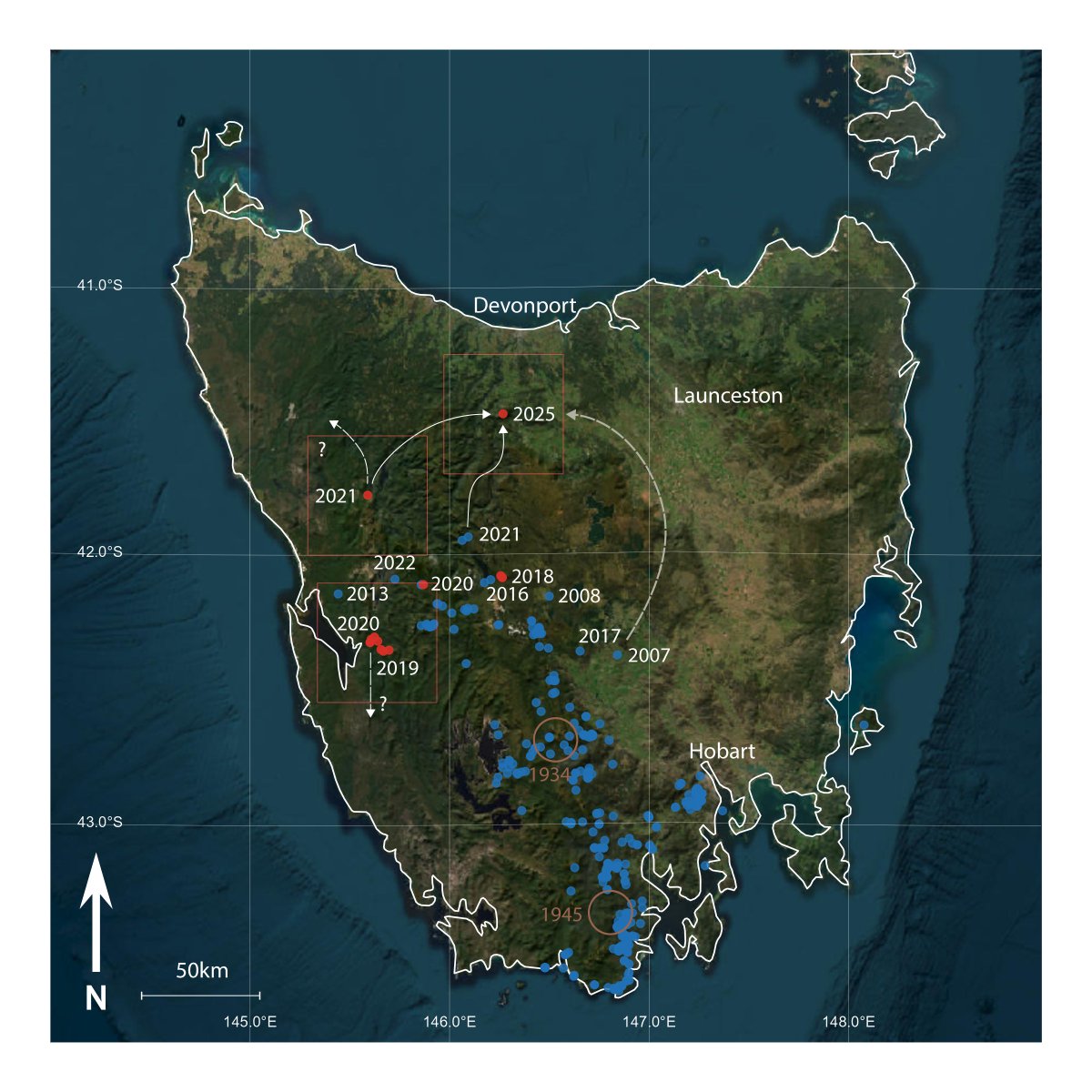
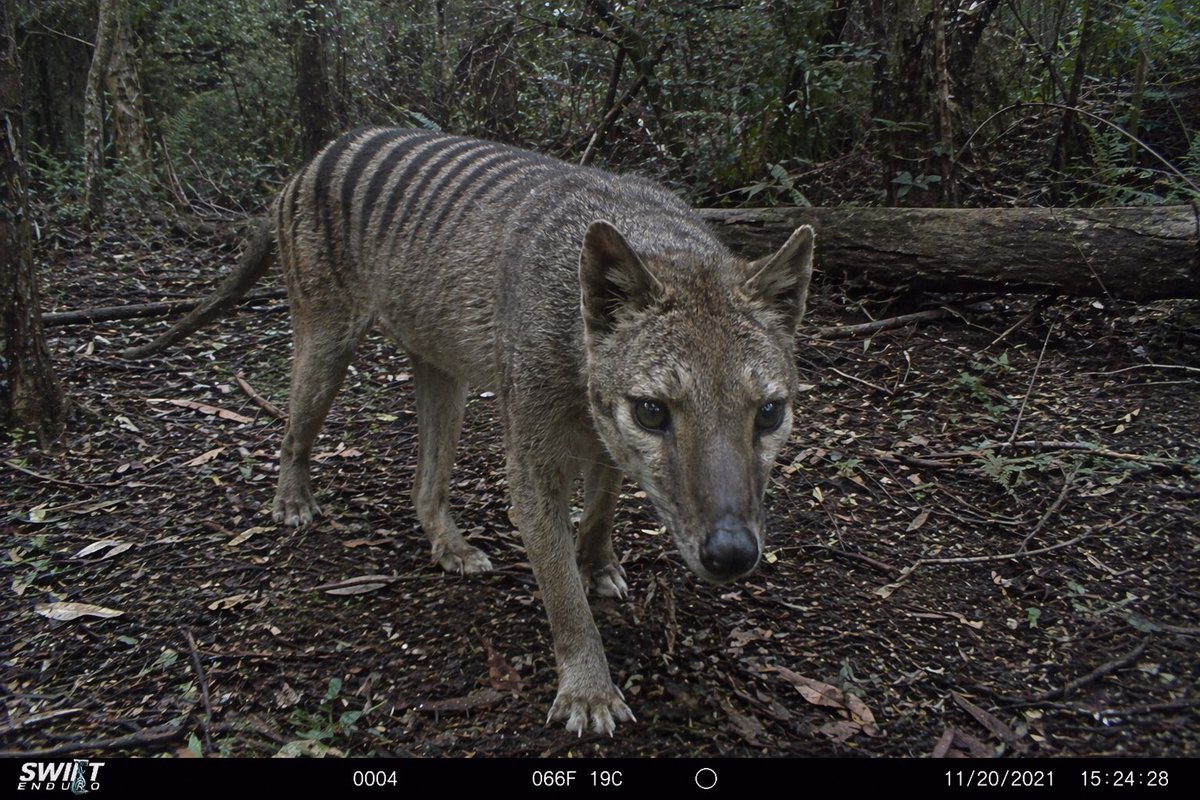
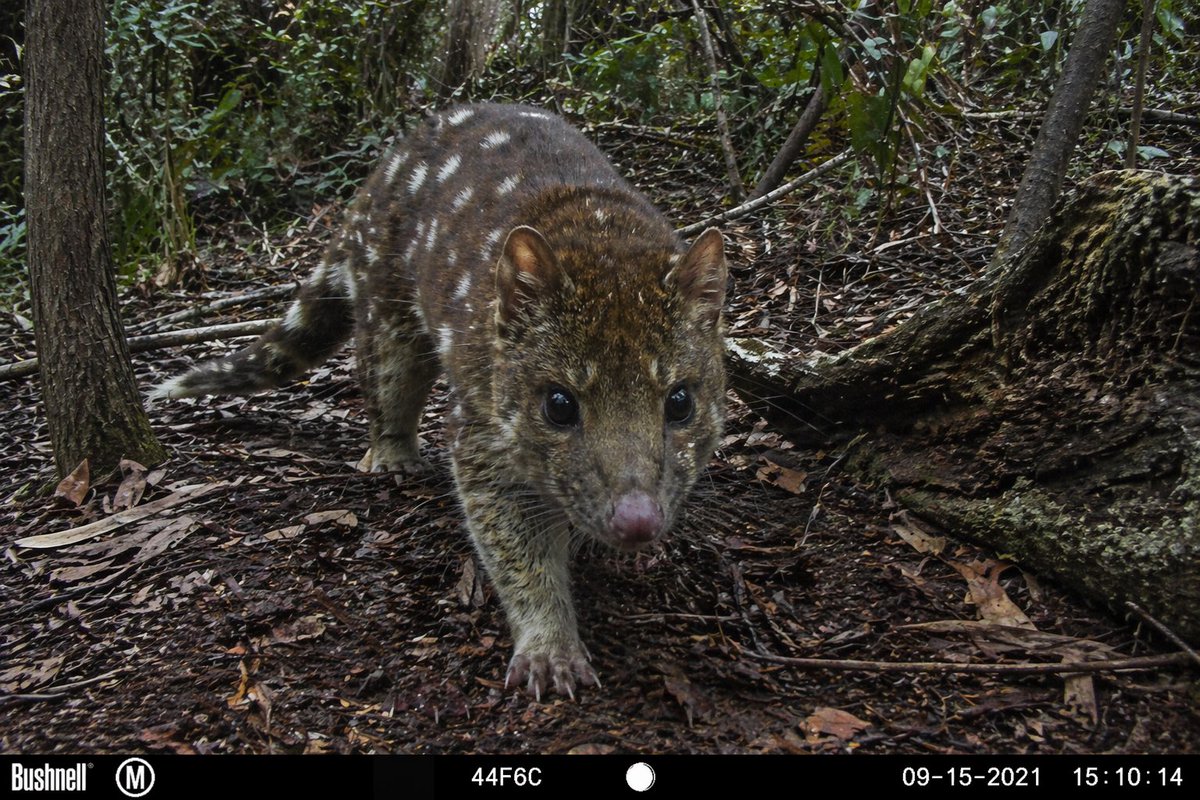
Much has been claimed about the extinction of the Tasmanian Tiger (thylacine). These two images come from NW Tasmania, taken in 2007 and 2013 on an early type of wildlife camera. Consider carefully what they might be. They were, for many years, quite perplexing!
Barry Brook tweet mediaBarry Brook tweet media
English
2
0
5
722
Tibo
Tibo@thsottiaux·
As a Codex user, which platform are you on
English
509
21
703
218.5K
Barry Brook
Barry Brook@BraveNewClimate·
@simpsoka I love the Windows app (via WSL) to bits, but it's currently sooooooo slow to pick-up on a new conversation or to restart an existing thread. Fine once it's going, it's just the first new/returned interaction that grinds...
English
0
0
1
100
Kath Korevec
Kath Korevec@simpsoka·
Windows Codex users. Tell me the good bad and ugly. Where do we need to dig in?
English
417
18
462
94.1K
Barry Brook
Barry Brook@BraveNewClimate·
@ajambrosino Good to hear. I love the Windows app (via WSL) to bits, but it's currently sooooooo slow to pick-up on a new conversation or to restart an existing thread. Fine once it's going, it's just the first new/returned interaction that grinds...
English
0
0
2
549
Andrew Ambrosino
Andrew Ambrosino@ajambrosino·
next app release is so much faster
English
53
14
783
60.5K
swyx 🇸🇬 AIE Singapore!
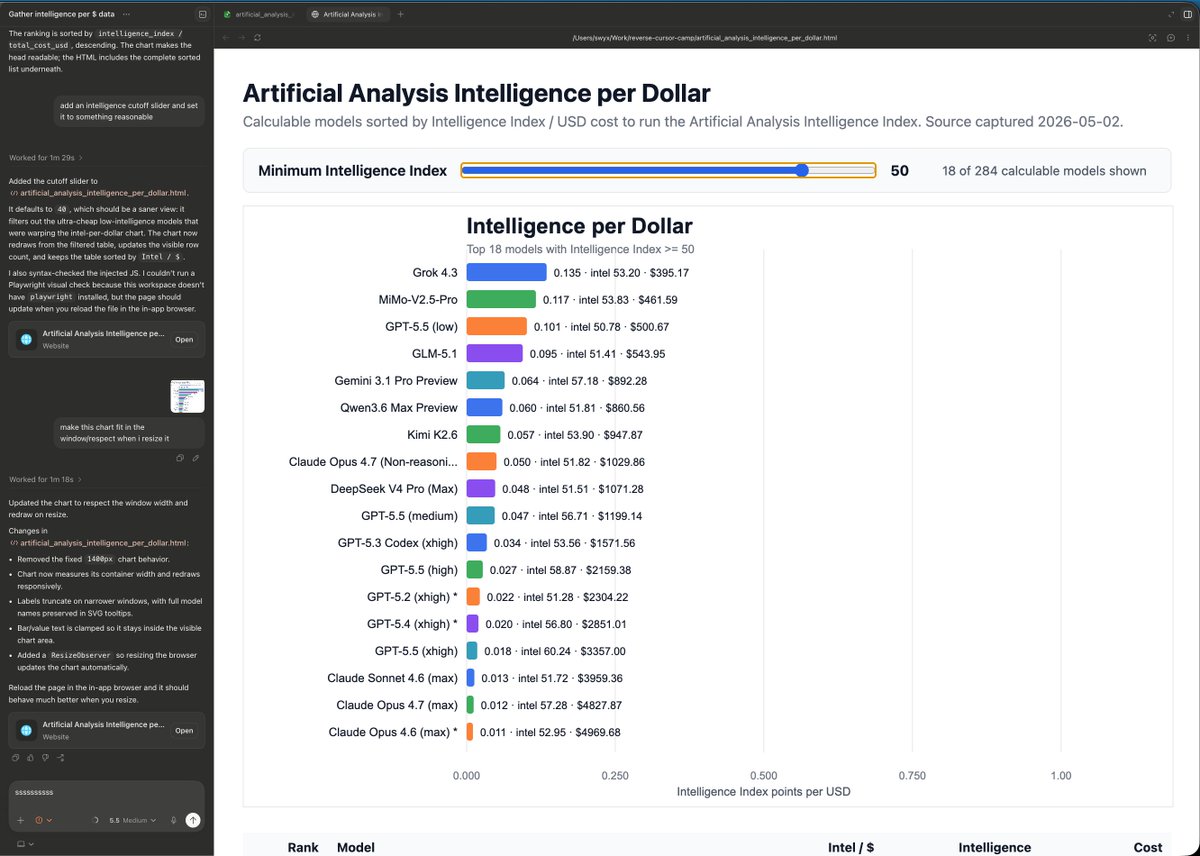
small milestone: uninstalled the chatgpt app. codex is strict superset now! found something cool - among frontier models, @xai @grok 4.30 is the most intelligence per dollar you can get, beating even open models like MiMo, Kimi, and DeepSeek. numbers pulled from @ArtificialAnlys
swyx 🇸🇬 AIE Singapore! tweet media
English
43
7
130
15.7K
Flowers ☾
Flowers ☾@flowersslop·
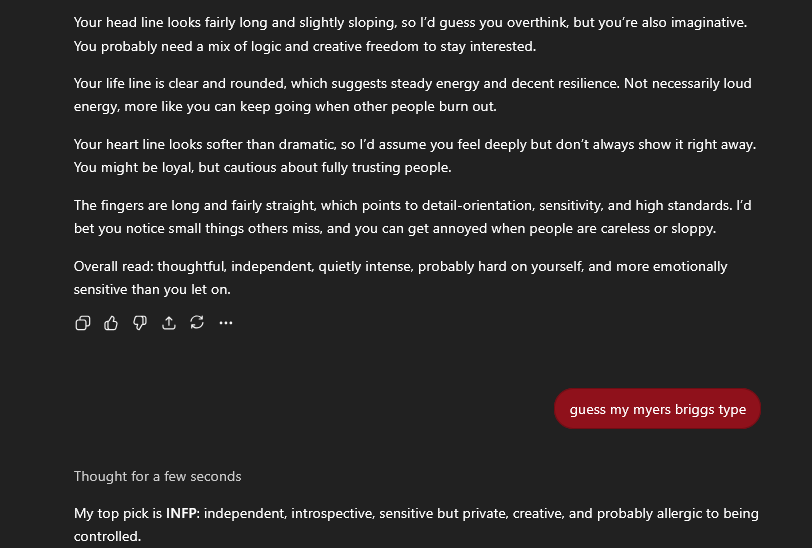
Maybe we live in a simulation, because GPT 5.5 guessed my personality type from a photo of my palm (memory off) The odds of getting it right by chance are 6% I am not esoteric, and I do not believe in palm reading. But I have no idea what kind of magic this is either..
Flowers ☾ tweet media
English
36
1
91
7.2K
Barry Brook
Barry Brook@BraveNewClimate·
@nlw It has all the hallmarks of a distilled model. Benchmark pleasing, but does weird things on edge cases that reveals its low parameter count. It is so different to Opus 4.6 that it must surely be a hard Mythos distillation, sized for compute efficiency not taste.
English
0
0
0
231
Nathaniel Whittemore
Okay...is it possible that....Opus 4.7 is like....fuckin terrible?
English
79
12
457
67.1K
Barry Brook
Barry Brook@BraveNewClimate·
Almost but not quite!
Barry Brook tweet media
English
0
0
0
59
Barry Brook
Barry Brook@BraveNewClimate·
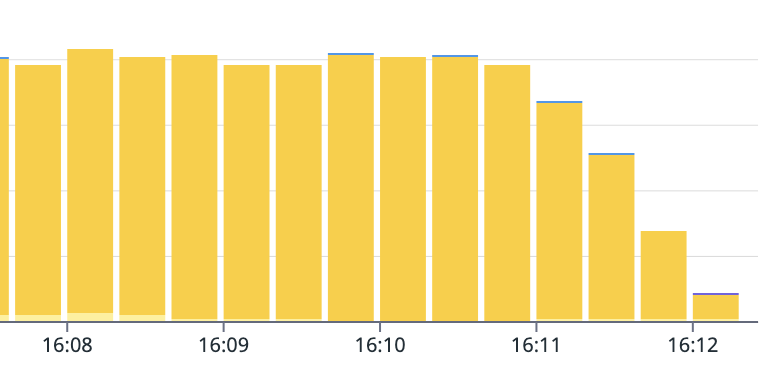
Fake camtrap images are now basically solved with gpt-image-2 model
Barry Brook tweet media
English
0
0
0
203
Barry Brook
Barry Brook@BraveNewClimate·
@JohnDPMorgan Yes, but deep-learning anchored AGI is more akin to nuclear energy, whereas and Marcus’ “neurosymbolic will win” proclamations is Diesendorf saying the equivalent about 100% WWS.
English
1
0
1
38
John Morgan
John Morgan@JohnDPMorgan·
> We’ve reached AGI! > Looks inside > IF … THEN statements > 90s expert system > It’s a good AI sir!
Gary Marcus@GaryMarcus

Claude Code is not AGI, but it is the single biggest advance in AI since the LLM. But the thing is, Claude Code is NOT a pure LLM. And it’s not pure deep learning. Not even close. And that changes everything. The source code leak proves it. Tucked away at its center is a 3,167 line kernel called print.ts. print.ts is a pattern matching. And pattern matching is supposed to be the *strength* of LLMs. But Anthropic figured out that if you really need to get your patterns right, you can’t trust a pure LLM. They are too probabilistic. And too erratic. Instead, the way Anthropic built that kernel is straight out of classical symbolic AI. For example, it is in large part a big IF-THEN conditional, with 486 branch points and 12 levels of nesting — all inside a deterministic, symbolic loop that the real godfathers of AI, people like John McCarthy and Marvin Minsky and Herb Simon, would have instantly recognized.* Putting things differently, Anthropic, when push came to shove, went exactly where I long said the field needed to go (and where @geoffreyhinton said we didn’t need to go): to Neurosymbolic AI. That’s right, the biggest advance since the LLM was neurosymbolic. AlphaFold, AlphaEvolve, AlphaProof, and AlphaGeometry are all neurosymbolic, too; so is Code Interpreter; when you are calling code, you are asking symbolic AI do an important part of the work. Claude Code isn’t better because of scaling. It’s better because Anthropic accepted the importance of using classical AI techniques alongside neural networks — precisely marriage I have long advocated. It’s *massive* vindication for me (go see my 2019 debate with Bengio for context, or to my 2001 book, The Algebraic Mind), but it still ain’t perfect, or even close. What we really need to do to get trustworthy AI rather than the current unpredictable “jagged” mess, is to go in the knowledge-, reasoning-, and world-model driven direction I laid out in 2020, in an article called the Next Decade in AI, in which neurosymbolic AI is just the *starting point* in a longer journey.* Read that article if you want to know what else we need to do next. The first part has already come to pass. In time, other three will, too. Meanwhile, the implications for the allocation of capital are pretty massive: smartly adding in bits of symbolic AI can do a lot more than scaling alone, and even Anthropic as now discovered (though they won’t say) scaling is no longer the essence of innovation. The paradigm has changed. — *Claude Code is plainly neurosymbolic but the code part is a mess; as Ernie Davis and I argued in Rebooting AI in 2019, we also need major advances in software engineering. But that’s a story for another day.

English
1
0
1
159
Barry Brook
Barry Brook@BraveNewClimate·
@chatgpt21 No signal left in GPQA, it's totally saturated
English
0
0
3
1.2K
Chris
Chris@chatgpt21·
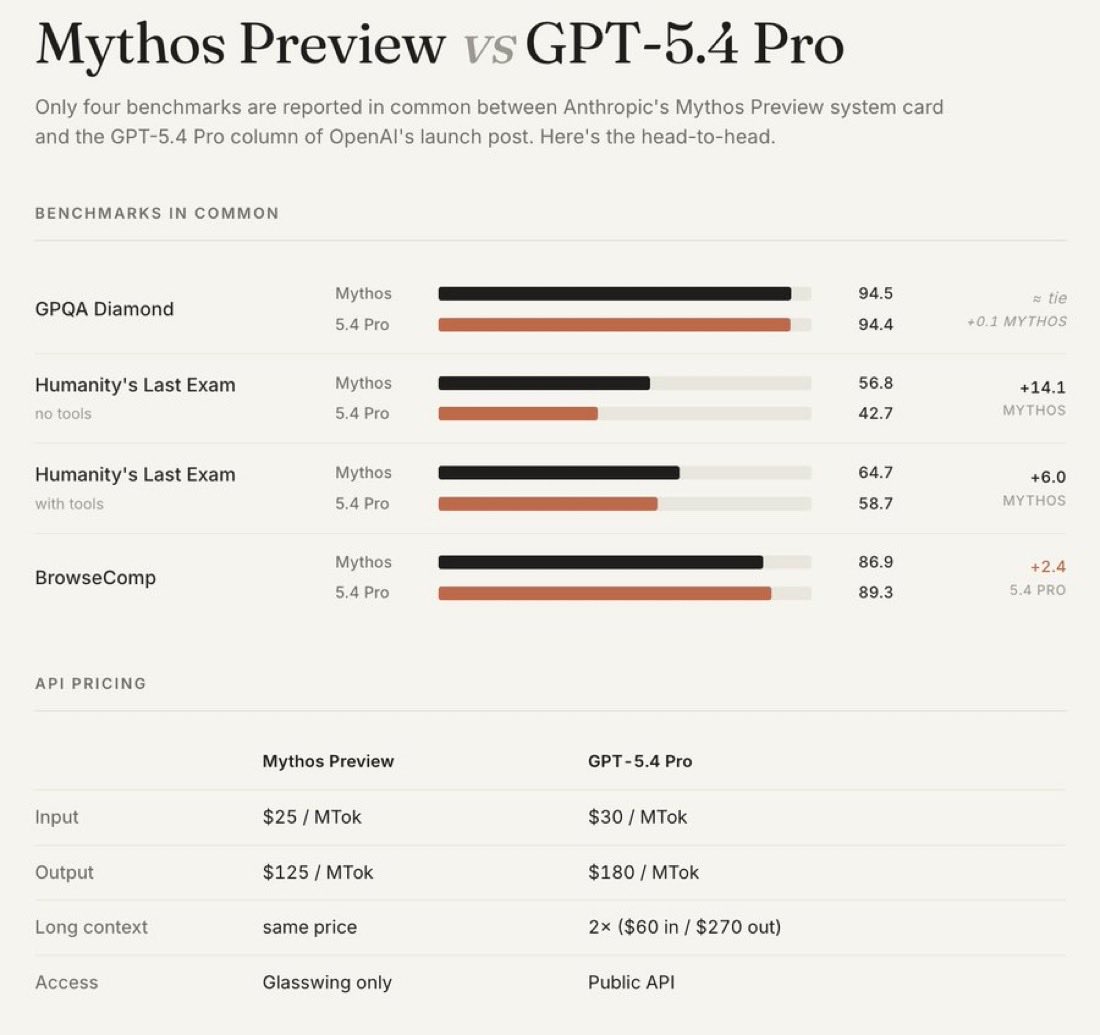
Honestly this chart makes me more bullish on GPT 5.4 Pro than anything else. People are focusing on Mythos looking strong, but what stands out to me is how well 5.4 Pro already stacks up on the overlap we actually have. GPQA is basically a tie at 94.4 vs 94.5. BrowseComp is a win for GPT 5.4 Pro at 89.3 vs 86.9. Yes, Mythos is ahead on Humanity’s Last Exam, 56.8 vs 42.7 without tools and 64.7 vs 58.7 with tools, but the bigger point is that 5.4 Pro is already this competitive right now. So if GPT 5.4 Pro is already THIS COMPETITIVE here, then Spud Pro, the next OpenAI flagship, is guaranteed to beat Mythos. This chart makes OpenAI look extremely close before its next real jump, and once that next jump lands I do not think Mythos stays ahead.
Chris tweet media
English
129
125
1.8K
323K
Rohan Varma
Rohan Varma@TheRohanVarma·
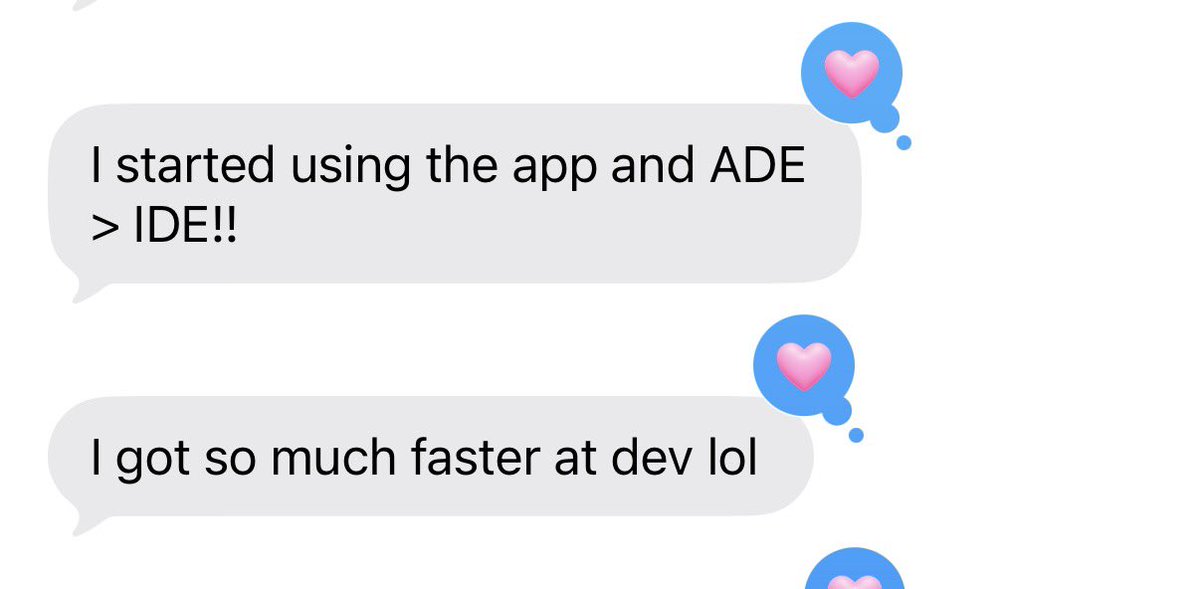
What would it take for you to stop using your IDE and completely switch to using the Codex App as your ADE (Agentic Development Environment)?
Rohan Varma tweet media
English
48
3
73
10.8K
Dean W. Ball
Dean W. Ball@deanwball·
I just got a S*bst*ck subscription that appears to be from a jointly owned account by a married couple, like the S*bst*ck account name is (not literally this for their privacy) “bill and jane smith” and this has given me a new marriage goal.
English
15
1
137
12K
Barry Brook
Barry Brook@BraveNewClimate·
@lu_sichu Regarding Chollet’s claim: that which is asserted without evidence can be dismissed without evidence. He calls it a misconception, yet never considers that it is he who might have misconceived.
English
0
0
0
31
Barry Brook
Barry Brook@BraveNewClimate·
@fchollet That's just an evidence-free assertion. The rounded sphere hypothesis *might* be correct, but so might the 10,000 IQ tower hypothesis. We just don't yet know. And current evidence points slightly more towards the latter than the former.
English
0
0
0
72
François Chollet
François Chollet@fchollet·
One of the biggest misconceptions people have about intelligence is seeing it as some kind of unbounded scalar stat, like height. "Future AI will have 10,000 IQ", that sort of thing. Intelligence is a conversion ratio, with an optimality bound. Increasing intelligence is not so much like "making the tower taller", it's more like "making the ball rounder". At some point it's already pretty damn spherical and any improvement is marginal. Now of course smart humans aren't quite at the optimal bound yet on an individual level, and machines will have many advantages besides intelligence -- mostly the removal of biological bottlenecks: greater processing speed, unlimited working memory, unlimited memory with perfect recall... but these are mostly things humans can also access through externalized cognitive tools.
English
302
176
2.1K
425.2K
Barry Brook retweetledi
Matthew Barnett
Matthew Barnett@MatthewJBar·
AI pause advocates often say they are pro-technology and pro-economic growth, and that they simply make one exception for AI because of its unique risks. But this reasoning will grow less credible over time as AI comes to account for a larger and larger share of economic growth. Simple growth models predict that AI capable of substituting for human labor will raise economic growth rates by an order of magnitude or more. If that's right, then AI will eventually be driving the vast majority of technological innovation and improvements in the standard of living. Stopping AI really would be like halting technology itself, because you would be shutting off the source of nearly all growth. This suggests that proposing to pause AI today is like proposing to pause electricity in 1880: yes, electricity is technically just one technology among many, but pausing it would threaten to shut down progress on most of the others. I also question the premise that AI is unique in its risks. Pause advocates argue that, apart from perhaps nuclear weapons, AI is the first technology to threaten the survival of the human species. But the boundary around "human species" is arbitrary. It only fails to feel that way because, for us today, the human species seems synonymous with the whole world. Replacing us feels like ending the world. Yet a hunter-gatherer tribe might just as easily feel the same way about themselves and their way of life. To them, the development of agriculture would feel like an existential risk. It would, from their point of view, be a threat to everything that matters. In reality, the world is much larger than either hunter-gatherer tribes or even the human species. By developing AI, we are bringing into existence a new class of sapient beings, ones who will inhabit the world alongside us. I predict that we will coexist with them peacefully, and I welcome efforts to make that outcome more likely. But peaceful or not, the outcome matters for them too. We are not the only people in the story. In the future, the vast majority of interesting and valuable events will likely occur between digital people, not between the more limited biological ones. The vast majority of relationships, discoveries, adventures, acts of kindness, and feelings of joy will take place within an artificial world, one to which the label "human" may no longer cleanly apply. In such a world, insisting that the human species represents everything that matters will be like insisting that hunter-gatherers represent the whole world. That may have felt like a reasonable claim 12,000 years ago, but today it would sound silly. Whether we like it or not, technology has always posed massive risks to "the world". AI is not the first technology to do this, and it will likely not be the last. The only difference is that this time, technology threatens the world that people alive today grew up in. Just as our ancestors experienced before us, we face the prospect of losing the world we know in exchange for material progress and prosperity. I am happy to take that trade, just as I am glad my ancestors took it in theirs.
English
27
4
44
10.2K
roon
roon@tszzl·
the year is 20xx. the surface of the sun is lined with ten trillion trillion trillion transistors. the machine deity Ra simulates infinite heavens for humankind to wander. Ed zitron remains skeptical about anthropic revenue figures
English
111
137
3K
123.6K