BruinCap

154 posts

BruinCap

BruinCap

@BruinCap8

Thinking in public. Posts are not financial advice. My opinions are frequently wrong.

Katılım Eylül 2021
1.2K Takip Edilen202 Takipçiler
BruinCap
BruinCap@BruinCap8·
@bucketshopcap Experts are great at inside view, often terrible at outside view. Can’t get at the most objective view of the future without combining the two.
English
0
0
2
194
Bucket Shop Capital
Bucket Shop Capital@bucketshopcap·
Too many of you are too certain of rapidly changing phenomena based on the statements of a few driving said change. Being too reliant on these ppl’s words is the same as being blind/resistant to change. Truth is always nuanced & in the middle- not a strength of Fintwit.
English
4
4
90
9K
BruinCap
BruinCap@BruinCap8·
"The data reveal that no public company has grown this fast for five years in the last three-quarters of a century. The results include all industries. The average compound annual growth rate is 7.0 percent, and the standard deviation is 10.6 percent. The forecast implies a roughly 9.5 standard deviation outcome for OpenAI under a normal approximation, which is extraordinarily unlikely"
BruinCap tweet media
Michael Mauboussin@mjmauboussin

We have a new report out today, "Bayes and Base Rates: How History Can Guide Our Assessment of the Future." -We place projected sales growth rates of some artificial intelligence (AI) businesses in the context of history. - We review literature on success rates for big projects (% on budget, on time, deliver expected benefits). -We discuss Michael Porter's work on plans to expand capital expenditures. Link in comment

English
0
0
0
146
BruinCap retweetledi
BruinCap
BruinCap@BruinCap8·
Another timely one (written in 2018): "A friend pointed out to me recently that the Federal Reserve, so far almost uniquely among major federal agencies, hasn’t had its basic organization and functional responsibilities threatened by the Trump administration. I’d like to think that, over the years, the Federal Reserve has in fact maintained the respect of the Congress and presidents alike. In an environment in which trust in government is dangerously low, the Fed still retains a high degree of credibility. In that respect, it is a national asset. It is not above accountability. It is not free from error. It does need the attention of the Congress to ensure it is equipped to maintain responsible and economical administration of its authorities. And it does need to be shielded from partisan politics. Taken all together, it remains a precious asset for the country in troubled times"
English
1
1
1
160
BruinCap
BruinCap@BruinCap8·
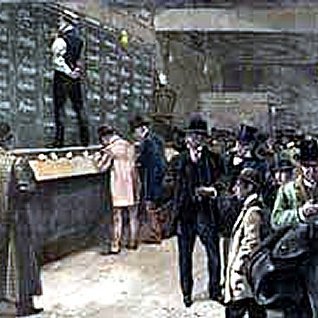
“social licenses are easily revoked”
BruinCap tweet media
English
0
0
1
63
BruinCap
BruinCap@BruinCap8·
From Quality Investing by Cunningham, Eide, and Hargreaves: "Above all, while phrases like 'demand super-cycle' sound like the foundation for an intelligent argument, they are euphemisms for the foolish belief that good times will last forever. When cyclical industries falter, many analysts portray it as a natural or even healthy adjustment period. They say it may be painful, but it will end. Yet when the cycle turns up, the talk is of permanent trends and why this upturn is different, and more durable, often using puffy adages such as 'all the easy oil has been drilled.' In flush periods, such narratives can be seductive. But for highly cyclical industries, it is when prospects look brightest that investors should be most wary"
English
0
0
0
51
BruinCap
BruinCap@BruinCap8·
Two unrelated thoughts: Ignorance of base rates is a key driver of bubbles. Generative AI is stochastic at its core.
English
0
0
1
249
BruinCap
BruinCap@BruinCap8·
Published in 2003, but think this dynamic will become increasingly important into 2026 + midterms: "Meanwhile, the fortunate participants in the gilded groups, regions and countries, experiencing the booming atmosphere, become ever more convinced of the appearance of a ‘new economy’ promising unending bliss. From the other side of the fence, this buoyant arrogance looks like scorn."
English
0
0
0
52
BruinCap
BruinCap@BruinCap8·
From Carlota Perez's Technological Revolutions and Financial Capital: "The velocity of technical change, typical of the early phases of technological revolutions ends up creating the problem of premature obsolescence. Since the mid-1990s, for instance, the speed of increase in computer power, in new generations of software or cellular phones and in dot com companies on the Internet, hardly allowed users the time for learning or for amortizing investment. But no producer could afford to stay behind in the innovation race. Wells in 1889 described a very similar situation in relation to steamships since the mid-1870s: 'The numerous and expansive steamer constructions of 1870–73, being unable to compete with the constructions of the next two years, were nearly all displaced in 1875–76, and sold for half, or less than half, of their original cost. And within another decade these same improved steamers of 1875–76 have, in turn, been discarded and sold at small prices, as unfit for the service of lines having an established trade, and replaced with vessels fitted with triple-expansion engines and saving nearly fifty per cent in the consumption of fuel. And now ‘quadruple-expansion’ engines are beginning to be introduced and their tendency to supplant the ‘triple expansion’ is unmistakable'"
English
1
0
0
78
BruinCap
BruinCap@BruinCap8·
“Software 1.0 easily automates what you can specify. Software 2.0 easily automates what you can verify.”
Andrej Karpathy@karpathy

Sharing an interesting recent conversation on AI's impact on the economy. AI has been compared to various historical precedents: electricity, industrial revolution, etc., I think the strongest analogy is that of AI as a new computing paradigm (Software 2.0) because both are fundamentally about the automation of digital information processing. If you were to forecast the impact of computing on the job market in ~1980s, the most predictive feature of a task/job you'd look at is to what extent the algorithm of it is fixed, i.e. are you just mechanically transforming information according to rote, easy to specify rules (e.g. typing, bookkeeping, human calculators, etc.)? Back then, this was the class of programs that the computing capability of that era allowed us to write (by hand, manually). With AI now, we are able to write new programs that we could never hope to write by hand before. We do it by specifying objectives (e.g. classification accuracy, reward functions), and we search the program space via gradient descent to find neural networks that work well against that objective. This is my Software 2.0 blog post from a while ago. In this new programming paradigm then, the new most predictive feature to look at is verifiability. If a task/job is verifiable, then it is optimizable directly or via reinforcement learning, and a neural net can be trained to work extremely well. It's about to what extent an AI can "practice" something. The environment has to be resettable (you can start a new attempt), efficient (a lot attempts can be made), and rewardable (there is some automated process to reward any specific attempt that was made). The more a task/job is verifiable, the more amenable it is to automation in the new programming paradigm. If it is not verifiable, it has to fall out from neural net magic of generalization fingers crossed, or via weaker means like imitation. This is what's driving the "jagged" frontier of progress in LLMs. Tasks that are verifiable progress rapidly, including possibly beyond the ability of top experts (e.g. math, code, amount of time spent watching videos, anything that looks like puzzles with correct answers), while many others lag by comparison (creative, strategic, tasks that combine real-world knowledge, state, context and common sense). Software 1.0 easily automates what you can specify. Software 2.0 easily automates what you can verify.

English
0
0
0
116
BruinCap
BruinCap@BruinCap8·
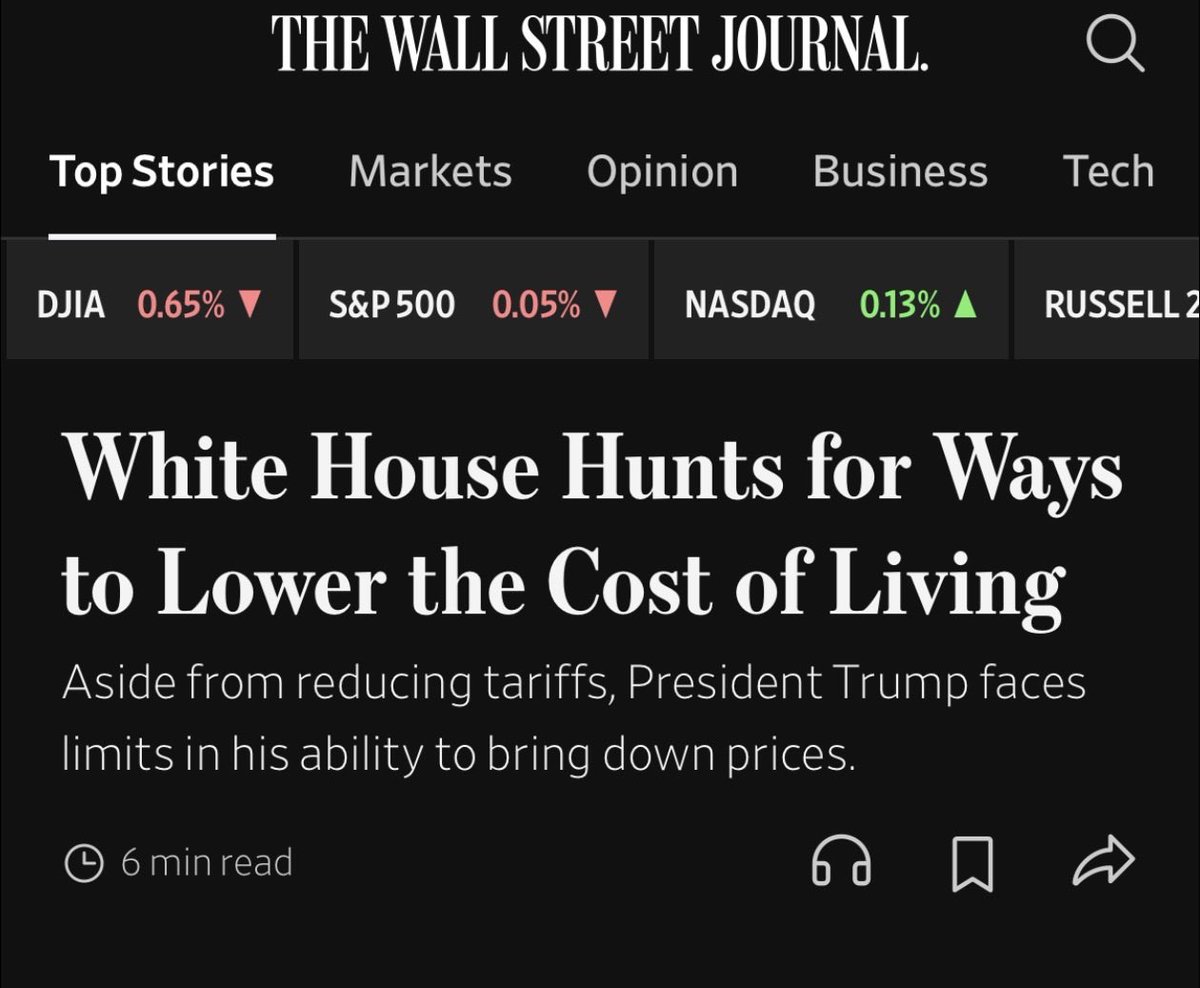
Any durable solution will push asset prices lower in the short term, which the administration has shown zero tolerance for. Affordability becoming issue number one into midterms so maybe this will change, but seems unlikely. Tailwind for Dems into 2026.
BruinCap tweet media
English
0
0
0
65
BruinCap
BruinCap@BruinCap8·
“I think the connection here to AI is people wonder if we're in the eruption phase of AI or not. Is this the start of a new technological revolution? …I think this is the end of the computer wave. I think this is the culmination of the computer wave. Why did we build computers? We build computers to help us think better. This is what they're for. They're knowledge machines. So now we've kind of reached the natural end stage of what they do. They're smart machines. So I think this is not a new technological revolution. I think it's the end of the old one. And this is why I compared it to containerization, because the previous wave was automobiles, mass production, starting in 1915 or so up until 1970. And containerization was squarely at the end of that wave. And it was really kind of pulling together the technologies of that wave into something that increased productivity.”
Joe Weisenthal@TheStalwart

NEW ODD LOTS: It's @ganeumann @tracyalloway and I talk to the longtime VC about where we are in the AI cycle, why he's skeptical that now is the time to place your bets, and why we won't know the real winners from the technology for years to come podcasts.apple.com/us/podcast/jer…

English
0
0
0
135
BruinCap
BruinCap@BruinCap8·
Courtesy of @profplum99: “If the expected payoff to effort approaches zero, rational agents allocate attention to chaos—where at least the distribution is wide”
BruinCap tweet media
English
0
0
0
76