Bruno Silva retweetledi
Bruno Silva
16 posts

Bruno Silva retweetledi

Market Cap:
$GOOG: ~$4.8T
$META: ~$1.5T
Google is a phenomenal business, but it is NOT 3x the business Meta is. Meta is growing revenue at 33% YoY compared to Google’s 22%, and Zuck is shipping product and integrating AI into the ad stack significantly faster than Alphabet.
Paying a massive infrastructure premium for Google while $META trades at a deep discount is a total disconnect from the fundamentals. The valuation gap makes zero sense.

English
Bruno Silva retweetledi

Feb 2023: Google invests $300M in Anthropic
Oct 2023: Google adds $2B
Mar 2025: Google adds $1B
Oct 2025: Anthropic deal for ~1M Google TPUs
Apr 2026: Multi-GW TPU deal, Google invests an additional $40B
May 2026: Anthropic commits ~$200B to Google Cloud
Kalshi@Kalshi
BREAKING: Anthropic commits to spend $200B on Google cloud and chips over next 5 years
English

@QualityGrowth_ @Sebastiaoferrao Now it's going to get even better !!
English

@BrunoSi6609201 @Sebastiaoferrao Some investments didn’t work out so well, basically!
Thanks for the good energy!
English
Bruno Silva retweetledi

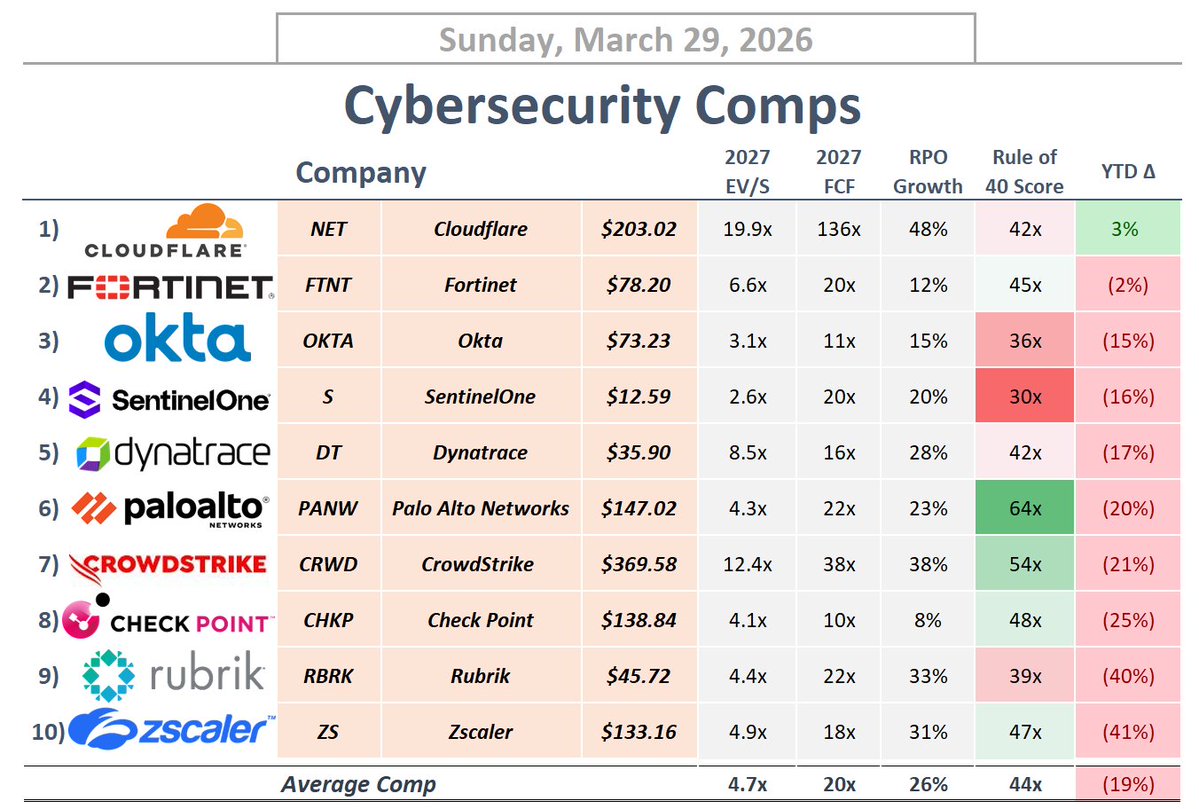
AGENTIC AI SECURITY STACK
• $ZS access layer for agentic systems
• $OKTA identity control for humans & agents
• $FTNT network security for agent traffic at scale
• $NET edge security for internet-facing agent activity
• $PANW full-stack security across the agentic enterprise
• $DT observability & security visibility for complex AI systems
• $RBRK data protection & recovery for AI-native environments
• $CRWD endpoint identity & cloud security for agentic workflows
• $CHKP prevention-first security for autonomous threat environments
• $S endpoint & identity defense against AI-driven attacks for the midmarket

English

@Sebastiaoferrao @QualityGrowth_ Yes, he now has a portfolio that I believe will outperform the market, I don't know how he didn't succeed in previous years
English

@QualityGrowth_ Why would you have your own portfolio if you consistently underperform the market?
English
Bruno Silva retweetledi

Gemini after Google invested $40,000,0000,000 on Claude

Karan@karankendre
Gemini watching Google investing in Claude
English
Bruno Silva retweetledi

Most people come into the market thinking the same way. I buy a stock at $100, it goes to $150, I win. If it drops to $70, something must be wrong. It feels logical, but it’s actually backwards.
In a perfect world, your stock wouldn’t behave like that. It would move in line with the business over time. If the business is generating 15% returns on capital, over time the stock will deliver a 15% return. It would be slow, steady, and almost boring in line with the return of capital your business generates.
But the market doesn’t work like that. Prices move on emotion, positioning, chaos, and short term thinking. They swing far more than the business underneath them and that where most investors lose perspective.
Take a simple example. A business (not a stock), goes from $100 to $115 to $132 over two years. Nothing extraordinary, just steady and natural improvement in value. The business is doing exactly what you want it to do.
Now look at the stock, it goes from $100 to $50 to $75 over that same period. Most investors feel like they lost money, even though the business is worth more than before. The only thing that changed was the price. That’s the game, the business compounds quietly but stock moves around it wildly.
Volatility is not risk, it’s the price you pay to own a compounding business in a public market. If you want the return, you have to accept the path and there’s no way around it.
And the path is the hard part because a stock can go from $100 to $150 to $100, or from $100 to $50 to $100. Same ending, completely different experience. One feels easy, the other makes people quit.
That’s why most investors don’t get the return the business produces. They don’t survive the path required to get there. They react to the swings instead of focusing on the intrinsic value.
When you ask for a stock to go from $100 to $150 quickly, you’re pulling future returns forward. It feels good now, but you’re lowering what you can earn next. The opposite is true when the stock drops and nothing changes. Up fast doesn’t mean you’re right and down fast doesn’t mean you’re wrong. Most of the time it just means the market moved.
The market trains you to focus on the wrong thing. It gives you a price every second and makes you feel like you need to act. It turns a long term process into a short term reaction.
Most people don’t sell because the business broke. They sell because the price broke. That one decision ruins more returns than anything else.
Time horizon changes everything. Over one year, this looks random. Over ten years, it starts to look obvious. Same business, different experience depending on how long you stay.
So what actually matters is simple. What does the business earn, and what does it do with that capital. If it earns strong returns and keeps reinvesting, that’s your return.
Imagine you owned the whole business privately. It earns $15 on $100 every year and keeps reinvesting. One day someone offers you $70, the next day $150. You wouldn’t care because you’d focus on what the business is earning. Public markets trick you into doing the opposite. The biggest mistake isn’t volatility. It’s confusing price with reality. Over time, the business does the work and the stock just reflects it. 🌹
English
Bruno Silva retweetledi