

Trace Crawford
738 posts
Trace Crawford
@BubbaDoesEcom
I USED to sell razors on the internet @ SUPPLY (Acquired) // Freelance growth marketer for 7 & 8-figure DTC brands. Let's chat growth 👇
United States Katılım Şubat 2021
359 Takip Edilen1.1K Takipçiler

Self-improving Claude Code skills are f*cking ridiculous 🤯
One loop → 10 test runs, scored against an eval, prompt rewritten, retested, winner kept.
A hook writer skill went from 32/50 to 47/50 overnight.
All inside Claude Code.
Perfect for DTC brands and agencies who have a Claude skill that's *almost* there — but the outputs still need a human pass before they're usable.
Here's the problem:
You build a skill that writes hooks. Or briefs. Or product descriptions.
The first version is decent. Maybe 70% there.
You spend the next two weeks tweaking the prompt by hand. Add a rule. Test it. Add another rule. Test it. The skill gets slightly better and you have no idea if you actually improved it or just got a lucky run.
This loop solves it:
→ Define what "good" looks like — a 10-point eval rubric the skill is graded against
→ The skill runs 10 times against real inputs
→ Claude scores every output against the rubric
→ Claude rewrites the skill's prompt based on where it lost points
→ Repeats until the score plateaus
→ Saves the winning version
No more guessing if your tweaks helped.
No more two-week tuning marathons.
No more skills that work 60% of the time.
What you get:
- A repeatable optimization loop you can run on any skill in your library
- Clear before/after scores so you know exactly what improved
- Skills that get sharper every time you run the loop
- The exact eval rubrics for hook writing, brief generation, and ad copy
Built 100% in Claude Code.
Want the full setup?
> Like this post
> Comment "EVAL"
And I'll send it over (must be following so I can DM)
English

Ad & SEO agencies can add 5-10 clients without making a single hire by rolling out hermes to their agency.
The problem is most agency owners don't have time to figure out how to install it, where to start, or what to actually hand it first.
So my team built an 83-page playbook that does it for you.
Inside:
— The 5 daily prompts that turn it into a second brain
— Plain English setup for Mac, Linux, and Android
— How to lock it down without torching client data
— 8 copy-paste workflows across reporting, outreach, sales, and ops
— The cron trick that drops token spend by 90%
10 new clients at 5k/mo= 50k/mo in new profit just from this one tool.
Comment HERMES and I'll send it.
GREG ISENBERG@gregisenberg
how to set up hermes agent step by step. built-in memory, 40+ tools, works on your phone, and what to think of hermes vs openclaw: 1. hermes is a personal AI agent that runs in your terminal. think of it like open claw but with built-in memory, 40+ tools out of the box, and 90% cheaper token costs. you install it with one command. 2. the 3 problems with open claw that hermes solves: no memory (you keep repeating yourself), constant gateway restarts, and zero visibility into what you're spending on tokens. 3. hermes remembers everything. every completed task gets saved to memory. it searches through past logs to find solutions. over time it literally gets smarter at your specific workflows. 4. connect it to open router. you see exact costs per model per task. free models rotate weekly. one founder went from $130 every five days on open claw to $10 on hermes. same output. 5. it comes preloaded with skills. apple notes, imessage, find my, browser, web search, image generation, cron jobs. no hunting for plugins. 6. connect it to obsidian so it reads your entire vault. connect it to gstack for your dev environment. create custom skills for your specific workflows. 7. the biggest money saver: have it write code once for recurring tasks. then it runs without burning tokens every time. stop paying an LLM to do the same scrape or report daily. 8. run it on android via telegram. name your agents. talk to them like coworkers. in this episode imran shows you how to set this up. 9. you can run it bare metal, in docker, or serverless on modal. pick your risk level. i begged @imranye to come on @startupideaspod and walk through the full installation live. he made it impossibly clear. if you've heard of Hermes Agent and want the clearest explanation of how to get set up like a pro let me know what you want me to cover on the next ep this is the best personal agent setup video on the internet right now. watch
English
Seb and his team create some of the most unique and thoughtful statics. WAYYYY better than 99% of the AI slop that a lot of other agencies are slingin.
This guy's a dawg and you should definitely hit him up if you're struggling to scale statics.
He's also a genuinely great human - can't recommend him enough
seb | static ads@sebastian_dtc
some statics we've shipped recently
English
Completely agree.
It feels like ChatGPT when it first came out — the initial output is impressive at first glance, but the hard part is getting that last 20%. Dialing in the copy, the imagery, making sure the page is actually intentional and built to accomplish a specific goal.
It can get there, but it takes more work and like you said, way more context.
English

Manus for Landing Pages - Initial Impressions
I've been seeing a lot of folks on the timeline gas up this feature, so I decided to take it for a test drive.
What I did:
1. I asked Manus "what do you need from me to build out a lander around a new angle.
It asked for brand guidelines, product info, details on the angle, a landing page template to work from
2. I told it to use the brand's website for brand and product info, gave it a detailed 3 paragraph brief on the angle, and told it to use a reference from another brand for the lander layout and content.
3. It said "great" and took about 10 minutes to build me a live lander...that left a lot to be desired:
Branding was wayyyy off. Looked nothing like our website. Fonts were totally different. AI generated images were not brand aligned.
Outline was good, but it was giving too much focus to the technical aspects of the mechanism, not enough focus on emotions or outcomes.
Takeaway: as I suspected, the folks getting the most out of this feature are likely seeding it with rich, structured context to enable a better outcome.
Of course, no one talks about that on here because it isn't "sexy", and the know-how behind it is also "alpha".
Next steps: I'm going to build out a context kit for landers–which will probably take me about a week–and then try again.
Because if I CAN get this right, it will be powerful.
Here's the ugly truth/missing piece in this discussion:
When it comes to AI, context enables scalable outcomes. Context comes from reps, and the quality of context is amplified by structured thinking.
No one is talking about this, and certainly no one is giving it away for free.
If your AI work is outputting slop that doesn't convert–that's why!
English

Anthropic just shipped Claude Design
Here's how any DTC brand can ship 5 on-brand landing page variations for Meta in a single afternoon:
AI-native design that reads your website, learns your brand, and generates production-ready landing pages you hand off to Claude Code with one click.
Perfect for DTC brands and agencies who are tired of waiting 3 weeks for a designer to ship every new advertorial angle they want to test.
Here's the workflow:
→ Set up your brand system once — upload your site screenshots, logo, and brand assets. Claude extracts colors, typography, and components automatically. Every project after this uses it.
→ Create a new Prototype project. Prompt with the full framework: goal + layout + audience + reference pattern ("advertorial for our sleep supplement, hero + testimonial + offer, targeting women 35-55")
→ Answer Claude's 7-10 clarifying questions. Refine with inline comments, edit mode, and the tweaks panel.
→ Export as standalone HTML → drop into Shopify. Duplicate the project, swap one angle in the prompt, generate variation #2. Repeat until you have 5.
No designer back-and-forth.
No Figma-to-dev translation.
No 2-week turnaround on every new angle.
What this builds you:
→ A reusable brand system that applies automatically to every page, deck, and prototype you generate
→ On-brand advertorials, landing pages, and pitch decks in 20-30 minutes each
→ Export to HTML, PDF, PPTX, or Canva — or hand off to Claude Code to ship production code
→ A prototyping layer that finally bridges your creative team and your dev team
→ Included in your existing Claude Pro or Max plan
I put together the full playbook: the design system setup process, the prompt framework, the 5-mode editing workflow, the Claude Code handoff, and 3 ready-to-run DTC workflows (landing pages, agency pitch decks, advertorial cloning).
Want it for free?
> Like this post
> Comment "DESIGN"
And I'll send it over (must be following so I can DM)
Claude@claudeai
Introducing Claude Design by Anthropic Labs: make prototypes, slides, and one-pagers by talking to Claude. Powered by Claude Opus 4.7, our most capable vision model. Available in research preview on the Pro, Max, Team, and Enterprise plans, rolling out throughout the day.
English

Next month we launch Pepsi's first ever ecommerce store.
Sit with that for a second. A company founded in 1898, sold in nearly every country on earth, with one of the most valuable brand assets in consumer history, is about to transact directly with a customer for the first time.
For 127 years, every Pepsi purchase has belonged to someone else. The grocery chain. The gas station. The vending operator. The stadium. Pepsi knew shipments, share of shelf, and panel data. They did not know Sarah in Cleveland who buys a 12 pack every other Thursday.
That changes the day the store opens.
The thing I want DTC founders to hear is this.
You already have what a $26B beverage company is spending real money to build. You have first party data. You have email lists you can write to tonight. You have the ability to test a new offer, a new bundle, a new landing page, and have an answer by Friday. You have a direct line to the person who actually pays you.
Most founders I talk to treat those assets like a checkbox. A Klaviyo account that sends a welcome series and goes quiet. A Shopify backend they have not opened in months. A customer list that never gets segmented past buyers and non buyers.
A legacy brand would trade almost anything for what you are ignoring.
The lesson is not that ecommerce is easy or that Pepsi is late. The lesson is that the infrastructure you have been told is commoditized is the same infrastructure the biggest brands on earth are still trying to get their hands on.
English

Millionaires will be built on top of HQ.
If you implement Al for businesses, I want to make you as successful as possible.
We're starting with a first cohort. We will train you, enable you and bring you business.
If you want to be apart of this, please reach out.
Jacob Posel@jacob_posel
We've created Glass for every business. It's called HQ. Every business struggles to get their team using AI together. We solved it. Launching this week.
English
@oliverwhudson Are you referring specifically to new Facebook pages or are you also testing new LP specifically for these new FB pages?
English

One of the best performing static formats we're running across accounts right now. "Meet the founder who solved X problem." It absolutely flies.
Once you've found a winner in the main account, spin up third party pages. With Club Neuro, we took the winning static and built pages positioned around neuroscience education. Same creative, more educational context, running at scale through an expert driven lens.
More native, more upper funnel and for brands that are protective of their guidelines, it's one of the best ways to unlock creative diversity without touching the core brand account.

English

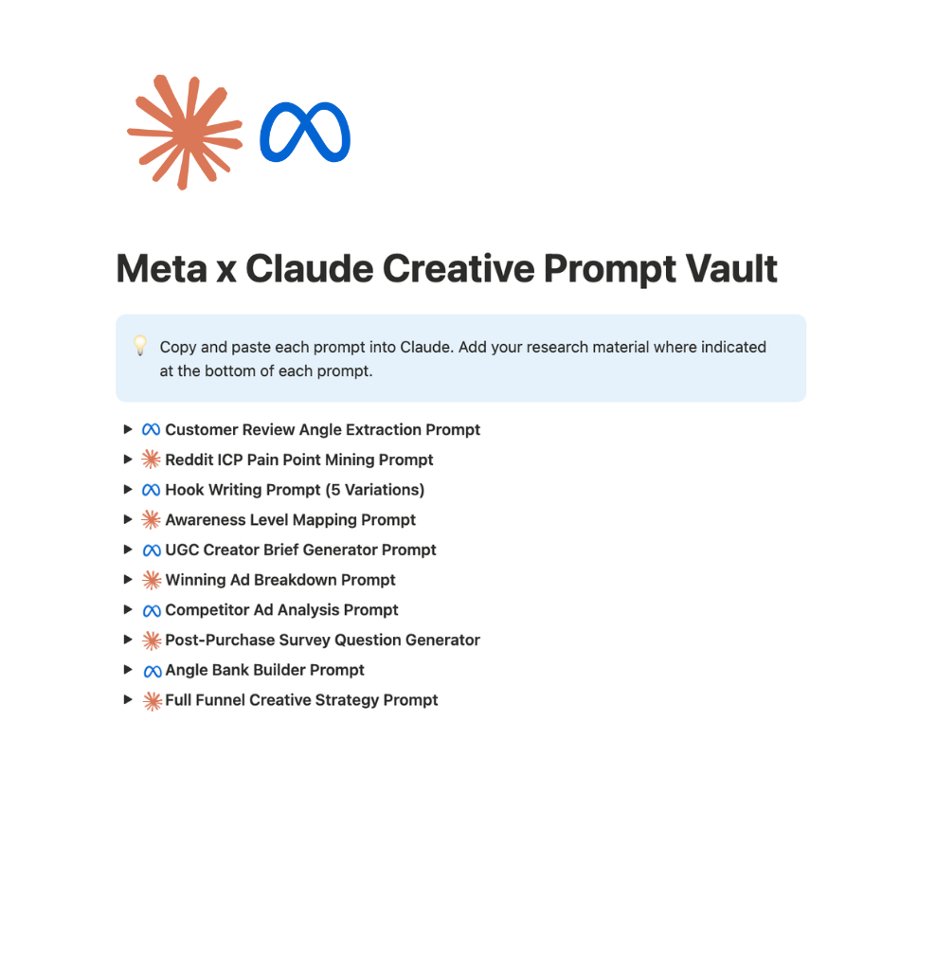
I use Claude to build winning Meta ad creative from scratch.
I put together my Meta Creative Research Vault (below)
Claude is BY FAR the best tool for extracting angles, writing hooks, and briefing creators.
I use my customer data combined with my prompts to go from zero to a full creative brief in under an hour.
My prompts replace an entire research team.
I compiled ALL my Claude prompts into one vault:
● Customer Review Angle Extraction Prompt
● Reddit ICP Pain Point Mining Prompt
● Hook Writing Prompt (5 variations from one angle)
● Awareness Level Mapping Prompt
● UGC Creator Brief Generator Prompt
● Winning Ad Breakdown Prompt
● Competitor Ad Analysis Prompt
● Post-Purchase Survey Question Generator
● Angle Bank Builder Prompt
● Full Funnel Creative Strategy Prompt
Want access?
→ Comment "Meta"
→ Follow me and I'll DM you the vault
English

I'm giving away the exact SOP my team uses to make claymation ads like this.
rt + comment "SOP" and I'll send it to you.
English


Has anyone gone DEEP on building design systems in Claude?
I think mine is pretty good and I’m able to design production ready pages for Shopify.
But it still takes too long and ignores a lot of the instructions.
Would love to compare notes with anyone that has gone deep here.
English
@ChrisLangSocial This is dope.
How was the process of launching of the page in Shopify? I’ve been using Manus a lot for LP mockups and then building those in Replo.
English

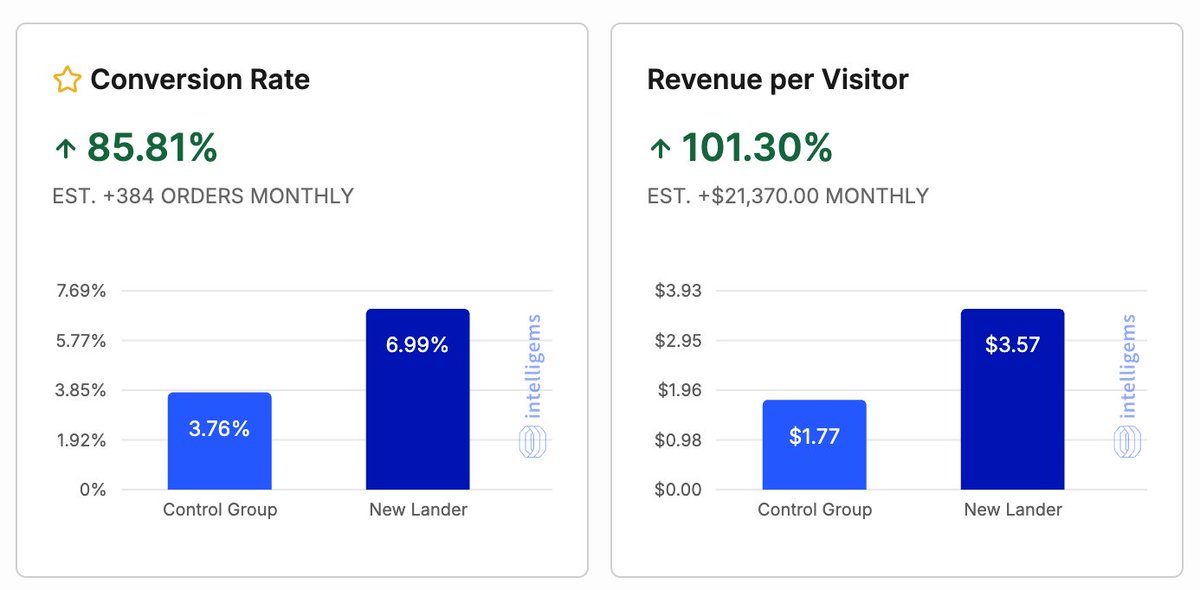
lol claude/manus lander ugly lander vs. shopify web dev agency
what's life rn?
waaaay to early results but it's pushing total site conversion to 3% for this brand
literal chad move, less thinking more testing
English
I wouldn’t argue that hit rate matters more then spend, but I will argue that hit rate is still a solid metric to track. I’m a little confused by the sudden change in the DTC communities opinion onit
Let’s first start by defining “Hit Rate”. I’m not sure what the general consensus here is, but I definite hit rate as -
The # of concepts launched that hit a specific spend threshold above our set target / # of concepts launched.
Tracked on a yearly running basis and monthly/quarterly basis.
“Concepts” for me is a group of ad units around a core idea or format in a single ad set.
I usually allow a bit of subjectivity into defining what actually counts as a winner but I won’t get into that here.
I think where hit rate is helpful is when you're tracking an individual brands hit rate over time and using it as an anchor metric to understand if your team is executing well.
For example, if historically the brand’s hit rate is between 15-20% launching 40 concepts/mo they’re getting between 6-8 “winners/mo. They decide to increase volume to 100 concepts/mo and that hit rate falls to 10% they may be getting 2 more winners/mo but there’s wasted resources and testing budget. The brand would be better off walking up volume to 60 concepts/mo and focusing more on maintaining their previous 20% hit rate to get 12 new winners.
Ultimately, I see it as a valuable metric to better understand and track the creative teams execution and holding them to a higher standard of quality rather than just forcing volume, but doesn’t directly correlate with real business growth.
So I guess I’m just agreeing with you, but in your opinion is hit rate a worthwhile metric to track or just throw it away?
English
Try to convince me that ad hit rate matters more than spend.
English
Yeah sorry bro I can't make it tonight. Some guy on X said that ABO is working better today so I gotta go rebuild my entire ad acct
English

@andreilunev You keep pumping AI slop just for the sake of you can say you launched 1000s of ads, and I'll focus on quality
English
We can settle this debate
If your hit rate is high enough, use ABO, as you'll be able to scale faster with multiple ads at the same time
If your hit rate is lower or budget is low compared to creatives you want to test, use CBO
David Herrmann@herrmanndigital
It's 2026 and we're still debating CBO vs ABO. Guys
English
We’ve had over 4000 downloads of our Meta resources in 2026 and we’ve put them all in one place for you to access.
The Meta Vault is a free, ungated collection of our best Meta resources - 8 guides, playbooks, and frameworks that represent everything we know about winning on Meta in 2026.
It covers the full picture: why the algorithm changed, what it means for creative strategy, and the exact systems that high-performing DTC brands are running right now.
Meta's algorithm changed everything in October 2025. Targeting precision is no longer the performance lever. Creative is. The brands pulling away from the pack right now aren't just producing more ads - they're running a system. Persona-driven, research-backed, and built to feed the algorithm exactly what it needs to find new audiences at scale.
Every resource in this vault exists to help you build that system.
We recommend working through these in order. Each one builds on the last - from understanding what's changed, to diagnosing the problem, to building the system, to scaling it.
Retweet this post and comment “meta vault” and we’ll send it your way.

English
We’ve put together a playbook of proven Meta strategies that are working right now for 8 and 9 figure DTC brands.
Meta advertising has changed more in the last two years than in the five before it. The algorithm is smarter, the competition is heavier, and the old playbook (stack your targeting, run your best creative, scale what works) doesn’t cut it anymore.
The brands pulling away from the pack aren't spending more. They're thinking differently.
They've shifted from audience-first to persona-first, from volume to variety, from optimising individual ads to building creative systems. They're feeding the algorithm better signals and getting better results in return.
This is a comprehensive guide of what those brands are actually doing right now - the strategies, structures, and thinking that are moving the needle on Meta right now.
Here’s what you can expect:
1️⃣ Understand how Meta actually works in 2026 - learn how Andromeda's individual-level ad matching has changed the rules of creative strategy, and what it means for how you build, structure, and scale your account.
2️⃣ Build a persona framework that drives real incremental reach - go beyond demographics into the psychological fears, desires, and cognitive biases that tell Meta exactly who to find, and stop wasting spend reaching the same people repeatedly.
3️⃣ Create ads that stop the scroll - discover the creative principles, narrative structures, and emotional frameworks behind the highest-performing Meta ads right now, with real case studies and measurable results.
4️⃣ Scale without starting from scratch - learn the systems, hierarchies, and portfolio thinking that the fastest-growing DTC brands use to keep creative output fresh, efficient, and compounding over time.
Get a full-funnel playbook you can apply immediately - from account structure and partnership ads to AI tools, organic strategy, and multi-channel thinking, every chapter is built around what's working right now.
Want it?
Retweet this post
Comment "meta guide" and I'll send it over
GIF
English