

Budzy.CULT 🩸🩸🩸
15K posts

Budzy.CULT 🩸🩸🩸
@BudzyTV
Buttery Vibes 🧈 @cultpunksnfts
Katılım Aralık 2017
316 Takip Edilen589 Takipçiler

Midterm years are always bearish for Bitcoin.
You can try and find plenty of reasons why, but narrative follows price.
English


Keep ignoring us. The whole industry is about to feel regret @ModulusZK.
RYAN SΞAN ADAMS - rsa.eth 🦄@RyanSAdams
@brian_armstrong Come on bankless when you have the answer. Because so far, we're short on good answers for bitcoin...
English
@RyanSAdams @brian_armstrong If I told you the answer, you wouldn't listen anyway.
English

@brian_armstrong Come on bankless when you have the answer.
Because so far, we're short on good answers for bitcoin...
English


@Chilearmy123 My coin is bullish because it helps BTC with quantum plus other things BTC can't normally do @ModulusZK x.com/ModulusZK/stat…
Modulus@ModulusZK
English

My favorite part about the quantum discussion is the $ZEC or (INSERT ALTCOIN) bulls coming out and saying
"This is bullish for my coin because it's quantum-resistant!"
I have some news for you:
If BTC goes down because of Quantum risk, your coin will NEVER go up in a meaningful way
Rooting for BTC's failure will do you zero favors
Because BTC's failure will lead to complete demise of your coin
Or at least its valuation will implode to numbers you never even thought were possible beyond your most disgusting nightmares that you wouldn't wish upon your worst enemy
English

@BudzyTV @ModulusZK The time doesn't matter. What matters is what happens next...
English

zcash
Justin Drake@drakefjustin
Today is a monumentous day for quantum computing and cryptography. Two breakthrough papers just landed (links in next tweet). Both papers improve Shor's algorithm, infamous for cracking RSA and elliptic curve cryptography. The two results compound, optimising separate layers of the quantum stack. The results are shocking. I expect a narrative shift and a further R&D boost toward post-quantum cryptography. The first paper is by Google Quantum AI. They tackle the (logical) Shor algorithm, tailoring it to crack Bitcoin and Ethereum signatures. The algorithm runs on ~1K logical qubits for the 256-bit elliptic curve secp256k1. Due to the low circuit depth, a fast superconducting computer would recover private keys in minutes. I'm grateful to have joined as a late paper co-author, in large part for the chance to interact with experts and the alpha gleaned from internal discussions. The second paper is by a stealthy startup called Oratomic, with ex-Google and prominent Caltech faculty. Their starting point is Google's improvements to the logical quantum circuit. They then apply improvements at the physical layer, with tricks specific to neutral atom quantum computers. The result estimates that 26,000 atomic qubits are sufficient to break 256-bit elliptic curve signatures. This would be roughly a 40x improvement in physical qubit count over previous state-of-the-art. On the flip side, a single Shor run would take ~10 days due to the relatively slow speed of neutral atoms. Below are my key takeaways. As a disclaimer, I am not a quantum expert. Time is needed for the results to be properly vetted. Based on my interactions with the team, I have faith the Google Quantum AI results are conservative. The Oratomic paper is much harder for me to assess, especially because of the use of more exotic qLDPC codes. I will take it with a grain of salt until the dust settles. → q-day: My confidence in q-day by 2032 has shot up significantly. IMO there's at least a 10% chance that by 2032 a quantum computer recovers a secp256k1 ECDSA private key from an exposed public key. While a cryptographically-relevant quantum computer (CRQC) before 2030 still feels unlikely, now is undoubtedly the time to start preparing. → censorship: The Google paper uses a zero-knowledge (ZK) proof to demonstrate the algorithm's existence without leaking actual optimisations. From now on, assume state-of-the-art algorithms will be censored. There may be self-censorship for moral or commercial reasons, or because of government pressure. A blackout in academic publications would be a tell-tale sign. → cracking time: A superconducting quantum computer, the type Google is building, could crack keys in minutes. This is because the optimised quantum circuit is just 100M Toffoli gates, which is surprisingly shallow. (Toffoli gates are hard because they require production of so-called "magic states".) Toffoli gates would consume ~10 microseconds on a superconducting platform, totalling ~1,000 sec of Shor runtime. → latency optimisations: Two latency optimisations bring key cracking time to single-digit minutes. The first parallelises computation across quantum devices. The second involves feeding the pubkey to the quantum computer mid-flight, after a generic setup phase. → fast- and slow-clock: At first approximation there are two families of quantum computers. The fast-clock flavour, which includes superconducting and photonic architectures, runs at roughly 100 kHz. The slow-clock flavour, which includes trapped ion and neutral atom architectures, runs roughly 1,000x slower (~100 Hz, or ~1 week to crack a single key). → qubit count: The size-optimised variant of the algorithm runs on 1,200 logical qubits. On a superconducting computer with surface code error correction that's roughly 500K physical qubits, a 400:1 physical-to-logical ratio. The surface code is conservative, assuming only four-way nearest-neighbour grid connectivity. It was demonstrated last year by Google on a real quantum computer. → future gains: Low-hanging fruit is still being picked, with at least one of the Google optimisations resulting from a surprisingly simple observation. Interestingly, AI was not (yet!) tasked to find optimisations. This was also the first time authors such as Craig Gidney attacked elliptic curves (as opposed to RSA). Shor logical qubit count could plausibly go under 1K soonish. → error correction: The physical-to-logical ratio for superconducting computers could go under 100:1. For superconducting computers that would be mean ~100K physical qubits for a CRQC, two orders of magnitude away from state of the art. Neutral atoms quantum computers are amenable to error correcting codes other than the surface code. While much slower to run, they can bring down the physical to logical qubit ratio closer to 10:1. → Bitcoin PoW: Commercially-viable Bitcoin PoW via Grover's algorithm is not happening any time soon. We're talking decades, possibly centuries away. This observation should help focus the discussion on ECDSA and Schnorr. (Side note: as unofficial Bitcoin security researcher, I still believe Bitcoin PoW is cooked due to the dwindling security budget.) → team quality: The folks at Google Quantum AI are the real deal. Craig Gidney (@CraigGidney) is arguably the world's top quantum circuit optimisooor. Just last year he squeezed 10x out of Shor for RSA, bringing the physical qubit count down from 10M to 1M. Special thanks to the Google team for patiently answering all my newb questions with detailed, fact-based answers. I was expecting some hype, but found none.
Español
zcash will be best prepared for quantum and won't be close btw
with quantum, there's not only a threat to stealing funds but also to breaking privacy and tracing past private activity
due to the way most systems implement privacy, they are almost all vulnerable
zcash i) is the least vulnerable because of its zk design not leaking any details, ii) already has a quantum proofing roadmap in the works today to be ready by summer
English

@CryptodousX @OwenJSYoung2 What we need is a 100% non freezable, fully decentralized stablecoin
English

I wonder how $CULT could possibly partner with decentralized stablecoin projects like $CRV or $CVX long term? That would be a monster combination of decentralization
🩸🩸🩸مْحَمْوُدْ• CULT DAO@CryptodousX
How can the treasury of $CULT be used to reduce the supply & a hedge against the market going down? First of all we need to rally obviously lets do some FUD and say we only $350m market cap on average The treasury taxes a total of 100B $CULT thats around $8m of $CULT into the treasury The plan is to convert the treasury into stables after a big move up and wait for the market to go down and then buy back This is a theoretical scenario just to explain this strategy of supply reduction Okay back to the math 🧮 so we went up to $350m and crashed to $3.5m it happened before but i doubt it happens this time with @ModulusZK being a source of demand for $CULT but lets just use this to explain the strategy $8m worth of $ETH buybacks on $CULT will result in the following: Burning 407B $CULT forever Sending 407B $CULT to stakers and sending the price to $0.000107 which is an instant 120x higher from the buyback levels So we went $350m to $3.5m to $406m Just by protecting the treasury all the way up and converting it to stables at the right time then buying back at the lows And even if we convert the treasury and then go higher good for our bags and the machine will continue taxing and we can convert it again at a higher price so it basically the treasury becomes a hedge against the market
English

Vitalik's obsession with Milady is Ethereum's biggest challenge to date
English
just to be very clear,
we all like CROPS.
and the EF mandate is not a milady pledge, but a commitment to CROPS.
all of us are at the EF to build a world where censorship resistance, open source, privacy, and security, are constantly available to anyone anywhere.
these cypherpunk properties unite the institution who wants to minimize counterparty risk, with the person fleeing a tyrannical government, it unites the mom who doesn’t want their kids data leaked to the world with the agent who needs to keep their human’s secrets.
the cypherpunk and the normie need the same thing and they just don’t know it yet.
this is not a mission limited to any one silo, but one that is clearly looking to advance all the silos. the value of CROPS enhances and extends our space and how it impacts daily human life in a way that is more exciting than anything else i have seen in a long time.
99.999% of the world (everyone) are not on our timeline and none of them care about our discourse, they only truly care about if the infrastructure for their freedom exists or doesn’t. the EF mandate ascertains that no matter what, that infrastructure will exist and will remain to be CROPS friendly.
the world is getting less free, surveillance is expanding and censorship is normalizing. the window for building the tools that protect people is getting smaller, we must not lose the gap.
digital freedom is more important than ever right now, and any ceded ground towards that freedom, is lost ground.
thank you for reading this far if you have, i feel this in my bones and it aches me that e are not talking about this more, let’s change that.
English

a lot of people are midcurving the EF milady thing
Ethereum was suffering abysmal cultural poverty & aesthetic stagnation over the last 4 years or so
there has been a consistent lack of any kind of mog factor or fun vibes, it always feels like the 'high horse' crowd of holier than thou ivory tower researchers
I've had my ups and downs with the milady thing (I'm not the biggest fan of charlotte), but every great coin is a cult & milady has built a true network spirituality culture that's ETH-aligned
Bitcoin hooks into gold-buggism and libertarianism, Ethereum does not
Solana hooks into Silicon Valley "markets" VC/Y-Combinator 'startup' ideology, Ethereum does not
Ethereum now has CROPS & network spirituality
I think it was a genius move on the part of the EF to make this cultural leap
embrace it, ride it, to me it feels like the beginning of scaling belief in somETHing
English
English

The silver lining to the CLARITY being a trojan horse for the banking industry is that DeFi adoption should absolutely skyrocket.
English
Budzy.CULT 🩸🩸🩸 retweetledi
@jaibhavnani *Solidity is too much risk, too little reward.
There is a catalyst, I’ve sent you 5 DMs in the past 12 months to try bring your attention to it
moduluszk.medium.com/moduluszk-addr…
English
This no longer excites me.
I don't want to make a deal with banks on my ability to earn the yield that is rightfully mine.
Cointelegraph@Cointelegraph
⚡ BIG: Rumors are circulating that a tentative deal has been struck between the White House and US lawmakers on stablecoin yield, and other news. Hodler's Digest via Cointelegraph Magazine
English
Pivot to the revolution @wearecultdao x @ModulusZK.
Joe Burnett, MSBA@IIICapital
If you’re in Venture Capital, pivot to Digital Credit.
English

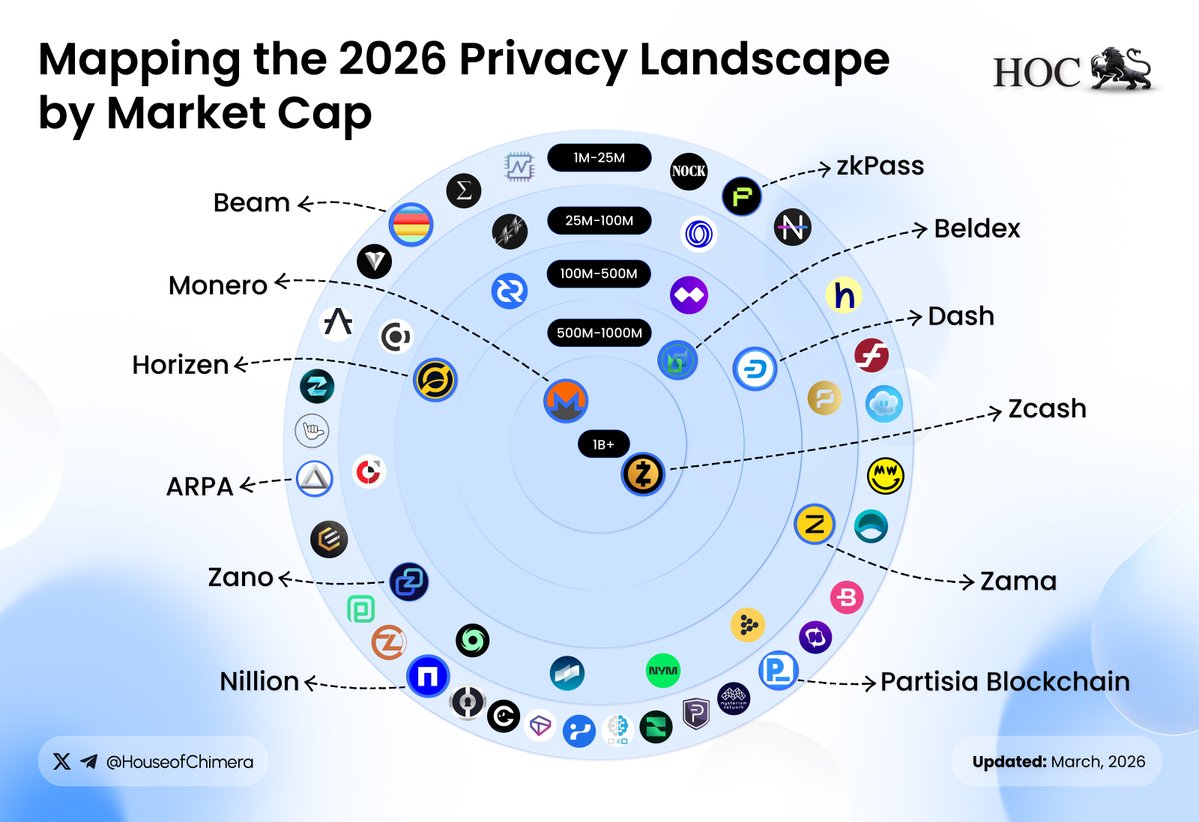
Whoever solves privacy may capture most of this market.
Here’s a snapshot of the landscape by mcap:
🔹 @monero
🔸 @Zcash
🔹 @BeldexCoin
🔸 @zano_project
🔹 @zama
🔸 @RAILGUN_Project
🔹 @Dashpay
🔸 @nillion
🔹 @OasisProtocol
Any favorites, anon?
English