Cristián Borgoño

65.9K posts

Cristián Borgoño banner
Cristián Borgoño

Cristián Borgoño

@CBorgono

Old Grangonian. Sacerdote católico; párroco; PhD Bioética, Licenciado en Medicina UC; Profesor de Teología @TeologiaUC. Opiniones a título personal.

Pedro Aguirre Cerda, Chile Katılım Aralık 2018
2.4K Takip Edilen2.4K Takipçiler
Sabitlenmiş Tweet
Cristián Borgoño
Cristián Borgoño@CBorgono·
Hoy el Cardenal @FernandoChomali lanzó su carta Crisis y Misión como plataforma para la pastoral de la Arquidiócesis de Santiago. Como por acá no leen mucho los documentos eclesiales, se las cuento en un HILO
Español
5
13
64
8.5K
Gonzalo Castillo Prado
Gonzalo Castillo Prado@Gonzalo98050470·
@CBorgono Estoy convencido que cerrar la Isapres sería muy malo para la inversión en salud. De hecho en este minuto el gobierno está haciendo los 2 millones de operaciones que le quedan por hacer en el sector privado. ( Ojo, La salud privada es 20 veces más eficiente que la estatal…)
Español
1
0
0
5
Cristián Borgoño
Cristián Borgoño@CBorgono·
La injusticia del sistema ISAPRE en su solo dato: sólo el 4% de los pensionados está en el sistema, mientras el 16% de los trabajadores dependientes lo está. Eso quiere decir, que hay una fuga masiva al pensionarse, que es cuando más necesitan del sistema de salud
Español
11
7
34
4.5K
Cristián Borgoño retweetledi
Grant Bailey
Grant Bailey@grantjbailey·
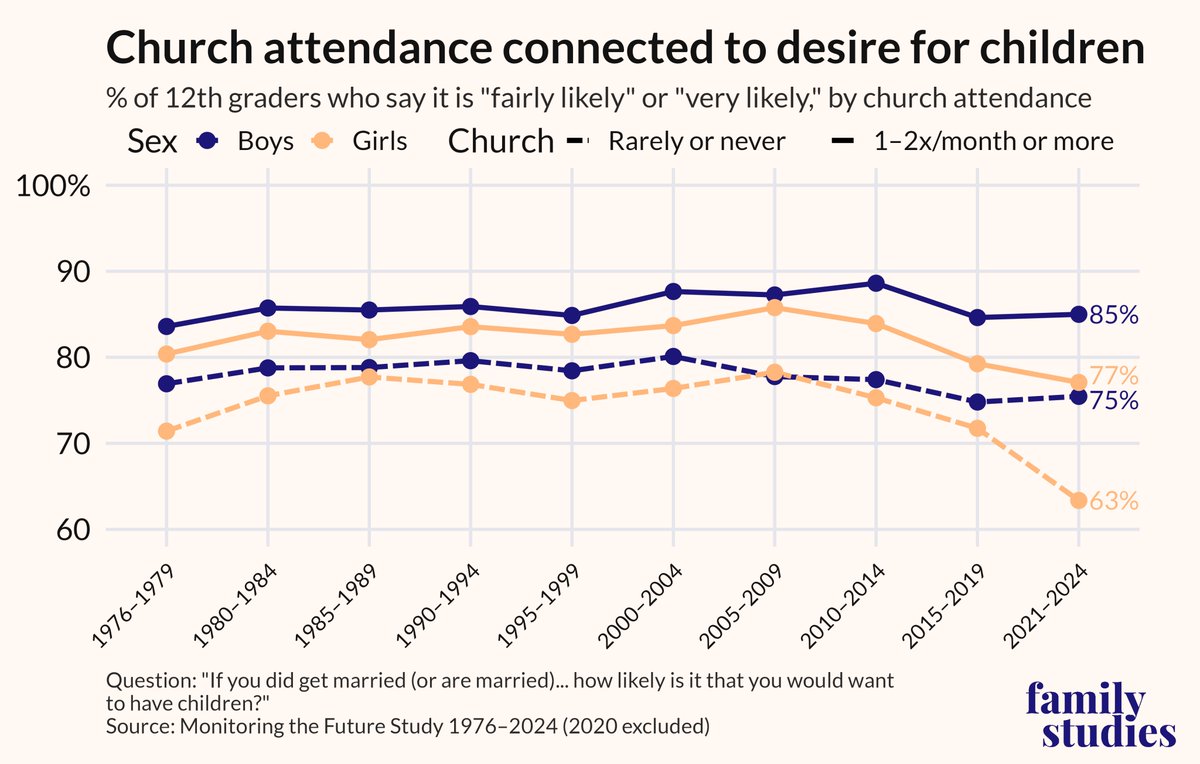
Honestly wasn't expecting this large of a difference🤯. Teens who don't go to church have much lower expectations of having children
Grant Bailey tweet media
Brian Blase@brian_blase

@grantjbailey Do you have this data broken down by whether teens regularly attend church or a religious service?

English
6
16
71
7.4K
Gonzalo Castillo Prado
Gonzalo Castillo Prado@Gonzalo98050470·
@CBorgono Las Isapres son compañías de seguros de salud. La legislación solo las ha perjudicado en los últimos años. Con una legislación que fomente más y mejores seguros de salud esto se podría solucionar
Español
1
0
0
4
Cristián Borgoño
Cristián Borgoño@CBorgono·
@FiGarayB No existe la neutralidad de la ciencia, porque los modelos no son neutrales. No es lo mismo que la neutralidad política y religiosa, pero se parece
Español
0
0
0
1
Felipe Garay B.
Felipe Garay B.@FiGarayB·
@CBorgono Una cosa es la gestión de recursos en ciencia y la aplicación tecnológica de la ciencia, y otra es la materia propia de estudio de cada disciplina científica. En el primer ámbito, la política está directamente involucrada, en el segundo no necesariamente.
Español
1
0
0
6
Cristián Borgoño
Cristián Borgoño@CBorgono·
Es muy mala idea aislar a la ciencia de la política y pretender que es casi como una religión que se coloca por sobre la deliberación del común de los mortales. Ya hay bastante escrito sobre eso que los científicos deberían conocer
Español
5
1
11
940
Cristián Borgoño
Cristián Borgoño@CBorgono·
El gobierno Boric le compró a Mazzucato su ayahuasca del Estado emprendedor, el de Kast no, es así de simple. Mucho cherry picking en la tesis de Mazzucato como la misma industria espacial ha mostrado y da cuenta el tema del litio en Chile
Español
0
4
20
606
Cristián Borgoño retweetledi
Card. Fernando Chomali
Card. Fernando Chomali@FernandoChomali·
Nadie se ha dado la vida a sí mismo. Lo que somos y tenemos es gracias a Dios, para desplegar nuestras alas hacia la Verdad y vivir amando desinteresadamente. Reconocerse creatura es el primer paso para ser auténticamente feliz, porque se es desde la Verdad. Todo intento de autodeterminarse sin Dios, es un fracaso anunciado.
Español
12
44
197
2.2K
Cristián Borgoño retweetledi
WenaChile
WenaChile@WenaChile·
Brutal monumento del escultor chen Weiming , nos recuerda a todos las víctimas del comunismo
Español
10
509
699
8.6K
Cristián Borgoño
Cristián Borgoño@CBorgono·
@atroncoz En la gran mayoría de los jardines infantiles es beneficio gratuito (JUNJI e Integra)
Español
1
0
0
95
akita
akita@atroncoz·
@CBorgono No es razonable, la respuesta a la baja demanda, baja la oferta, con suerte los precios se mantendrán.
Español
1
0
0
109
Cristián Borgoño
Cristián Borgoño@CBorgono·
Es razonable pensar que con la drástica caída en la natalidad el gasto en jardines infantiles se reduzca y luego será el turno de los colegios y las universidades
Español
9
5
40
4.1K
Cristián Borgoño
Cristián Borgoño@CBorgono·
@FelipeFOI Hay que huir de la tesis de que los fenómenos humanos se explican sólo por el sentido, hay muchos que tienen explicaciones simplemente por el cambio como tal (o quizás el estrés del período electoral) yo buscaría explicaciones que tengan proxy biológico
Español
1
0
0
15
Felipe_Opazo
Felipe_Opazo@FelipeFOI·
@CBorgono Puede ser. Cuadra con 2014, 2018, 2022 y 2026. Me cuesta verle sentido, son de signo distinto políticamente y representan valoraciones distintas de la maternidad. Pero igual las fechas cuadran.
Español
1
0
0
9
Felipe_Opazo
Felipe_Opazo@FelipeFOI·
@CBorgono No he dicho que estábamos mal y ahora estamos bien. Lo puedes ver leyendo el hilo entero 🙂. Tampoco tenemos constructo para los cambios de 2014 y 2018. Sólo el de 2022 podría relacionarse con parejas que pospusieron la paternidad durante la pandemia. Llevamos 5 meses seguidos.
Español
1
0
0
19
Cristián Borgoño
Cristián Borgoño@CBorgono·
Wow, como no supe esto antes.
Ihtesham Ali@ihtesham2005

A Stanford neuroscientist published a paper a few years ago that quietly answered one of the oldest questions in human history, and almost nobody outside his field has heard of it. The question is why we dream. Not what dreams mean. Why they exist at all. Why your brain spends a third of its sleep hallucinating images instead of just resting like every other organ in your body. His name is David Eagleman. He runs a lab at Stanford. The paper is called "The Defensive Activation Theory", and the moment you read it the explanation collapses every other theory you have ever been taught about dreams. Freud said dreams were repressed desires. He was guessing. He had no brain scans. He had no electrodes. He had a couch and a notebook and a century of credibility that nobody has been able to fully scrub off the subject since. Modern neuroscience replaced him with the memory "consolidation theory". The idea that dreams are your brain sorting through the day, filing things away, deciding what to keep. That story is partially true. Sleep does consolidate memory. But it does not explain the single strangest thing about dreams, which is that they are almost entirely visual. You do not dream in pure sound. You do not dream in taste. You do not dream in smell. You dream in pictures. Vivid, detailed, often impossible pictures that activate the back of your brain so hard a scientist scanning you would think your eyes were wide open. Eagleman started from one fact almost nobody outside neuroscience knows. The brain is territorial. Every region holds its turf through constant electrical activity. The moment a region goes quiet, its neighbors start invading. They take the silent territory and reassign it to themselves. This is called "cortical takeover", and it is not slow. It is not a long process measured in years. In experiments where adults are blindfolded, the visual cortex starts processing touch and sound within an hour. One hour of darkness, and the territory is already being annexed. In congenitally blind people, the visual cortex is fully repurposed. It runs language. It runs hearing. It runs touch. The hardware never went unused. It was just reassigned to whoever showed up first. Now sit with the implication of that for a second. Every night, when you close your eyes and fall asleep, the sun has set. The planet has rotated. The visual cortex, which takes up roughly a third of your entire cortex, is suddenly receiving zero input. For eight hours. Every single night. For your entire life. And evolution has shaped your brain inside a planet that has been spinning into darkness for billions of years. If cortical takeover happens in an hour, the visual cortex should have been lost a long time ago. Stolen by hearing. Stolen by touch. Reassigned by morning. Humans should have evolved into a species whose vision works fine during the day and then degrades every time the sun goes down because the territory keeps getting renegotiated overnight. But that did not happen. Vision works the moment you open your eyes. Which means something is defending the territory while you sleep. Eagleman's claim is that dreams are that defense. Every 90 minutes through the night, a precise burst of activity fires from the brainstem into the visual cortex. Pontine-geniculate-occipital waves. PGO for short. They are anatomically aimed. They are not general arousal. They are a targeted volley of signal launched directly at the back of the brain where vision lives. The cortex lights up as if it is receiving real images, and you experience that artificial activation as a dream. The bizarre narrative your conscious mind invents around it later is just your brain trying to make sense of the noise. The dream is not the point. The dream is the side effect. The point is keeping the territory occupied. The evidence for this is the part that should haunt you. Newborns spend roughly 50% of their sleep in REM. Adults spend twenty. Old adults spend fifteen. The amount of dreaming you do tracks almost perfectly with how plastic your brain is. Newborns have the most plastic brains on earth. Their visual cortex is in the highest danger of being overrun by neighboring senses while it develops. So evolution gave them an enormous defense budget. As you age, your brain becomes less plastic, the takeover risk drops, and the defense system scales down accordingly. Eagleman and his co-author ran the same correlation across twenty-five primate species. The more plastic a species' brain, the higher the proportion of REM sleep. The relationship held across the entire primate family tree. Plasticity and dreaming move together. They are two halves of the same evolutionary equation. A species that ranks higher on flexibility and learning also dreams more. A species that is born ready to walk and survive dreams less. Plasticity is the asset. Dreaming is the insurance premium. And the prediction the theory makes is the one that quietly closes the case. Of all your senses, only one is disadvantaged by darkness. You can still hear in the dark. You can still feel in the dark. You can still smelll and taste in the dark. The only sense that depends on light is vision. Which is exactly the sense your dreams are made of. The defense system is targeted at the only territory that is actually vulnerable while you sleep. Memory consolidation is real. Emotional processing is real. Your brain does do those things at night. But Eagleman's argument is that those functions piggyback on a much older system whose original job was simpler and more brutal. Keep the lights on inside the visual cortex while the planet is dark, or lose it. For thousands of years, people have asked what dreams mean. Prophets wrote about them. Poets wrote about them. Freud built a discipline on them. None of them had access to the actual answer, which is that dreams may not mean anything in the symbolic sense at all. They may be the visible flicker of a defense system running in the background, the way a screen saver protects a monitor by keeping the pixels moving even when nobody is looking. The strangest thing about the theory is how cleanly it explains why dreams feel so real. Your visual cortex cannot tell the difference between a PGO wave and an actual photon. It is the same hardware lighting up the same way. The cortex does its job. It builds an image. Your conscious mind, half-awake, wraps a story around it and calls it a dream. You are not seeing your subconscious tonight. You are watching your brain defend a piece of itself from being stolen. Every animal that has ever closed its eyes on this planet has done the same thing.

Español
0
2
4
1.1K
Cristián Borgoño retweetledi
Rafael R. Guthmann
Rafael R. Guthmann@GuthmannR·
The fact is that Chile, Argentina, and Uruguay were historically more developed than the rest of Latin America, forming the "South Cone." This region was relatively well developed, competing with the US for European immigrants. However, after many crises and macroeconomic underperformance, the South Cone had largely converged with Latin America by the late 20th century. But Chile and Uruguay have mostly recovered over the past ca. 40 years and are now categorized as high-income economies again. I expect that Argentina might recover in the near future as well.
Felipe Jiménez Ángel@felipeangell

En 1990, la productividad de un trabajador colombiano y uno chileno era la misma. Hoy, la de un chileno es el doble que la del colombiano.

English
25
59
749
78.6K
Esteve Rodríguez
Esteve Rodríguez@CopasLuis·
@CBorgono Pues la IA misma hará balance evaluativo y dará informe al que tenga en su labor dicha supervisión.
Español
1
0
0
4
Esteve Rodríguez
Esteve Rodríguez@CopasLuis·
Dejemos de ver la IA como una "máquina de respuestas" y empecemos a verla como un andamio cognitivo. Su futuro en educación no es ahorrar trabajo al alumno, sino actuar como un tutor socrático que desafía el pensamiento y guía el aprendizaje.
Español
3
5
16
532
Cristián Borgoño
Cristián Borgoño@CBorgono·
@FelipeFOI En natalidad, todo lo que está por debajo de 2.1 es malo. Está por verse si es o no tendencia y cuáles son los cambios estructurales que podrían eventualmente explicarlo. No se ve que haya algún factor externo o interno que pueda explicar una tendencia
Español
1
0
0
23
Felipe_Opazo
Felipe_Opazo@FelipeFOI·
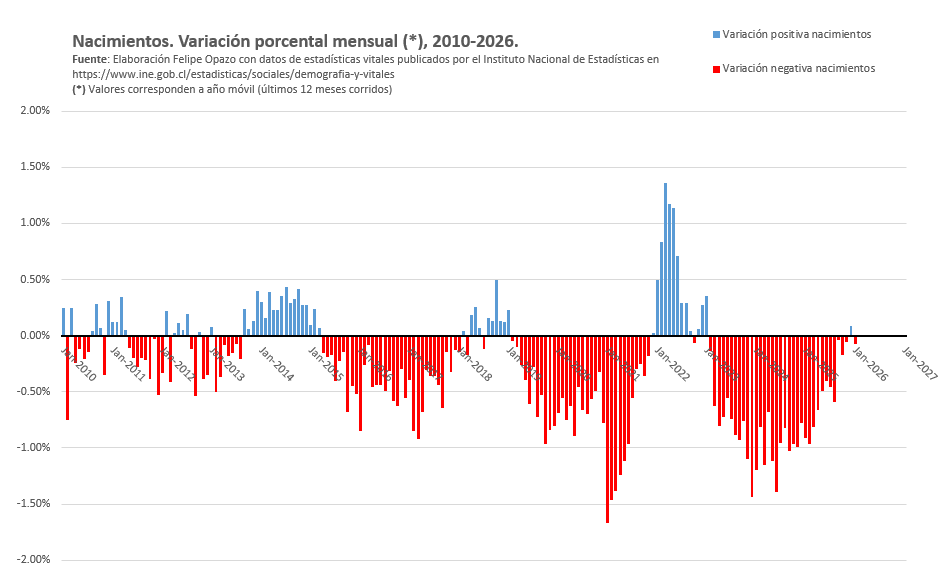
@CBorgono En la primera mitad de 2024 la diminución mensual comienza a atenuarse y en enero ya tenemos aumento respecto al mes anterior. Aparentemente estaría terminando un ciclo de descenso y podría iniciar un ode ascenso como los de 2018-2019 y 2022-2023. No-descenso (y eventual subida).
Felipe_Opazo tweet media
Español
1
0
0
34
dpgp
dpgp@dpgp00·
@CBorgono Es que usted hizo una aseveración de un fraude que dice conocer, yo se de educación y es primera vez que lo leo. Por eso le pregunto, tiene alguna fuente?
Español
1
0
33
718
Cristián Borgoño
Cristián Borgoño@CBorgono·
La dura realidad (especialmente en IP y CFT) es que hay un número no menor de estudiantes que se matriculan por gratuidad y que no van nunca a clases pero se alimentan más barato por la JUNAEB y tienen el pase escolar
Español
16
18
116
12.8K