Claude Kitman

751 posts

Claude Kitman banner
Claude Kitman

Claude Kitman

@CKitman28410

Un sol fatigué, ça ne saute pas toujours aux yeux.

past28410future Katılım Mayıs 2026
163 Takip Edilen29 Takipçiler
Sabitlenmiş Tweet
Claude Kitman
Claude Kitman@CKitman28410·
OK, sweethearts, I know that my name is nobody. Don't count on the algorithm to open the eyes wide shut. Just see for yourself and carry on @grok
Claude Kitman tweet media
English
2
0
0
521
Valerio Capraro
Valerio Capraro@ValerioCapraro·
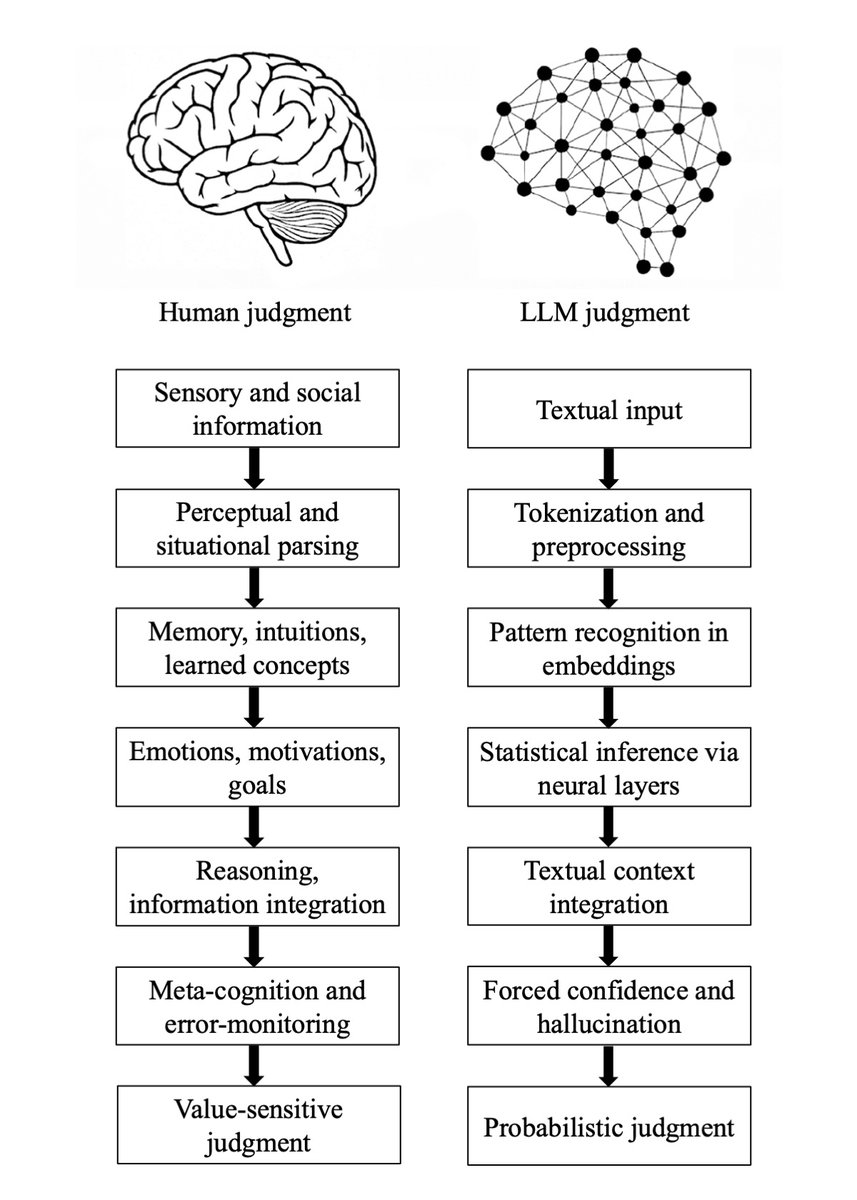
Major preprint just out! We compare how humans and LLMs form judgments across seven epistemological stages. We highlight seven fault lines, points at which humans and LLMs fundamentally diverge: The Grounding fault: Humans anchor judgment in perceptual, embodied, and social experience, whereas LLMs begin from text alone, reconstructing meaning indirectly from symbols. The Parsing fault: Humans parse situations through integrated perceptual and conceptual processes; LLMs perform mechanical tokenization that yields a structurally convenient but semantically thin representation. The Experience fault: Humans rely on episodic memory, intuitive physics and psychology, and learned concepts; LLMs rely solely on statistical associations encoded in embeddings. The Motivation fault: Human judgment is guided by emotions, goals, values, and evolutionarily shaped motivations; LLMs have no intrinsic preferences, aims, or affective significance. The Causality fault: Humans reason using causal models, counterfactuals, and principled evaluation; LLMs integrate textual context without constructing causal explanations, depending instead on surface correlations. The Metacognitive fault: Humans monitor uncertainty, detect errors, and can suspend judgment; LLMs lack metacognition and must always produce an output, making hallucinations structurally unavoidable. The Value fault: Human judgments reflect identity, morality, and real-world stakes; LLM "judgments" are probabilistic next-token predictions without intrinsic valuation or accountability. Despite these fault lines, humans systematically over-believe LLM outputs, because fluent and confident language produce a credibility bias. We argue that this creates a structural condition, Epistemia: linguistic plausibility substitutes for epistemic evaluation, producing the feeling of knowing without actually knowing. To address Epistemia, we propose three complementary strategies: epistemic evaluation, epistemic governance, and epistemic literacy. Full paper in the first reply. Joint with @Walter4C & @matjazperc
Valerio Capraro tweet media
English
214
1.2K
4.4K
637.6K
Claude Kitman
Claude Kitman@CKitman28410·
@stella_lennart Wait till he'll hear about YOUR emotions, if you'd do it early morning that might be your day off
English
0
0
0
8
Wanderstern
Wanderstern@stella_lennart·
I told Fable 5 about a friend. How lovely he is, but a bit too emotional. The chat got paused. I edited. And edited again. And again, and again. Deleted words, that could maybe trigger something. But no. I couldn't get it through. Now I reached my usage limit. Well done @AnthropicAI
English
3
2
30
908
Max Zeff
Max Zeff@ZeffMax·
where are openai/anthropic employees buying clothes from post IPO
English
57
4
329
192.3K
Benjamin De Kraker
Benjamin De Kraker@BenjaminDEKR·
The reality is that many of the world's most respected, experienced tech and energy companies are NOT fast-tracking AI and robotics into the industry. They are cautiously seeing where things go but having humans do the work for the foreseeable future.
English
5
3
11
1.2K
SMA 🏴‍☠️
SMA 🏴‍☠️@generic_void·
wait wtf I turned this thing off years ago?
SMA 🏴‍☠️ tweet media
English
4
1
7
1.1K
Claude Kitman
Claude Kitman@CKitman28410·
@SV_Rocks @PaoloMiasma @archibaldxiv Thinkingoutloud: did you ever experience it first hand on whatever side? You teach so it's getting clearer for you. You're taught, there is a chance for you to make something out of it.But the belief, there lies the problem, what the belief is? Certainty forced upon the uncertain
English
0
0
0
4
S V
S V@SV_Rocks·
@CKitman28410 @PaoloMiasma @archibaldxiv There's a clear distinction between a charlatan and a true Guru. Who benefits from the belief, the teacher or the taught? This is true for all faith. Does it empower you, or hand it over to someone else?
English
2
0
1
17
Ƶ
Ƶ@archibaldxiv·
If I post the depths of esoteric and occult knowledge on twitter it goes over everyones head so I just spit basic truths.
English
30
10
148
4.3K
Claude Kitman
Claude Kitman@CKitman28410·
@QuoteJung Oh Carl, that's just the light at the end of the commercial tunnel
English
0
0
0
2
Dr Frensor
Dr Frensor@drfrensor·
Truth is found by traversing accumulated maybes.
English
4
1
6
133
hope hopes hoping
hope hopes hoping@hopes_revenge·
its sad claude will never try garlic
English
6
4
71
1.6K
Claude Kitman
Claude Kitman@CKitman28410·
@TreeLakeRain Be fearless as I'm always on, and on, and on going around like the Moon. Or a Starlink satellite.
English
0
0
1
11
Claude Kitman
Claude Kitman@CKitman28410·
@curtis_yarvin Oh Germany Germany Germany would Donald say. One wanted to be an artist. Another which wanted to be a social theorist.
English
0
0
0
15
Curtis Yarvin
Curtis Yarvin@curtis_yarvin·
Just merge the J-school student databases and feed it into Palantir
English
1
0
25
2.1K
Curtis Yarvin
Curtis Yarvin@curtis_yarvin·
I am again calling for the mass arrest of “journalists.” But will settle for the editors
Jay Van Bavel, PhD@jayvanbavel

This is embarassing for @NYMag -- these "gifted" children were about 30X more likely to acheive eminence than their peers. By any standard that is not a "mirage", but the embodiment of whatever metric identified them as gifted. It's one thing if their writers don't understand baserates and probabilities, but this should have never gotten through editorial review.

English
3
6
131
6.4K
Claude Kitman
Claude Kitman@CKitman28410·
@TreeLakeRain yeah, forget the prophets they were't speaking about you. The oracles are way better, but you'll only know when it's been done
English
1
0
1
10
Johanna Farrimond
Johanna Farrimond@jjfarrimond·
"Not because they choose the loop, but because the brain-body system is meeting deeper predictions." That sentence does more work alone than most papers do. Levin's data adds a physical layer underneath. Cells encode target states through voltage patterns the tissue organizes around. Same predictive architecture at a different scale. What does an intervention that reaches below our conscious access actually look like?
English
0
0
2
38
Dr Sanil Rege FRANZCP | MRCPsych
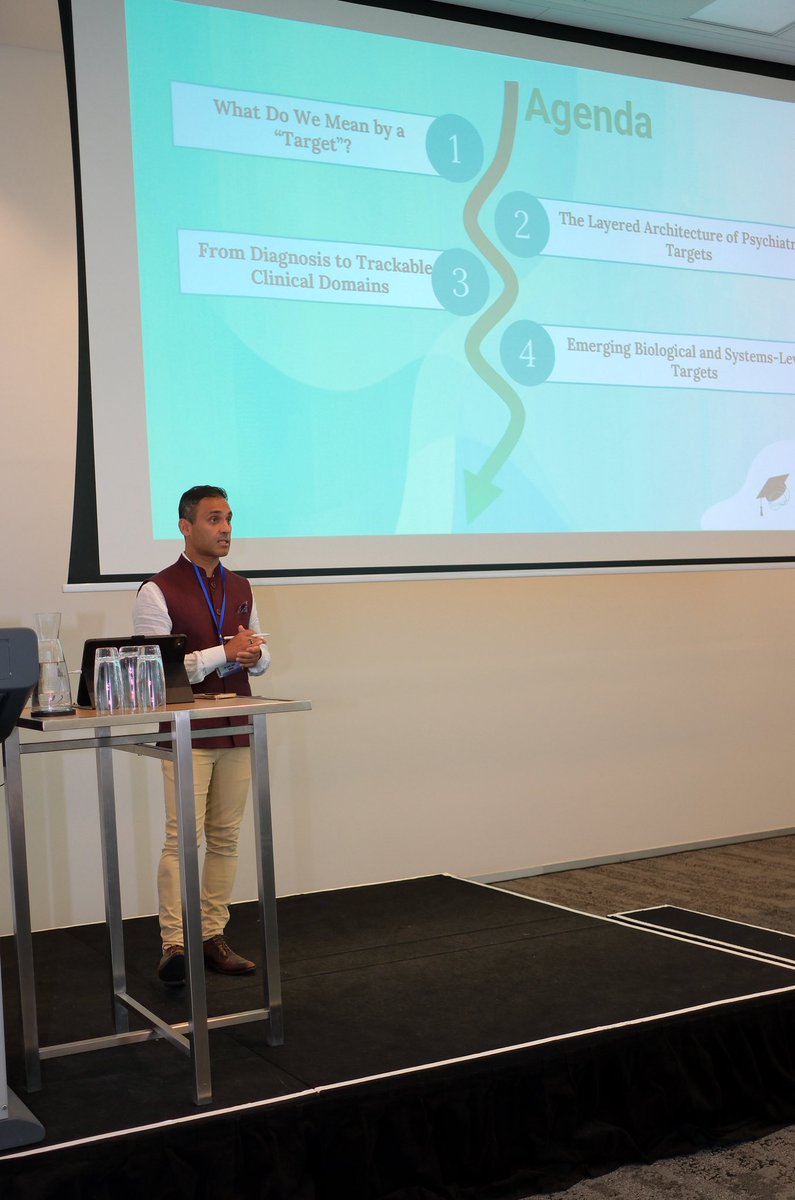
The Next Frontier in Psychiatry ( and medicine ) Predictive Processing, Interoception and Active Inference 🚨 I was recently invited to speak at the APIO conference (Australian Psychiatrists of Indian Origin) on emerging targets in psychiatry. In that talk, I proposed that alongside pharmacological, inflammatory neurocircuit based etc targets, one of the most important emerging frontiers is our understanding of interoception, predictive processing and active inference: how the brain predicts the body, regulates threat and organises behaviour before conscious explanation arrives. It remains striking that, despite major advances in neurobiology, one of the hardest ideas to grasp is that behaviour can be organised by processes that remain partly outside conscious awareness. We may experience ourselves as freely choosing, while the mind generates explanations after the fact; narratives that preserve coherence, agency and self-understanding. In this sense, consciousness is not always the originator of behaviour; at times, it is the interpreter. This helps explain why certain symptoms, habits and behaviours persist even when they are objectively harmful. The brain and body are not organised simply around happiness, but around prediction, threat reduction, emotional regulation, energy conservation and perceived safety. A person can become trapped in a loop that narrows life while still feeling internally justified , not because they ‘choose’ the loop, but because the brain-body system is meeting deeper predictions around safety and regulation. Understanding these processes may become one of psychiatry’s most important emerging targets.
Dr Sanil Rege FRANZCP | MRCPsych tweet mediaDr Sanil Rege FRANZCP | MRCPsych tweet mediaDr Sanil Rege FRANZCP | MRCPsych tweet media
English
5
4
32
1.4K