Techno Capital

34 posts

Techno Capital banner
Techno Capital

Techno Capital

@CapitalTechno

Coffee, Deep Research, SAAS

Katılım Eylül 2022
116 Takip Edilen26 Takipçiler
Techno Capital retweetledi
Autopilot
Autopilot@joinautopilot·
Breaking: OpenAI fired Leopold Aschenbrenner at 22. Three years later, he manages $5.5 billion. And is quickly becoming one of the best AI investors out there Today, we're launching a tracker to trade alongside his picks, automatically. Here's his full portfolio: 1. Power & Energy: $BE — Bloom Energy (29%) → fuel cells powering data centers $EQT — EQT Corp (4%) → largest US natural gas producer $CRWV — CoreWeave (4%) → GPU cloud infrastructure for AI $SEI — Solaris Energy (3%) → energy infrastructure 2. Bitcoin Miners: $CORZ — Core Scientific (14%) → Bitcoin miner turned AI data center host $IREN — Iris Energy (11%) → Bitcoin mining + AI cloud $APLD — Applied Digital (9%) → AI data center infrastructure $CIFR — Cipher Mining (5%) → Bitcoin mining / HPC $RIOT — Riot Platforms (3%) → largest US Bitcoin miner 3. Semiconductors & AI Hardware: $SNDK — Sandisk (8%) → memory/storage for AI workloads $COHR — Coherent (3%) → laser/photonics for data centers $TSEM — Tower Semiconductor (3%) → analog chip foundry $INTC — Intel (2%) → US chip manufacturing bet $LITE — Lumentum (2%) → optical networking for AI infra You can now mirror the portfolio automatically on Autopilot. Just connect your broker, choose his tracker, and you're good to go Link below
Autopilot tweet media
English
71
179
2.1K
714.2K
Techno Capital retweetledi
Caesar Capital
Caesar Capital@CaesarCapitalz·
👀 Institutions are buying these stocks! 10 stocks with institutional ownership at all time highs: 1) $IREN - Iren Limited
Caesar Capital tweet media
English
58
161
1.4K
508.6K
Techno Capital retweetledi
RyshabTalks
RyshabTalks@RyshabTalks·
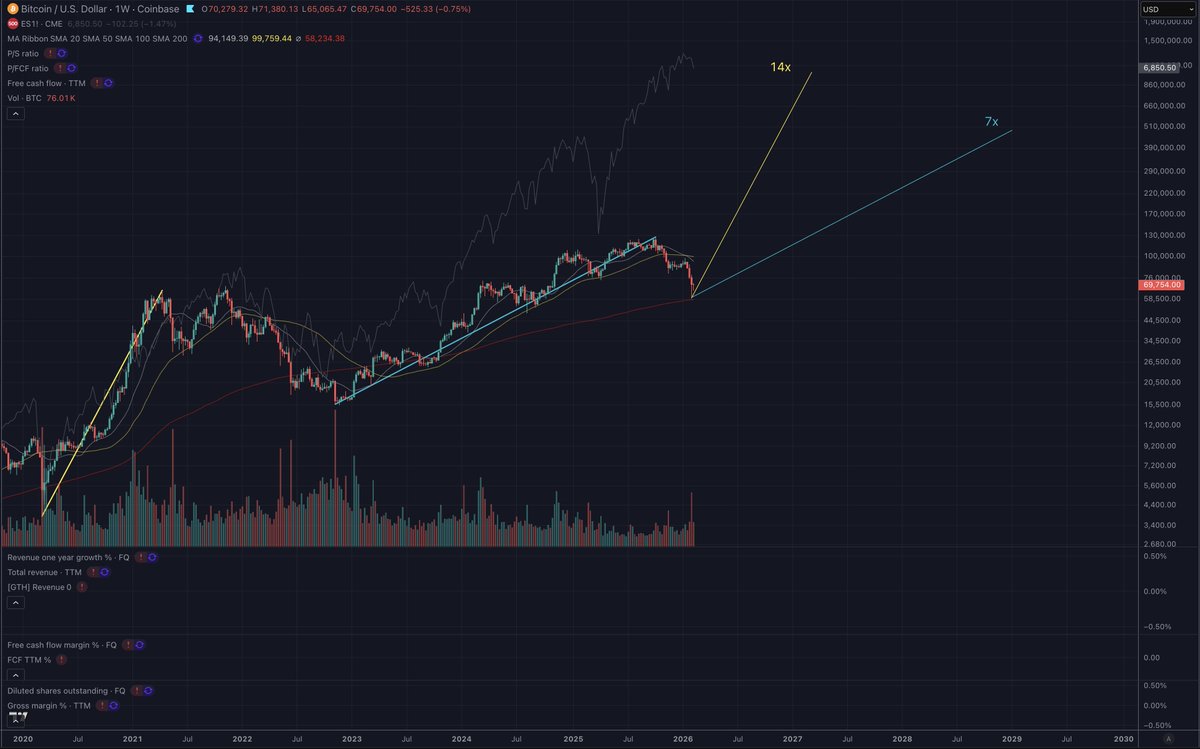
You are NOT bullish enough! Here's why? In the next 3 years, we might see a 7x to 14x move in Bitcoin. Just imagine what that will do to your growth portfolio. Here's the exhibit. Bitcoin's last two moves from covid low in 2020 and post inflation low in 2022 has generated 14x and 7x returns respectively. I think markets are poised to make another run like that. No one is ready for this. But if you position yourself right. Your portfolio can 10x in the next 3 years. Bitcoin is at critical support. Once the next move starts, I believe we are going to see something that mimics somewhere between 2020 and 2022 moves. A 10x in Bitcoin is a very real possibility. The stocks I own are high beta with sector tailwinds for a reason. I am extremely bullish and my portfolio represents that.
RyshabTalks tweet media
English
5
1
5
1.8K
Mojo
Mojo@MrMojoRisinX·
Continuation of my thoughts on AI and its impact on software (and other impacted spaces): Unless I’m being tailgated, I try not to drive looking in the rearview mirror. We’re at the point where the person tailing you is experiencing road rage in traffic (not my driving) when in reality they should have just left for their destination earlier. Earnings revisions drive multiples. Yes, the expensive starting point matters but it’s not the whole story. A lot of these businesses have slowed from a rate of change perspective, albeit still growing. That doesn’t make them bad businesses, but in software the stock price is part of the business. It’s a comp tool, a recruiting currency, and a barometer for health and future prospects. The narrative has shifted. People are now questioning terminal value and how much moat these businesses actually have to protect. Meanwhile public investors want management to protect the stock with buybacks. Solving a business operations question with financial engineering has never been the answer and investors pushing that playbook need to look at private markets and get their mind right. I’d rather see insiders step up and buy stock with their own money than use the company balance sheet to do their talking. Turn your attention to the lending environment. It has tightened and the flywheel has changed but remember during good times lenders are more relationship managers. And keep in mind the PE guys aren’t walking away from their portfolio companies like public investors are, and are using reporters and interviews to try and impact sentiment before it gets away from them... They’re not handing keys to lenders. They’re consolidating, exiting what they can, rolling into continuation vehicles, and avoiding down rounds even though mark to market becomes an issue once every financial engineering mechanic to avoid new, lower marks meets reality. Kick the can in private while public stocks re-rate violently after they overshot to the upside. These aren’t isolated problems from my perch. They’re more like interlocking gears. Stock price drives recruiting and retention. The lending environment dictates the financial engineering options. The narrative shift hits customer confidence, which hits revenue, which feeds back into everything else (perhaps they try introducing a new KPI). When one gear slows, the friction transfers across all of them. The same interconnectedness that created the (perhaps in hindsight questionable) compounding premium on the way up is now compounding the discount on the way down. Cc @buccocapital who is putting in a lot of effort thinking through the state of affairs in AI, saas, software, et al
Mojo@MrMojoRisinX

What stage ?

English
7
24
210
108.4K
Techno Capital retweetledi
The Tech Investor
The Tech Investor@TheTechInvest·
🚨 @TickerSymbolYOU Just dropped a video on $IREN Q2 and the company’s AI Cloud business and how the market still look to the company as a $BTC miner when its AI Cloud grew by 540% YoY. WORTH WATCHING! *Alex is a YouTuber with over 500K subs and investor with solid tech background.
The Tech Investor@TheTechInvest

🚨BREAKING🚨 BNP PARIBAS, WOLVERINE ASSET MANAGEMENT, AND LEGAL & GENERAL GROUP JUST BOUGHT 7.7M SHARES OF $IREN 🔥🔥🔥

English
17
39
409
87.4K
Techno Capital retweetledi
Dulce
Dulce@litigious_dulce·
At this point. @jiahanjimliu is a better source of insight on $IREN than me. 🫡
Jim Liu@jiahanjimliu

Speculative Post $IREN: Earnings Call Transcript Notes Some other people may see Dan Roberts, IREN CEO, as over confident or "over playing" his hand, but I disagree. Having studied most if not all @danroberts0101 interviews, it's clear to me that Dan is very ambitions in actions/planning but conservative in words. He drags negotiations out for maximum flexibility but will firmly commit when the time comes. Dan does not hype, and when he says something, it's backed by real discussions. Whether or not the negotiations succeed, we do not know, but Dan speaks in terms of concrete events. Therefore, I find it worthwhile to scrutinize statements made in the earnings call. In particularly, this earnings call had statements that don't make sense to an untrained eye and deviated from previous calls. I will directly quote the Q2 2026 earnings call transcript. You can cmd-f / ctrl-f to verify context: finance.yahoo.com/quote/IREN/ear… (2) Backdrop Right now, IREN investors' biggest questions is: "how will IREN get better contract economics?" or in other words "how are the negotiations going?". @Umbisam pointed out that hyperscalers have the negotiation power because: 1. They might be a cartel to keep prices low. 2. There's only a few of them will billion dollar pockets to buy at the scale which IREN needs to sell. I directionally agree that HS have an inordinate amount of negotiation power but not for the reason @Umbisam pointed out. The main reason is that HS have their own DC buildout and IaaS operations teams. HBM is subjected to points 1 & 2 that @Umbisam makes, but crucially HS cannot make their own HBM. I believe the first MSFT deal had lower topline because: 1. Anchor tenant for site and the entire company. 2. Unproven uptime risk mean that MSFT would use IREN's bare metal GPUs for internal projects instead re-sell them as an extension of Azure compute. If IREN delivers, it would not have to do this risk discount for subsequent HS customers. However the true unlock comes from how ORCL achieved higher topline for bare metal GPUs. You see OpenAI, Palantir, Tiktok all use ORCL bare metal GPUs (1) and it's not because ORCL is better than MSFT, AWS, or GCP. It's because OpenAI, Palantir, Tiktok are all very capable at managing their own software infrastructure and ORCL provides just enough software (bare metal GPUs + Kubernetes). This enables ORCL to split the the HS margins with them. Knowing this backdrop, let's scrutinize the earnings transcript for clues on what type of customer $IREN is negotiating with and what are the dynamics. Time to DC Previously IREN had spoken about time to power. This was the first earnings call when IREN spoke about time to DC. "time to power is critical, but time to data centers is actually the more limiting factor" (2) So there's 1+ customer whose needs are pretty urgent that it's not longer about time to power (years) but time to datacenter (months). After all, IREN has "idle" power capacity and can build DCs within 6-9 months but the customer is concerned about time to datacenter meaning they need something pretty urgently. Air Cooled "We're also seeing hyperscalers and leading enterprises actively pursue both liquid and air-cooled GPU deployments as they work to accelerate rollouts. The increased focus on air-cooled deployments aligns extremely well with our existing footprint of 810MW of already operational air-cooled data centers." (2) Previously IREN had focused on retrofit talks for their Canada DCs. For Childress, TX, IREN-MSFT went with liquid cooled. Now all of a sudden, IREN is talking about their air-cooled deployemnts within their 810MW footprint. Canada only has 160MW so the 810MW must include the Childress DCs. A rationale for the sudden change is that the customer who is concerned with time to DC sees that the standing air-cooled DCs would bring compute up fast enough to meet their needs. Previously IREN had mainly mentioned hyperscalers for their Texas sites. But now IREN is including "leading enterprises". Hyperscalers have planned compute for at least their core business and can sell more or less of their lower priority services if they don't have enough compute. In other words, it's okay for Hyperscalers to not meet some of their lower priority demand. This means Hyperscalers don't need to deviate from their specs and probably wouldn't accept the air-cooled DCs at Childress. This leads me to conclude the customer who is discussing air-cooled at Childress is a leading enterprise instead of a Hyperscaler. There are very few leading enterprises that are not hyperscalers and have 300MW IT of unplanned demand. That's at least a $10-15B five year contract or $2-3B/year depending on GPU type. Multi-Billion Dollar Software Customer "one of the contracts we are negotiating at the moment is a multi-billion-dollar contract where we need to bring a software solution" (2) What kind of software could this be? I'll be the first to admit that IREN is not strong in Cloud software. Dan admits his own view on software: "we continue to think that it is likely to be one of the areas in this space that gets commoditized the fastest". The software likely referred to is Kubernetes for Bare Metal GPUs. You see, what the customer needs IREN to do is setup Kubernetes so that it abstracts away the datacenter. Kubernetes is open sourced by Google so what IREN needs to optimally layout/design the datacenter and configure Kubernetes to reflect the datacenter layout design. In other words, this is not really software. IREN is using Google software and providing the network fabric, storage architecture, cluster topology. This is not easy because there are thousands of connections via networking cables and complex rack/row/failure domain. However this is not a software problem but rather a datacenter design problem. Google's Kubernetes is the software that handles the complexity and IREN just needs to design and setup the datacenter correctly. Additionally, IREN will need observability to monitor when to physically have data center technicians service end of life or degraded parts. This software falls within the realm of IaaS for bare metal, not PaaS or SaaS. Whereas HS can handle everything including providing the DC specs and setting up the hardware side of Kubernetes, some leading enterprises are pure software. Some AI Natives might even be better than HS at software but because they don't have the years of operating DCs. IREN's DC team from Rackforce has operated DCs for over a decade (3) and now they have knowledge transfer from Microsoft on setting up an state of the art training DC. Thus there is no worry that IREN all of a sudden needs to do "software". This is IaaS software that is more about datacenter and hardware knowledge, not PaaS/SaaS software which IREN is not good in. The Right Customer "The focus is on choosing the right long-term partnerships that support durable platform-level growth" (2) IREN has recognized that being plan B for HS is not the optimal way to achieve great economics. Although subsequent contracts with HS will have better economics, the real unlock comes from working with an AI native that needs scale on the magnitude of 4.5GWs. Given all the clues above, I hate that I arrive at the same conclusion as some pumpers. The pumpers got the timing wrong but the client they guess might be right. 1. Who all of a sudden has 300MW IT of unplanned demand they need within 6 months (time to DC)? 1a. Anthropic just raised it's revenue guidance for 2026 by 20% to 55B (5). 2. Who is big enough to sign billion dollar contracts but has no internal DC team and bare metal + Kubernetes setup? 2a. You see most companies that can sign billion dollar contracts have internal DC teams. Anthropic uses bare metal on AWS with Kubernetes setup to abstract away the DC and have no internal DC team. 3. Who is very careful about unit economics and has the HS+ software capabilities to convert software prowess into compute savings? 3a. Anthropic is god-like in software and doesn't need AWS software, GCP software, or $NBIS software. IREN is more than willing to give up PaaS/SaaS margins for IaaS scale. Buying bare metal at HS rates is detrimental to Anthropic's unit economics and Anthropic just needs to find a partner that can match it's scaling. The missing question is whether or not IREN can get <6% debt financing at a large billion dollar scale (so not Dell financing) with Anthropic as the counter party? I think there's a good chance because many are trying to get Anthropic exposure. $ZM went up 10% that one day just because it had invested in an early Anthropic round (6). Hypothesis You see Stargate made ORCL the DC/IaaS arm of OpenAI and Anthropic needs an DC/IaaS provider that's going to give it better margins than HS Clouds has the HS-level power capacity and time to power. With the rest of Childress, SW1, SW2, Oklahoma - IREN has power capacity at the right the time to fit Anthropic's ambitions. It's not seeking PaaS/SaaS margins. Can $IREN be the DC arm of Anthropic?

English
17
10
236
49.4K
Techno Capital retweetledi
StockMarket.News
StockMarket.News@_Investinq·
History follows a 5-stage crash pattern that Wall Street hopes you ignore. 4 out of 5 stages are already flashing red, the window is closing fast. Save this video to understand the signals before the final trigger hits.
English
28
147
617
72.6K
Techno Capital retweetledi
Bilaal- BD investing
Bilaal- BD investing@bdinvestingg·
The White House is telling you exactly where to invest : • AI: $GOOGL $NBIS $IREN $CRWV • chips: $TSM $ASML $NVDA $AMD • space: $RKLB $ASTS $LUNR $RDW • crypto: $COIN $BTC $ETH • energy: $GEV $CEG • drones: $ONDS • nuclear: $CCJ $OKLO $VST • defense: $KTOS $AVAV $AMTM • robotics: $SYM $AMZN $ISRG • batteries: $TE $EOSE $ELVA $FLNC • quantum: $QBTS $IONQ $RGTI • healthcare: $GH $GRAL $MIRM • data centres: $VRT $ANET • rare earths: $CRML $TMC $IDR • manufacturing: $MTZ $AGX $POWL • critical minerals: $TMQ $UUUU $CCJ DONT OVERTHINK IT.
English
74
397
3.5K
394.3K
Techno Capital retweetledi
Kash
Kash@KashRamki·
Fun fact about $NUAI: Powered land today trades at $300k-$500k/acre. TCDC = 438 acres New Mexico site = 3,500 acres That’s $1.2bn to $2bn in land value alone! NUAI’s market cap today = $0.35bn. You can bet there’s a ton more value once this land is developed into a DC. Just ask $IREN. What do you think $NUAI is worth? (Hint: it’s not $0.35bn)
English
12
21
123
14.8K
Techno Capital retweetledi
Kash
Kash@KashRamki·
On down (and up) days in the market, it is important to remember the following: People are more interested in owning what they’ve spent time “researching” and telling their friends about this next great winner that they brilliantly stumbled on, thereby stroking their fragile egos, than truly understanding what they own and trying to improve that position by destroying their most cherished ideas. Tale as old as time. @MohnishPabrai has this wonderful example of 2 competing gas stations at the same intersection. The long-term loser in this game would rather sit there and talk trash about the other guy while their own business is tanking because they failed to copy the other guy’s superior strategy. It is the hubris of our dumb competitors that allows us to capitalize on wonderful ideas like $IREN.
English
5
5
62
32.8K
Techno Capital retweetledi
𝐀𝐠𝐫𝐢𝐩𝐩𝐚 𝐈𝐧𝐯𝐞𝐬𝐭𝐦𝐞𝐧𝐭𝐬
Why I initiated a position in $NUAI $NUAI is a stock that has been on my radar since late November. Up until late last week, I had completely written it off. I saw it as an extremely speculative “story stock” and wanted nothing to do with it. However, my stance has changed over the past few days. Over the weekend I had a long discussion with my friend @litigious_dulce, who shared a perspective that made me completely revisit the thesis and ultimately flip my view on the stock. Here is why I am bullish on $NUAI: One of the reasons I decided to enter a position is that Dulce himself has taken a significant stake in $NUAI. On the surface that might sound like a superficial point, until you understand who he is and how he operates. He was one of the early $IREN investors and part of the original “IREN alpha” group chat with @FransBakker9812, @TheKamaHsutra, him, and myself. Back then (~1.5 years ago), we spent hours every day doing nothing but dissecting $IREN from every angle and discussing our thoughts within the group chat. I learned a lot about $IREN from him. He has a deep understanding not only of $IREN, but also of the broader data center and power landscape. I would put him among the very few retail investors who know at least as much about $IREN as I do. Dulce is also not a small fish. At one point he owned over 1% of $IREN's float. He’s as serious as they come and pours hundreds, if not thousands, of hours into his concentrated bets… $IREN in the past and $NUAI today. So seeing him back $NUAI, and do so in a very vocal way, adds a layer of conviction I can lean on. It’s not the only reason I bought, but it does matter. With that context in place, let me now get to $NUAI's strategic position and why I’m bullish on the stock. There is no doubt political pressure is building on hyperscalers to sort out their power needs without simply loading more demand onto already stressed grids. Less than 10 days ago, the Trump administration warned hyperscalers not to push electricity prices higher for ordinary consumers. Soon after, AI & crypto czar @DavidSacks framed this as part of a broader push to have big tech sort out its energy needs by generating more of its own power on-site, instead of relying on the grid. So how does this tie into $NUAI? $NUAI's background is in the natural gas business. Today it owns several large greenfield sites in the Permian Basin, one of the premier regions in the US for gas production. A long standing criticism I’ve had of behind-the-meter, on-site power generation is that it’s materially more complex than simply connecting to the grid. There are more moving parts, more ways things can go wrong, and more operational risk. If given the choice, most hyperscalers would likely prefer grid connected power over building and running their own power plants. That said, as I laid out in my recent deep dive on Substack, the power shortage is intensifying rapidly. When you add political pressure and public concern about rising consumer electricity prices driven by industrial demand, on-site generation becomes a very real and increasingly relevant strategy in the data center space. While $NUAI has multiple sites across the Permian Basin, the company’s focus today is on its massive 435 acre “TSDC” site in West Texas. This land sits next to multiple power plants, with several gas pipelines running nearby, making it extremely attractive for future on-site generation tied to a larger data center campus. As announced last Friday, $NUAI has now partnered with a company called Primary Digital Infrastructure (PDI), which has been involved in the Stargate project (for OpenAI) in Abilene, Texas. PDI positions itself as an independent data center investment platform, and its leadership brings deep industry experience. Its CEO, Bill Stein, was a co-founder of $DLR, a $57b data center REIT and one of the most successful firms in the sector. This partnership meaningfully derisks the $NUAI thesis. PDI brings capital, networking and significant development expertise, while $NUAI brings strategically located land and experience in the natural gas industry. $NUAI's current guidance is to sign a hyperscaler agreement by Q1 or early Q2 2026. With PDI now in the mix, I think the probability of that guidance being met has increased materially. Now, to be clear, while I am bullish on $NUAI, I do not think it is anywhere close to being another $IREN. The good news is it does not need to become that for this to work well as an investment. $NUAI's market cap today is merely ~$300m. For comparison, $IREN is roughly $14b, $CIFR about $6.6b, $APLD around $9b, $WULF about $5.2b, and so on. At this size, I think $NUAI is one meaningful deal away from a major re-rating, potentially on the order of 10-15x over the course of this year. At a $300m market cap, the contract would not even have to be a mega-deal with the most prestigious counterparty to move the stock meaningfully higher. That said, the risk is real and significant. This is very much an all or nothing setup. If $NUAI comes up empty and fails to land a deal, I would not be surprised to see the stock perform very poorly. You can argue that the 435 acre site alone could be worth something in the ballpark of $50-150m if sold, which provides a bit of downside support. But in practice, if $NUAI fails to meet its guidance, I can still see the stock falling meaningfully from here. On the other hand, if $NUAI lands a hyperscaler agreement, I would expect the stock to move from today’s roughly $5.50 share price to at least $30-$50 in the days and weeks post announcement. Based on what I know today, I would put the probability of success somewhere around ~70%. That said, I’m still early in my due diligence process. Over the coming weeks I plan to dig much deeper into the thesis. Once I have a more comprehensive view, I will publish a detailed deep dive on $NUAI for my Substack subscribers. I also want to be transparent about how I funded this position. Up until yesterday, I was basically all in on $IREN, with more than 98% of my capital in that one stock. To make $NUAI an ~11.5% position, I did sell an equivalent portion of my $IREN holdings. $NUAI is the first new major investment I have made since I went all in on $IREN more than 18 months ago. Given the risk profile, I am unlikely to increase my exposure much from here in the near term. I have invested enough for the outcome to matter, but not so much that it would be devastating if the thesis fails. In any case, I’m treating this as a serious investment. I will start covering the company here on X and publish institutional-grade research on it for my Substack subscribers. Thank you for reading, cheers! ✌️
English
71
94
788
146.3K
Techno Capital retweetledi
Alex & Books 📚
Alex & Books 📚@AlexAndBooks_·
Read one book every week for a year and your whole life will change:
Alex & Books 📚 tweet media
English
24
40
352
12.2K
Techno Capital retweetledi
Dulce
Dulce@litigious_dulce·
GP/LP structures are standard in private infrastructure because they optimize risk-adjusted returns for a defined pool of capital, but they can be structurally misaligned with the objectives of public-company equity. For public companies such as $APLD, $WULF, and $CIFR, the core metric is not project-level IRR but absolute equity value creation and per-share upside. A GP/LP structure may be capital-efficient in percentage terms, but it typically caps absolute dollar returns because a large portion of the economics is allocated to LP capital. For companies that already command substantial market capitalizations—though these were achieved only after years of punishing dilution between 2021 and 2025[^1]—even a very attractive GP promote may be immaterial at the enterprise level, making it difficult to justify to public shareholders who expect large, scalable value accretion. In addition, these companies maintain relatively small pipelines (e.g., 1-3 GWs), which enforces a scarcity mindset. Their primary competitive advantage is ownership of grid-connected power sites, which are increasingly rare, difficult to permit, and slow to replicate. Unlike diversified infrastructure developers with dozens of projects in flight, these firms often have a limited number of highly strategic assets in development at any given time. Giving up economics on even a single site through a GP/LP structure meaningfully reduces the total valuation uplift that can be achieved across the portfolio, particularly when each site represents a non-trivial percentage of enterprise value. Closely related is the issue of control and governance. Grid-connected sites are not just financial assets; they are strategic platforms that determine optionality around expansion, repowering, AI/HPC conversion, and future capital formation. GP/LP structures, even when the sponsor retains control on paper, introduce consent rights, investment committees, and economic vetoes that constrain long-term flexibility. For public companies, retaining full ownership and unilateral decision-making is often more valuable than incremental capital efficiency, especially when future strategic pivots may dwarf near-term returns. While dilution remains a real cost—particularly given the enormous capex required for data center development—public companies are willing to bear it. Management views issuing equity to retain 100% of a scarce, strategic asset as preferable to permanently ceding economics, control, and long-term strategic leverage through a GP/LP structure. The calculus is pragmatic: dilution reduces ownership percentage and can weigh on per-share metrics in the near term, but it keeps all future cash flows, multiple expansion, and strategic outcomes within the corporate perimeter. By contrast, $NUAI's strategy is structurally aligned with a GP/LP model because it operates behind the meter, where power and site availability are far more abundant than front-of-the-meter, grid-constrained locations. This abundance fundamentally changes the economic calculus. NUAI is not optimizing a handful of scarce, irreplaceable assets; it is building a repeatable development machine with a theoretically very large pipeline. In that context, individual sites are closer to fungible units of production rather than singular, irreplaceable crown jewels, making it rational to trade some project-level economics for speed, scale, and certainty. Starting from a much smaller market capitalization of roughly $250 million further reinforces this logic. Because NUAI does not carry the historical baggage of a prior bitcoin-mining business, the absolute dollar returns generated by GP/LP structures are highly material relative to its equity base. What might be "too small to matter" for a multi-billion-dollar public miner can be transformational for NUAI, even if the percentage economics retained per project are lower. Critically, NUAI avoided the structural trap that ensnared legacy miners: it was never forced to issue equity repeatedly into a skeptical, hostile market simply to survive. This clean capital structure gives NUAI vastly more strategic flexibility and allows it to pursue partnerships and joint ventures without the political and financial baggage that constrains its peers. Moreover, NUAI's GP/LP model is designed to generate exceptional returns on invested capital through two primary mechanisms: carried interest on project-level equity and power royalties on the underlying energy assets. Despite committing very little GP capital—for example, as little as $25 million per $5 billion of capex—NUAI can capture substantial economics through a ~20% promote on LP returns and ongoing royalties on power sales. This structure allows NUAI to achieve huge multiples on its actual equity investment, transforming relatively modest capital commitments into significant absolute dollar returns. The power royalty also provides a recurring, long-duration cash flow stream that compounds over the life of the asset, further magnifying returns per dollar invested while requiring no additional equity outlay. This abundance mindset also enables NUAI to be generous with economics in a way that incumbents cannot. By retaining strong margins through the GP/LP model, NUAI can deliberately share value with best-in-class partners across power, construction, capital, and tenancy. Rather than fighting for a larger slice of a fixed pie, NUAI's strategy is to expand the pie itself. That willingness to allocate economics strategically makes it easier to partner with the strongest players at each layer of the value chain, accelerating scale and improving execution quality. Importantly, this partnership-first approach has second-order strategic benefits. By consistently aligning incentives and avoiding zero-sum behavior, NUAI integrates into the ecosystem more quickly and is perceived as a collaborative platform rather than a competitive bottleneck. That perception materially derisks execution, shortens development timelines, and increases counterparties' willingness to commit capital, power, and tenants early in the project lifecycle. Finally, the GP/LP structure directly addresses dilution risk, which is existential in hyperscale data-center development given the enormous capex per project. Because the GP capital requirement is minimal, NUAI can control multi-billion-dollar projects with a very small equity check. This capex-light, asset-light profile allows NUAI to fund multiple projects simultaneously without repeated equity raises. Over time, operating cash flows can recycle into new developments, enabling growth with little to no incremental dilution—something that is structurally impossible for companies pursuing full ownership of every asset. [^1]: The dilution these companies endured was not a strategic choice but a function of structural necessity. Bitcoin mining is an extraordinarily capital-intensive business, requiring continuous investment in miners, infrastructure, and power capacity just to maintain competitiveness. Because the business model—speculative exposure to a volatile, non-cash-flowing digital asset—was widely mistrusted and often outright rejected by traditional investors and Wall Street, these companies had no access to conventional debt or institutional capital at scale. They were forced to repeatedly issue equity, which is the most expensive form of capital, often at depressed valuations during periods of market weakness or Bitcoin downturns. This cycle compounded over time: each equity raise diluted existing shareholders, reduced per-share metrics, and made the next round of financing even more difficult and more dilutive. The result is a shareholder base that has been structurally punished, and a capital structure that remains a legacy burden. Dilution, once done, is largely irreversible—it permanently reduces the ownership stake of early investors and constrains the company's ability to deliver per-share value creation going forward. This baggage continues to tie the hands of these companies, limiting their flexibility and making any additional dilution politically and financially untenable, even when strategically sound.
English
9
7
71
42.1K
Techno Capital retweetledi
StockWhale
StockWhale@thestockwhale·
It's YOUR turn to become a millionaire because of the Greenland dip. Here are the top stocks to buy: (list updated daily): 1. IREN Limited $IREN 2. Ondas Holdings $ONDS 3. 20+ Year Treasury Bonds $TLT 4. Super Micro Computer $SMCI 5. Plug Power $PLUG 6. Nebius Group $NBIS 7. Eos Energy $EOSE 8. Archer Aviation $ACHR 9. D-Wave Quantum $QBTS 10. Rigetti Computing $RGTI 11. Opendoor $OPEN 12. MicroStrategy $MSTR 13. RocketLab $RKLB 14. CleanSpark $CLSK 15. Grab $GRAB 16. BigBear AI $BBAI 17. Richtech Robotics $RR 18. CoreWeave $CRWV 19. Joby Aviation $JOBY 20. NuScale Power $SMR 21. Quantum Computing $QUBT 22. IonQ $IONQ 23. USA Rare Earth $USAR 24. Hims & Hers $HIMS 25. Oklo $OKLO 26. JD (China) $JD All my exact buy and sell signals in Discord @ stockwhale.vip.
English
72
193
1.3K
214.4K
Techno Capital retweetledi
BuccoCapital Bloke
BuccoCapital Bloke@buccocapital·
Samsara is very interesting to me during this software sell-off 1. 2nd time CEO, loved by employees 2. Hook into hardware/physical world = less likely to be disrupted by AI 3. Growing like a weed 4. Multi-product success, becoming SOR 5. Profitable Not cheap, but getting there
English
43
8
639
251.1K
Techno Capital retweetledi
Mojo
Mojo@MrMojoRisinX·
Twitter is drowning in stock picks while starving for investment process. The issue is Twitter doesn't realize this. People haven't gone through the process of knowing thyself or even really digging in deep to execute their PMs process better, versus criticizing them in public after the PM wants to size the position larger after the stock has moved, when in reality the market provided information the PM "needed to see" in order to feel more confident. I see so many isolated questions on Twitter that are impossible to answer without more context. How many positions should I own? Should I use stops? How long should I hold? Anyone dealing in absolutes here isn't helping you. The only honest answer is "it depends." To actually help someone/team, I need to understand how they invest, their mandate, their role within it. What I don't see enough of: How did you source this and does it fit your universe? How do you size it, structure it, monitor it, and manage the risk? What drives your exits? Valuation, thesis deterioration, news, or just emotional reaction to price? Is your process actually driving decisions or are you just reacting? Investment process doesn't start with due diligence checklists or valuation multiples. It starts with sourcing and origination. This is where people need to spend a lot more time. Define your universe. Rank order it. Understand your mandate and your role within it. I'm a believer in direction of fundamentals over snapshot multiples. Force ranking by valuation alone will make you struggle. Valuation should be an observed statistic, not your primary sorting mechanism. This comes from years building process across different fund structures: macro managers, short sellers paid on absolute returns and some paid purely on alpha, value investors needing complete process overhauls, activist situations requiring engagement strategy rather than underwriting help. People hate when I say this, but I don't need to know everything about your position to strengthen or weaken the thesis. Part of why this is true is because of portfolio construction. Portfolios aren't just a collection of trades but a holistic expression of mosaic, conviction, risk management, and opportunity cost. When someone brings an idea to investment committee or reaches out to discuss one-on-one, whatever the backdrop, they'll always know more details (not drivers) than me. That doesn't make my questions less valuable. I prefer getting involved when situations require deeper thinking: direct engagement with management, analyzing incentive structures, pushing for change. But none of this matters without proper sourcing and origination. If you find an interesting idea from reading Twitter, talking to a hedge fund contact, or hearing from sell-side (and then complaining about the price target change after news), really think about whether it belongs in your universe. People criticize the pod structure, but pods have repeatable process: drawdown triggers book cuts, position-level stops, hard sizing guidelines, exposure parameters. It starts with defining the universe and rank ordering from there. I'm not a pod guy. Spent time there and think it's valuable training ground for building multi-step process, but it's not my desired way to invest. The discipline matters more than the structure. Someone will invoke Tepper's gut or Druck's instincts. You don't know Tepper and you don't know Druck. They're anomalies like Buffett who've evolved over decades as markets changed. Tepper's brass balls are about sizing, not sourcing. Never borrow someone else's conviction. (See my $CFLT dark arts post.) Unfortunately, putting this all together, isn't in some book. It's the Good Will Hunting scene where Robin Williams challenges Will about real experience versus reading. You can study investment theory, but building actual process comes from years across different strategies, learning markets and yourself, extensive trial and error. I've written about this extensively at Inside the Mind of Mojo: pieces like "Everyone Has a Process," the merger arbitrage frameworks, the multiflation archetypes. I implore you to focus more on sourcing and origination. Define your universe and rank order it! It will improve your process, your hit rate, reduce drawdowns, and position you to play better offense during dislocations.
English
9
19
411
114.8K
Techno Capital retweetledi
Shay Boloor
Shay Boloor@StockSavvyShay·
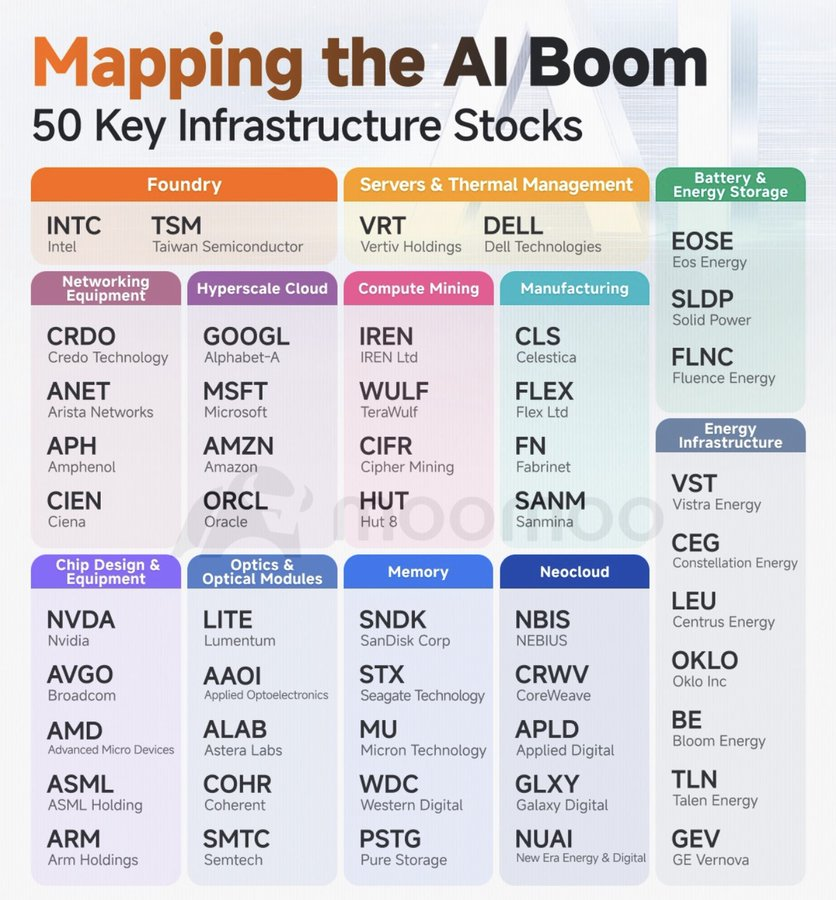
THE 8 LAYERS OF THE REAL-WORLD AI BOOM 1. $NVDA, $AMD, $ASML, $ARM & $AVGO design & manufacture the processors that AI models run on. 2. Those chips only work at scale because of networking & optics where $ANET, $CRDO, $CIEN, $LITE & $AAOI move massive amounts of data between servers, racks & entire data centers so AI systems can operate as one. 3. $VRT & $DELL then provide the physical systems like the servers, cooling & power management that keep AI systems running nonstop under extreme loads. 4. Memory & storage make AI intelligence usable where $MU, $SNDK, $WDC, $STX & $PSTG store the data that models are trained on & pull from when they generate answers. 5. Behind the scenes are the compute operators like $IREN, $CIFR & $WULF which supply large-scale, power-secured infrastructure capable of running AI workloads continuously. 6. Because AI power demand isn’t smooth that means battery & energy storage become critical where $EOSE & $FLNC stabilize load by storing energy & releasing it when data-center demand spikes. 7. None of this works without electricity which $VST, $CEG, $TLN, $OKLO, $BE & $GEV generate & manage to keep AI running 24/7. 8. On top of all of this sit the cloud platforms like $MSFT, $GOOGL, $AMZN & $ORCL along with neoclouds like $NBIS, $GLXY, $CRWV & $APLD which turn raw infrastructure into AI capacity that companies rent by the hour.
Shay Boloor tweet media
English
102
618
2.3K
347.6K