Cash With Dara

2.9K posts

Cash With Dara banner
Cash With Dara

Cash With Dara

@CashWithDara

🍇Longterm investor 🌶Short term options trader 🍋Tweets are just my ideas and personal plays☄️ @unusual_whales @trendspider partner🐳🕷

RoadTo10Figures Katılım Eylül 2019
1.3K Takip Edilen3.2K Takipçiler
Sabitlenmiş Tweet
Cash With Dara
Cash With Dara@CashWithDara·
One of the biggest questions in general is what are the impacts of ai agent proliferation? How long will ai agent proliferation take? How do we measure progress? What reprices as drivers do or don’t unfold? Payments in stablecoins + ID thru blockchain and NFTs, what else?
Cash With Dara@CashWithDara

@pmarca @TMTLongShort what if… the 🇨🇳 are ✅ and the goal is to build out the kill ⛓️‍💥 and then grow it into a life ⛓️‍💥 and eventually EarthOS to program the 🌍 and beyond 🚀 step 1️⃣ relevant now. Time to think about defining states, drivers, subsequent path, and implications

English
2
0
1
476
Cash With Dara
Cash With Dara@CashWithDara·
@edgeofarete someone else maybe might What would happen if Elon or Jensen or Dario decided wholeheartedly to leave the US and move to China and dedicate all energy to helping them develop?
English
1
0
0
66
Leo
Leo@edgeofarete·
Will we ever have a timeline where the frontier labs engage in corporate espionage? Sex tape black mail, bribery to sabotage data center buildouts, wet work teams sent out to assassinate political opponents.
English
1
0
4
204
Cash With Dara
Cash With Dara@CashWithDara·
@DerivativesDon So if remittances occurred sooner it would result in more income to treasury, reducing its need to borrow and it could choose to borrow less in short or wam duration and would probably chose wam based on rate level? Would treasury prefer Fed sell securities to breakeven faster?
English
1
0
0
31
Derivatives Don
Derivatives Don@DerivativesDon·
Interesting in the weeds talk about how the Deferred Asset Account(s) work - at the Regional Bank level. Will be a source of easing for longer than one might have expected in aggregate (of course, duration management of these Deferred Assets is critical). linkedin.com/posts/bill-nel…
English
1
0
12
2K
Cash With Dara
Cash With Dara@CashWithDara·
@DerivativesDon Can you explain the treasury reaction function piece? I assume they want higher remittances and lower yields, so what can they really do?
English
1
0
0
27
Derivatives Don
Derivatives Don@DerivativesDon·
@CashWithDara Correct. They will hold a larger portfolio than they otherwise would have if they had remitted the overall systems net gains. How Treasury would/will behave around the remittances matters as well. As always, the WAMs are the game, not the quantity.
English
1
0
1
49
Cash With Dara
Cash With Dara@CashWithDara·
@biancoresearch Mass drones without the aimbot component from global superpower targeting assistance is futile.
English
0
0
0
32
Cash With Dara
Cash With Dara@CashWithDara·
@biancoresearch The meta is cheap mass produced munitions, with a global superpower providing aimbot (targeting intelligence). The US provided targeting to Ukraine and Russia/China to Iran.
English
1
0
1
60
Jim Bianco
Jim Bianco@biancoresearch·
I am not a military analyst. I'm a financial analyst focused on macroeconomic risk. That different lens might explain why I see something most military strategists and investors are missing. --- The New Rules of Warfare—And Why We Can't Opt Out For nearly a century, warfare belonged to whoever controlled the biggest defense budget. Aircraft carriers. Stealth bombers. Multibillion-dollar weapons systems. That model is changing in ways many aren't appreciating. Ukraine and Iran are showing the West what 21st-century conflict actually looks like: decentralized, highly iterative, fast-changing, unmanned, and cheap. Neither the US nor Russia—beginning in 2022—appears prepared. We might now have no choice but to show we can fight and win such a war. The Ukraine Approach Faced with a small defense budget, a much smaller population, and a vastly outnumbered army, Ukraine had to get creative. They couldn't match Russia's industrial capacity or spending. So they abandoned that playbook entirely. They developed an entirely new way to fight, highly decentralized, iterative, and most importantly, cheap. They also created Brave1—a completely new way to conduct war. Frontline commanders log into an iPad and bypass central command entirely. They spend digital points to purchase equipment directly from hundreds of (Ukrainian) manufacturers. When they encounter a new threat, they message the manufacturer directly and work with the engineers to find a solution, even if that means they visit to the front. The result is hardware or software upgrades that once took months now take days. Here's the crucial part: hundreds of manufacturers compete fiercely for these dollars by offering the best possible product as fast as possible. This isn't centralized procurement. It's a market. Competition drives innovation at scale. Weapons evolve as the enemy evolves in real time. Units are also awarded points for confirmed kills, uploaded from drone video—a powerfully eloquent way to grade effectiveness. But the real innovation might be how they decentralized manufacturing itself. Instead of building weapons in massive, centralized factories that make perfect targets for Russian bombing, Ukraine distributed production across hundreds of small manufacturers—workshops, machine shops, garages, and yes, kitchens. Each produces components or complete systems. This approach serves two purposes: speed and survival. You can bomb a tank factory. You destroy production for months. You cannot bomb ten thousand kitchens. If one workshop gets hit, ninety-nine others keep producing. The network regenerates faster than Russia can destroy it. This is why the manufacturing process includes actual kitchens—it's not a metaphor. It's a strategy. The Metric That Defines a New Era The result is staggering: at least 70% of battlefield casualties now come from drones. This is the first time in over a century that the primary cause of combat death is neither a bullet nor an artillery shell. Since World War I, industrial warfare meant industrial killing. Ukraine has broken that equation entirely. As a result, Russia is now controlling less territory than at any point since 2022 and going backward. In March, Ukraine made gains while Russia recorded no gains for the first time in two and a half years, and Drone-led offensives recaptured 470 square kilometers while paralyzing 40% of Russian oil exports. Ukraine has lowered the "cost per kill" to less than $1,000 per casualty—a 99.98% reduction from the millions of dollars that were common in the post-9/11 wars. This isn't an incremental improvement. This is a complete inversion of modern military economics. Yet the Western defense establishment is not learning from this. Rheinmetall CEO Armin Papperger mocked Ukraine's entire approach. In The Atlantic, he called Ukrainian manufacturers "housewives with 3D printers," dismissing their work as "playing with Legos." They are not studying this revolution. They are mocking it. And the "housewives with 3D printers" are beating the Russian army! Ukraine Is Now in the Middle East The US Military and Gulf states face an eerily similar problem. Iran's Shahed drones threaten shipping in the Strait of Hormuz—a chokepoint that funnels 21% of global oil. They cannot fend off Iran by firing a $4 million Patriot missiles at $20,000 drones. They need what Ukraine has discovered: a decentralized, rapidly adaptive defense network that doesn't require centralized industrial capacity. That's why Ukraine just signed historic 10-year defense deals with Saudi Arabia, Qatar, and the UAE. Over 220 Ukrainian specialists are now on the front lines of the Persian Gulf—exporting not just weapons, but a completely new doctrine of how to fight. The precedent is set. The model works. Everyone is watching. Mosaic On April 1st, Trump threatened to bomb Iran "back to the stone ages" if they don't reopen the Strait within weeks. It's the classic 20th-century playbook: overwhelming offense force, massive bombardment, industrial-scale destruction. The problem? That playbook doesn't work against distributed, cheap, rapid-iteration systems—especially when your enemy is organized under a mosaic structure. Iran's "Mosaic Defense" doctrine is a decentralized command system where authority and capability are distributed across multiple geographic and organizational nodes. Each region operates semi-autonomously with overlapping chains of command and pre-planned contingencies. It's designed so that when you destroy the center, the edges keep fighting. You cannot decapitate a system with no head. You cannot out-bomb your way to victory when your enemy is not centralized; this was the solution for 20th-century industrial warfare. Defense Wins Championships 21st-century asymmetrical threats require defensive shields, not aggressive offenses. Ukraine has built exactly that: rapid-iteration defenses, decentralized manufacturing, commanders empowered to buy solutions in real time and rewarded for success. That same defensive model may hold the key to opening the Strait of Hormuz. Not through massive offense, but through the ability to adapt and defend quickly. Why We're Stuck Whether you viewed this as a war of choice or not, it has now become a war to keep global trade open. And that makes it inescapable. This is precisely why the US cannot declare victory and walk away from the Strait of Hormuz— or TACO. Every adversary on the planet will interpret American withdrawal as confirmation that cheap asymmetric systems work against powerful centralized platforms. And these adversaries might have sent us a message last month. In mid-March 2026, an unauthorized drone swarm penetrated Barksdale Air Force Base in Louisiana, home to the U.S. Air Force's Global Strike Command. The fact that this happened not overseas but in the United States, and that these tests occurred just weeks ago, underscores how close this threat is now. They didn't attack. They announced their presence. Every adversary watching learned that cheap drone networks can reach into the US. The Global Supply Chain Risk If the US abandons the Gulf while Iran holds the Strait contested, markets will price this as validation that cheap systems can hold global trade hostage. The current market disruptions will become permanent. Supply chains will have to pivot from "just-in-time" efficiency back to "just-in-case" redundancy. Inflation returns as safety costs money. Trade routes diversify away from vulnerable chokepoints. The global friction tax becomes permanent. The Unavoidable Truth Once you prove that cheap, asymmetric systems can hold global trade hostage, that knowledge spreads globally and irreversibly. Every adversary learns the same lesson: you don't need a $2 trillion Navy—you need $20 million in drones and the will to use them. Withdrawing while the Strait remains contested would permanently validate this model. Supply chains shift to "just-in-case" redundancy. Insurance costs rise. The friction tax becomes structural—baked into every global transaction for decades. The cost of staying is measured in months. The cost of leaving is measured in decades of economic drag. We cannot leave unfinished business.
English
330
346
1.7K
682.8K
Brett Caughran
Brett Caughran@FundamentEdge·
I was in New York last week and for the first time I'm starting to hear senior investment professionals think seriously about the incremental utility of junior investment talent. Agents are solving process bottlenecks that heretofore required the efforts of junior investment talent across modeling, meeting prep, and data analysis. ”I may not need to hire a junior after all”, It is a more common refrain. And it's widespread enough that I do think some concern is now warranted. My response back is: what if you just fundamentally rethought the role of the junior investor? What if instead of updating models, updating weekly industry data drops, writing first cut earnings previews, and building out management question lists, the responsibility stack of a junior dramatically changed? What if you simply challenged the junior investor to develop more accurate and timely revenue forecasts across three dozen names? And the apprenticeship role almost felt more like an AI enabled data scientist, while that person develops their own investor toolkit. What if you challenged that junior analyst to be an in-house AI-enabled risk analyst? Building AI-augmented risk checklists, counter pitches on every idea in the portfolio & pipeline? What if you challenged that junior to become the most AI-fluent person on the team, putting them through an intensive six-month AI self-study? Which, for your senior investors with portfolio responsibility, is very difficult to find the time. The junior then, through the apprenticeship period, becomes a highly value-added generalist. And during that apprenticeship period, where they're mostly a cost center, they develop into a true AI-augmented investor, and at year three will drive dramatically positive ROI to the firm. Same apprenticeship model, but rethought in specific structure. The foundational reality still exists that your junior investor for a scaled investment firm is going to be a rounding error in terms of comp. The consideration of slowing down junior hiring isn't a cost consideration, it's an efficiency consideration. And while much of the traditional junior stack is quickly becoming abstracted into agents, I do think there is a real potential to rethink the role of junior investors to the effect of very attractive ROI. I do think, to a large degree, we have some moral responsibility to do this as well. In a competitive business, it is absolutely imperative that we drive efficiencies and research quality with all the tools at our disposal. That definitionally will impact the existing role of juniors more than seniors. I'm feeling a bit more of a mission to help firms rethink how they deploy junior talent. If you're doing the same, I'd love to connect and find creative ways to rethink the junior role in fundamental investing firms.
English
32
23
615
84.3K
lele
lele@CherrilynnZ·
if sf is wasia and oakland is blasia where will chindia be?
English
313
71
4.7K
713.2K
Capital Flows
Capital Flows@Globalflows·
Construction spending is directly linked with the AI capex build-out This is why we are seeing $CAT moving in lockstep with AI capex spending flows
English
2
0
24
4.8K
EconstratPB
EconstratPB@EconstratPB·
Apparently two questions from my lecture at U-Mass Amherst advanced investments class made it on to the final. Poor kids. H/t @benjaminMlavine
EconstratPB tweet media
English
4
0
34
4K
Cash With Dara
Cash With Dara@CashWithDara·
@DerivativesDon Interesting. Thanks for sharing. I will have to play around with that framework and familiarize myself with thinking that way. If we opened/gapped below the smas on 4hr, what would your thinking/reaction be?
English
1
0
1
68
Derivatives Don
Derivatives Don@DerivativesDon·
@CashWithDara NASDAQ is leading Many components in NASDAQ are also in SPX Of course SPX is going up with such a strong move in NASDAQ. And, although lower beta, there is not sufficient divergence outside NASDAQ leadership to have any moving average/trend divergence.
English
1
0
0
97
Derivatives Don
Derivatives Don@DerivativesDon·
It is a complete waste of time to try to figure out why and who is the buyer right now Stay out of the way React when they are done
English
7
3
59
2.5K
Cash With Dara
Cash With Dara@CashWithDara·
@DerivativesDon How do you interpret the price action on the S&P recently? Does low volume suggest lack of participation (missing the move) or fragility?
English
1
0
0
66
Derivatives Don
Derivatives Don@DerivativesDon·
@CashWithDara Bingo They are clearly leaning on the levels Would not go short above 30 minute levels
English
1
0
3
108
Bob Elliott
Bob Elliott@BobEUnlimited·
Bank fund of hedge funds pitching clients 1.0+ Sharpe and zero correlation. Looks nice until you notice its only lost money 1 of the last 32 months and has a return distribution vs natural occurrence that puts Mr. Madoff to shame.
Bob Elliott tweet media
English
5
1
44
15.2K
Cash With Dara
Cash With Dara@CashWithDara·
@CRUDEOIL231 Why is oil not roofing then? Genuine question. I know Asia and American refineries will come out of maintenance + summer demand + min operational thresholds all collapse on July, but even July prices are not rising in a way that suggests competition and demand destruction
English
3
0
4
1.3K
JH
JH@CRUDEOIL231·
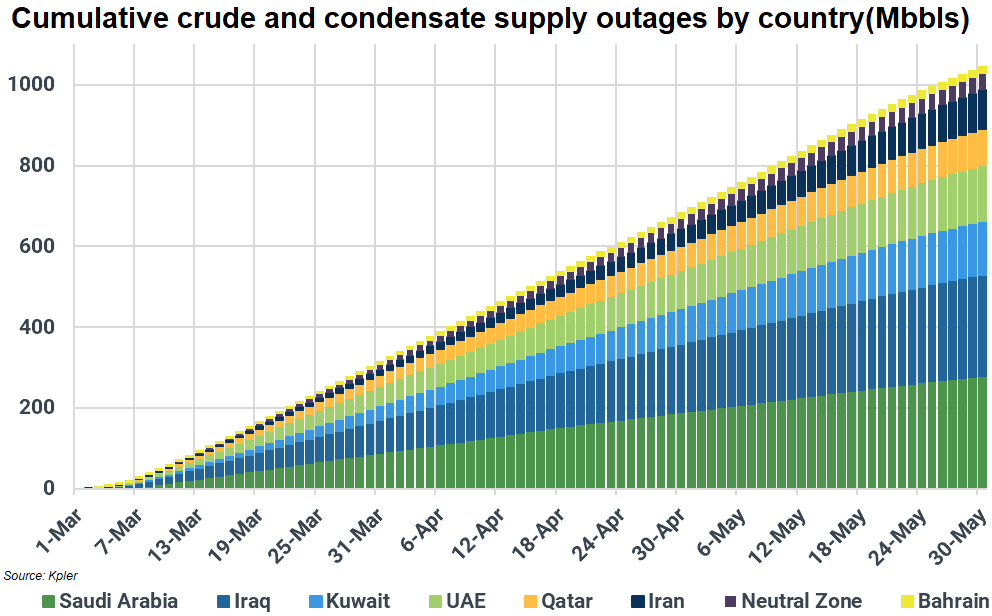
Just a reminder in case you forgot: despite all the bullshit on Axios and Truth Social, massive production losses are piling up in the Persian Gulf. Considering the logistical delays to restart production, I have no idea how huge the final loss will actually be. It’s absolutely insane. Meaningless time passing and things becoming deadlocked is the best gift of all. Let's just let time do the work :) #oott #iran
JH tweet media
English
20
74
491
36.2K
Craig Fuller 🛩🚛🚂⚓️
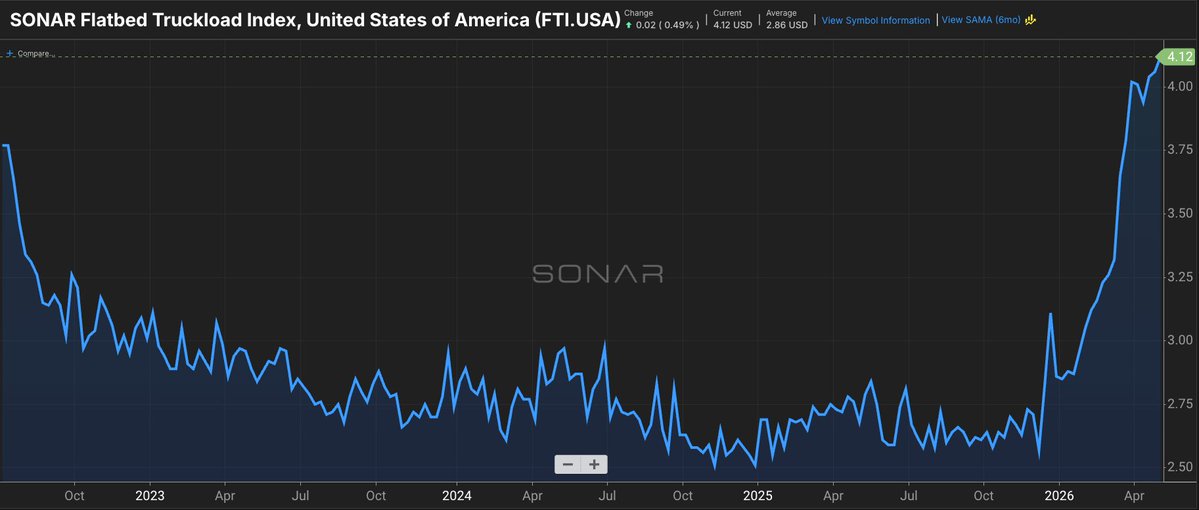
Flatbed truckload spot rates to new all-time high. $4.12/mile as industrial freight cranks.
Craig Fuller 🛩🚛🚂⚓️ tweet media
English
9
34
245
33.6K