
Chandra Observatory

78.1K posts

Chandra Observatory banner
Chandra Observatory

Chandra Observatory

@chandraxray

Official Twitter account of NASA’s Chandra X-ray Observatory. Operated for NASA by Smithsonian (SAO). Verification: https://t.co/oQRMjHqCRI Legal: https://t.co/BUQNO29Sjg

In orbit Katılım Ocak 2008
198 Takip Edilen419K Takipçiler
Chandra Observatory
Chandra Observatory@chandraxray·
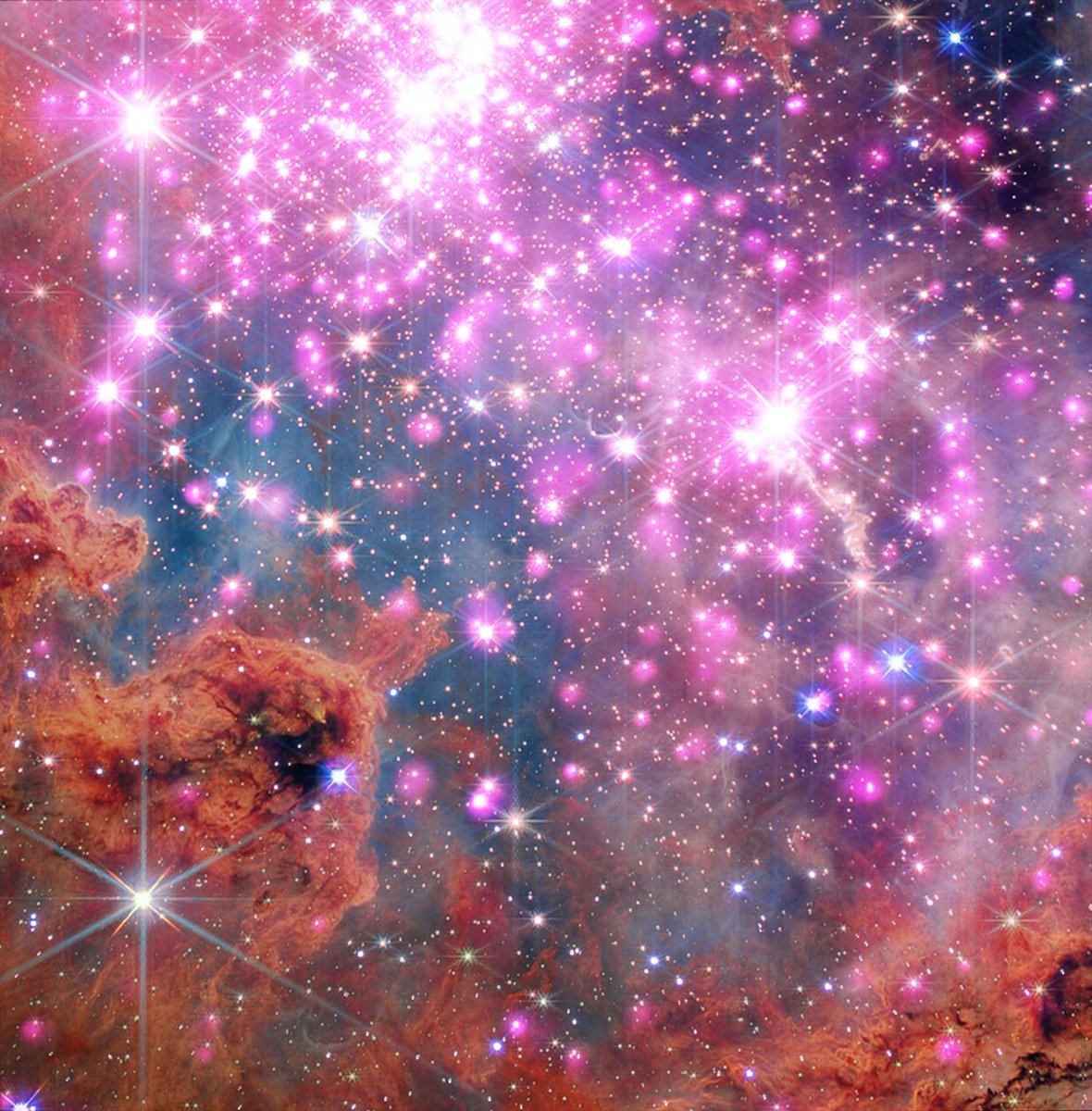
Westerlund 2 is a young cluster of thousands of stars located about 20,000 light-years from Earth. This close-up image, roughly 12 light-years across, combines observations from NASA's Chandra X-ray Observatory & @NASAWebb.✨
Chandra Observatory tweet media
English
34
385
1.9K
90.2K
Chandra Observatory
Chandra Observatory@chandraxray·
At the heart of galaxy NGC 1365, a supermassive black hole is basically feasting at an all‑you‑can‑eat buffet in this image from Chandra and @NASAWebb. Located about 60 million light-years from Earth, this gobbling black hole has a mass of roughly 2 million suns... and growing.⚫
Chandra Observatory tweet media
English
25
266
1.2K
78.3K
Chandra Observatory
Chandra Observatory@chandraxray·
Sometimes described as "the most relaxed galaxy cluster in the universe," Abell 2029 had a wild past according to new observations from NASA's Chandra X-ray Observatory. More at: chandra.si.edu/photo/2026/a20… 🌀
Chandra Observatory tweet media
English
9
154
611
20.3K
Chandra Observatory retweetledi
NASA
NASA@NASA·
A-meow-zing 😻 @NASAWebb and @ChandraXray joined forces to deliver this view of the Cat's Paw Nebula. Different wavelengths combine to reveal young stars at the center of these dusty clouds.
NASA tweet media
English
1.2K
8.4K
40.8K
1.9M
Chandra Observatory retweetledi
Hubble
Hubble@NASAHubble·
The force awakens in newborn stars. Hubble captured some cosmic "lightsabers" far, far away. These are actually young stellar jets, colliding at fast speeds with nearby gas and dust. Happy Star Wars Day from the Hubble team!
Hubble tweet mediaHubble tweet media
English
93
3.9K
17.5K
331.1K
Chandra Observatory retweetledi
NASA Ames
NASA Ames@NASAAmes·
Even the cosmos has a green thumb 💐 160,000 light-years away, 30 Doradus is in full bloom, displaying a stellar bouquet of thousands of stars. This image combines data from NASA’s Chandra X-ray Observatory, @NASAHubble, and the Atacama Large Millimeter/submillimeter Array.
NASA Ames tweet media
English
72
603
2.8K
127.2K
Chandra Observatory
Chandra Observatory@chandraxray·
This striking new view of the Pinwheel Galaxy combines X-ray light from Chandra with other types of light from ground-based observations, @NASAHubble, and XMM-Newton. The galaxy is roughly 170,000 light-years across, making it about 70% larger than our own Milky Way Galaxy.🌀
Chandra Observatory tweet media
English
39
491
2.2K
70.8K
Chandra Observatory
Chandra Observatory@chandraxray·
These results highlight the power of multi-mission astronomy and Chandra's decades-long history of observations! Shortly after NASA's Webb Telescope began observing, scientists reported a new class of unexplained objects that eventually became known as "little red dots" (or LRDs). The scientists compared new data from Webb with a deep X-ray survey previously performed by Chandra. By bringing data together from different telescopes, even more information was revealed! 😁
English
0
1
1
72
Christopher Thomas
Christopher Thomas@Chris_Thomas226·
@chandraxray Observation dates were back in 2005 - 2008, why take so long to publish this information? Thanks.
English
1
1
2
207
Chandra Observatory
Chandra Observatory@chandraxray·
An X-ray emitting "little red dot" about 11.8 billion light-years from Earth may be key to unlocking the true nature of a mysterious class of sources that astronomers have found in the early universe. More: chandra.si.edu/photo/2026/xra… 🔴
Chandra Observatory tweet media
English
5
68
314
13.6K
Chandra Observatory
Chandra Observatory@chandraxray·
Over 1,000 stars are located within 4 light-years of the center of the Westerlund 1 "super" star cluster. To give you a little context, 4 light-years is roughly the distance between our Sun and the next closest star to Earth. 🤯
Chandra Observatory tweet media
English
19
200
919
32.8K
Chandra Observatory
Chandra Observatory@chandraxray·
Sun-like stars are dimming in their X-ray output more quickly than previously thought. Unlike in the movie "Project Hail Mary," this quieting of stars is a benefit for the prospects for life on orbiting planets around these stars — not a threat. ✨More: s.si.edu/dimming
Chandra Observatory tweet media
English
8
95
432
25.6K
Chandra Observatory retweetledi
NASA Marshall
NASA Marshall@NASA_Marshall·
We're coloring in the picture, one telescope at a time! 🎨 NASA’s IXPE telescope has taken a new observation of a supernova remnant, RCW 86, which helps create a fuller picture of what other telescopes have observed >> go.nasa.gov/4t14Qhk
NASA Marshall tweet media
English
24
230
1.2K
32.2K
Chandra Observatory
Chandra Observatory@chandraxray·
Visual Description: Two composite images, presented side-by-side. Each image represents an extraordinarily large survey of galaxies, with a single galaxy positioned at the center of each frame. The two images appear visually similar. Both feature dozens of galaxies; glowing specks and elliptical shapes in purples, golden oranges, blues, and whites, scattered across the blackness of space. In both images, blue colors represent optical data from Hubble. Reds and greens represent infrared data from Webb. And purples and pinks represent X-ray data from Chandra. The focal points are the galaxies at the center of each frame. Both galaxies glow in pinks and whites, and both have supermassive black holes at their core. But the featured galaxy on our left is far more distant than the featured galaxy on our right. On our left is a spiral galaxy some 5.6 billion light-years from Earth. It resembles a large dot with a hazy, neon pink outer ring, and a white core. The strong pink glow is due to gas rapidly falling into the supermassive black hole at its core. When that gas is heated up, it produces large amounts of radiation, including X-rays. On our right is an elliptical galaxy at a distance of about 3 billion light-years. This galaxy resembles an egg with an oval-shaped white outer ring, and a round pink circle at its core. This galaxy’s supermassive black hole is a much fainter source of X-rays than the source in the left panel. This indicates that the supermassive black hole on our right is consuming material at a much slower rate than the more distant supermassive black hole on our left.
English
1
6
38
4.4K
Chandra Observatory
Chandra Observatory@chandraxray·
Astronomers have an answer for a long-running mystery in astrophysics: why is the growth of supermassive black holes so much lower today than in the past? More about the discovery: chandra.si.edu/photo/2026/bhg…
Chandra Observatory tweet media
English
12
84
327
16.7K
Chandra Observatory
Chandra Observatory@chandraxray·
Visual Description: In this composite image of the Cat's Paw Nebula, pockets of starry blue sky appear behind thick, overlapping rings of dark orange cloud. At the center of the image, tucked amongst the clouds, is a mottled patch of purple.
English
2
9
36
4.2K
Chandra Observatory
Chandra Observatory@chandraxray·
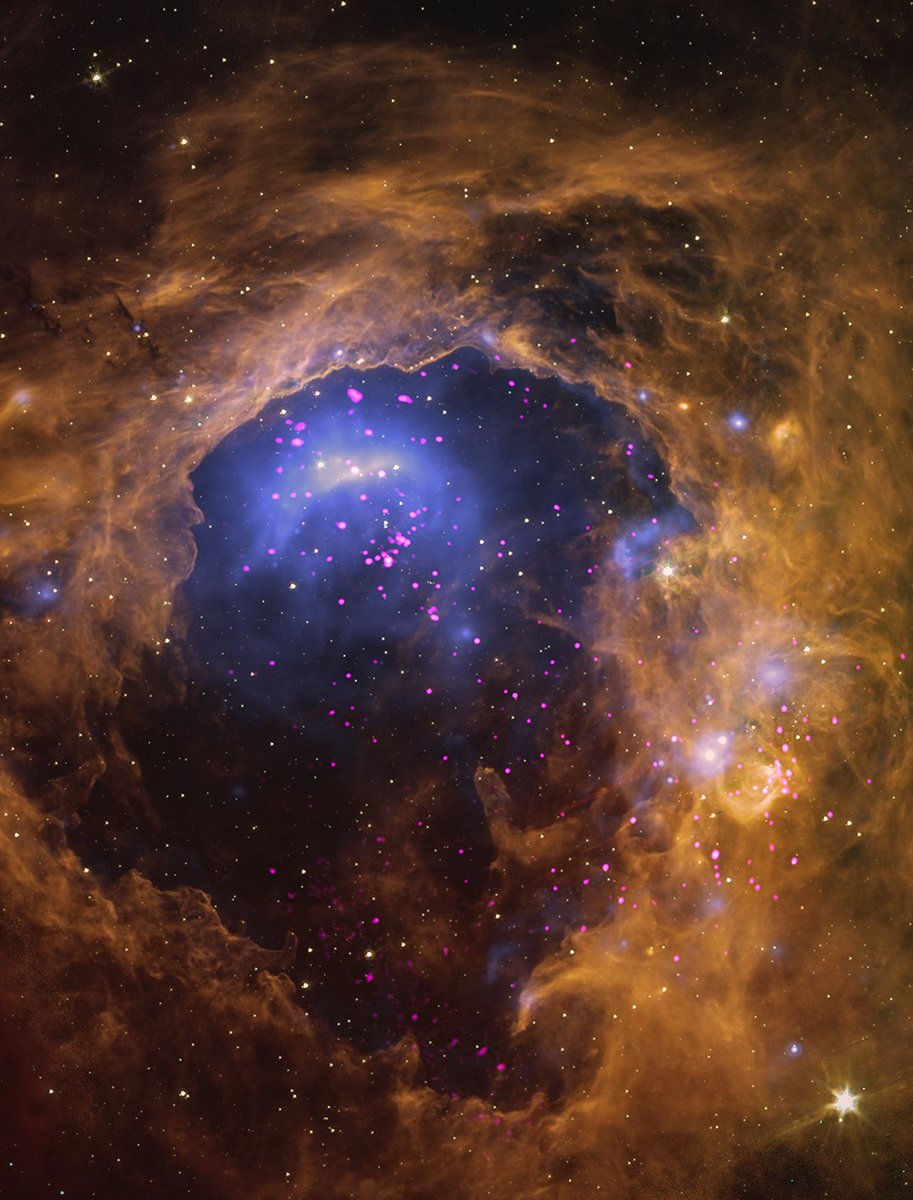
Spring into spring with this new image of the Cat's Paw Nebula from NASA's Chandra and @NASAWebb. We expect it to start knocking planets off the counter for sport any minute now. 🐾
Chandra Observatory tweet media
English
32
395
1.7K
88.1K
Chandra Observatory
Chandra Observatory@chandraxray·
Astronomers have spotted an extreme collision between two neutron stars in a very odd place about 4.7 billion light-years from Earth. This result may help answer two different mysteries about stars and intergalactic space. More at: chandra.si.edu/photo/2026/nsm…
Chandra Observatory tweet media
English
18
155
789
50.6K
Chandra Observatory retweetledi
NASA Marshall
NASA Marshall@NASA_Marshall·
Chandra doesn’t just study black holes — it also reveals new details across our solar system. This sonification blends X-rays from @chandraxray with a Cassini image of Saturn, turning data into sound. 🪐 Check out more planetary sonifications here: go.nasa.gov/4bb0cpP
English
47
311
1.4K
104.1K
Julian C
Julian C@JulianUnlocked·
@chandraxray @NASAHubble This rules. Jupiter as a horror movie soundtrack, but it’s real data. What’s the “big moment” to listen for, aurora spikes, flares, or something else?
English
1
0
3
277
Chandra Observatory
Chandra Observatory@chandraxray·
Listen your way across Jupiter with this new sonification combining data from Chandra and @NASAHubble. Want to know more about it? Check out the description below 👇
English
10
118
516
44.6K