Scientists used cryo-EM to capture 13 distinct structures of the chromatin remodeler SNF2H in action. This research provides a complete view of nucleosome sliding, a key process in gene regulation. ow.ly/mhv150VtUoH
Virologists and biophysicists at the UNC School of Medicine have discovered that a type of RNA in #Zika virus can "freeze itself in time" in an effort to make more copies of itself and further its spread in the body.
news.unchealthcare.org/2025/02/some-v…
Most people misunderstand the Central Dogma.
In school, perhaps you were taught it as “DNA → RNA → protein.” But that’s a massive oversimplification.
Francis Crick’s real "Central Dogma" was about what *cannot* happen in a cell. Let’s break it down. 🧵
Scientists have tracked microplastics moving through the bodies of mice in real time
The tiny plastic particles are gobbled up by immune cells and eventually become lodged in blood vessels in the brain
go.nature.com/4h66iJV
Sometimes the experimental control is messed up – but in a really interesting way! – and it's a great 'night science' trick to make a discovery by recognizing it when it happens.
Fresh out of the press! ✨Check out our new paper on the violent entry of the HIV capsid into the nuclear pore — watch it crack that gate! 🤯 💥 Incredible work from @Beck_Laboratory and @HummerLab
🤩 More here: biophys.mpg.de/2842024/hivcap… 🔗
We're thrilled to present ESM3 in @ScienceMagazine. ESM3 is a generative language model that reasons over the three fundamental properties of proteins: sequence, structure, and function. Today we're making ESM3 available free to researchers worldwide via the public beta of an API for biological intelligence.
Trained with over a trillion teraflops of compute, this is the first time a model of this scale has been trained for biology, pushing the frontier of AI for biological discovery and engineering.
ESM3 learns to represent the immense complexity of protein biology, learning from billions of natural proteins. From this training it developed the capability to design proteins, responding to complex prompts combining atomic level details and high level instructions to generate new proteins.
ESM3 can explore protein space far beyond natural evolution. We prompted ESM3 to generate a fluorescent protein at a far distance from any known fluorescent proteins, searching an unknown region of protein space, to discover a new fluorescent protein.
We estimate this is equivalent to simulating five hundred million years of evolution.
My PhD adviser Liliana Florea has developed a Coursera course "Bioinformatics Methods for Transcrptomics". A great resource to learn cutting-edge short- and long-read RNA-seq data analysis techniques: coursera.org/learn/bioinfor…
Chemicals derived from neurotransmitter molecules in the brain can act as epigenetic marks on histone proteins to regulate gene expression. These marks control circadian clock genes and influence behaviour go.nature.com/3DLWE0a
We performed subtomogram averaging on complexes from >3 MDa to ~200 kDa, including 80S ribosomes, Rubisco, clathrin, microtubules, ATP synthase photosystem II, and nucleosomes. Most density maps achieved sub-nanometer resolution!🔬✨ #CryoET#StructuralBiology#VisualProteomics
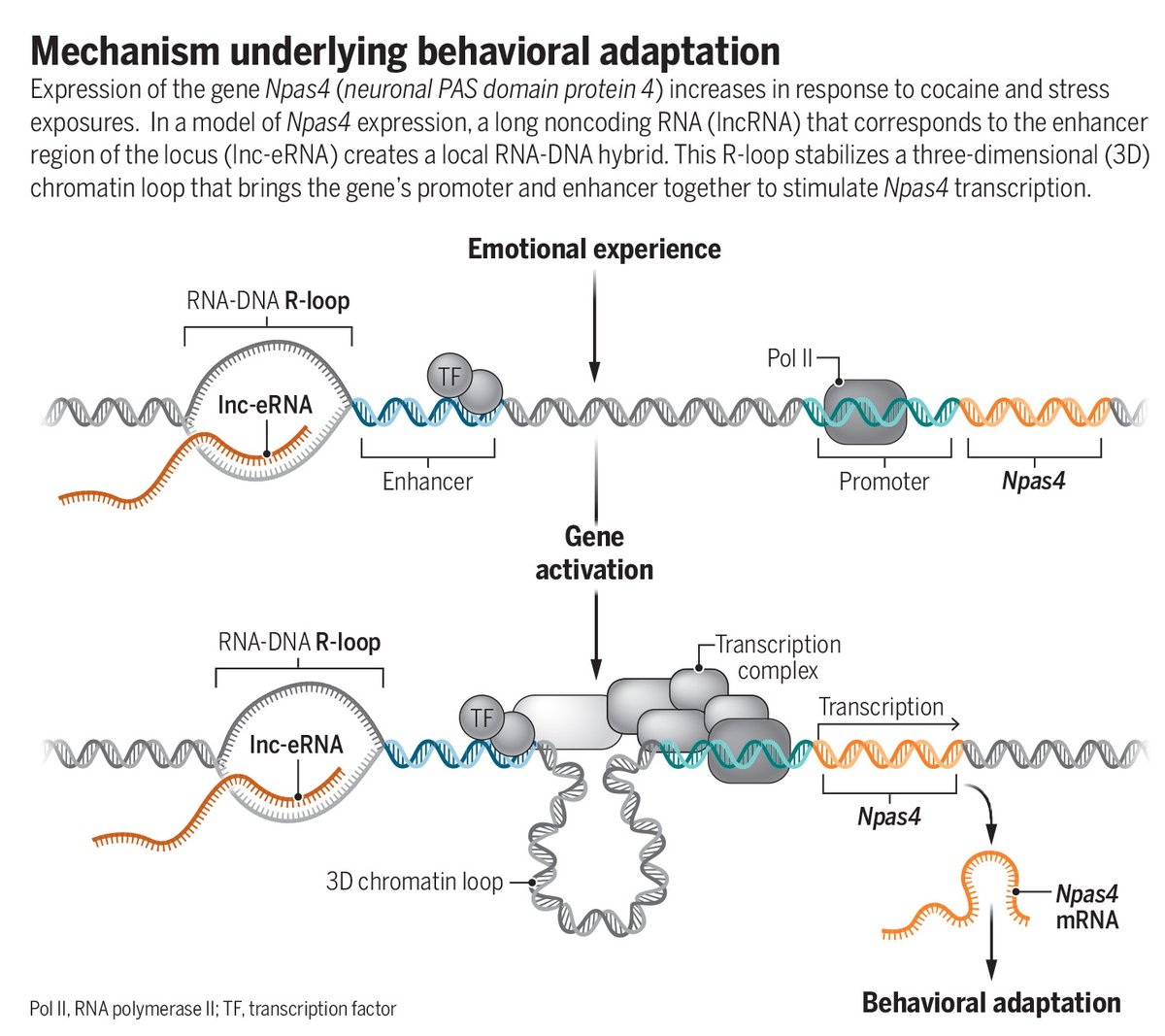
Noncoding RNA controls the expression of a gene implicated in drug- and stress-induced behaviors.
Learn more in a new #SciencePerspective: scim.ag/49D7eCD
“For a scientific career the most important elements are good teachers and mentors […] not only during early years as student and postdoc, but throughout the entire career of a scientist.”
- medicine laureate Thomas Südhof.
#NobelPrize
The good idea comes when one person feels comfortable enough to say something that might make them look stupid and their friend is open enough to recognize its potential.