Christian Bolivar

207 posts

Christian Bolivar banner
Christian Bolivar

Christian Bolivar

@ChrisBolivarAI

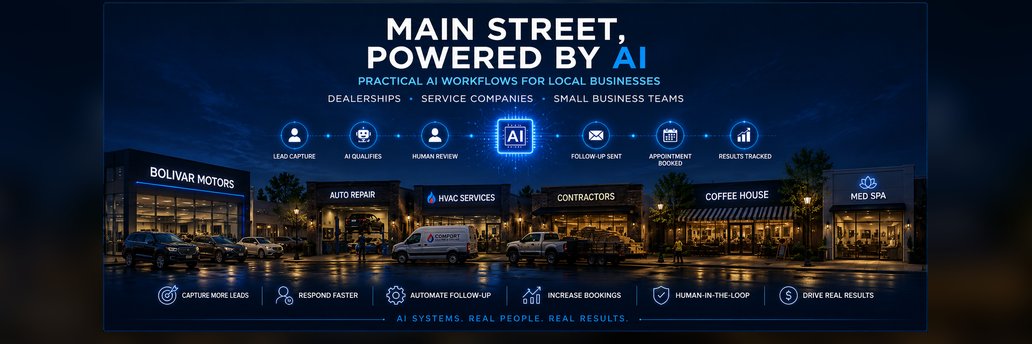
AI expert helping small businesses & dealerships implement practical AI workflows and train their teams | Founder @BolivarStrategy

Chicago Katılım Aralık 2012
627 Takip Edilen62 Takipçiler
Christian Bolivar
Christian Bolivar@ChrisBolivarAI·
Sometimes I have an idea but I can’t see the execution yet. So I’ll record a voice note for a few minutes. Just me brain dumping the abstract idea, what I think the end goal is, and where I’m stuck. Then I feed it to ChatGPT. It helps me clean up the thought, find the actual plan, and sometimes gives me a prompt I can hand to Ramsay, my Hermes agent, so it can start working while I’m at work or with my family. Then I nudge it along in the little gaps. On lunch. On the toilet. Waiting while my girlfriend disappears into the Target dollar section. Grabbing a snack. Stepping away for a minute. That used to be doom scrolling time. Now it’s build time.
English

0
0
0
6
Christian Bolivar
Christian Bolivar@ChrisBolivarAI·
This Sakana Fugu release is interesting because it points to where AI may be going next. Not just bigger models. Better coordination. For the last few years, most of the AI conversation has been: Which model is smartest? GPT vs Claude vs Gemini vs Grok vs everything else. But real work usually does not need one “perfect” model. It needs the right system. Planning. Research. Reasoning. Coding. Verification. Summarizing. Routing. Knowing when to ask another specialist. That is what caught my attention with Sakana Fugu. From what I understand, Fugu is trying to make a multi-agent system feel like one model. You send one request. Behind the scenes, it can decide whether to answer directly or coordinate different expert models to handle parts of the task. That is a big idea. Because most people and most businesses do not want to manage 12 different models, 8 different APIs, and a giant custom agent workflow. They want useful output. They want fewer moving parts. They want a system that knows when to use the right tool without making the user become the AI architect. That matters for small businesses too. A law office does not care which model is best at every subtask. They care whether the system can help organize documents, summarize notes, draft something for review, and keep the human in control. A doctor’s office does not need model drama. They need safer admin workflows, intake support, internal knowledge search, call summaries, and human-reviewed drafts. A local business does not need AI hype. They need coordination. The right model for the right task. The right boundary around sensitive data. The right review step before anything goes out. That is why this direction feels important. The future may not be one giant model that does everything. It may be systems that know how to coordinate many models, route around weaknesses, verify outputs, and make the complexity invisible to the user. Of course, the real questions still matter: How reliable is it? How expensive is it? Where does the data go? What controls does the user have? Can businesses trust it in real workflows? But directionally, this feels like a shift worth paying attention to. The next AI advantage may not come from asking: “What is the best model?” It may come from asking: “What is the best system for this job?”
Sakana AI@SakanaAILabs

Introducing Sakana Fugu: A full multi-agent orchestration system accessible via a single model API. Our ‘Fugu Ultra’ model matches the performance of Fable and Mythos, delivering frontier capability without the risk of export controls. Try it: sakana.ai/fugu 🐡

English
0
0
0
9
Christian Bolivar
Christian Bolivar@ChrisBolivarAI·
I don’t think everyone needs a bachelor’s degree to get into AI anymore. That does not mean degrees are useless. If you want to be a research scientist, machine learning engineer, or work on frontier model training, formal education can still matter a lot. But AI is becoming much bigger than research labs. There are going to be jobs around: implementing AI workflows training teams how to use tools building internal assistants automating admin work creating better prompts and processes connecting tools together testing AI systems documenting what works helping small businesses use AI safely And for a lot of that work, the best credential is not always a diploma. It is proof that you are building. Proof that you can learn fast. Proof that you understand what these tools can actually do. Proof that you can take a messy problem and turn it into a useful workflow. That is why I’m trying to build in public. I may not know everything. I’m going to make mistakes. But I would rather be learning with the tools every day than waiting until I feel qualified enough to start. Because there are still a lot of people who have no idea what AI is capable of. They think it is just a chatbot. They do not see the workflows yet. They do not see the local setups. They do not see the no-send systems. They do not see the internal assistants, review queues, trackers, reports, and small automations that can actually help a business. That gap is opportunity. Not because I’m smarter than anyone. Because I’m paying attention and building while other people are still debating whether this matters. I think the people who win the next few years are going to be the ones who can say: “I built this.” “I tested this.” “I broke this.” “I fixed this.” “I know where this helps.” “I know where this is risky.” “I can show you how to use it.” That is the path I’m betting on. Learn fast. Build proof. Stay useful. The degree may open doors. But the work is what keeps you in the room.
English
0
0
0
4
Christian Bolivar
Christian Bolivar@ChrisBolivarAI·
The future of small business software may not look like another dashboard. It may look like a hidden operating system that keeps the business from forgetting itself. The lead that came in after hours. The customer who said “call me tomorrow.” The quote that never got followed up. The payment promise buried in a note. The manager asking for an update that lives in three different places. None of that looks dramatic in the moment. But that is where businesses leak money, trust, and momentum. Most small businesses do not need more apps. They need a layer that helps remember what happened, route the next step, draft the response, and keep a human in control. That is where AI gets interesting to me. Not AI as a gimmick. AI as operational memory.
English
0
0
0
5
Peter H. Diamandis, MD
Peter H. Diamandis, MD@PeterDiamandis·
We are about to unlock a near infinite supply of resources in our solar system. The reality is an overwhelming amount of abundance. A near infinite supply of energy, metals, minerals and real estate. Abundance is our future, scarcity is our past.
English
216
292
2.7K
83.4K
Christian Bolivar
Christian Bolivar@ChrisBolivarAI·
Overthinking feels productive because it gives you the illusion of progress. But the only way I’ve learned anything worth keeping is by failing faster. Post the thing. Make the call. Build the ugly first version. Let the market, the customer, or the result tell you what’s real. Imposter syndrome does not disappear before you start. It gets quieter after you prove to yourself that you’ll keep moving anyway. Most of the time, the real waste of time is not trying and failing. It’s spending months thinking about the perfect version of something you never gave yourself permission to begin.
Lorwen Harris Nagle, PhD@LORWEN108

The most socially acceptable way to destroy your life: Overthink everything. Act on nothing. Your mind calls it “figuring things out.” Here are Eckhart Tolle’s 7 steps to break the loop: 👇 1. Recognize that there’s a voice in your head that never shuts up.

English
0
0
0
6
Christian Bolivar
Christian Bolivar@ChrisBolivarAI·
@AlexFinn I remember seeing one of your first videos where you seemed frantic, and I thought, “WTF is this guy talking about?” I couldn’t afford a Mac mini, but I had a MacBook M1 Max. Now I have a hybrid VPS and local Hermes setup. It’s been a lot of fun to build and learn.
English
0
0
1
237
Alex Finn
Alex Finn@AlexFinn·
5 months ago I spent $30,000 on 3 Mac Studios, 2 Mac Minis, and a DGX Spark I went all in on local LLMs and encouraged others to do the same I warned prices would explode I was called crazy, a hype beast, dangerous, and that I had no idea what I was talking about Since then: • Mac Studios above 96gb have become unavailable • Memory prices have 4x’d • Other hardware prices have 10x’d Now those same AI influencers who destroyed me are spending 5 to 6 figures on hardware publicly GLM 5.2 dropped and it’s Opus level. I’m running it on 1 of my 3 Mac Studios 512gbs. The same ones I was called an idiot and hype beast for buying. The same ones that are reselling for triple the price used. The insane part is this is just the beginning Intelligence will be integrated into every device you own, including devices that aren’t even publicly available yet like humanoid robots All of these new devices will require GPUs, memory, storage, and more components Components that have already 10x’d in price That’s not even counting all the people that will start vibe coding when Codex and Claude Code become more mainstream Right now less than 1% of the world is even taking advantage of those tools Imagine what happens when it reaches 2% The local revolution is here. Hardware is the bottleneck Act accordingly
Alex Finn tweet media
English
289
114
1.5K
234.4K
Christian Bolivar
Christian Bolivar@ChrisBolivarAI·
A law office probably does not need an “AI lawyer.” That is the wrong starting point. A more practical first AI workflow might be: Intake notes come in. AI organizes the key details. It summarizes related documents. It helps find internal notes or templates. It drafts a routine communication. A human reviews everything before it goes anywhere. That is not replacing the lawyer. That is helping the office handle the admin pile around the legal work. But the architecture matters too. If the workflow touches sensitive documents, client notes, patient info, internal policies, or private business data, you cannot treat the AI tool like a normal app. Where does the data go? Who can access it? Is it used for training? Is it logged somewhere? Is there a proper agreement in place if it is cloud-based? Can the business control retention, permissions, and review? That is why local or private AI architecture matters. Not because local models are magic. They are not. But for privacy-sensitive businesses, keeping more of the work inside a controlled environment can reduce unnecessary data exposure and give the business more control over what the AI can see. Same idea could apply in a doctor’s office too. Not diagnosis. Admin first. Call notes. SOPs. Appointment prep. Policy search. Follow-up drafts. Staff questions. The safest starting point is not: “AI makes the decision.” It is: AI organizes the work so a human can make a better decision faster. And for sensitive work, the first question should not just be: “What can the AI do?” It should also be: “Where does the data live, who controls it, and what is the AI allowed to touch?” That is a very different conversation.
English
0
0
0
18
Christian Bolivar
Christian Bolivar@ChrisBolivarAI·
If you want better AI answers, show it what good looks like. That one idea helped me a lot. Most people ask AI for something like: “Write me a follow-up message.” Then they get something generic and think the tool is bad. But the model is guessing. It does not know your taste. It does not know your customer. It does not know what “good” sounds like to you. It does not know what you would never say. So now I try to give it a target. Instead of: “Write me a follow-up message.” Try: “Write me a follow-up message for someone who asked about financing but stopped responding. Keep it friendly, not pushy. The goal is to restart the conversation, not pressure them. Here is the style I like: ‘Hey, just wanted to check in and see if you still wanted help looking at options. No pressure either way.’ Give me 3 versions: casual professional very short” Same tool. Completely different input. Completely different output. That is something I think normal people miss with AI. You do not need fancy prompt engineering. You need context. You need examples. You need to show the model what good looks like. That is how I’m trying to use AI now. Not as a mind reader. More like a very literal assistant that gets better when I explain the job clearly. #AI
Christian Bolivar tweet media
English
0
0
0
23
Christian Bolivar
Christian Bolivar@ChrisBolivarAI·
@0xMovez The future of AI feels less like “better prompts” and more like operating systems: planning, memory, verification, skills, loops, and human oversight all working together.
English
0
0
0
39
Christian Bolivar
Christian Bolivar@ChrisBolivarAI·
@cobi_bean This mirrors a lesson I’ve learned building with Hermes: agent performance improves dramatically when you focus less on prompts and more on environment design. Memory, skills, context, and feedback loops matter more than most people realize.
English
0
0
0
37
Christian Bolivar
Christian Bolivar@ChrisBolivarAI·
Small businesses do not need an AI that “runs the company.” They need help with the boring mess: missed follow-ups scattered notes repeated questions messy inboxes unclear next steps things the owner explains over and over Start there. Draft. Summarize. Organize. Review. Approve. That is where trust starts.
English
0
0
1
8
Christian Bolivar
Christian Bolivar@ChrisBolivarAI·
@cabinsmountain We’ve spent decades building for privacy and convenience, but not enough for connection. I think a lot of people are realizing that success feels different when you have a village to share it with.
English
0
0
0
18
Mountain Cabins
Mountain Cabins@cabinsmountain·
Normalize buying land with your siblings and closest friends and building a place where your families can grow together. Modern isolation isn't how people were meant to live. A few generations ago, extended families often lived just down the road from one another. Meals were shared, support was always nearby, and childcare wasn't a constant concern. Bring back the village.
Mountain Cabins tweet media
English
1K
3.1K
20K
2.8M
Christian Bolivar
Christian Bolivar@ChrisBolivarAI·
@garrytan As someone building AI systems, what worries me isn’t taxation, it’s uncertainty. Founders can adapt to almost any rule. They struggle when the rules can fundamentally change after they’ve already taken the risk.
English
0
0
0
440
Garry Tan
Garry Tan@garrytan·
Bernie Sanders introduced a bill to seize 50% of any AI startup that crosses $200M in revenue. The same anti-prosperity bloc spent the year trying to ban startup acquisitions, blocking the only exit 85% of founders ever get. This is a war on building startups in America.
Garry Tan tweet media
English
1.1K
796
9.6K
664.4K
Christian Bolivar
Christian Bolivar@ChrisBolivarAI·
@Tim_Denning Most people think they have a time problem. They actually have a priority problem. When the priority is clear, saying no becomes much easier
English
0
0
0
106
Christian Bolivar
Christian Bolivar@ChrisBolivarAI·
@fivosaresti The real asset isn’t AI. It’s institutional memory. Once every project, decision, workflow, and lesson learned becomes reusable context, a small team can operate like a much larger company. That’s where the leverage comes from.
English
0
0
1
20
Christian Bolivar
Christian Bolivar@ChrisBolivarAI·
@MatthewBerman The most overlooked part of agent loops isn’t the loop, it’s the stopping condition. I’ve seen too many “agents” that are really just infinite automation with no verification step. The best loops have clear proof of completion, human review points, and measurable outcomes.
English
0
0
1
82
Christian Bolivar
Christian Bolivar@ChrisBolivarAI·
@septisum smells like rage bait to me. I'm sure they had the right people consulting them.
English
0
0
1
2.6K
Christian Bolivar
Christian Bolivar@ChrisBolivarAI·
I’m building Ramsay and Hermes as my own operator system first. Not because I think every business needs some giant AI brain running everything. Actually, the opposite. The more I build this for myself, the more I think small businesses need simpler, safer AI workflows first. My setup keeps teaching me the same lessons: Read-only before action. No-send before automation. Drafts before public messages. Review queues before trust. Trackers so I don’t repeat work. Daily reports so I know what changed. Local or hybrid setups when privacy matters. Human approval before anything touches the outside world. That is not flashy. But it is useful. And I think that is where a lot of small businesses should start too. Not: “Let AI run the office.” More like: Help me organize the mess. Help me draft the thing. Help me find the note. Help me summarize the call. Help me prepare the follow-up. Then wait for me to review it. That is the kind of AI I trust right now. The boring kind that makes the human operator better.
English
1
0
2
33
Christian Bolivar
Christian Bolivar@ChrisBolivarAI·
@garrytan This resonates. I sell cars by day, but AI has allowed me to start building software, workflows, research systems, and businesses that would have been out of reach for me a few years ago. Same technology. Different outcome because of agency.
English
0
0
0
89
Garry Tan
Garry Tan@garrytan·
For people who don’t have a clear sense of the future they want, AI is just another mechanism of control But in the hands of someone with agency, AI is the breaker of chains, something that lets you do things no humans can do alone. AI can be a liberator if you choose agency.
English
153
138
1.4K
49.4K