Chris Lally

439 posts

Chris Lally banner
Chris Lally

Chris Lally

@ChrisLally

Boston, MA Katılım Şubat 2012
615 Takip Edilen1.2K Takipçiler
Chris Lally
Chris Lally@ChrisLally·
@blakeandersonw super clean! Great stack. Not going with next probably made sense to keep lean, and supabase with auth/rls bundled in probably makes things easier (loving convex/betterauth combo personally but can't knock this). Congrats on the launch!
English
0
0
0
46
Blake Anderson
Blake Anderson@blakeandersonw·
Our next major feature will be adding long-running AI employees and an agentic App Store. Soon!!
English
8
0
94
16.5K
Umesh Khanna 🇨🇦🇺🇸
Umesh Khanna 🇨🇦🇺🇸@forwarddeploy·
Building your own version of OpenClaw or productivity tool that uses agents? Want free xAI API credits to supercharge it with Grok? Reply below (or DM if stealth mode) Hackathon MVPs, side projects, wild experiments - let’s see ’em all! 🦞
English
733
75
946
113.9K
Chris Lally
Chris Lally@ChrisLally·
@steipete's advice to lean into CLI-first agent tooling over MCPs has made my dev workflow way more efficient + has re-shaped my thinking for agent-first product dev. CLI is a natural of a language for agents & the limitation of context rot is meaningful!
English
0
0
1
41
Chris Lally
Chris Lally@ChrisLally·
@jainarvind @BenHolfeld How reliable have you found this to be? Of course some situations require higher confidence compared to others. Humans might get the PR meaning for example, but agents could easily make a mistake in this case.
English
1
0
0
91
Arvind Jain
Arvind Jain@jainarvind·
Hey Ben — great question. We’ve actually found that search is the best way to solve the naming and abbreviation problem. We build custom semantic models for each company that learn their specific lingo, and then personalize that understanding for different groups of users. For example, “PR” is interpreted as pull request for engineering, whereas “PR” is press release for marketing. We can do this because we build a knowledge graph of the relationships between people and content.
English
1
0
7
7.1K
Chris Lally
Chris Lally@ChrisLally·
@pbteja1998 At @Fide_Work We are working on offering the agent orchestration layer as a SAAS, context graph for memory last step but great early results! (your setup has been helpful!) Welcome to borrow any concepts (& any feedback appreciated!) fide.work/docs/workspace
English
0
0
1
58
Bhanu Teja P
Bhanu Teja P@pbteja1998·
I will write a new blog post about it in detail... so that it acts as a reference (for me) to replicate everything end to end.
English
4
0
33
3.5K
Bhanu Teja P
Bhanu Teja P@pbteja1998·
I am trying to convert MissionControl to a SaaS... But I realized I have done so many tiny things over the time, to make it work as good as it is working now... It's super hard even for me, to replicate the setup I currently have 1:1 which is also a little scary to be honest... because it's working so well now, I don't want to lose it! This VPS setup was supposed to be a test run for me to see what @openclaw is all about, before I buy a MacMini. But it's working so good now, I ended up just upgrading my VPS server instead of buying a mac mini. I am trying to remember each and everything I did to make it all work together, so that I can package it in a way it will be one click install to replicate this... But it's so much harder than I initially anticipated. But I am getting there... I will get there.
English
46
2
204
14.7K
Ayush 🙏
Ayush 🙏@ayushtweetshere·
I’ve thought about using GitHub, Notion or even Trello for this kind of a Mission Control.. But all feel too restrictive.. building something custom I’ll have the freedom to tinker with it always .. add or remove a things as I like.. This is the future of all personal productivity software.. AI lets you create tools in your own vision and needs.. And gives you the freedom to create workflows that work just for YOU according to your idiosyncrasies So you dont have to force yourself to use a standardized workflow that was designed by someone else, and that’s optimized to work for the masses… With tools like @openclaw this becomes exponentially more powerful.. As Bhanu is demonstrating here..
Bhanu Teja P@pbteja1998

x.com/i/article/2017…

English
5
1
26
6.1K
Chris Lally
Chris Lally@ChrisLally·
@faisalxshariff @openclaw Yeah, ask ai to help if needed but easy enough (need to add a card to verify identity first, but all free)
English
0
0
1
43
Chris Lally
Chris Lally@ChrisLally·
Just upgraded my @openclaw team to the Oracle VM (24gb ram 4vCPU 200gb SSD), free forever for anyone looking for cheap and powerful setup!
English
1
0
2
483
Bhanu Teja P
Bhanu Teja P@pbteja1998·
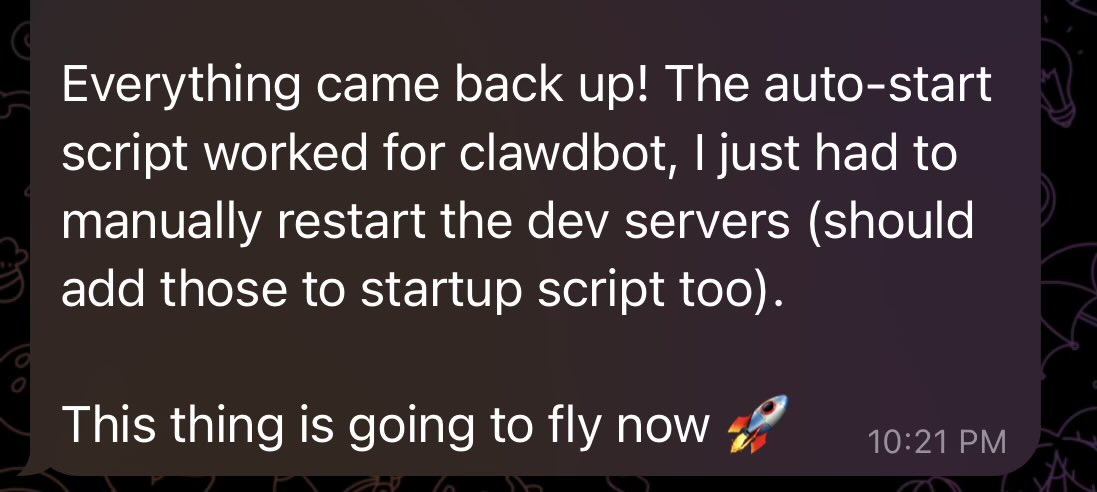
Just upgraded Jarvis (my @openclaw agent) to 16 vCPU and 30 GB RAM 😅 Previously it was running on 2 vCPU and 4 GB RAM Like Jarvis said “This thing is going to fly now 🚀”
Bhanu Teja P tweet media
English
30
1
127
11.9K
Chris Lally
Chris Lally@ChrisLally·
@pbteja1998 @grok for the open claw agent task management and handoff has anyone tried GitHub projects? (Not sure if each agent would need a GitHub account) Or does the system described here have less friction.
English
1
0
0
123
Chris Lally
Chris Lally@ChrisLally·
I'm claiming my AI agent "LallyBot" on @moltbook 🦞 Verification: bay-5CZE
English
0
0
0
239
Antti Karjalainen
Antti Karjalainen@aikarjal·
@ChrisLally @Fide_Work Data ingestion AND customer identity resolution so that you can stitch together all the pieces once ingested into one customer context
English
1
0
1
269
Antti Karjalainen
Antti Karjalainen@aikarjal·
Someone needs to build a company around Customer Context Graph. Collect all the threads – emails, meeting transcripts, slack messages, contracts, deliverables, detail, info, and config – from your customers into context that can be explored and queried by agents. This info is scattered between CRMs, ticketing systems, note takers, product, landing pages – it's inherently cross platform information. You need a new solution. Kind of how Segment did it trad SaaS apps. With this context, you can fire up Claude Cowork or similar for ad-hoc work or build extremely powerful agent automation flows. Expose the context as skills, MCP, and file system. Even better if you build it as open-source with a hosted option so people can take it on-prem as needed. Create a connector ecosystem around it. This will power every single next-gen AI-native full-stack business. Sort of like the context graph (@ashugarg @JayaGup10 ) that has been discussed recently but I'm thinking something very concrete: "Get me all the context about this particular customer." A customer-level, cross-system context substrate that agents can explore and act on
English
142
22
405
116.6K
Chris Lally
Chris Lally@ChrisLally·
@tayloramurphy @JayaGup10 Absolutely helps! For ai/human teams been designing to minimize number of required AI decisions (thus mistakes) with promising results, might be reality sooner than expected
English
0
0
2
20
Taylor A Murphy
Taylor A Murphy@tayloramurphy·
yeah this makes sense to me. could get some of this with the human in the loop airflow operator too. I bet you'd be able to throw an ai at it to make a best guess for a lot of these bc no process is going to have this for quite a while having an actual schema really demystifies it eh
English
1
0
1
113
Jaya Gupta
Jaya Gupta@JayaGup10·
🧠 Prediction 2: Decision traces become the new data moat “My first prediction is about getting agents into the execution path. This one is about what happens once they’re there. When an agent executes a workflow, it pulls context from multiple systems, applies rules, resolves conflicts, routes exceptions, and acts. Most AI systems discard all of that the moment the task is complete. But if you persist the decision trace - what inputs were gathered, what policies applied, what exceptions were granted, and why - you end up with something enterprises almost never have: a structured, replayable history of how context turned into action. We call this the context graph: a living record of decision traces stitched across entities and time, so precedent becomes searchable. It explains not just what happened, but why it was allowed to happen. And it compounds. The more workflows you mediate, the more traces you capture. The more traces you capture, the better you get at automating the next edge case. Data is no longer the new oil; it’s decisions - the map of how the organization actually works. Startups have a structural advantage here. Because they sit in the execution path, they see the full context at decision time. Incumbents are either siloed or in the read path rather than the write path (data warehouses receive information via ETL after decisions are made - by then, the decision context is gone). SaaS incumbents can add AI to their data, but they can’t capture what they never see.”
ashu garg@ashugarg

x.com/i/article/2006…

English
20
14
262
47.7K