Chris Larsin

1.4K posts

Chris Larsin banner
Chris Larsin

Chris Larsin

@ChrisLarsin

The Washington Company | Alpha Horizon Fund Management
Washington, D.C. Katılım Ağustos 2011
5.4K Takip Edilen611 Takipçiler
Chris Larsin retweetledi
Naval
Naval@naval·
Introducing USVC - a single basket of high-growth venture capital, for everyone. No accreditation required, SEC-registered, and a very low $500 minimum. Includes OpenAI, Anthropic, xAI, Sierra, Crusoe, Legora, and Vercel. As USVC adds more companies, investors will own a piece of that too. Liquidity typically comes when companies exit, but we’re aiming to let investors redeem up to 5% of the fund every quarter. This isn’t guaranteed, but if we can make it work, you won’t be locked up like in a traditional venture fund. It runs on AngelList, which already supports $125 billion of investor capital. And I’ve joined USVC as the Chairman of its Investment Committee. — Go back to the 1500s, you set sail for the new world to find tons of gold - that was adventure capital. Early-stage technology is the modern version. It says we are going to create something new, and it’s risky. It’s daring. But ordinary people can’t invest until it’s old, until it’s no longer interesting, until everybody has access to it. By the time a stock IPOs, most of the alpha is gone. The adventure is gone. Public market investors are literally last in line. This problem has become farcical in the last decade. Startups are reaching trillion dollar valuations in the private markets while ordinary investors have their noses up to the glass, wondering when they’ll be let in. Investing in private markets isn’t easy. You need feet on the ground. You need judgment built over years. Most people don’t have the patience to wait ten or twenty years for an investment to come to fruition. But there is no more productive, harder-working way to deploy a dollar than in true venture capital. USVC enables you to invest in venture capital in a broad, accessible, professionally-managed way, through a single basket of innovation, focused on high-growth startups, at all stages. It is how you bet on the future of tech: the smartest young people in the world, working insane hours, leveraged to the max, with code, hardware, capital, media, and community. Your dollar doesn’t work harder anywhere. There is an old line - in the future, either you are telling a computer what to do, or a computer is telling you what to do. You don’t want to be on the wrong side of that transaction. USVC lets you buy the future, but you buy it now. Then you wait, and if you are right, you get paid. Get access here: usvc.com
AngelList@AngelList

Announcing: USVC AngelList exists to power the innovation economy. To date, we have powered $125 billion in assets, 25,000+ funds, and 13,000+ startups. Today, we’re opening it for retail access. @usvc_ is a regulated fund that holds stakes in promising private companies. There are no accreditation requirements and anyone can get started with as little as $500. Early portfolio includes xAI, Anthropic, OpenAI, Sierra, Vercel, Crusoe, and Legora. Own a stake in the companies defining the future. Learn more: usvc.com

English
504
473
6.3K
1.3M
Chris Larsin retweetledi
Ihtesham Ali
Ihtesham Ali@ihtesham2005·
A MIT professor who built the world's first neural network machine said something about intelligence that nobody in Silicon Valley wants to admit. His name was Marvin Minsky. He co-founded MIT's artificial intelligence lab with John McCarthy in 1959. He built SNARC the first randomly wired neural network learning machine in 1951, as a graduate student at Princeton. He won the Turing Award. He advised Stanley Kubrick on 2001: A Space Odyssey. Isaac Asimov, who was not a modest man, said Minsky was one of only two people he would admit were more intelligent than him. In 1986, after decades of building machines that could think, Minsky published a book about something far more unsettling. How humans think. And why we are wrong about almost everything we believe about it. The book is called The Society of Mind. It has 270 essays. Each one is a page long. Together they build a single argument that most people, when they first encounter it, reject immediately because it is too uncomfortable to accept. The argument is this: you do not have a mind. You have thousands of them. What you experience as a single, unified self making clear-headed decisions is not a thinker. It is an outcome. The result of hundreds of tiny, specialized, mostly mindless agents competing, negotiating, overriding, and occasionally cooperating with each other beneath the surface of your awareness. You do not decide things. You are what is left over after the arguing stops. Minsky was precise about this. He wrote that the power of intelligence stems from our vast diversity, not from any single perfect principle. He called this the trick that makes us intelligent, and then immediately added: the trick is that there is no trick. There is no central processor. No ghost in the machine. No unified self sitting behind your eyes, calmly evaluating options and choosing rationally. There is only the parliament. And the parliament is always in session. This reframing destroys the standard explanation for every failure of self-control. The reason you procrastinate is not laziness. It is that the agent in you that understands long-term consequences is losing an argument to the agent that wants comfort right now, and neither of those agents has a decisive vote. The reason you change your mind the moment someone pushes back is not weakness. It is that the social agent, the one that monitors status and belonging, just outweighed the analytical one. The reason willpower fails is not a character flaw. It is that you sent one small agent into a fight against dozens, and you called that discipline. Minsky had a specific line that breaks this open completely. He said: in general, we are least aware of what our minds do best. The things you do with the most apparent ease, reading a face, walking through a crowded room, understanding a sentence, catching a ball, are not simple at all. They are the products of staggeringly complex agent networks that run so smoothly, so far below conscious access, that you experience them as effortless. The things that feel like work, the logical arguments, the deliberate choices, the careful plans, are actually the clumsy surface layer, the small fraction of mental activity you can observe at all. You have been taking credit for the wrong parts of your own intelligence. The practical implication is the one that most productivity advice misses entirely. If your decisions are not made by a single rational self but by whichever coalition of agents happens to win the moment, then the game is not about training yourself to be more disciplined. The game is about designing the environment so that the right agents win without needing a fight. This is why removing your phone from the room works better than deciding not to check it. This is why writing one task on an index card works better than building a sophisticated system. This is why commitment devices beat motivation every time. You are not strengthening your will. You are changing the conditions of the argument so that the outcome you want becomes the path of least resistance. Minsky spent his entire career building machines that could imitate intelligence. What he discovered in the process was that natural intelligence, the kind running inside every human brain on earth, is nothing like what we think it is. It is not a single flame burning in a single chamber. It is a city. Loud, chaotic, full of competing interests, with no mayor. The people who understand this stop trying to win the argument through force of will. They learn to build a better city instead.
Ihtesham Ali tweet media
English
143
671
2.4K
177.1K
Chris Larsin
Chris Larsin@ChrisLarsin·
It's interesting to look back at the retail technology inflection points that were, in a sense, milestones that marked eras in which the previous times immediately seemed rather quaint and antiquated: Colorized Movies, (from b/w); Color TV, (from b/w); Personal Computers; Mobile/Smart Phones; AI.
English
0
0
0
43
Brian Roemmele
Brian Roemmele@BrianRoemmele·
It is very hard to capture the past. Its essence. It’s emotional flavor. It is vital to somehow catalog a time that existed before our devices. This is what I endeavor to do. Even if AI is the reminder….
English
121
200
1.7K
60K
NASA
NASA@NASA·
LIVE: After their journey around the Moon, our @NASAArtemis II astronauts are back on Earth. Agency leaders are discussing today's splashdown and answering media questions in a live news conference. twitter.com/i/broadcasts/1…
English
294
1.2K
7.4K
824.9K
Chris Larsin
Chris Larsin@ChrisLarsin·
@MarioNawfal Thanks for all of your great coverage. Trump's overarching goal has been an Iran that is permanently-free of nuclear weapons and aligned with the aim of peace in the Middle East. The means may have been be unorthodox, but this outcome could be within reach.
English
0
0
0
1.3K
Mario Nawfal
Mario Nawfal@MarioNawfal·
Here's a few important points before I go to sleep: 1. Iran won the war. The terms of the ceasefire they shared give them control of the Strait of Hormuz, charging $2M per ship, pocketing $100 Billion a year. Those numbers are wild! And on top of it, the ceasefire proposal includes the lifting of all sanctions Remember, one could say Iran has been in a state of war for decades due to the crippling American sanctions, and now this is all coming to an end 2. Trump did the right thing pulling out, not listening to the lunatic war mongers around him, and not listening to anyone in the Israeli lobby that may have wanted the war the continue. As I said earlier today, a good leader knows when to walk away 3. I am not surprised we have a deal, I've mentioned it all day, as Trump's posts made it obvious to me he was pressuring Iran for some final concessions before accepting his off-ramp 4. Trump will twist this into a win, and his diehard supporters will believe him. This is a GOOD thing, as Trump no longer needs to militarily try to get a 'win'. As I've said earlier in the day, Trump can (and just did) create his own offramp. 5. The Middle East will never look the same. I expect the Gulf to gradually normalize relations again with Iran, which started after Israel's strike on Qatar. Also the balance of power will drastically shift away from Israel, and this may have massive positive implications on Lebanon, Syria, and possibly even Palestine. 6. China is the BIGGEST winner, as Iran controlling the Strait of Hormuz means China is indirectly controlling it 7. Iran's control of the Strait of Hormuz is a generational strategic loss for the U.S., and a risk to the dollar dominance (Iran can chip away at the Petrodollar) 8. Hezbollah will come out stronger from all this, possibly more powerful than it has been in decades (unless the deal involves Iran disbanding their proxy network) 9. I'm exhausted and need to sleep. Below there's some more info on my stance over the past 24 hours, as well as how we broke the story of a ceasefire almost an hour before any media outlet and Trump's post. Good night everyone!
Mario Nawfal@MarioNawfal

WHAT JUST HAPPENED? 8:07 am: I posted that Trump should walk away from this war even if the Strait of Hormuz is not opened by Iran 4:07 pm: I posted 'The War Is Close to Ending' 5:50 pm: I broke the story that Trump accepted the ceasefire, based on a source that is part of the negotiations 6:32 pm: Trump confirms a ceasefire 6:51 pm: Israel confirms they are abiding to the ceasefire

English
1.1K
967
4.2K
1.7M
Chris Larsin retweetledi
NASA Artemis
NASA Artemis@NASAArtemis·
The eclipse from Orion. On April 6, external cameras attached to the Orion spacecraft's solar array wings captured the Moon backlit by the Sun during a solar eclipse.
NASA Artemis tweet media
English
286
7.1K
34K
2.1M
Chris Larsin retweetledi
NASA Artemis
NASA Artemis@NASAArtemis·
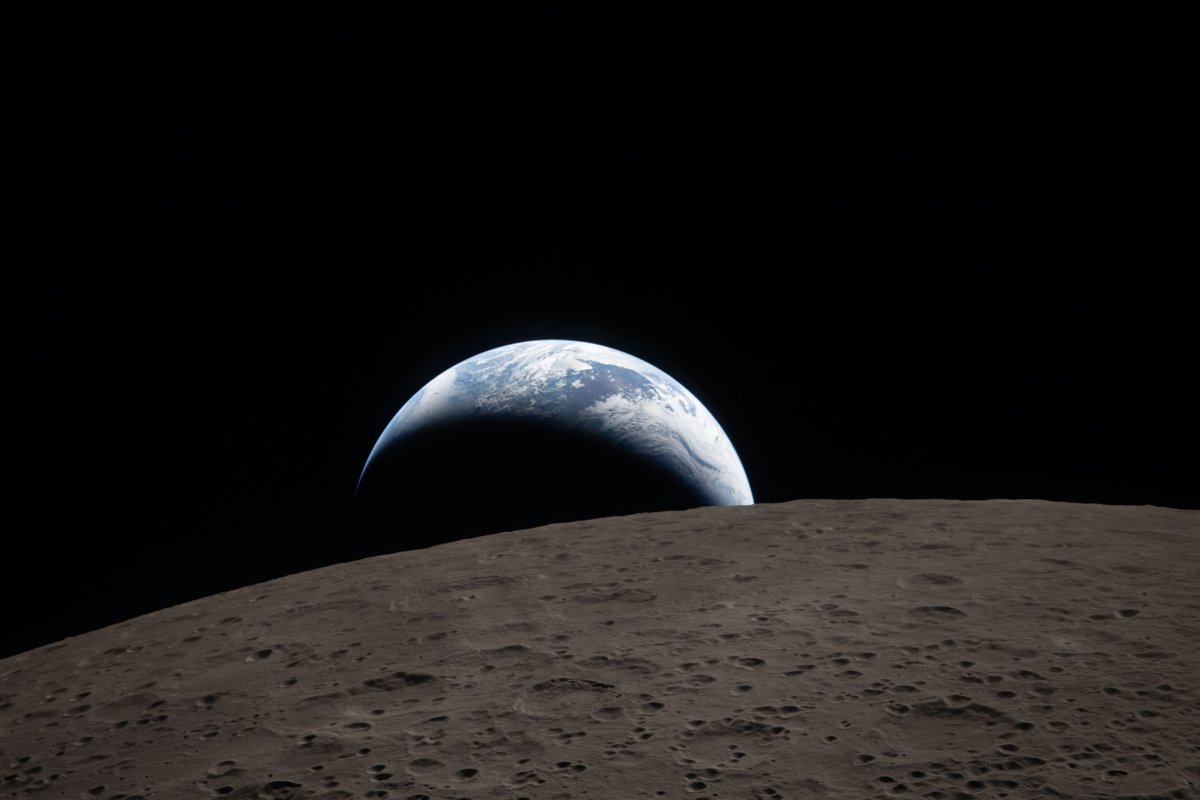
Earthset. The Artemis II crew captured this view of an Earthset on April 6, 2026, as they flew around the Moon. The image is reminiscent of the iconic Earthrise image taken by astronaut Bill Anders 58 years earlier as the Apollo 8 crew flew around the Moon.
NASA Artemis tweet media
English
992
27.5K
117.5K
7.9M
Chris Larsin retweetledi
William Shatner
William Shatner@WilliamShatner·
Congratulations to the crew of #ArtemisII on going beyond where no human has gone before! 👏🏻👏🏻👏🏻👏🏻
English
815
5.6K
57.3K
1.2M
Chris Larsin
Chris Larsin@ChrisLarsin·
@BrianRoemmele Biological re-programming, i.e., age-reversal, is coming... AGI ~> Age-defy
English
0
0
0
22
Brian Roemmele
Brian Roemmele@BrianRoemmele·
Eternal beauty…
Français
13
49
332
17.2K
Chris Larsin
Chris Larsin@ChrisLarsin·
It's ironic that even with all of the wonderous technological advancements since the 1970's, we are generally much more timid now about dreaming big about space and our future, (Mr. Musk et. al. excepted). That kid saying, "We are going back to the friggin' Moon!" gives me hope, however.
English
0
0
1
118
William Shatner
William Shatner@WilliamShatner·
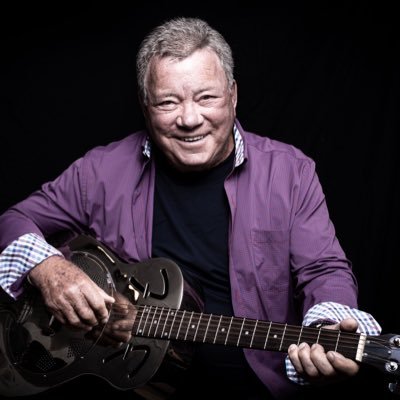
My Daughter came over to tell me her daughter heard that I had brain cancer. 🙄 She took this photo and sent it to me to upload to prove I'm not ill. The people who are ill are those that are spreading these ridiculous stories. I'm fit as a fiddle. You don't have to worry.
William Shatner tweet media
English
4.6K
5.9K
79.5K
1.2M
Gareth Harney
Gareth Harney@OptimoPrincipi·
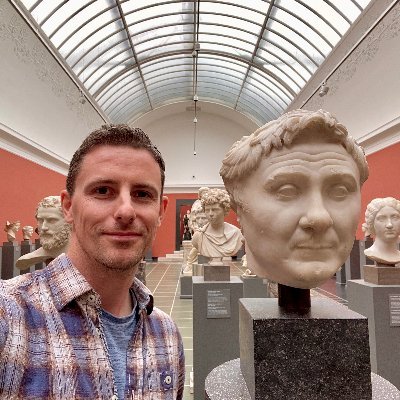
A beautifully preserved ancient Roman table tennis paddle. The sport of table tennis, or ‘tenisia mensalis’ as the Romans knew it, became a wildly popular parlour game among Roman elites in the early empire. Carried along the Silk Roads, ancient ping-pong found even greater favour in the imperial court of Han China. Sources report that in the late-second century AD, the Roman emperor Marcus Aurelius dispatched a team of his finest table tennis players to the Far East for a fiercely contested inter-empire competition. The historian Cassius Dio dismisses the emperor’s sporting venture as a trivial folly and pointless distraction from the many troubles afflicting the empire during his reign, and regrettably, the result of the Rome–China table tennis tournament has been lost to history.
Gareth Harney tweet media
English
78
76
586
26.7K
William Shatner
William Shatner@WilliamShatner·
I had insipid Grok do a scientific randomization. First I had it randomize the list that was in order of sales and renumber the 166 and then I had it choose 69 numbers from 1 to 69. If you didn’t get one; Grok is to blame.
Chris Larsin@ChrisLarsin

@WilliamShatner Will the 69 Round 2 Elon dollars be allocated randomly or to the first 69 in? (I know Bill dollars will be priceless in due course, so win/win regardless.)

English
15
5
81
15.5K
Chris Larsin
Chris Larsin@ChrisLarsin·
@WilliamShatner Will the 69 Round 2 Elon dollars be allocated randomly or to the first 69 in? (I know Bill dollars will be priceless in due course, so win/win regardless.)
English
0
0
2
15.9K
Math Files
Math Files@Math_files·
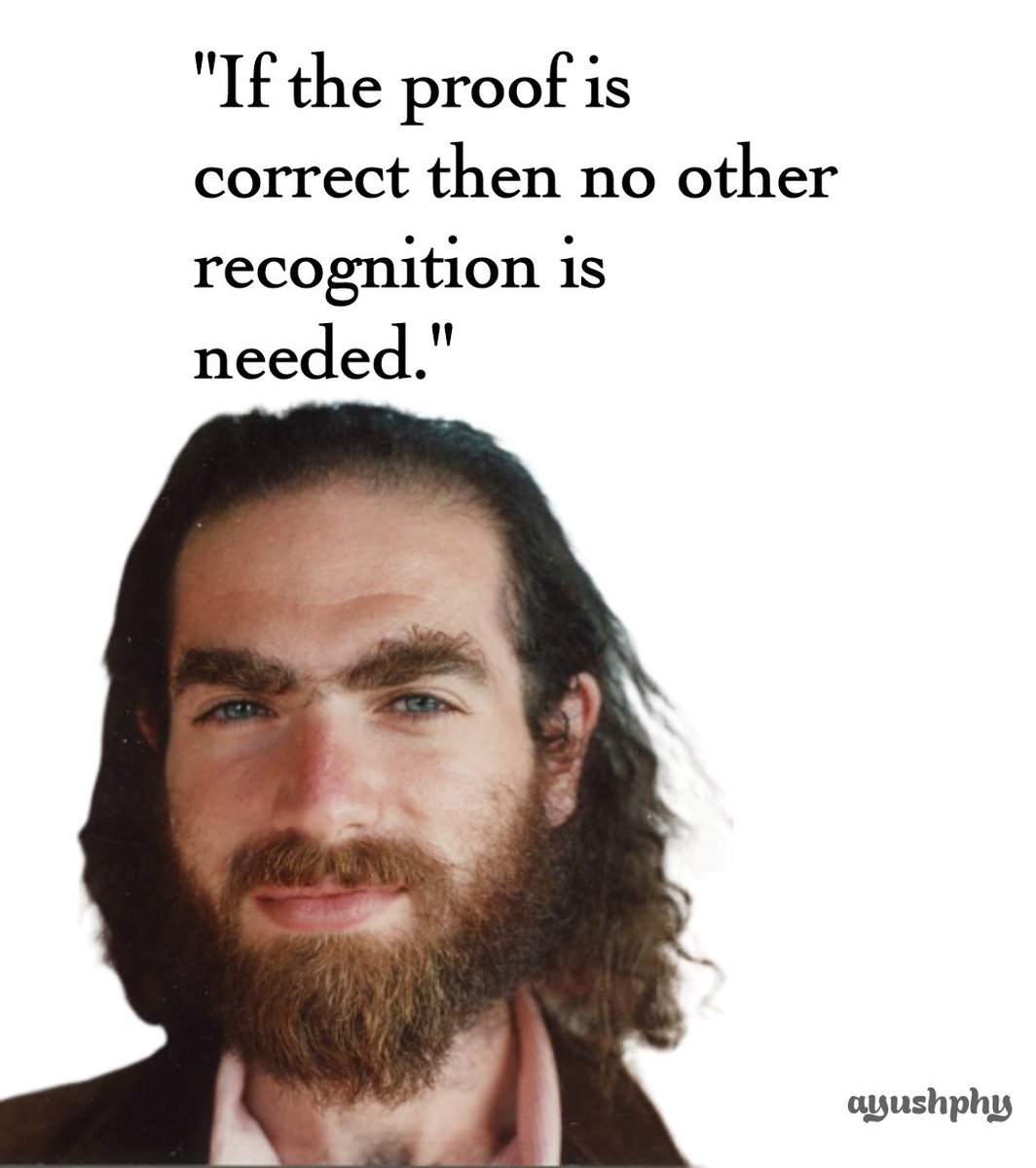
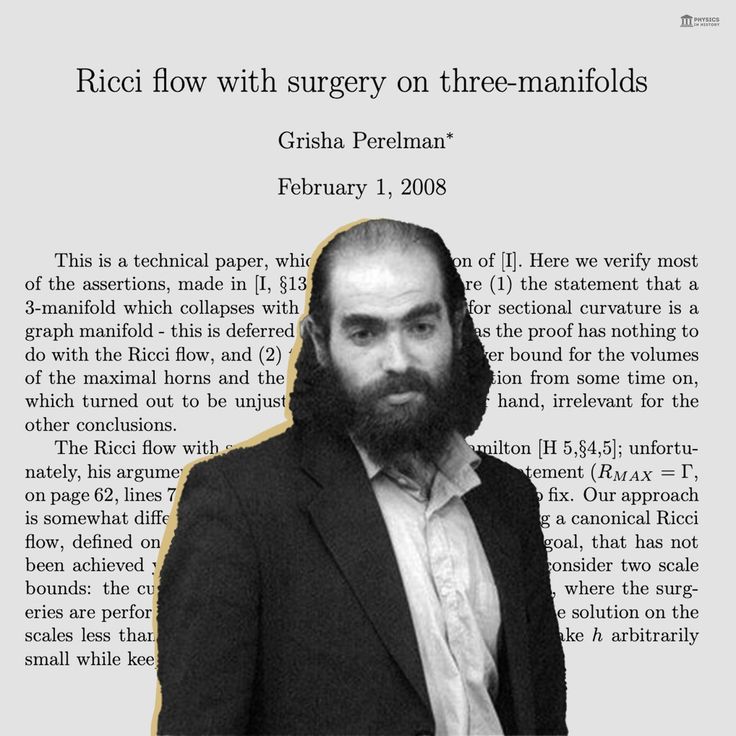
In 2008, mathematician Grigori Perelman wrote a paper explaining his work on Ricci flow with a technique called surgery. The idea is to imagine a complicated shape slowly smoothing out over time, like heat spreading evenly on a surface. Sometimes the shape develops very sharp points or “pinches.” When this happens, the method carefully cuts the shape and fixes it, then continues the smoothing process. Using this clever idea, Perelman was able to solve the famous Poincaré Conjecture, one of the biggest problems in mathematics.
Math Files tweet media
English
19
75
754
50K
Chris Larsin
Chris Larsin@ChrisLarsin·
@JoeSquawk Rearranged for haiku / poetic aesthetic: Iran Coverage Iran Regime doing well The headlines abound
English
0
0
0
45