Bryan Johnson@bryan_johnson
Bad news #1:
I have an autoimmune disease. My stomach is eating itself.
Bad news #2:
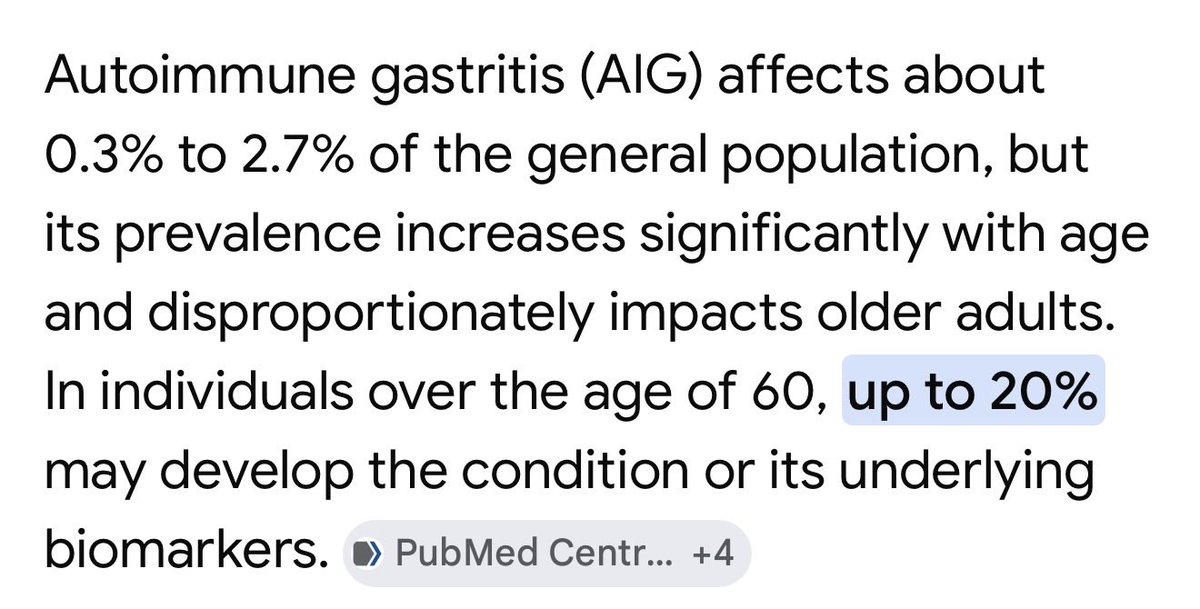
2–5% of people have this, too. Likely more, because it hides.
Good news:
I'm going to try and solve it. Will share all.
As a kid, I ate sugar cereal, drank sugary soda, and gobbled down fast food. I had a few healthy years in my early 20s but then became a young father of three and began building a business.
Juggling that stress and grind, I let my health slip and gained 40 lbs. Within a few years I’d fallen into a deep, chronic depression.
Somewhere in that timeline, my body began developing an autoimmune process affecting my thyroid and then my stomach lining.
It’s called Autoimmune Gastritis (AIG).
My hypothyroidism got diagnosed when I was 21 years old with a routine blood draw. That enabled me to begin proactive management, supplementing levothyroxine and Armour Thyroid. They are the hormones my body should be producing on its own but wasn’t.
By taking these pills daily, my body was able to operate as though my thyroid was functioning properly. What I didn’t know was that something else was going on inside my body: my stomach had begun attacking itself. But there was no routine test to find out and I didn’t have any symptoms.
I just discovered it in May. I'm unsure how long I've had it. AIG causes irreversible damage: nutritional deficiency, anemia, and over a long horizon, elevated cancer risk. When AIG is discovered today, standard medical care concedes defeat, stating that nothing can be done except managing the condition, no matter how awful or lethal the effects.
Looking back over the past few years, I can now see the early signals we were picking up in measurement but hadn’t connected the dots. For 11 years, I’ve had low ferritin, without anemia. We continually tried to raise my iron levels with food and supplementation but nothing would work.
We chased the obvious solutions first. A plant-based diet means all my iron is the hard-to-absorb, non-heme kind. Hard training, sauna, and hyperbaric oxygen all raise the body's demand for iron. But none of them explained the core failure: despite me taking iron orally, trialing every formulation, and using every timing trick, none of the iron would stick.
What I didn’t fully appreciate until recently is how many stones my previous providers had left unturned. The low ferritin kept getting explained away but not fixed.
I overhauled my medical team earlier this year. It was the rebuild to lay the groundwork for Immortals Care, our $1M a year protocol. With greater capacity, we revisited everything.
On the surface, my low ferritin was easy to dismiss by most standards of care. My hemoglobin and hematocrit were normal. Ferritin measures stored iron, while hemoglobin measures circulating iron, and because the body drains its reserves first to keep hemoglobin normal, you can be fully iron deficient with a perfectly normal hemoglobin and hematocrit.
This is why my low ferritin kept getting dismissed: the numbers that define anemia looked fine, so no one asked why my iron reserves wouldn't refill.
My team pressed on that question. They first turned to a colonoscopy. I was 48 years old and overdue. It was good health hygiene to have while also serving a specific purpose of searching for a hidden source of blood loss such as a polyp or even cancer in my bowels. Either one of those would be an explanation of why the iron kept disappearing.
At the same time, they began connecting the dots. Iron absorption depends on stomach acid, so one theory was that my stomach acid was disrupted. They also knew that thyroid and stomach autoimmunity often travel together, so often that the pairing has a name: thyrogastric syndrome.
Put against my 27+ year history of autoimmune thyroid disease, the pieces pointed to a single hypothesis: my own immune system was attacking my stomach.
To our surprise, my colonoscopy came back clean. A perfectly healthy colon, better than 95% of colonoscopies of men, according to the gastroenterologist. That ruled out the first concern and worst possible outcome: slow continuous bleeding from colon cancer, or pre-cancerous polyp.
My team had exercised great foresight though, anticipating this possible outcome. In addition to a colonoscopy, they’d ordered an upper endoscopy to be performed at the same time. The combined procedure is a bi-directional endoscopy. Probes would look at my entire intestinal tract, up from below and down the throat.
Additionally, we had several blood biomarkers measured ahead of the procedure to try and pick up on any signals that would give the gastroenterologist guidance for what to look for while doing visual inspections.
Fifteen minutes before the procedure, my blood results returned, finding elevated levels of anti-parietal-cells-antibodies (APCA). They came back at roughly five times the upper limit of normal (103, against a ceiling of 20 Units/mL). It was a positive result confirming the suspicion of AIG being the culprit behind my low ferritin, the other type of gastritis, driven by a bacterial infection, was already ruled out, as we knew I am negative to H. pylori.
Even before this finding, my team had ordered five biopsies to be taken from three regions of my stomach.
The biopsies were the critical piece. Had they not been ordered, the bi-directional endoscopy would have been completed and AIG remained undiagnosed as there were no visual signatures of the condition in my intestines.
Two days later, the results of biopsies came in, showing clear signs of early autoimmune gastritis: early atrophy confined to the acid-producing lining, with the rest of the stomach still spared. My team had anticipated this, methodically tracing every line of evidence.
We now had a formal diagnosis. I have autoimmune gastritis AIG. My stomach is eating itself.
So this was never one problem. It was three, linked to one another: the iron deficiency, the autoimmune gastritis driving it, and the autoimmune thyroid disease alongside it. Iron and thyroid feed each other both ways, low iron impairs the conversion of thyroid hormone into its active form, and an under active thyroid impairs how the body uses iron. Each made the other harder to fix.
Autoimmune gastritis affects an estimated 2–5% of people, and likely more, because it hides and is challenging to diagnose. It's usually silent for years, surfacing only once the stomach has atrophied enough to do real damage: iron deficiency first, then B12 deficiency, then anemia from both, and over a long horizon, raised stomach-cancer risk. In one study of people with precancerous gastric lesions, roughly 18% carried the autoimmune antibodies, and only about 1% had ever been diagnosed.
And the earliest clue, low ferritin, is the one standard medicine waves through. Low iron stores get normalized and rarely investigated at all when anemia hasn't shown up yet. That blind spot is what hid mine for a decade.
The good news: the iron deficiency is now corrected. I received a 1,000 mg Monoferric iron infusion. This was chosen for two reasons after considering multiple formulations. First, it can safely deliver a full dose of iron in a single infusion (1,000 mg), while older options like Venofer require several separate appointments to reach the same total.
Second, certain other IV iron formulations can cause a drop in blood phosphate levels, an important mineral for bones and energy. Monoferric is much less likely to do this, which matters given how closely we track long-term metabolic and bone health parameters.
As mentioned earlier, current medical standards treat AIG as something to be managed, not resolved.
It's worth noting that many of you give me a hard time, inviting me to "live life" and engage in self-destructive behaviors like a "normal person". I'm cool with the playful ribbing. Also, had I not taken care of my health during the past five years, my situation could potentially be very serious.
You too may have a lurking health issue that is undiagnosed and could increase in severity from unhealthy life choices, without your knowing. The absence of symptoms is not the presence of health.
A gentle nudge that minding your health, no matter your situation in life, is good decision making.
My team and I are going to try and solve my AIG. This is how we’re approaching it:
First, routine monitoring keeps the disease in view: ferritin and iron, B12, the pepsinogen I/II ratio, gastrin, and chromogranin A. Gastrin is the dial to watch. If it climbs, the disease is advancing, and the risk of gastric neuroendocrine tumors climbs with it.
Second, we’re doing advanced characterization of the disease. We’ll do a repeat biopsy to read the immune infiltrate, deep cytokine profiling, and T-cell subset analysis, to see which pathways are actually firing.
That testing drives the intervention plan, including the experimental approaches we intend to develop.
+ If gastrin and chromogranin rise: damp the gastrin drive (netazepide) and tighten endoscopic surveillance. If the profile is Th1 / interferon-driven: target JAK/STAT.
+ If it's Th17 / IL-17-driven: target IL-17 and STAT3.
+ If regulatory T cells are failing: rebuild them (low-dose IL-2, induced Tregs).
+ If it's antibody- and B-cell-driven and antigen-specific: engineered cell therapy (CAAR-T).
Which organizes into four tiers, from available today to frontier:
Tier 1, now: protect and support; zinc-L-carnosine, and acid replacement (betaine HCl with pepsin) under physician supervision. This is specific to my case and not something to self-prescribe, especially given the cancer-surveillance considerations above.
Tier 2, target the signaling , JAK/STAT, GSK-3, IL-17, and damp the gastrin drive (netazepide).
Tier 3, reset the cells, induced regulatory T cells (iTregs).
Tier 4, frontier: engineered T-cell therapy (CAR-T / CAAR-T), custom AI-designed antibodies, or synthetic proteins, that can specifically seek out inactivate or destroy the rogue immune cells attacking my stomach lining.
To be clear: there's no approved cure for autoimmune gastritis today. Medicine treats it as something to manage, not solve. Tiers 2 through 4 are investigational preclinical evidence at best, and in several cases therapies that still have to be built.
If you're working on autoimmune gastritis, antigen-specific tolerance, regulatory T cells, or CAAR-T for organ-specific autoimmunity, please reach out.
Modern medicine has normalized too many conditions that erode our health, function, and comfort, shrinking the goal to monitoring and management while a cure is rarely even attempted. Most of these verdicts were handed down decades ago, in an era that predates nearly all of our current tech and science, and they have gone largely unchallenged.
We want to change that. In the age of AI, multiomics, and custom-built DNA, proteins, and cells, no condition should be presumed incurable simply because no one has yet tried to cure it with today's stack.
I’ll end on a personal note.
We fill our days mostly on things that are trivial next to what we ultimately care about. We know, deep down, however, that in the noise of it all, health is easily forgotten until it’s the only thing that matters.
We spend a fraction of our lives truly sober to the preciousness of life. We feel it when someone we love dies, when a child is born, when we come close to death ourselves, or when a diagnosis marks our limit. In those moments, we are sobered, and the rarity of it all becomes self evident. Imagine the existence we’d build together if that clarity didn’t fade.
I wish all of you the very best. Care for yourself, care for others, care for the planet and care for our animal friends. Care for life as it’s the most precious gift there is.