Benjamin Clark
212 posts

Benjamin Clark
@Clarkisin
Living the dream. Surviving the nightmares.
Seattle, Wa Katılım Haziran 2013
56 Takip Edilen32 Takipçiler

@pmarca why couldn’t we have just repurposed a bunch of Minecraft playing 12-year-olds to plan this thing?
English

Do I hear $300 billion? $500 billion? $1 trillion?
Judge Glock@judgeglock
California high-speed rail cost now up to $231 billion. That means the average worker in the state will pay out over $12,000 to fund a single project that almost no one will ride. CA rail will be studied for generations, a truly once-in-a-lifetime level of government failure.
English
Benjamin Clark retweetledi

“UBI” is obviously nowhere near the panacea many of you seem to think it is. The median left-leaning Westerner isn’t angry at Elon Musk because he can buy a million times more groceries than them. They aren’t upset with Palantir because Peter Thiel can afford to eat a thousand burgers to their one. This whole thing is in large part post-material. It’s the hierarchy & subordination they’re uncomfortable with. They feel their dignity is being trampled and their autonomy progressively diminished – rightly or wrongly they feel politically disenfranchised and stripped of a say over the future. Offering a guaranteed food budget and a pod to spend the night in return for further disempowerment is incredibly tone-deaf and should be expected to provoke more, not less, outrage.
keysmashbandit@keysmashbandit
Actually this is correct and I'd go further. Beyond PR, the moral move is for big labs to start heavily investing in UBI lobbyists, thinktanks, whatever, to mitigate the risk of economic upheaval. A better world is possible!
English

Benjamin Clark retweetledi

Damn
the Panacean era for human art is here
Higgsfield AI 🧩@higgsfield
We just made a 23-MINUTE sci-fi pilot in 4 days. And it is 100% AI.
English
Benjamin Clark retweetledi

I've always said language is our most powerful and most imprecise tool. Its the best we've got, yet still just a proxy for intelligence. We didn't build AI on the raw topology of thought; we shrink-wrapped LLMs onto the shape language happens to leave in the sand. It's not intelligence itself. It's the silhouette intelligence casts when it tries to speak. The meme is right: we're hammering nails into waves. The real wonder is that anything coherent ever emerges at all.
English


@Clarkisin I'm interested in your business. Please check your LinkedIn
English

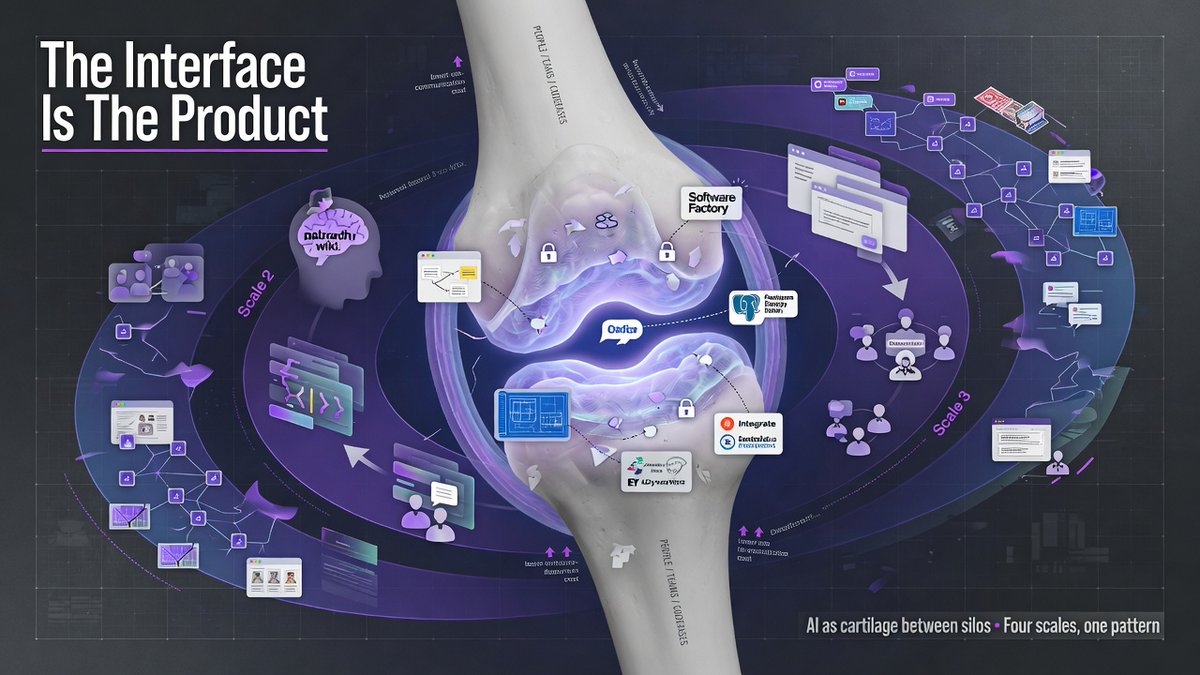
The Interface Is The Product
Short version: The most interesting software right now isn't about solving brand new problems. It's about rebuilding the layer that sits between all these information silos. AI lives in that layer and soaks up context so we humans don't have to keep carrying it around. You see the same basic pattern showing up at four different scales. Once you spot it in one spot, it starts popping up everywhere.
Think of AI as the cartilage in a joint. The bones (people, teams, companies, codebases) have always been there. What we were missing was some decent low-friction tissue in between that could absorb shock, stop the grinding, and let everything move without constant pain. We've made do with rough versions forever: meetings, endless email threads, shared drives, PDFs. This new stuff is just way better at the job.
Why does the interface stuff matter so much?
Inside any one little pocket of information (a team, a codebase, someone's own head, or a single company) people are usually pretty solid at what they do. The big expensive screw-ups almost always happen at the edges. One team handing off to another. A contractor syncing with the main group. Tacit knowledge from the old timer to the new hire. Or even your own brain trying to remember what past-you was thinking.
That's where context falls through the cracks, questions get asked all over again, decisions get re-litigated, and hours disappear. If that rings true, then the smartest place to drop new technology isn't buried deep inside one of those pockets. It's right on the boundary between them.
And that's exactly what's unfolding right now, across a few different levels at once.
Scale 1: Your personal second brain (and all the stuff growing on top)
The clearest early example came from Andrej Karpathy (@karpathy) and his "LLM wiki" idea. It kicked off a bunch of personal second brain projects. The shift is pretty straightforward. Quit treating the LLM like a search box you poke with random questions. Start using it like a compiler that keeps a growing markdown knowledge base for you.
Drop in a source and it gets pulled in, linked up, and filed away. Ask a question and you get an answer plus a new page that sticks around. The whole thing just keeps getting richer instead of wiping the slate clean every time.
The wiki part isn't even the exciting bit. It's everything building on top of it. Personal CRMs that track everyone you've ever talked to and pull up the right context before your next call. Decision logs that remember what you picked, why you picked it, and what actually played out later. Tools that scan your notes and call out the stuff you're claiming without any real backup.
Garry Tan (@garrytan)'s open source gbrain shows where this can go if someone really commits. Postgres plus pgvector, hybrid search, a nightly "dream cycle" that quietly enriches and connects everything, dossiers on thousands of people, plus thirty or so MCP tools tied into live integrations.
All of it is rebuilding the same basic interface: the one between you and your own past thoughts. Most notes apps die because keeping them up costs more than the benefit you get pulling stuff back out. Push that maintenance cost close to zero with AI and the math flips. Suddenly a bunch of personal workflows that never quite worked start to make sense.
Scale 2: The codebase
Move up a level and you hit @chamath's (@8090solutions) and their "Software Factory." They're not just pushing "write code faster." They treat shipping software as a coordination headache across PMs, designers, engineers, and QA. The real leverage sits upstream of actually generating code: grabbing requirements, locking down architectural choices, holding onto the planning context. Then they line up multiple models against that shared context so the output stays documented, governed, and actually matches what's already there.
Speed isn't the main point. A codebase is really a coordination tool in itself. It's how engineers pass intent down through time, across team lines, and from the people writing the code to the ones running it. In big enterprise setups the real cost isn't the typing. It's trying to figure out why the last person did it that way in the first place.
An AI layer that soaks up that reasoning and keeps it easy to ask about? That's cartilage again. The actual product isn't the code. It's the smoother connection between humans (and agents) and the code.
Ernst & Young teaming up with them on EY PDLC gives you a sense of the direction. They're selling it to big companies not as some coding helper but as a full development lifecycle platform. That's a much larger play.
Scale 3: Inside a single company
The same idea shows up in all kinds of forms inside one organization. Knowledge copilots, AI assistants layered over Slack, Notion, and Linear that can actually tell you "what did we decide on X and why." Onboarding setups that try to swallow enough company history so a new person can just query the system instead of booking a dozen meetings with whoever's left.
The underlying bet is the same one the personal wiki makes. Organizations waste huge amounts of time having people re-explain stuff that already exists somewhere. Give an AI layer enough context to organize it and the cost of bringing people up to speed, handing things off, and getting teams to work together drops fast. The cushion in the joint gets thicker.
Scale 4: Across companies
The toughest and most interesting version is the cross-company one. This is where the really big, hairy projects live: defense programs, aerospace, supply chains, car manufacturing. They stretch across contractors, prime vendors, government customers, regulators. Most of the real friction sits right on those boundaries.
And it's exactly where the old tools (email, PDFs, messy spreadsheets, shared drives with spotty permissions) fall apart worst.
A few companies are trying to build proper cartilage here. What @JConafay, @stephenaorr and others are building over at Integrate (@Integrate_co) looks like one of the more compelling ones I've seen. They're going straight at multi-party collaboration on classified defense and aerospace work, with an AI-first mindset built in from the start. cplace comes at it from another angle, aimed at joint ventures and supplier networks with tight controls on who sees what. SharpCloud (@sharpcloud) is already running at that scale, helping General Dynamics coordinate something like 140 different member companies.
The older PPM and ERP players (Cora (@corasystems), Deltek (@Deltek)) sit in the same general area but feel more like the legacy systems these newer platforms want to push aside.
Cross-company is a heavier lift than inside one company because the edges come with serious limits: security rules, classification, legal stuff, compliance, basic trust. You can't just vacuum up context across organizations without fixing those first. Solve them though and the upside is bigger, since that's where the most time and money usually leak away.
Why does it matter that this pattern is showing up at every scale together?
It's not really about any one tool. It's that the exact same shape (stick AI on the boundary, let it absorb context, let people query instead of repeating themselves) keeps appearing on its own from the individual level all the way up to huge groups of organizations working together.
When you see the same basic architecture pop up independently at four different zoom levels, it usually means something real is underneath all the noise.
A practical way to judge whether any of these will last: don't get hung up on how fancy the model is. Look at how well it actually takes in context that would otherwise live in someone's head or in another meeting. What you're really paying for is lower re-communication cost. Everything else is just details.
What happens when the cartilage gets better
Cartilage carries load. Improve it and the whole joint starts working differently, not just the one spot it touches.
If the coordination layer between people, teams, and companies actually gets thinner and more reliable, you can expect some knock-on effects. Organizations might flatten out because you don't need as many managers whose main role was translating context between layers. They might also scale up bigger, since the point where things usually fall apart gets pushed higher. A company that used to start fracturing at a certain size could stay coherent at ten times that.
Programs that cross company lines could start feeling more like one single organization because the seams are no longer so painful. Joint ventures stop being this awkward exception and become closer to normal operating mode.
And a bunch of jobs that were mostly about shuttling information from one person to another get replaced by roles that are more about knowing how to ask the system the right questions.
None of this is locked in. But these are the kinds of second-order shifts you tend to see when a load-bearing piece of the system suddenly gets a lot stronger. Worth keeping an eye on all four scales. Whichever one gets it right first is probably going to change the possibilities for the rest.
Questions I want answers to:
If the interface layer is really where the value is, then what does the next generation of organizational design look like when that interface becomes a system instead of a bunch of people?
Do organizations get flatter because coordination no longer needs as many managers translating between layers? Do they get a lot bigger because the coordination ceiling suddenly lifts? Do cross-company programs start feeling more like one single company because the seams get thin enough to basically ignore?
I don’t know the answers yet. But these are exactly the kinds of questions I’d be asking if I were placing bets on what work is going to look like in a few years.

English