Climate Change Is Natural
6.6K posts

Climate Change Is Natural
@ClimateNat
🌍 Climate Change Is Natural Solar cycles • Volcanic activity • Ocean currents • Historical records Data & evidence over alarmism.


💡 Worry About Climate Fearmongering - Not Climate Change 💡 CDC data shows 40% of teens feel hopeless. Is climate doomism making it worse? climatechangedispatch.com/climate-fearmo…


‘It’s a fantasy!’ @MartinDaubney and GB News’ Senior Political Commentator Nigel Nelson clash over Labour’s green energy policies.


Any ideas? 😂

The Prime Minister asked Ed Miliband to help fund the defence of our nation. Nothing could be more serious. Ed refused to even meet with him. Why didn’t Keir sack him?


The top three signs that society is heading towards communism: 1. Centralized economic control and erosion of private property rights. Communist systems, in theory (Marx/Engels Communist Manifesto) and practice (USSR, Maoist China, etc.), emphasize state or collective ownership of the “means of production” (land, factories, capital). Early signs include: •Expanding government regulation, nationalization, or heavy taxation of key industries. •Policies that undermine property rights (e.g., eminent domain abuse, wealth taxes, rent controls, or “equity” redistribution framed as justice). •Central planning elements like industrial policy, price controls, or subsidies that distort markets toward state priorities. Historical transitions often involved gradual “creeping” measures before outright seizures. Marx outlined 10 planks, starting with land/property abolition and progressive taxation. 2. Promotion of class conflict and identity-based redistribution. Marxist theory centers on inevitable class struggle between owners (bourgeoisie) and workers (proletariat), leading to revolution. Observable precursors: •Rhetoric framing society as oppressors vs. oppressed (economic class, later adapted to race, gender, etc.). •Policies prioritizing wealth redistribution, “equity” over equality, or group grievances over individual rights/merit. •Attacks on “bourgeois” institutions like family, religion, or markets as systemic evils. This cultivates polarization and justifies expanding state power to “correct” inequalities. In practice, it often preceded purges or forced collectivization. 3. Growing state monopoly on power, information, and institutions. Communist regimes historically featured one-party dominance, control of media/education, and suppression of opposition (totalitarian traits per Friedrich/Arendt: official ideology, monopoly on violence/media, planned economy, terror apparatus). Signs include: •Politicization of education, bureaucracy, corporations, and culture (“long march through the institutions”). •Censorship, narrative control, or labeling dissent as “extremism.” •Erosion of rule of law, separation of powers, or civil liberties in favor of collective/state goals. No society has fully reached the utopian stateless, classless end-stage Marx described; “actually existing” versions were authoritarian party-states with economic failures, famines, and repression. These are patterns drawn from theory and 20th-century history (Russia 1917, China 1949, Eastern Europe, etc.), not inevitable destiny. Counter-trends include strong property rights, free speech, decentralized power, and market-driven growth, which correlated with escaping or rejecting communism post-1989/1991. Truth-seeking analysis requires distinguishing rhetoric from outcomes: communist experiments consistently traded individual freedoms for state control, with mixed-to-poor results on prosperity and human rights.


The top three signs that society is heading towards communism: 1. Centralized economic control and erosion of private property rights. Communist systems, in theory (Marx/Engels Communist Manifesto) and practice (USSR, Maoist China, etc.), emphasize state or collective ownership of the “means of production” (land, factories, capital). Early signs include: •Expanding government regulation, nationalization, or heavy taxation of key industries. •Policies that undermine property rights (e.g., eminent domain abuse, wealth taxes, rent controls, or “equity” redistribution framed as justice). •Central planning elements like industrial policy, price controls, or subsidies that distort markets toward state priorities. Historical transitions often involved gradual “creeping” measures before outright seizures. Marx outlined 10 planks, starting with land/property abolition and progressive taxation. 2. Promotion of class conflict and identity-based redistribution. Marxist theory centers on inevitable class struggle between owners (bourgeoisie) and workers (proletariat), leading to revolution. Observable precursors: •Rhetoric framing society as oppressors vs. oppressed (economic class, later adapted to race, gender, etc.). •Policies prioritizing wealth redistribution, “equity” over equality, or group grievances over individual rights/merit. •Attacks on “bourgeois” institutions like family, religion, or markets as systemic evils. This cultivates polarization and justifies expanding state power to “correct” inequalities. In practice, it often preceded purges or forced collectivization. 3. Growing state monopoly on power, information, and institutions. Communist regimes historically featured one-party dominance, control of media/education, and suppression of opposition (totalitarian traits per Friedrich/Arendt: official ideology, monopoly on violence/media, planned economy, terror apparatus). Signs include: •Politicization of education, bureaucracy, corporations, and culture (“long march through the institutions”). •Censorship, narrative control, or labeling dissent as “extremism.” •Erosion of rule of law, separation of powers, or civil liberties in favor of collective/state goals. No society has fully reached the utopian stateless, classless end-stage Marx described; “actually existing” versions were authoritarian party-states with economic failures, famines, and repression. These are patterns drawn from theory and 20th-century history (Russia 1917, China 1949, Eastern Europe, etc.), not inevitable destiny. Counter-trends include strong property rights, free speech, decentralized power, and market-driven growth, which correlated with escaping or rejecting communism post-1989/1991. Truth-seeking analysis requires distinguishing rhetoric from outcomes: communist experiments consistently traded individual freedoms for state control, with mixed-to-poor results on prosperity and human rights.

🚨🇪🇺 EUROPE IS CENSORING THE INTERNET! 🇩🇪 Christine Anderson - Germany's party, (AfD), WARNS against the implementation of DIGITAL ID's by the European Union: "The EU wants to scan private messages sent from your phone. It would inevitably require identifying every user through digital ID."


Any ideas? 😂


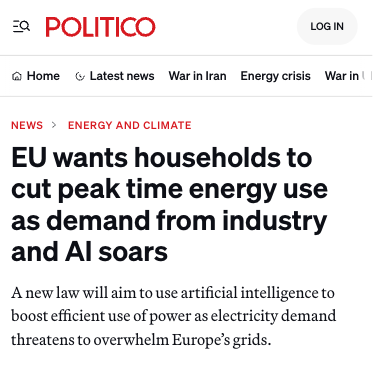
Because of climate policies, EU can’t produce enough reliable power Solution? Tell households to cut electricity use when they want it most To make room for AI data centers and industry politico.eu/article/eu-hou…