Coach Jeremy Simmons

613 posts

Coach Jeremy Simmons banner
Coach Jeremy Simmons

Coach Jeremy Simmons

@CoachJSimmons11

Nederland HS Football & Track

Orange, TX Katılım Temmuz 2020
194 Takip Edilen130 Takipçiler
Coach Jeremy Simmons retweetledi

Eli Schwartz
Eli Schwartz@5le·
Research has shown that excessive screen time in children can actually lead to thinning of the brain's cortex, the part responsible for critical thinking and reasoning. Check out this interactive guide for parents to break the addiction to screens: amzn.to/407g3RE
English

20
82
384
620.8K
Coach Jeremy Simmons retweetledi
AJ Inapi (Allan)
AJ Inapi (Allan)@aj_inapi·
When you're a war fighter in the United States military, most of the time you start very young. 18, 19, 20 years old. You haven't seen the world yet. You haven't seen politics. You haven't seen war. You haven't seen how ugly humans can be to each other. Then people ask: Why do young Americans join the military? The most common reasons are actually very simple: Patriotism — they genuinely love their country Education — GI Bill, college, training Opportunity — travel, career, stability Family tradition — father, mother, grandfather served Discipline and purpose — structure and direction Financial stability — steady pay, benefits To be part of something bigger than themselves Very few 18-year-olds are thinking about geopolitics, oil routes, trade lanes, NATO alliances, deterrence strategy, or global power balance. They just sign up to serve. Then they deploy. They see things no human being should see. They lose friends. They operate in places most Americans can’t find on a map. They come home if they’re lucky — and many come home different people. And then the questions start: Why are we fighting all these wars? Why are we spending so much money overseas? Why are Americans dying in countries most Americans don’t know about? Is it worth it? If that veteran starts reading history, geopolitics, military strategy, economics, world wars, Cold War strategy, trade routes, global power competition — they sometimes begin to understand why America is involved everywhere. Not because war is good. But because power vacuums are worse. However, if instead they only listen to certain political voices, media narratives, or one-sided explanations, they can form a worldview based only on their deployment experience, not the full global picture. Their view of the world becomes frozen in time — the year they deployed, the war they fought, the friends they lost. Then they go home. They build a life. They raise kids. And they pass that worldview to their children. Now look at the military families. Wives raising kids alone during deployments. Parents waiting for phone calls. Families seeing their son or daughter come home changed. Birthdays missed. Funerals attended. Marriages strained. PTSD, injuries, memories that never leave. War doesn’t just affect the soldier. It affects entire families for generations. Now here’s the uncomfortable truth: War is never good. Nobody sane wants war. But saying you want a world without war is like saying you want a world without crime, greed, power, religion, resources, borders, or ideology. In other words, you’re saying you want a different humanity. Civilization itself has always been protected by people willing to fight for it. No military = no deterrence. No deterrence = power vacuum. Power vacuum = someone else takes control. And history shows that the people who take control are usually not the nice ones. So the bottom line is this: In America, you sign up voluntarily. Not by force. You choose to serve. You choose to fight. You choose to defend something you believe in. You may grow older and question the wars, the politics, the decisions. You may even become a voice trying to change the system. But to completely eliminate war, conflict, and power struggles… You wouldn’t just have to change governments. You would have to change human nature itself.
English
84
301
900
89.8K
Coach Jeremy Simmons retweetledi
The Deseret Stone
The Deseret Stone@DeseretStone·
I had a high school science teacher with an unusual policy The day before any major test, he would do a pre-test The pre-test was *exactly the same* as the real test, which would be the next day This was long before camera phones, and the only rule was that you could not copy the test Students had zero excuses for not knowing what would be on the test and *exactly* what to study According to him, he had years of data to compare performance between normal testing and his fully-exposed pre-test And the score distributions were effectively identical You either cared and you were ready, or you didn’t and you never would be I did well enough in the class, and while I can’t remember chemistry to save my life, I still think about that policy
James A. Furey@JamesAFurey

Similarly, I’ve eliminated all test re-takes. I used to have students, before taking the quiz, request a retake because they “didn’t have the time to study last night.” If you have a test retake policy you encourage students to pick and choose which ones they’ll work for and which they’ll put off. Absolutely no. Take the time to prepare the first time, give your best effort, and stop relying on the kindness of your teachers to help you finagle your way to a better grade. Much better lessons learned from this.

English
146
445
13.9K
1.7M
Coach Jeremy Simmons retweetledi
Athenaeum Book Club
Athenaeum Book Club@athenaeumbc·
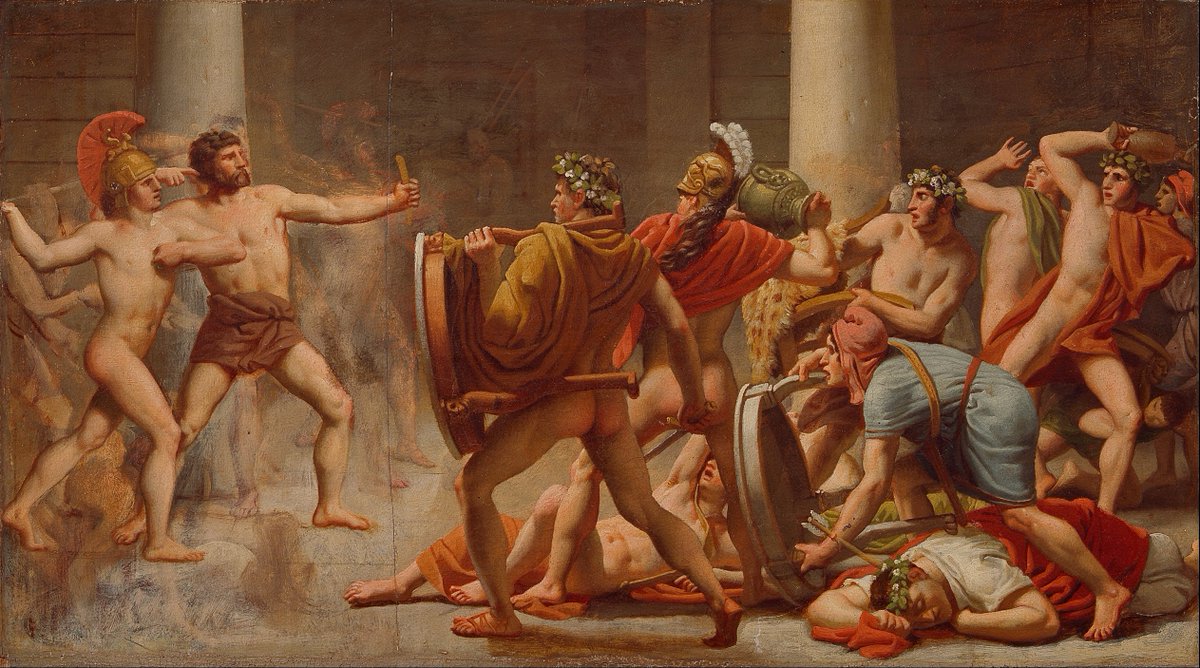
A powerful scene in the Odyssey happens when Odysseus finally returns to Ithaca after twenty years of war and wandering. You would expect the story to end with celebration, with the hero coming home, the family reunited, and order restored. Homer does something far stranger. Odysseus arrives disguised as a beggar, because Athena warns him that the palace has been taken over by more than a hundred suitors who have been living there for years, eating his food, drinking his wine, and pressuring his wife Penelope to marry one of them. They believe Odysseus is dead and in their minds the kingdom is already theirs. So the king of Ithaca walks through his own halls dressed in rags while the men stealing his house sit comfortably at his tables. They mock him, throw scraps at him, and one of them even strikes him, and Odysseus takes it. That is the remarkable part, because the same man who blinded the Cyclops and survived twenty years of disasters now stands quietly while strangers insult him in his own home. Homer tells us his heart burns inside his chest and that he wants to attack them immediately, yet he restrains himself and waits. Instead of striking, Odysseus studies the room carefully. He counts the men, watches their habits, and quietly observes which servants remain loyal and which have betrayed him. The hero of the Odyssey does something most people cannot do, which is delay revenge until the moment is right. Eventually Penelope announces a contest and brings out Odysseus’ great bow, declaring that she will marry the man who can string it and shoot an arrow through twelve axe heads lined up in a row. One by one the suitors try and fail, because none of them can even bend the bow. Then the beggar asks for a turn. The suitors laugh at first, but the bow is eventually handed to him. Odysseus takes it in his hands and strings it effortlessly. Homer says the sound of the bowstring tightening rings through the hall like the note of a swallow. Then he places an arrow on the string and sends it cleanly through all twelve axe heads. In that moment the beggar disappears. Odysseus turns the bow toward the suitors and reveals who he is. What follows is one of the most brutal scenes in Greek literature. The doors are sealed and the suitors realize too late that they are trapped inside the hall. Odysseus, his son Telemachus, and two loyal servants begin killing them one by one. There is no escape, no mercy, and no negotiation. The men who spent years consuming another man’s house die inside it. It is a violent ending, but Homer wants you to understand something important. The real danger to Odysseus was never just the monsters and storms on the long journey home. It was the possibility that someone else might take his place while he was gone. When Odysseus finally returns, he reminds everyone in Ithaca of a simple truth: a man’s home is not truly his unless he is willing to fight for it.
Athenaeum Book Club tweet media
English
1.8K
12.3K
69.1K
28M
Coach Jeremy Simmons retweetledi
Fixing Education
Fixing Education@FixingEducation·
It’s not the teachers!
English
23
102
421
17K
Coach Jeremy Simmons retweetledi
Trad West
Trad West@trad_west_·
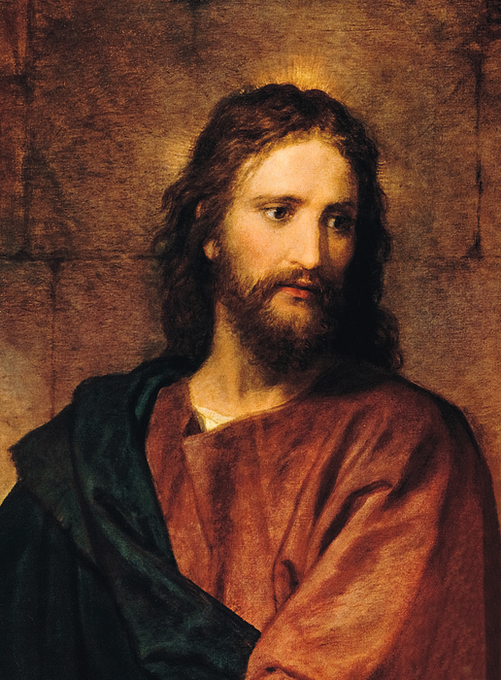
"Turning the other cheek" isn't about submission. It is, actually, an act of defiance. Modern society interprets Christ's command as a call to be a doormat, to be passive, weak, and defenseless. In 1st Century Judea, the left hand was considered unclean. You would never use it to strike someone. Therefore, to slap someone on the right cheek (as Jesus specifies), you had to use the back of your right hand. A backhand slap was an act of insult. It was how a superior hit an inferior. It said, "You are beneath me." By turning your head and offering the left cheek, you physically prevent them from backhanding you again. You force the aggressor to use their open palm or a fist. Why does this matter? Because a fist is how you hit an equal. Jesus wasn't telling his followers to cower. He was telling them to stand their ground, look their oppressor in the eye, and say without words: "I am not your slave. I am a man. If you are going to hit me, treat me like one." It is not an act of cowardice. It is an assertion of dignity that requires terrifying courage.
Trad West tweet mediaTrad West tweet media
English
344
1.9K
11.6K
325.7K
Coach Jeremy Simmons retweetledi
Nederland Bulldogs Football
Nederland Bulldogs Football@Nederland_FB·
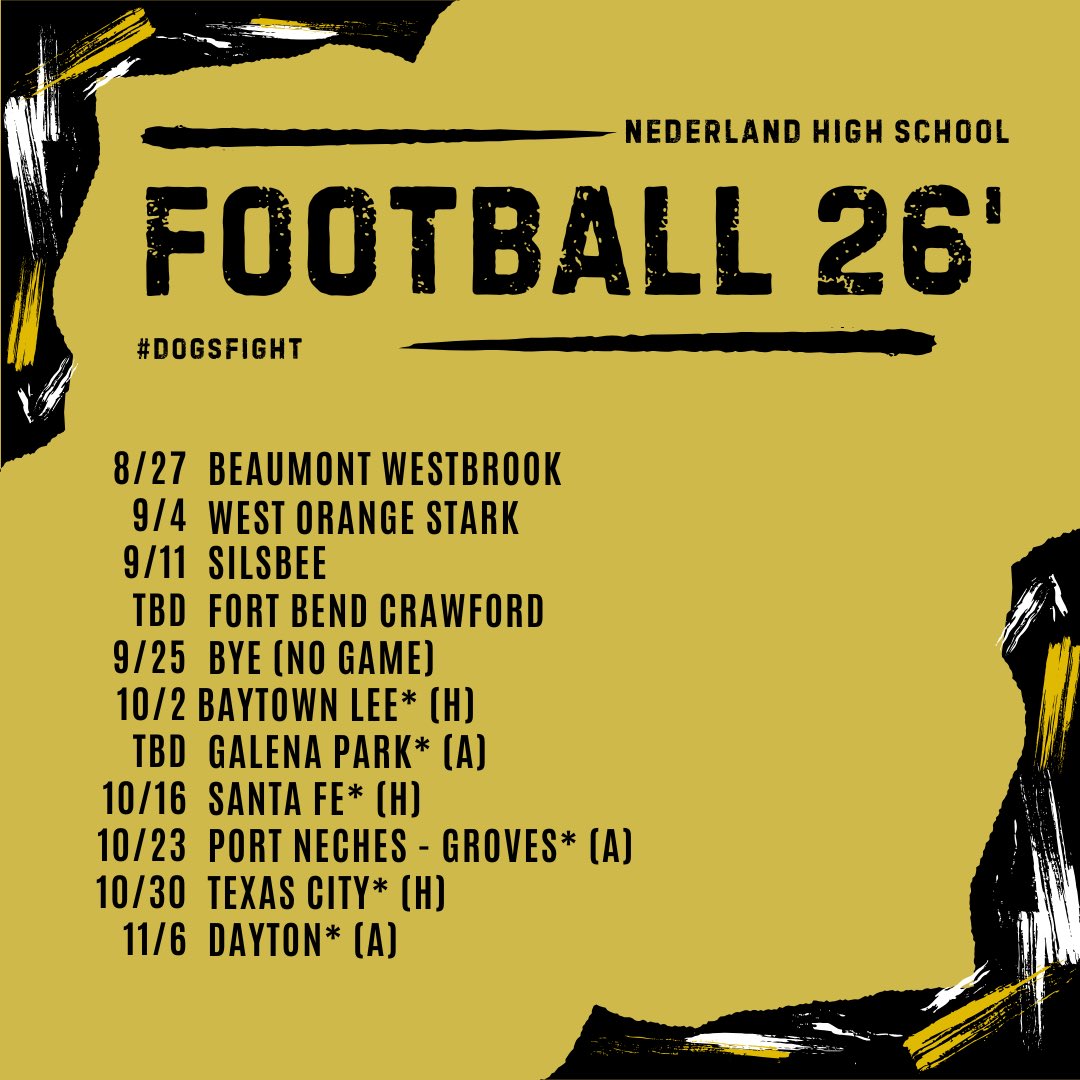
Bulldog Football Schedule for to 2026 Season!
Nederland Bulldogs Football tweet media
English
0
5
17
1.4K
Coach Jeremy Simmons retweetledi
Nederland Bulldogs Football
Nederland Bulldogs Football@Nederland_FB·
Good luck at state to our Bulldog cheer squad! Let that hardwork payoff. -Dogs Win!
Nederland Bulldogs Football tweet media
English
0
4
8
482
Coach Jeremy Simmons retweetledi
Elizabeth Thompson
Elizabeth Thompson@elizabethltboyd·
The most terrifying detail about Noah's Ark isn't the size of the flood. It is the design of the boat. If you look closely at the blueprints God gave Noah in Genesis 6, He was extremely specific. He gave the exact length, width, and height. He specified the type of wood and the pitch to seal it. In my little years, I have never thought of this, but God intentionally left out one crucial component. There was no steering wheel, no sail, and worse still, there was no engine. Think about how scary that is. Noah was building a massive vessel to survive a global storm, but he had zero control over it, or over where it went. He couldn't steer it away from rocks. He couldn't turn it into the waves. He couldn't aim for dry land. He was completely at the mercy of the water. The Ark was not designed for navigation; just for floating. Noah’s job was to be the Passenger, not the Captain. God was the Captain. This is a picture of your life right now. You are trying to put a steering wheel in a boat that God can control, if you let Him…
Elizabeth Thompson tweet media
English
2.1K
12.9K
69.9K
3.5M
Coach Jeremy Simmons retweetledi
Greg Berge
Greg Berge@GregBerge·
Nick Saban: "Everybody's smart that goes to medical school. But everybody doesn't make it through… It's the same kind of thing with athletes. Some of 'em have great talent but they don't have the right psychological disposition." Mindset Matters.
English
41
936
11.7K
550.4K
Coach Jeremy Simmons retweetledi
☘️𝕃𝕦𝕔𝕜𝕪 Ƒʉͫcͧкͭιͪηͣ 𝕄𝕔𝔾𝕖𝕖‎
👏🏼🔥🎯👇🏼 I’m worn out hearing people moan, “Our grandparents could buy a house on one paycheck, but now we can’t even afford rent on two!” Yeah, maybe because Grandma wasn’t dropping half her income on $14 iced lattes and avocado toast shaped like art projects. Back then, if they wanted coffee, they boiled it at home in a dented pot. It tasted like burnt rubber and regret — but it woke you up and cleaned your pipes. And Grandma wasn’t “out to brunch.” You think she had time for mimosas and hashtags? She was making something called whatever’s left in the fridge and feeding six people with it. Don’t even start with Uber Eats. You think Grandpa was out here paying $38 to have a burger delivered three blocks away? Please. He grilled mystery meat on a rusted barbecue, and everyone called it dinner. Now people cry about being broke while sitting in a house full of gadgets. Two SUVs in the driveway, six streaming services, three air fryers, and matching tattoos that cost more than their light bill. You think Grandpa had a tattoo? He did. It said “Korea, 1951,” and it came with trauma, not Instagram likes. And the kids—Lord help us. “We can’t make ends meet, but Brayden needs the new iPhone!” No, he doesn’t. You’re handing an $1100 device to a child who still eats crayons and forgets to flush. When we were kids, there was one phone. It hung on the wall like a family relic. The cord stretched just far enough for you to whisper secrets before someone yelled, “Get off, I need to make a call!” And guess what? We lived. The TV? One. In the living room. With three channels and a dial that clicked like a safe. And if Dad wanted to watch bowling, you were a fan of bowling, end of story. Now there’s a flat screen in every room, the baby’s got an iPad, the dog’s got a camera, and everyone’s wondering why they can’t afford rent. Because you’re living like rock stars on retail salaries, that’s why. Grandpa wasn’t leasing Teslas or buying $12 smoothies called “Green Zen Awakening.” He drove a truck that coughed smoke, rattled like a storm, and smelled like oil and hard work. They lived within their means. Whatever Grandpa brought home on Friday — that’s what they had. They weren’t keeping up with the Joneses; they were keeping the lights on. So yeah, Grandpa bought a house on one salary. But he also didn’t have a gym membership, three delivery apps, and emotional support crystals on his nightstand. His only support system was Grandma, who told him to quit whining and mow the yard. Nowadays, everyone’s broke, anxious, and “manifesting abundance” while ordering tacos on DoorDash for the fourth time this week. It’s not the economy — it’s the lifestyle. Wake up, turn off your subscriptions, make your own coffee, and maybe—just maybe—you’ll smell the truth. ✍🏼Credit: “Wow Wonders” on FB
☘️𝕃𝕦𝕔𝕜𝕪 Ƒʉͫcͧкͭιͪηͣ 𝕄𝕔𝔾𝕖𝕖‎ tweet media
Olivia Julianna 🇺🇸🦅🗳️@0liviajulianna

Because we can’t afford to buy a home to raise them in.

English
1.3K
2K
8.9K
454.2K
Coach Jeremy Simmons retweetledi
TeachTapes
TeachTapes@TeachTapes·
We’ll Deal with this Tomorrow. Let’s Go Win. #TEACHculture
English
2
36
764
151.8K
Coach Jeremy Simmons retweetledi
The Disrespected Trucker
The Disrespected Trucker@DisrespectedThe·
This is where im at. Wheres my tribe?
English
1.3K
4.4K
21.5K
201.5K
Coach Jeremy Simmons retweetledi
Wendi A. Irlbeck MS, RDN, LD, CISSN
And we wonder why we’re losing great coaches and struggling to find quality ones. No one wants to deal with this level of nonsense. Entitled parents are teaching entitled kids that they can whine, complain, and manipulate their way into what they want. But that’s not how life works. The best players earn their spot that’s how it’s supposed to be. Don’t like where you stand? Work harder or move on. Because in college and especially in the real world you can’t just call the coach or your child’s future employer and demand they get a position, scholarship, or job they didn’t earn. Accountability builds character. Excuses don’t. And it’s sad, because these parents aren’t helping they’re robbing their kids of the opportunity to build confidence and resilience through hard work. When you step in and do it for them, the message you send is: “You’re not good enough on your own.” But the truth is, they’ll never know what they’re capable of if you don’t let them earn it.
English
4
14
164
23.1K