Compounding Lab

5.9K posts

Compounding Lab banner
Compounding Lab

Compounding Lab

@CompoundingLab

Chief DCF manipulator, market investigator and fundamental chartist. ACCA, CISI. Dynamic asset allocation. Not financial advice.

Katılım Ocak 2016
342 Takip Edilen1.9K Takipçiler
Sabitlenmiş Tweet
Compounding Lab
Compounding Lab@CompoundingLab·
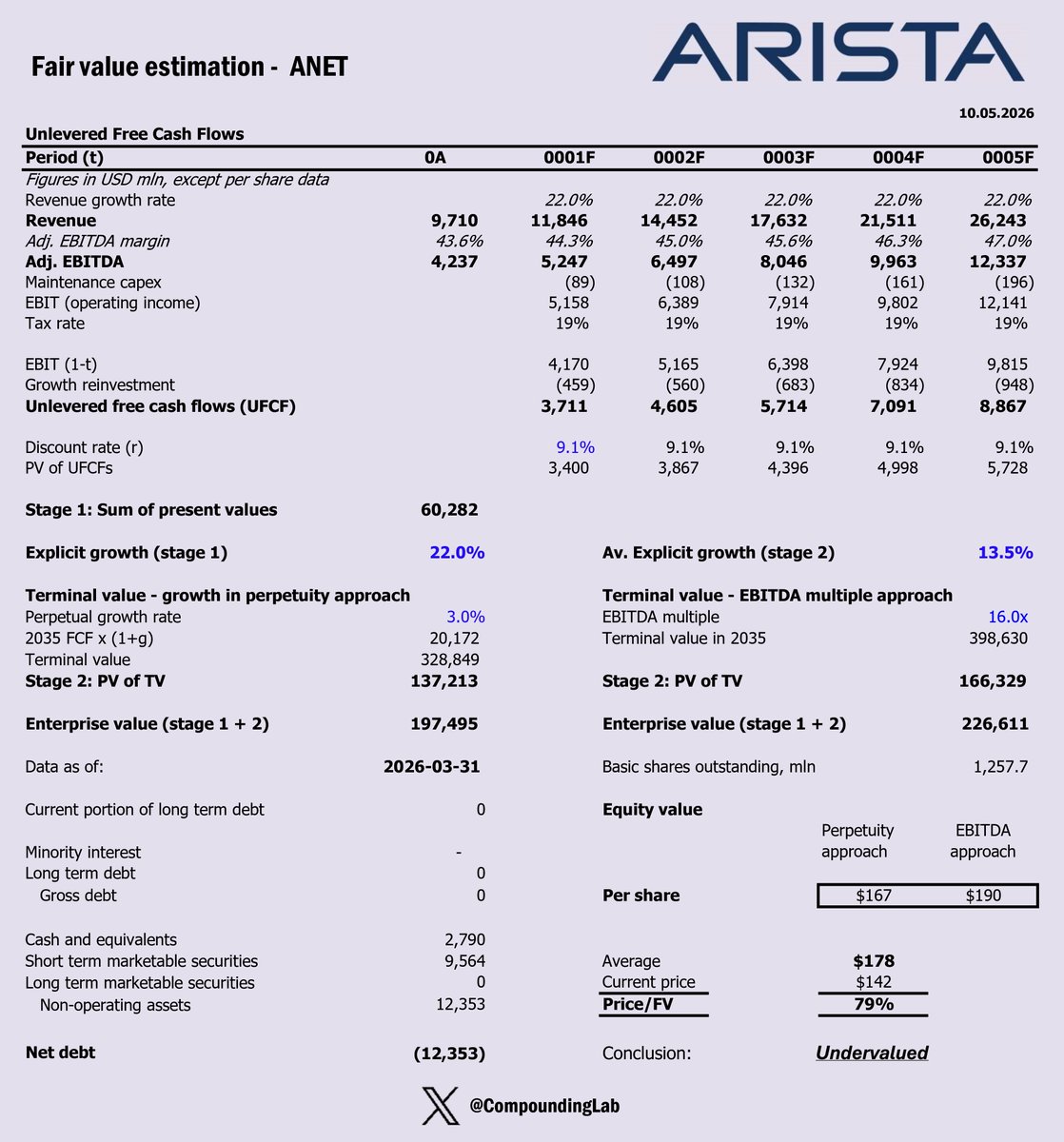
$ANET DCF valuation model Arista has been a wonderful growth story for shareholders, with an impressive 42% return over the past 10 years. That's genuinely remarkable! But for us investors it's important to consider what lies ahead. Can Arista continue to outperform the index? Let’s take a closer look to find out. Key assumptions: * Explicit average 5Y/5Y growth @ 22%/13.5% * Long-term growth in perpetuity @ 3% * EBITDA Margin expansion by 0.7pp every year until the end of explicit period * WACC @ 9.1%. * Adj. EBITDA exit multiple of 16 * Tax rate 19% - in line with historical average * The input that drives reinvestment is Sales to Capital ratio = 5.7 More details on Substack - link in bio and below 👇
Compounding Lab tweet media
English
1
1
3
823
Compounding Lab
Compounding Lab@CompoundingLab·
Following 5x return in just one year, $NBIS isn't so expensive after all.
Compounding Lab tweet media
English
0
0
1
304
Compounding Lab
Compounding Lab@CompoundingLab·
Why I believe $BTDR is an opportunity you would not want to miss. Out of 3GW capacity, >50% (1,708/3,000) is already converted / on it's way to be converted into HPC/AI, with expected timing by no later than 2027/2028. As $BTC popularity wanes, the shift from cryptocurrency to AI is not just possible but likely. Fine, capacity is twice that of $NBIS (they target 4GW by 2027). But BTDR MC is 3.2B and Nebius >50B. So even if Bitdeer catches up to half of Nebius, that's 25B and 8x from here. Opportunity is here.
Compounding Lab tweet media
English
0
1
1
277
Compounding Lab
Compounding Lab@CompoundingLab·
Another potential multibagger similar to $Mara. It's $BTDr. Their AI cloud business hit $69M in annualized recurring revenue (ARR), a 60% month-over-month increase, with 4,184 GPUs deployed and a 92% utilization rate. Bitdeer is advancing its Tydal facility in Norway, expected to become the country's largest operational AI data center, while transitioning US and European sites from crypto toward AI workloads. MC 3.5B with 3gw global power portfolio. Just a re-rate closer to $NBIS can bring 10x return here. Execution will be key.
English
1
1
3
417
DonDraper
DonDraper@DonDraperDude·
According to GuruFocus, $EOSE has a GF Value of $17.08 indicating the stock is currently undervalued by approximately 52.9% This substantial margin of safety suggests that investors may have an opportunity to acquire shares at a discount relative to their intrinsic value.
DonDraper tweet media
English
2
15
89
5.8K
Compounding Lab
Compounding Lab@CompoundingLab·
$CBRS shares gained 68% immediately after IPO today, 14 May. Cerebras is an AI semiconductor and systems company that designs processors for AI training and inference. Its third-generation Wafer-Scale Engine (WSE-3) is described as the largest chip ever sold. Cerebras initially priced its IPO at $185 per share, set to raise approximately $1.785 billion. J.P. Morgan, Bank of America, Barclays, and RBC acted as bookrunners. This is the headline deal of the month.
English
0
0
0
191
Donald Crowhurst
Donald Crowhurst@Crowhurst68·
$CVV now has ~$23m of cash, ~$30m+ of owned industrial real estate, and zero debt following its asset sale. That’s roughly $7.50+ per share of hard asset value vs. a stock trading below $6.00 meaning the market is assigning negative value to the operating business. Investors are getting free optionality on AI/SiC, hypersonics, and nuclear exposure. @RADHardTech @CompoundingLab @SimeonResearch_ @KakashiCapital_
English
2
1
7
656
Odd Diligence
Odd Diligence@OddDiligence·
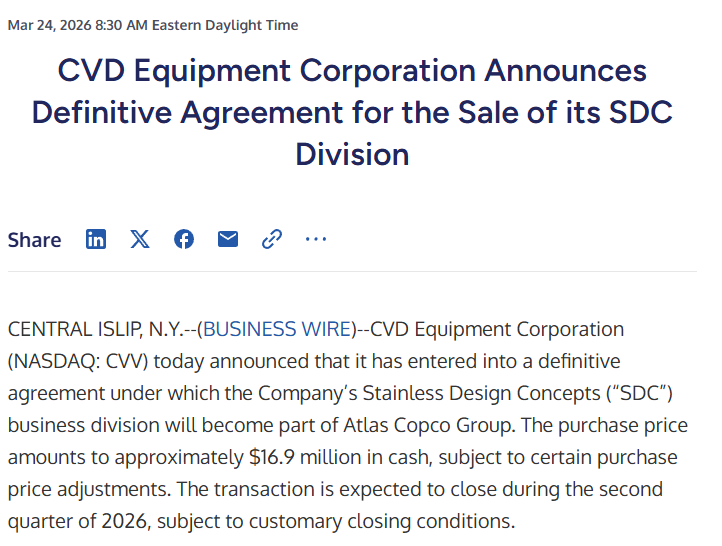
$CVV announced a DA to sell their non-AI related biz today for $16.9M and keeps their biz that makes equipment for Silicon Carbide manufacturing Should be an AI picks and shovels moonshot here - high risk, high reward. $CVV EV now is around $8m now after the sale based on $4.50 stock price
Odd Diligence tweet media
English
5
3
25
8.4K
Compounding Lab
Compounding Lab@CompoundingLab·
$IonQ posted a 755% year-over-year revenue increase in Q1 2026 to nearly $65 million and raised its full-year guidance to $260-270 million after selling its first 256-qubit system, signaling commercial viability. Remaining performance obligations jumped to $470 million, up 554% year-over-year. Commercial customers now drive 60% of revenue, and IonQ has sold into over 30 countries. From 2025 to 2028, analysts expect IonQ's revenue to grow at a 67% CAGR to $600 million. The main risk is of course valuation. It's already at $20B market cap and stays unprofitable for the foreseeable future. A 10x from here requires the quantum thesis to fully materialize, but it's the purest play on a potentially generational technology shift.
English
0
0
0
206
Compounding Lab
Compounding Lab@CompoundingLab·
$MARA MC 4.8B targeting a multi-gigawatt footprint over time. $NBIS MC 50B targeting 4GW capacity. Re-rating for $MARA is coming, don't be late.
English
5
6
80
8.6K
Compounding Lab
Compounding Lab@CompoundingLab·
You need to do a proper research before posting this shit. Frontier Power USA is a new venture and the big bet. This was the main event of the call, and it's worth understanding properly. The core problem Eos has been trying to solve isn't technology, it's what management calls "bankability." Every energy storage project requires capital, insurance, construction, and an offtake agreement, and historically each of those has been assembled one at a time, deal by deal. That's slow and expensive. This is a joint venture where eose will supply batteries, frontier and Cerberus take care of the rest. And by the way, UK is final destination, and it's a normal worldwide practice to use intercompany shell cos. Frontier Power USA is an attempt to pre-package all of that into one platform. Cerberus is putting in $100 million, and Eos is planning to contribute $150 million through a rights offering to existing shareholders. On top of that sits a technology performance insurance wrap from Ariel Green at Lloyd's of London, which is the structural innovation here. By converting technology risk into an insured obligation, it opens the door to senior project debt targeted at over $1 billion with investment-grade characteristics. The idea is that customers get faster project timelines, lower cost of capital, and a single integrated solution rather than months of sequential negotiations. Do your research.
English
0
0
0
253
FuzzyPanda
FuzzyPanda@FuzzyPandaShort·
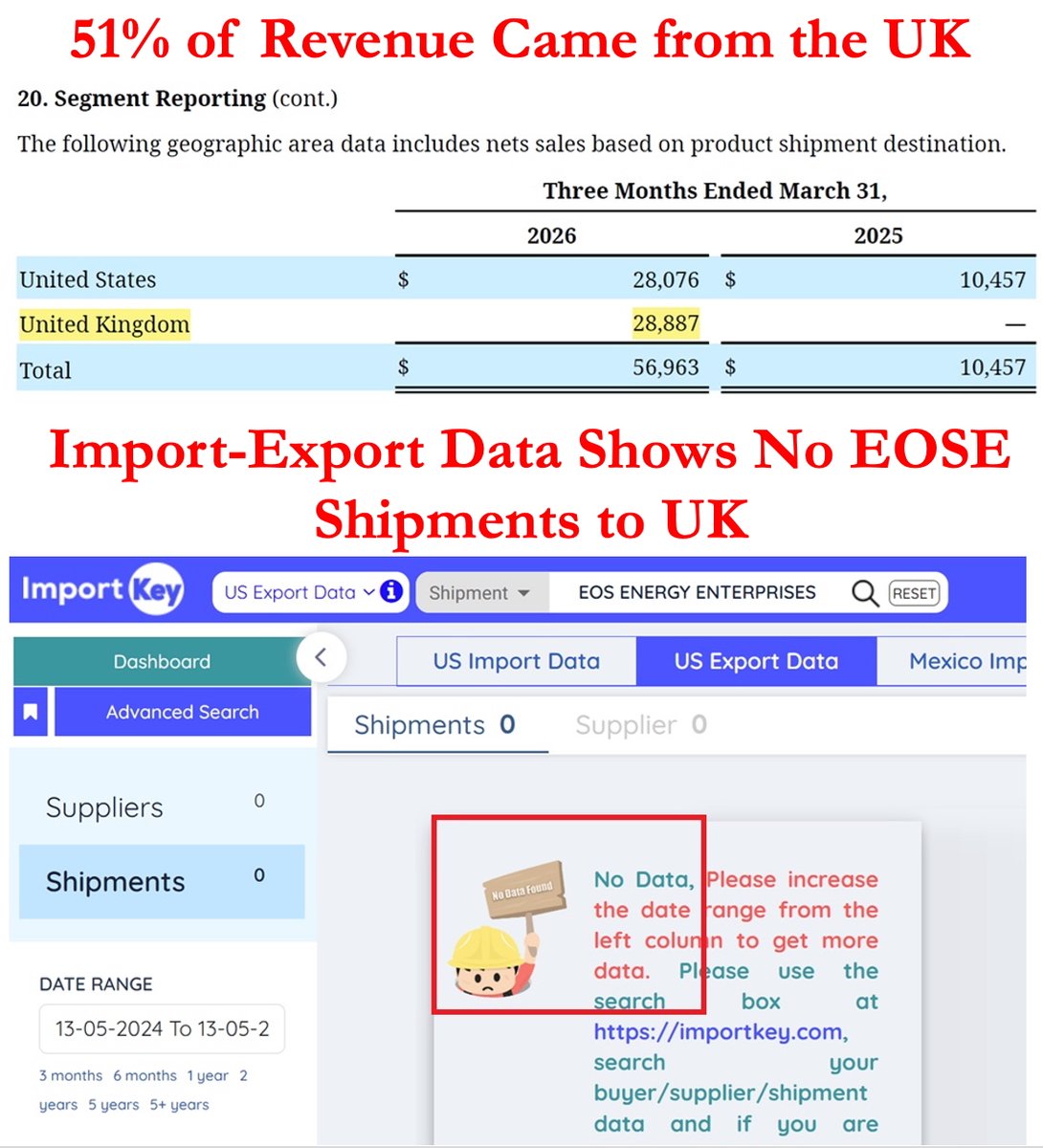
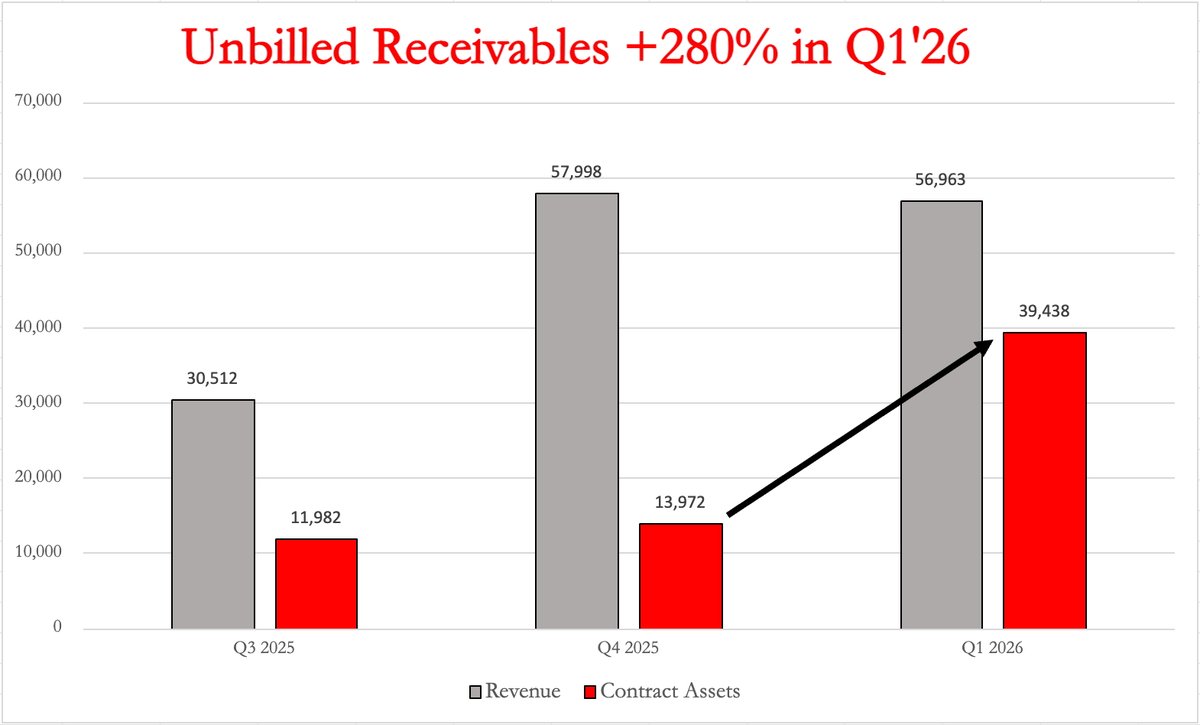
$EOSE's 10-Q reveals huge revenue & customer issues that CEO Joe clearly doesn't want investors to know 51% of Revenue ($28.9m) came from the UK Which customer is in the UK? Frontier Power UK (connected to Cerberus, Eos's PE owner) But digging deeper gets dirty: - Import-Export Databases reveal 0 shipments by Eos or any of it's subs to the UK...so 51% of Q1-26 Rev is from batteries that were NOT actually shipped to the UK - Meanwhile - Eos's 10-Q shows an unexplained 180% spike in Unbilled Receivables (aka contract assets). The spike almost perfectly matches the amount of revenue booked from Frontier Power UK It looks like $EOSE both did NOT ship batteries to Frontier Power + did NOT bill for them! This is a bombshell on top of the fact that Eos's new major customer was revealed this morning to be "Frontier Power USA," an entity that was only registered last week and which was created by Cerberus & Eos During the hottest AI boom and demand for batteries ever $FLNC reported backlog increasing +100% YoY Meanwhile, $EOSE's backlog is -5% YoY & their only hope now seems to be selling batteries to themselves GFLTA
FuzzyPanda tweet mediaFuzzyPanda tweet media
English
23
14
96
69.4K
Investor Denis
Investor Denis@InvestorDenis·
The big news from $EOSE earnings report today was the formation of Frontier Power USA with Cerberus Capital Management. Frontier Power USA is a platform for long-duration energy storage development. Cerberus Capital Management has commited $100 million, $EOSE is expected to provide $150 million later. This joint venture will help $EOSE focus strictly on manufacturing and technology development. Frontier Power will act as an independent power producer. It will find and secure sites for energy storage and raise capital for building and managing them. The first agreement between $EOSE and Frontier Power has already been signed: $EOSE will have to provide 2 GWh in storage capacity. This boosted $EOSE’s backlog to $644,6 million and helped the company reaffirm the 2026 revenue guidance of $300 million - $400 million. To be on the safe side, Frontier Power has secured a $1,5 billion 15 year non-cancellable technology performance insurance. Creditors could be wary of $EOSE’s zinc-aqueous batteries. It's new technology that may or may not work. If it doesn't, the insurance will cover the losses. I like it that $EOSE has separated manufacturing and energy storage development. It’s already faced operational challenges. Let it do what it does best: Develop and produce durable, non-flammable batteries from components sourced domestically. Frontier Power will take care of where those batteries will be deployed.
Investor Denis tweet media
English
2
3
49
3.7K
Compounding Lab
Compounding Lab@CompoundingLab·
$SMOP up 91% YTD. Forward 3Y CAGR in revenue @ 26% is not impressive. Paying 34x 2028 Revenue is a stretch for Smartoptics Group AS.
English
1
0
0
470
Compounding Lab
Compounding Lab@CompoundingLab·
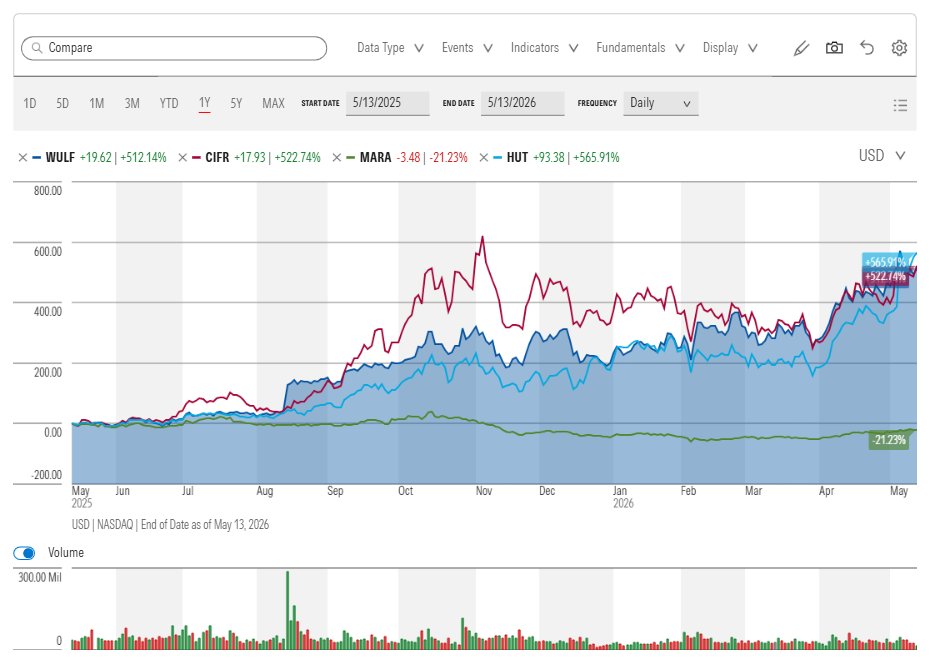
Potential for $MARA re-rating is massive, if they decide to fully transition to AI Data Center. Fred Thiel @fgthiel said several notable things in his Bloomberg appearance today about MARA Holdings and the broader Bitcoin/AI infrastructure market. Main points from the interview: * MARA is positioning itself as more than a Bitcoin miner. Thiel emphasized the company’s transition toward an energy + compute infrastructure platform. He highlighted MARA’s strategy of building or controlling power generation assets to secure long-term low-cost electricity for both Bitcoin mining and AI workloads. * He discussed MARA’s growing focus on AI inference infrastructure, including colocating AI compute with mining operations. Thiel argued that combining Bitcoin mining and AI workloads can improve utilization of energy infrastructure because mining is flexible while AI compute is more constant-demand. * He reiterated that MARA still sees itself primarily as a Bitcoin-focused company, not a “digital asset treasury” firm like some newer BTC holding vehicles. On Bitcoin, he remained bullish long term and described recent volatility as more of a “healthy retracement” rather than structural weakness. The most important strategic comment for us was probably this: MARA wants to own the “power → data center → compute” stack. That’s the piece making me compare it to companies like: $NBIS $CORZ $WULF $CIFR $IREN Of course there’s still a major difference: Nebius was built for AI cloud infrastructure from the start. MARA is retrofitting a Bitcoin-mining platform into I/compute infrastructure. So my question is: Can MARA successfully monetize AI compute before the Bitcoin cycle weakens again? That determines whether it gets: * a normal miner valuation, or * a much higher “AI infrastructure multiple.” One especially interesting comment from Thiel was around co-locating AI inference with mining. That suggests MARA may initially focus less on hyperscaler-scale AI training clusters and more on edge inference, lower-cost AI compute, flexible energy arbitrage or modular data center deployment. That’s a different angle than Nebius, which is pursuing more traditional GPU cloud infrastructure. Thiel has also been increasingly vocal about the idea that future winners in AI infrastructure are really energy companies in disguise. A theme that is becoming common across the sector.
Compounding Lab tweet media
English
2
6
45
6.1K
Compounding Lab
Compounding Lab@CompoundingLab·
$EOSE EOS Energy Q1 2026 summary. Let's start with the headline: Eos had a genuinely good quarter. EPS came in at $0.12 against a forecast of -$0.22, and revenue hit $57 million, just ahead of the $56.4 million expected. Stock jumped over 23% in pre-market trading, later retreating lower. For a company that has asked its shareholders for a lot of patience, this was a meaningful moment. The numbers tell a real story Revenue was up 445% versus the same quarter last year, and battery cube output rose 467% over the same period. Put another way, the company generated more revenue in the last two quarters alone than it did in the whole of 2025. Looks like company is starting to find its stride. The manufacturing improvements are particularly encouraging. Direct labor cost per cube dropped 47% year-over-year and another 25% just from Q4 to Q1. Gross loss improved by around $10 million sequentially as output scaled. These are the kinds of signals that suggest the operational progress is real, not cosmetic. The second factory is almost live The new Thornhill facility which is essentially a purpose-built version of everything they've learned at their existing Turtle Creek plant, has its second production line powered up and in debug mode. Initial production is targeted for end of Q2, with full production expected by Q4. This matters because once that line is running, fixed costs spread across significantly more units, and supplier pricing should improve with higher committed volumes. Thornhill is where the cost curve really starts to bend. Frontier Power USA - the big bet This was the main event of the call, and it's worth understanding properly. The core problem Eos has been trying to solve isn't technology, it's what management calls "bankability." Every energy storage project requires capital, insurance, construction, and an offtake agreement, and historically each of those has been assembled one at a time, deal by deal. That's slow and expensive. Frontier Power USA is an attempt to pre-package all of that into one platform. Cerberus is putting in $100 million, and Eos is planning to contribute $150 million through a rights offering to existing shareholders. On top of that sits a technology performance insurance wrap from Ariel Green at Lloyd's of Londo, which is the structural innovation here. By converting technology risk into an insured obligation, it opens the door to senior project debt targeted at over $1 billion with investment-grade characteristics. The idea is that customers get faster project timelines, lower cost of capital, and a single integrated solution rather than months of sequential negotiations. This aligns with Data Center boom requirements. The CEO made a point of structuring this so existing shareholders can participate through transferable subscription rights on a pro-rata basis. That's a deliberate choice, and it signals something about how management views its shareholder base. What to watch closely The rights offering is the most immediate decision facing shareholders. Those who participate maintain their proportional ownership; those who don't will be diluted. Management framed full participation as accretive at current prices, but every shareholder should do their own math. The June 3 shareholder meeting will be important. Five proposals are on the ballot, including an increase in the authorized share count needed to fund the Frontier investment. One of those proposals requires a 67% approval threshold. If that vote fails, the whole Frontier platform stalls before it starts. Management explicitly asked all shareholders to vote. On the financial side, it's worth keeping perspective. The gross loss was still $44.4 million this quarter, and the adjusted EBITDA loss was $68 million. Management is guiding for adjusted gross margin positivity in the second half of this year and positive adjusted EBITDA before year-end. Those are achievable targets given the trajectory, but obviously they're targets, not guarantees. 2026 revenue guidance of $300–$400 million was reaffirmed, with longer-range projections pointing toward $600 million by FY2027. One more thing worth flagging: the stock, even after the post-earnings jump, is still down roughly 47% over the past six months. With a beta of 2.57, this isn't a low-volatility hold. There are also third-party valuation signals suggesting it may be stretched at current levels. That doesn't mean the story is wrong. Rather, it means the market is pricing in a lot of execution, and execution is something Eos is still proving. TL:DR Eos is moving faster than it was, the technology performance data is improving, and Frontier Power USA could be a genuine inflection point for converting that $24 billion pipeline into revenue. The two things that will determine whether this quarter is a turning point or a blip are the shareholder vote on June 3 and whether management delivers on its H2 margin targets. Both are worth watching closely.
English
0
0
0
416
Compounding Lab
Compounding Lab@CompoundingLab·
$MARA is one of the most interesting and complex pivots in the sector right now in my view. Here's a deep dive and how it compares to $NBIS. What MARA Has Built So Far * Acquisition of Exaion for $168 million finalised on February 20, 2026. Exaion is a subsidiary of French state energy giant EDF, and the deal grants MARA an option to expand its stake to 75% for an additional $127 million by 2027. Importance of "sovereign AI" is growing as governments become increasingly wary of hosting sensitive data in foreign-controlled clouds. * The Starwood JV North American hyperscale. MARA and Starwood Digital Ventures will develop, finance, and operate next-generation digital infrastructure targeting enterprise, hyperscale, and AI customers across MARA's existing power-rich portfolio. MARA contributes energised data center sites, while Starwood leads design, development, tenant sourcing, construction, and facility operations. The joint venture targets over 1 GW of data center capacity. * The Long Ridge acquisition. MARA entered a $1.5 billion agreement to buy Long Ridge Energy & Power, including a 505 MW gas-fired power plant in Ohio and 1,600+ acres for future AI and HPC development. The company expects to start initial AI buildout in 2027, with capacity coming online around mid-2028. * MARA now operates 19 data centers across four continents, totalling around 1.9 gigawatts of energy capacity. * Sold 20,880 Bitcoin for $1.5 billion in Q1 to fund its AI pivot and debt reduction. MARA's Bitcoin holdings fell to 35,303 BTC as of March 31, down from 53,822 at end of 2025. * The "Toggling" Model has a unique angle. Under this model power is shifted between Bitcoin mining and AI compute in real-time based on profitability. By owning power generation and digital infrastructure, MARA is pioneering a model of vertical integration, allowing it to mine Bitcoin when grid demand is low and sell power or compute to AI clients when demand spikes. Analysts call it "computational arbitrage." The company has already begun deploying specialised modular racks in its Granbury, Texas facility, utilising advanced battery technology to manage sub-millisecond load transitions. Can It Be the Next Nebius? MARA has assets Nebius didn't start with. 1.9 GW of live, operational energy capacity across four continents, a power plant it will own outright, a European sovereign AI beachhead via Exaion, and a unique toggling model that lets it generate revenue during the transition. The Long Ridge acquisition especially mirrors Nebius' strategy of controlling the underlying power substrate rather than just leasing it. Still, the gap is significant. Nebius enters 2026 with approximately $46 billion in contracted backlog from Meta and Microsoft with legally binding demand. The only question there is execution. MARA, by contrast, has no signed hyperscaler deal yet. The model MARA appears to be working toward is co-location: keeping AI and HPC infrastructure on the same sites as its existing mining operations, generating mining revenue in the short term while preserving the optionality to shift power capacity toward AI workloads once customer demand materialises. That's a reasonable strategy, but "optionality" is very different from Nebius's $46B in contracted backlog. It will be challenging for them to manage the "high-touch" nature of the AI business compared to the "set-it-and-forget-it" nature of Bitcoin mining. The real prize lies in multi-year colocation contracts with Big Tech and sovereign governments. Until MARA lands one of those, it remains a promising pivot story rather than a validated AI infrastructure company. Good news is that today while on Bloomberg, CEO mentioned that first deals are expected by the end of 2026. Their team is already in touch with hyperscalers. Verdict MARA has the right ingredients: energy ownership, geographic diversification, sovereign AI exposure, and a credible development partner in Starwood. Currently, lag behind Nebius is estimated at roughly 18-24 months (in terms of signed revenue, operational AI capacity, and market re-rating). If it closes a major hyperscaler deal in 2026, the gap could close fast. Right now it's a higher-risk, higher-optionality bet than Nebius with a much lower entry market cap ($3.6B vs Nebius' $50B).
Compounding Lab tweet media
English
0
1
1
232