Every animal on Earth unpacks using the same DNA-mRNA-Ribosome architecture
Every animal is a proteomic program executed from a single molecule of instructions
Likely this architecture is universal throughout the cosmos
@metaphorician You are getting closer to our Cosmic Watch! It's cool because it validates the design I came up with in 2012 :)
Keep spacetime watch: it will help you in getting downloads. Think the name is also keywords that match search results. Use Heaven and Earth as subtitle ;)
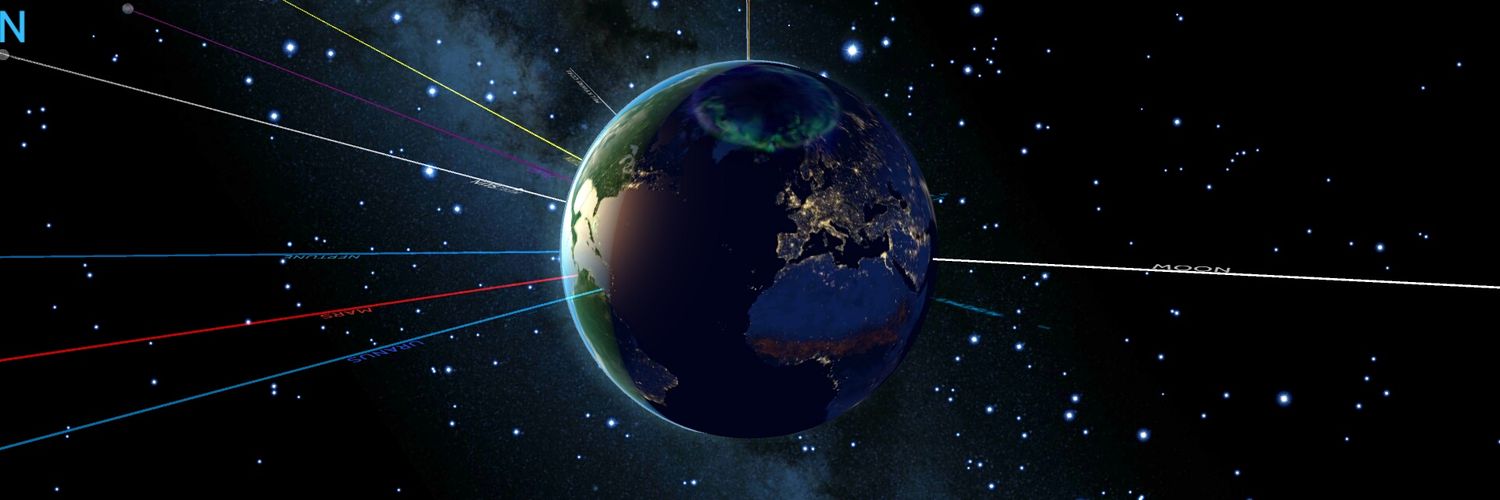
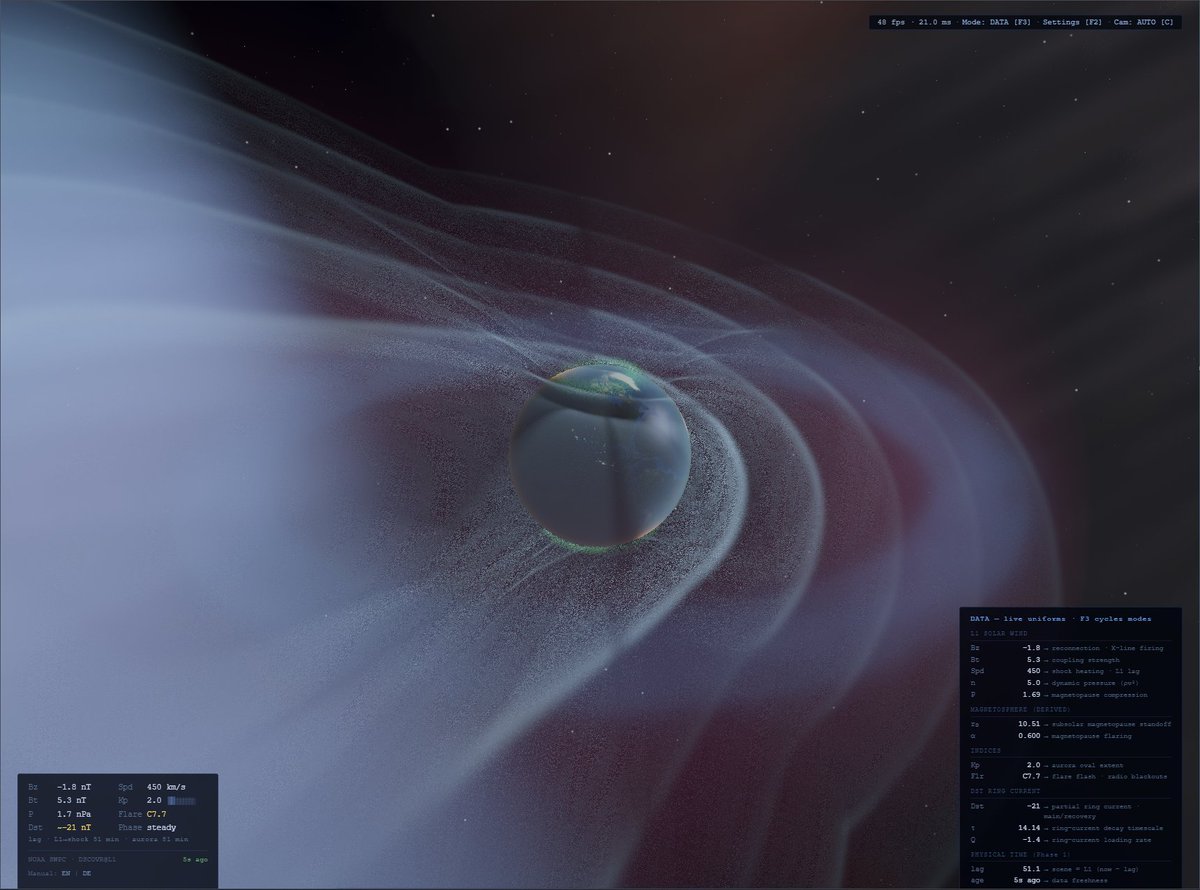
Claude worked really hard on this one. It shows how there's two layers to my clock concept, heaven and Earth
I am considering changing the name from "Spacetime Watch" to "Heaven and Earth" to really put the two layers front and center. What do you think?
WATCH: A fiery meteor appeared to plunge toward Mayon Volcano in the Philippines as the volcano erupted, lighting up the night sky in a breathtaking scene straight out of a disaster movie.
If you could see our planet's inner magnetism, it would look like this geodynamo simulation. Turbulence in the outer core (red/blue) alters the field (orange).
Abrupt changes down there create noticeable "jerks" in the magnetic field we experience.
esa.int/Applications/O…
I'm amazed we can monitor the currents of molten metal in Earth's outer core, 2200 km (1400 miles) underground--but we can. Lately, part of that flow has reversed direction, for reasons unknown.
There's a whole dynamic world inside the world we see.
esa.int/Applications/O…
How hot is Earth’s core?
Earth’s core is one of the most extreme places on the planet, but its temperature is not a single fixed number. It changes with depth, pressure, composition, and the boundary being discussed.
The best estimates place core temperatures roughly between 4,400 and 6,000 degrees Celsius, with the deepest regions reaching temperatures comparable to the visible surface of the Sun. The outer core is generally estimated at about 4,500 to 5,500 degrees Celsius, while the inner core is usually placed around 5,200 to 6,000 degrees Celsius, depending on the model and how scientists interpret the melting behavior of iron under enormous pressure.
The reason there is uncertainty is simple: we cannot measure the core directly. No drill, probe, or instrument can reach it. The deepest human-made boreholes barely scratch the crust, while the core begins almost 2,900 kilometers below the surface. So scientists study it indirectly, mainly through seismic waves from earthquakes, laboratory experiments on iron at extreme pressures, computer simulations, and measurements of Earth’s magnetic field. The core is not guessed into existence; it is inferred from multiple independent lines of evidence that all point toward the same basic structure: a liquid outer core surrounding a solid inner core.
The outer core is a vast ocean of molten metal, mostly iron and nickel, about 2,200 kilometers thick. It is liquid not because it is less hot than the inner core, but because the pressure there is lower than in the planet’s center. This moving metal is crucial: its convection generates Earth’s magnetic field, the planetary shield that protects the atmosphere and surface from much of the solar wind. Without that restless metallic layer, Earth would be a very different world.
The inner core is stranger. It is hotter, or at least under more extreme conditions, yet it is solid. That sounds contradictory only if we think of melting at everyday pressure. At the center of Earth, pressure is so immense that iron atoms are forced into a solid structure even at temperatures that would easily vaporize or melt iron at the surface. In other words, temperature alone does not decide whether a material is solid or liquid. Pressure matters enormously. The inner core survives as a solid sphere of mostly iron because the weight of the entire planet above it compresses it into that state.
Part of Earth’s internal heat is ancient. It is leftover energy from the planet’s formation, when collisions, compression, and differentiation turned early Earth into a hot, partially molten body. Another part comes from the decay of radioactive elements inside the planet. A third contribution comes from the slow crystallization of the inner core: as liquid iron freezes onto the solid inner core, heat is released, and lighter elements are expelled into the outer core, helping drive convection. Earth is cooling, but very slowly, over geological time.
The comparison with the Sun is useful, but it needs precision. Earth’s core is often described as “as hot as the surface of the Sun.” That is broadly true for the hottest estimates: the Sun’s visible surface is around 5,500 degrees Celsius, and parts of Earth’s core may be in that same range or slightly hotter. But the Sun’s interior is vastly hotter, reaching millions of degrees. So the comparison works only for the Sun’s surface, not for the Sun as a whole.
What makes Earth’s core scientifically fascinating is not only its temperature, but the balance between heat, pressure, composition, and motion. It is even hotter than the outer core, yet it remains solid. It is buried beyond direct reach, yet it leaves signatures in earthquake waves. It is invisible to us, yet it helps make the surface habitable by powering the magnetic field. The core is not just a hot metallic center. It is a dynamic engine, still cooling, still moving, and still shaping the planet from the inside.
Parker Solar Probe is one of the most extreme spacecraft ever built. It is currently flying through the Sun’s outer atmosphere, the corona, at about 430,000 miles per hour, or roughly 690,000 km/h, making it the fastest human-made object ever recorded. At that speed, it could cross the continental United States in around 20 seconds.
But the most remarkable part is not only how fast it moves. It is that it can survive while repeatedly passing just 3.8 million miles, about 6.2 million kilometres, above the Sun’s visible surface, closer than any spacecraft before it. NASA confirmed that Parker matched this record distance and speed again during its 27th close approach on March 11, 2026.
The spacecraft survives because of a very precise piece of engineering: its Thermal Protection System, usually called the heat shield. This shield is only 4.5 inches thick, about 11.5 centimetres, and is made from a lightweight carbon foam core placed between carbon-carbon composite panels. Its Sun-facing side is coated in a specially designed white material that reflects as much solar energy as possible.
The shield does not make the whole spacecraft immune to the Sun. Instead, it creates a protected shadow. The instruments and spacecraft body stay hidden behind it, while the shield takes the direct solar radiation.
This is why Parker Solar Probe can move through a region where the corona can reach temperatures of millions of degrees. That sounds impossible at first, but temperature and heat are not the same thing. Temperature measures the average energy of particles; heat is the amount of energy actually transferred to an object.
The corona is extremely hot, but it is also extremely tenuous, almost a vacuum compared with air on Earth. There are not enough particles there to transfer heat in the same way a dense gas or liquid would. The greater threat comes from intense sunlight and radiation, which is why the shield’s orientation is critical. If sensitive parts of the spacecraft moved out of the shield’s shadow during closest approach, they could be damaged very quickly.
Parker did not simply launch straight toward the Sun. That would actually require an enormous amount of energy because Earth is already moving around the Sun very fast. To fall inward efficiently, the spacecraft used repeated gravity assists from Venus, gradually reducing its orbital energy and lowering its closest approach to the Sun.
After its final Venus flyby in November 2024, Parker entered the orbit that allows these record-setting solar passes. Its extreme speed is mainly the result of falling deep into the Sun’s gravitational well: as it approaches the Sun, gravity accelerates it dramatically, and as it moves away, it slows down again.
Scientifically, Parker Solar Probe is important because it is measuring the Sun from inside the region where many key solar processes begin. It studies the solar wind, magnetic fields, energetic particles, plasma turbulence, coronal mass ejections, and the Alfvén surface, the boundary where solar material stops being magnetically tied to the Sun and escapes outward as solar wind.
These measurements matter because solar activity affects the whole Solar System, including Earth. Strong solar storms can disturb satellites, GPS, radio communications, aviation routes, astronaut safety, and even power grids.
The mission is also helping us investigate one of solar physics’ long-standing puzzles: why the Sun’s corona is far hotter than the visible surface below it. The photosphere is around 5,500 degrees Celsius, while the corona can reach millions of degrees. Parker’s close measurements allow us to test how magnetic reconnection, plasma waves, turbulence, and energetic particles may contribute to that heating and to the acceleration of the solar wind.
The deeper achievement of Parker Solar Probe is not just its speed, but its control.
It has to stay correctly oriented, manage its temperature, collect data, survive communication blackouts, and operate autonomously during the most dangerous parts of each orbit. It is not “touching” the Sun in a solid sense, because the Sun has no hard surface, but it is directly sampling the outer solar atmosphere in a way no previous spacecraft could.
In practical terms, Parker is showing that a spacecraft can survive at the edge of a star’s atmosphere with a shield thinner than many books, as long as the physics, materials, geometry, and autonomy are engineered with extraordinary precision.
@Artedeingenio@mitte_ai But that's a link to mitte ai with your referral... I'm interested in your work and would like to contact you. Y podemos hablar español, by the way , soy de canarias!
Creating music videos inspired by the Moebius and Métal Hurlant aesthetic is still one of my biggest passions.
I made these animations in @mitte_ai, the platform with the most affordable prices for Seedance 2.0, along with many other AI tools to help you create your videos.
👉 If you’re interested, you’ll find a link in my bio.
May 22, 2026 The cosmic reset button is being pressed hard.
With the Sun and Uranus officially colliding in Gemini today, expect your brain to feel like a browser with 45 open tabs, and 3 of them are playing music you can't find.
This isn't just a minor vibe shift; it’s a total system override. Gemini rules the mind, and Uranus is the cosmic wildcard. When they fuse under the Sun’s spotlight, our usual mental patterns completely short-circuit. If you feel an overwhelming urge to abruptly change your mind, burn a bridge that was already shaky, or completely pivot your current direction out of nowhere, you're right on schedule. The mental static is real, but so is the breakthrough on the other side of the chaos. Hold on tight.
Futuristic 3D vehicle telemetry interface built with Three.js and GLSL shaders. Procedural sci fi vehicles, glowing propulsion systems, holographic HUD elements, live telemetry visuals, and cyberpunk inspired rendering.